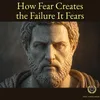
Are you motivated by fear? What if that fear is actually at the root of why you’re not getting the results you’re going after? In this week’s episode I want to talk about how to stop fear from sabotaging your best work. “What I advise you to do is, not to be unhappy before the crisis comes; since it may be that the dangers before which you paled as if they were threatening you, will never come upon you; they certainly have not yet come." — Seneca The Problem Let me ask you something that might sound strange. What if the thing pushing you forward — the thing that gets you out of bed, that makes you open the laptop, that keeps you grinding when you'd rather quit — what if that thing is also the thing quietly sabotaging you? I'm talking about fear. And before you push back on me, hear me out. Because fear is sneaky. It dresses up as motivation. It feels like drive or even responsibility. You tell yourself you're being realistic, you're being prepared, you're staying sharp. But underneath the productivity, there's this low hum — what if it doesn't work, what if I can't make it, what if I'm not enough. And you keep moving, partly because you love what you're doing, but partly because the alternative is to sit still with that fear, and that feels unbearable. So we keep moving. And it kind of works. For a while. Look around. The world right now is loud. Politics, economics, AI, climate, the news cycle that won't stop screaming at you. Fear is in the culture. It seeps in whether you want it to or not. And on top of that ambient hum, most of us are carrying our own private version of it. The fear of failing at something we care about. The fear of not being able to pay the bills. The fear of looking foolish. The fear of falling behind. I'll be honest with you. I know this one personally. I run a coaching practice. And there are days when the work I do isn't really driven by let me build something I'm proud of. It's driven by what happens if this doesn't work? How am I going to cover the bills? And I notice it, because the work I do from that place feels different. It feels tighter. more desperate, and less like me. I bring that up not because this episode is about me, but because if you're listening and you recognize that pattern in yourself, the fear that hides behind the hustle, you're not alone, and you're not broken. You're just human, doing what humans do. But here's what I want you to sit with for this episode. Here's the thing the Stoics understood that I think most of us miss. Fear-driven work tends to produce the very failure it's afraid of. When you work from fear, you work small. You hedge and play it safe. You don't take the creative risk, you don't make the bold offer, you don't say the true thing. You optimize for not losing instead of for actually creating. And the work suffers. People can feel it, and it shows in your work. So fear isn't just unpleasant to live with. It's actively undermining the thing you're trying to protect. Which raises a question. If fear is such a bad driver, what do we replace it with? A lot of people would say optimism. Just be more positive. Believe it'll work out. Visualize success! I don't think that's quite right either. And in a minute I want to tell you why optimism, in the way most people use the word, is just fear wearing a different costume. And what the Stoics offer instead, is sturdier than both. The Philosophy The Stories We Tell Ourselves So let's go back about two thousand years. Epictetus was a Stoic philosopher who started his life as a slave in Rome. Eventually freed, he went on to become one of the most influential teachers of his era. And in his handbook, the Enchiridion, he spoke a line that I think is one of the most useful sentences ever written about the human mind. He said: "People are disturbed not by things, but by their judgments about things." Think about that. We are not disturbed by things. We are disturbed by our judgments about things. It’s the stories in our head that create the fear. The economy isn't making you afraid. Your judgment about what the economy means for you is making you afraid. The empty calendar isn't making you anxious. Your story about what the empty calendar predicts is making you anxious. The chaotic news cycle isn't making you tense. Your interpretation of what it all means for your life is making you tense. This is a description of how the mind actually works. Something happens — an event, a piece of news, a number in your bank account — and before you even notice, your mind hands down a opinion, a verdict. This is bad. This means I'm in danger. This means I'll fail. And then you feel the fear, and you assume the fear is abo
Podzilla Summary coming soon
Sign up to get notified when the full AI-powered summary is ready.
Free forever for up to 3 podcasts. No credit card required.
More from Stoic Coffee Break

Interview with Kelly McGinnis: What it Takes to Really Lead | 381
What's the Worst that Could Happen? | 380
Why Searching for Meaning Is Keeping You Stuck | 379
Collaborating with Reality: The Stoic Art of Being Present | 378
Get summaries like this every morning.
Free AI-powered recaps of Stoic Coffee Break and your other favorite podcasts, delivered to your inbox.
Free forever for up to 3 podcasts. No credit card required.