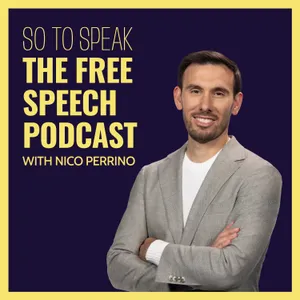
Free Daily Podcast Summary
So to Speak: The Free Speech Podcast: Daily Summaries Delivered
by FIRE
So to Speak: The Free Speech Podcast takes an uncensored look at the world of free expression through the law, philosophy, and stories that define your right to free speech. Hosted by FIRE's Nico Perrino.
Latest Episodes
The most recent episodes — sign up to get AI-powered summaries of each one.
- 1 weeks ago1h 2m
Ep. 282: Breaking down our 2027 College Free Speech Rankings
Harvard, institutional neutrality, how we determine the rankings, partisan censorship, how schools can improve their ranking, and more! Timestamps: 00:00 Intro 03:18 Learn about our inaugural Soapbox conference 04:02 Preorder Nico's book Free Speech Generation 5:00 Check out FIRE's 2027 College Free Speech rankings 06:05 Who are the top- and bottom-ranked schools? 09:27 What's new with the Harvard evaluation? 13:08 How does FIRE choose which schools to rank? 13:46 What can universities do to improve their ranking? 15:54 What is institutional neutrality? 18:05 What exactly are students being asked about campus speech? 21:25 How does FIRE make sure defending free speech doesn't inadvertently protect censorship in the classroom? 25:19 Is campus censorship coming more from the "right" or the "left"? 26:53 Did the University of Washington settlement involving Professor Stuart Reges affect its ranking? 30:45 What does it mean to pre-register our methodology? 31:35 Why did Claremont McKenna drop in the rankings? 33:07 What advice does FIRE have for students at low-ranked schools facing censorship? 36:47 Do politically homogeneous campuses make students more comfortable speaking freely? 40:26 Do low-ranked colleges tell FIRE how they are improving? 42:56 What can administrators do now to improve next year's ranking? 43:50 Does FIRE account for turnover in university leadership? 45:47 What do the rankings reveal about different student demographic groups? 49:41 Does FIRE account for differences between types of institutions? 52:00 What's up with MIT? 56:02 Should attacks on tenured professors carry more weight than actions against other faculty? 57:02 Who does FIRE contact when evaluating a university? 58:09 Are there regional patterns in the rankings? 58:57 Were there bigger ranking swings than usual this year? 01:00:44 Outro Joining us: Nico Perrino, executive vice president Angela Erickson, vice president of research Sean Stevens, chief researcher Ronnie London, general counsel and director of litigation Connor Murnane, campus advocacy chief of staff Become a paid subscriber today to receive invitations to future live webinars. If you became a FIRE Member through a donation to FIRE at fire.org and would like access to Substack's paid subscriber podcast feed, please email sotospeak@fire.org. If you already are a paid subscriber and would like to listen to this episode via Apple Podcasts, click on the "Apple Podcasts" icon at the top right of this page!
- 1 weeks ago1h 5m
Ep. 281: What's the First Amendment's original meaning? w/ Jud Campbell and Stephen Solomon
The First Amendment is only 45 words long. But more than 200 years and thousands of court decisions later, we're still arguing over a basic question: what do those words mean — and what did they mean to the early Americans who adopted them? To look through history and debate what originalism can — and can't — tell us about the First Amendment's free speech clause, we are joined by: Jud Campbell, Stanford Law School professor and the author of Natural Rights and the First Amendment and Determining Rights Stephen Solomon, Marjorie Deane Professor of Journalism at New York University, the founding editor of First Amendment Watch, and the author of Revolutionary Dissent: How the Founding Generation Created the Freedom of Speech Timestamps: 00:00 Intro 02:20 Original meaning and modern First Amendment doctrine 09:12 Would the founders recognize our Constitution today? 16:00 The Alien and Sedition Acts 20:21 How the founding generation practiced free speech 24:35 Can we define "originalism"? 32:05 Representative government and the promise of liberty 45:00 The First Amendment's absolute language 51:36 New York Times v. Sullivan 58:01 Amending the First Amendment 01:04:30 Outro Enjoy listening to the podcast? Donate to FIRE today and get exclusive content like member webinars, special episodes, and more. If you became a FIRE Member through a donation to FIRE at fire.org and would like access to Substack's paid subscriber podcast feed, please email sotospeak@fire.org.
- 3 weeks ago1h 13m
Ep. 280: Social media, speech, and kids w/ Joel Thayer and Kate Ruane
**Editor's note: This episode was recorded before Meta settled a social media addiction trial with a coalition of state attorneys general on Aug. 26, 2026. The case alleged the company knew some of its features on Facebook and Instagram could be harmful to kids and the company publicly misrepresented those risks. Social media and artificial intelligence are increasingly powerful tools for sharing and accessing information. They're also at the center of a push for the government to address their potential harms — particularly to kids. So where's the constitutional line between regulating technology and regulating speech? And could this latest wave of legislation and litigation change what we can see, say, and create online? Joining us to break down the latest developments in social media and AI and what it all means for free speech are: Joel Thayer, senior fellow for AI and emerging technology policy at the America First Policy Institute and president of the Digital Progress Institute Kate Ruane, director of the Center for Democracy & Technology's Free Expression Project Timestamps: 00:00 Intro 02:02 The case for regulating social media 09:23 The case for social media as protected speech 18:12 Are social media design features protected speech? 23:46 Section 230 and platform liability 37:21 Privacy, COPPA, and online child safety 58:40 Are AI chatbots speech? 01:09:06 Will Congress regulate social media and AI? 01:12:27 Outro Enjoy listening to the podcast? Donate to FIRE today and get exclusive content like member webinars, special episodes, and more. If you became a FIRE Member through a donation to FIRE at fire.org and would like access to Substack's paid subscriber podcast feed, please email sotospeak@fire.org.
- Aug 7, 202645 min
Ep. 279: Legendary lawyer Michael Tigar on juries, free speech, and the trial of John Peter Zenger
Long before the First Amendment, John Peter Zenger stood trial for publishing criticisms of New York's then colonial governor. Although the law seemed to guarantee a guilty verdict, a jury refused to convict him. Zenger's trial was an early indication that the American colonists harbored a view of liberty more expansive than that offered to them by the British Crown. Few people are better suited to explain the case than Michael Tigar. Over a legendary legal career spanning more than six decades, Tigar has argued before the Supreme Court (multiple times), represented civil rights activists and other controversial clients, taught generations of lawyers, and written what has become the definitive stage play about the Zenger trial. Michael joins us to revisit the Zenger trial and reflect on his own remarkable career from the Berkeley Free Speech Movement and the Chicago Eight trial to jury nullification and lawyers' First Amendment rights. To read more about Michael's life, check out his memoir. Timestamps: 00:00 Intro 03:11 The Berkeley Free Speech Movement 09:17 Michael's path to becoming a lawyer 13:44 Defending the Chicago Eight 20:25 The trial of John Peter Zenger 27:03 Jury nullification and the Zenger verdict 37:26 The Zenger play and its legacy 39:52 NYT v. Sullivan and SLAPP lawsuits 44:30 Outro Enjoy listening to the podcast? Donate to FIRE today and get exclusive content like member webinars, special episodes, and more. If you became a FIRE Member through a donation to FIRE at fire.org and would like access to Substack's paid subscriber podcast feed, please email sotospeak@fire.org.
- Jul 29, 202659 min
Ep. 278: The Trump admin wants to change how scientific research is funded w/ Catharine Young, Evan Morris, and Ryne Weiss
In May 2026, the Office of Management and Budget proposed sweeping changes to how the federal government administers billions of dollars in federal research grants. That funding fuels scientific discovery, medical breakthroughs, and technological innovation. The proposal was open for public comment for 45 days and drew more than half a million responses. Supporters of the proposal argue that it will prevent waste, fraud, and abuse in federal spending. Critics contend that the proposal will politicize research funding by giving executive branch political appointees greater influence over which research projects receive federal support. Joining us to break down the OMB proposal and what it could mean for the future of research are: Evan Morris, professor of radiology and biomedical imaging and of biomedical engineering at Yale Catharine Young, senior fellow at the Harvard T.H. Chan School of Public Health Ryne Weiss, director of research here at FIRE Timestamps: 00:00 Intro 02:57 What's in the OMB proposal? 08:57 Research grant "kill switches" and their consequences 17:17 Limits on foreign research partnerships and professional activities 21:29 The importance of federal funding to medical research 23:23 Are pharmaceutical companies the "boogeymen"? 25:13 The gold standard of scientific research 26:22 The "replication crisis" 31:16 Open science and peer review 40:37 Bias in research funding decisions 44:06 Should science be shielded from politics? 49:04 Has research always been political? 53:14 How politicization could change scientific research 58:59 Outro Enjoy listening to the podcast? Donate to FIRE today and get exclusive content like member webinars, special episodes, and more. If you became a FIRE Member through a donation to FIRE at fire.org and would like access to Substack's paid subscriber podcast feed, please email sotospeak@fire.org.
- Jul 15, 20261h 14m
Ep. 277: Ada Palmer on the history of censorship from the Renaissance to AI
Censorship is often associated with authoritarian governments. But throughout history, efforts to control ideas have taken many different forms — and they haven't always come from the state. In this episode, Nico sits down with University of Chicago professor Ada Palmer to explore the history of censorship from the Renaissance to the present day. They discuss what motivates censorship, why it evolves alongside new communication technologies, how effective it has been throughout history, and what historical patterns can teach us about today's free speech debates. Ada Palmer is a professor of early modern European history at the University of Chicago and the author of Inventing the Renaissance: Myths of a Golden Age. She is also an acclaimed science fiction and fantasy author, composer, singer, and expert on anime and Japanese popular culture. Visit her website to read her blog and explore her other projects. Timestamps: 00:00 Intro 01:29 Palmer's interest in censorship 03:13 Renaissance censorship 13:15 The Inquisition and Jansenism 22:50 The blurry line between state and private censorship 31:35 Fear and self-censorship 35:12 Does America hide its censorship efforts? 38:45 The case of Giovanni Pico della Mirandola 43:50 Will AI change censorship? 53:36 Censorship will always be with us 01:06:47 Are you a free speech absolutist? 01:13:46 Outro Enjoy listening to the podcast? Donate to FIRE today and get exclusive content like member webinars, special episodes, and more. If you became a FIRE Member through a donation to FIRE at fire.org and would like access to Substack's paid subscriber podcast feed, please email sotospeak@fire.org.
- Jul 1, 202659 min
Ep. 276: Book banning's trial of the century w/ Anthony Aycock
Over the past five years, book bans and book challenges have become a major flashpoint in American politics. School boards, parents, librarians, and lawmakers are fighting over what students should—and shouldn't—have access to on library shelves. Supporters of library restrictions say they are protecting children. Opponents say they are censoring ideas. But this debate isn't new. In the 1970s, America saw a similar surge in book challenges. One local dispute in Long Island, New York, made its way to the U.S. Supreme Court and became the only school-library book-removal case the Court has ever decided. That case was Island Trees School District v. Pico, better known simply as Pico. In this episode, we're joined by Anthony Aycock, legislative library director at the North Carolina General Assembly and the author of Just Plain Filthy: The Story Behind Book Banning's Trial of the Century. His book tells the story behind Pico, including the school board that removed the books from its libraries, the students who fought back, and the Supreme Court justices who delivered a fractured ruling that left some of the case's most important constitutional questions unresolved. Don't miss the free speech event of the year! Get your tickets and learn more about our Soapbox Conference at soapbox.fire.org. The early bird discount ends July 4. Timestamps: 00:00 Intro 03:02 How Anthony became a librarian 05:08 What inspired Anthony's book? 07:33 The origins of Island Trees School District v. Pico 13:25 The Miller test for obscenity 14:43 Steven Pico and the road to the Supreme Court 18:15 The local reaction to Pico 20:17 If libraries choose what comes in, why can't they choose what goes out? 20:51 How librarians build a collection 26:05 When and why books leave library shelves 26:52 The Supreme Court's plurality opinion 30:08 Why Pico still matters: the Llano County case 35:41 Libraries, viewpoint diversity, and public access 38:24 When is censorship justified? 39:55 Should parents decide what everyone can read? 51:01 Stress test: Should Hitler's Mein Kampf be available in libraries? 54:05 How librarians feel about literary censorship today 57:57 Outro Enjoy listening to the podcast? Donate to FIRE today and get exclusive content like member webinars, special episodes, and more. If you became a FIRE Member through a donation to FIRE at fire.org and would like access to Substack's paid subscriber podcast feed, please email sotospeak@fire.org.
- Jun 17, 202642 min
Ep. 275: Stress-testing the limits of the First Amendment w/ Chaz Stevens
Debates over religious freedom have shaped American life for centuries. From Quakers facing persecution in colonial America to The Crucible to South Park, fights over religious expression have repeatedly tested the country's commitment to free speech and religious liberty. At the heart of these debates are a few difficult questions: Does the Constitution protect only popular beliefs, or all of them? If the government opens the door for one form of religious expression, does it have to allow every form? And if not, where does the Constitution draw the line? Few people have tested those questions more directly than Chaz Stevens. Stevens is the founder of the Church of Satanology and a longtime activist who uses satire, publicity stunts, and litigation to challenge what he sees as hypocrisy in how governments apply First Amendment protections. In this episode, Chaz joins us to talk about those battles, the philosophy behind his activism, and what he's learned from years of pushing the boundaries of the First Amendment. Follow Chaz on Substack here. Timestamps: 00:00 Intro 02:26 What is Satanology? 04:15 Using malicious compliance to defend viewpoint neutrality 07:14 Pushing the boundaries of religious freedom protections 10:12 The First Amendment right to petition the government 11:20 Fighting state-mandated religious displays 15:37 Why Chaz puts Festivus poles in state capitols 19:59 Ron DeSantis, school libraries, and book ban controversies 23:44 Suing the government without a lawyer (pro se litigation) 30:18 Chaz's lawsuit against Rep. Chip LaMarca and Lindke v. Freed 34:48 How Chaz's activism started 35:54 The Consentivius tour and the Epstein files 38:55 What is Chaz's endgame? 41:27 Outro Enjoy listening to the podcast? Donate to FIRE today and get exclusive content like member webinars, special episodes, and more. If you became a FIRE Member through a donation to FIRE at fire.org and would like access to Substack's paid subscriber podcast feed, please email sotospeak@fire.org.
Get So to Speak: The Free Speech Podcast summaries in your inbox
Free AI-powered daily recaps. Key takeaways, quotes, and mentions — in a 5-minute read.
Get Free Summaries →Free forever for up to 3 podcasts. No credit card required.
You Might Also Like
Listeners also like.
The Rubin Report
Political talk show with interviews focused on free speech and current events.
5-4
A progressive critique of the Supreme Court’s landmark decisions and the political forces shaping the law.
Stanford Legal
Experts analyze pressing legal issues, landmark cases, and constitutional questions shaping American democracy and society.
Civics 101
Explains how U.S. government institutions and constitutional rights function in everyday life.
Outloud with Gianno Caldwell
A conservative political commentator explores news and culture by challenging prevailing orthodoxies and advocating for free expression.
Honestly with Bari Weiss
Conversations with influential figures on overlooked stories and ideas shaping American life, hosted by journalist Bari Weiss.
Brief Recess: A Legal Podcast with Michael Foote & Mélissa Malebranche
Two lawyers dissect viral legal stories, answer listener questions, and explain how to use the law for social change.
Another Way, by Lawrence Lessig
Explores policies and movements aimed at restoring democratic power through interviews with activists, politicians, and reformers.
Steve Deace Show
Daily commentary on principled conservatism with a snarky tone.
The Lawfare Podcast
Discussions with experts on national security, law, and policy covering foreign policy, intelligence, cybersecurity, and governance.
Slow Burn
Examines pivotal political and cultural moments in American history through archival audio and firsthand accounts.
Intelligence Squared
Live debates and in-depth discussions on pressing global issues featuring leading experts and thinkers.
About So to Speak: The Free Speech Podcast
So to Speak: The Free Speech Podcast takes an uncensored look at the world of free expression through the law, philosophy, and stories that define your right to free speech. Hosted by FIRE's Nico Perrino.
Customized Recaps
AI-powered recaps with compact key takeaways, quotes, and insights.
Straight to Your Inbox
Get key takeaways from So to Speak: The Free Speech Podcast in a 5-minute read.
Save Hours Every Week
Stay current on your favorite podcasts without falling behind.
Frequently Asked Questions
What is Podzilla's So to Speak: The Free Speech Podcast daily summary?
It's a free AI-powered email that summarizes new episodes of So to Speak: The Free Speech Podcast as soon as they're published. You get the key takeaways, notable quotes, and links & mentions — all in a quick read.
How does the So to Speak: The Free Speech Podcast podcast summary work?
When a new episode drops, our AI transcribes and analyzes it, then generates a personalized summary tailored to your interests and profession. It's delivered to your inbox every morning.
Is this an official So to Speak: The Free Speech Podcast product?
No. Podzilla is an independent service that summarizes publicly available podcast content. We're not affiliated with or endorsed by FIRE.
Can I get summaries of other podcasts too?
Absolutely! The free plan covers up to 3 podcasts. Upgrade to Pro for 15, or Premium for 50. Browse our full catalog at /podcasts.
What topics does So to Speak: The Free Speech Podcast cover?
So to Speak: The Free Speech Podcast covers topics including News, Politics, Commentary. Our AI identifies the specific themes in each episode and highlights what matters most to you.
Start getting So to Speak: The Free Speech Podcast summaries tomorrow morning.
Free forever for up to 3 podcasts. No credit card required.
Free forever for up to 3 podcasts. No credit card required.