Free Daily Podcast Summary
Sleepy Facts About History: Daily Summaries Delivered
by sciflix.one - Sleepy History
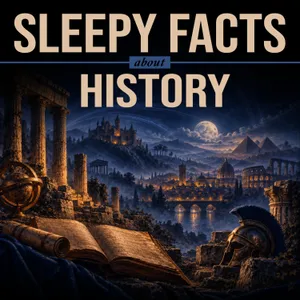
Sleepy Facts About History is a calm history podcast for sleep, relaxation, and quiet curiosity.Each episode explores the human past in a gentle documentary style: ancient civilizations, forgotten kingdoms, empires, historical figures, wars and conflicts, cultural traditions, scientific discoveries, daily life, great turning points, and the stories that shaped our world — without loud drama or stressful narration.If you enjoy relaxing history podcasts, historical facts for sleep, ancient history explained, or peaceful documentaries about the past, this show is designed to keep you curious while letting your mind slow down.Sleepy Facts About History is produced by the small team at [sciflix.one](http://sciflix.one). Each episode is built from human-researched facts and written exclusively for this
Latest Episodes
The most recent episodes — sign up to get AI-powered summaries of each one.
- Today30 min
Who Really Wrote the History of Boudica's Revolt? - Separating Boudica from Myth | Sleepy Facts About History
Got something to say to this podcast? Send a voicemail, and you might hear yourself on the next episode!Boudica is one of the most recognizable figures in early British history, yet almost everything we know about her comes from the very empire she fought. Every description of her appearance and every speech attributed to her was written by Roman historians decades after her death. This episode examines the violent revolt of the Iceni in 60 or 61 CE, exploring the Roman provincial abuses that triggered the uprising and the systematic destruction of Camulodunum, Londinium, and Verulamium. By comparing the accounts of Tacitus and Cassius Dio with the physical evidence left behind in archaeological destruction layers, we can see where Roman literary invention ends and historical reality begins.I wanted to understand why a figure who supposedly led a unified British resistance remains so historically invisible as an actual person. Working through this episode, I kept returning to one question: how do we responsibly study a rebellion when the only surviving voices belong to the victors?The result is an exploration of the gap between national myth and documented fact. We look at the strategic choices made by the Roman governor Suetonius Paulinus, the brutal suppression of the revolt, and how later generations reinvented Boudica to suit their own political needs. By separating the physical scars left in the earth from the moralizing narratives of Roman writers, we can better understand both the reality of ancient imperial violence and the complex conditions of our historical knowledge.
- Today29 min
Why Does Roman Concrete Still Stand After Two Millennia? - Opus Caementicium and the Reality of Roman Construction | Sleepy Facts About History
Got something to say to this podcast? Send a voicemail, and you might hear yourself on the next episode!Roman concrete is often described as a lost superformula, a magical substance modern engineers have forgotten how to make. The reality is far more interesting. This episode explores opus caementicium not as a single miraculous recipe, but as a family of adaptable mixtures, a complex chemical process, and a carefully coordinated human labor system. By examining the combination of lime, volcanic ash, and aggregate, we look at how Roman builders created structures that have survived for two millennia.The episode traces the material from the quarries to the construction site, explaining the slow pozzolanic reaction that allowed underwater harbor structures at Portus and Caesarea Maritima to cure and gain strength. It also contrasts this marine concrete with the graduated aggregate selection used to reduce weight in the massive unreinforced dome of the Pantheon. Far from being a uniform product, Roman concrete was a flexible technology adapted to local geology and specific structural demands.I wanted to understand why we treat Roman concrete as a mythical lost secret rather than a practical, empirical building technology. Exploring the actual chemistry and the organized human effort behind these ancient structures reveals an achievement far more impressive than a simple forgotten recipe.
- Today26 min
What Does It Take for a Scientific Idea to Become Persuasive? - Aristarchus of Samos and the Ancient Heliocentric Hypothesis | Sleepy Facts About History
Got something to say to this podcast? Send a voicemail, and you might hear yourself on the next episode!In the third century BCE, the Greek astronomer Aristarchus of Samos proposed that the Earth circles the Sun. He suggested a heliocentric cosmos nearly two thousand years before Copernicus, using nothing more than careful observation, geometric reasoning, and the naked eye. Yet, his contemporaries understood his idea perfectly and chose to reject it. This episode explores the fascinating gap between proposing a correct hypothesis and actually proving it, examining why the ancient world remained unconvinced that the Earth moves.We look at the surviving evidence for Aristarchus's model, including his surviving geometric treatise on the sizes and distances of the Sun and Moon. By tracking the half-Moon and timing lunar eclipses, he demonstrated an enormous cosmic scale that made a moving Earth geometrically plausible. However, this same vast scale created an insurmountable observational problem: stellar parallax. Without telescopes to detect the minute shifts in distant stars, and without a physics of motion to explain why objects on a moving Earth would not be left behind, the geocentric model remained the most rational and evidence-based choice for ancient scholars.I wanted to understand why a correct scientific idea can fail to take hold, and this episode began with a deceptively simple question about how knowledge actually develops. Aristarchus was not a prophet ignored by a dogmatic society; he was a brilliant mathematician lacking the conceptual infrastructure to make his theory persuasive. Exploring his rejected hypothesis offers a calm, clear look at how scientific acceptance truly works, reminding us that being right in broad outline is not the same as being established.
- Today29 min
Why Was the Athenian Tetradrachm Trusted Across the Ancient World? - The Athenian Owl and the Laurion Mines | Sleepy Facts About History
Got something to say to this podcast? Send a voicemail, and you might hear yourself on the next episode!The Athenian owl tetradrachm is one of the most recognizable objects of the ancient world. For centuries, this small silver coin, stamped with the helmeted head of Athena and a watchful owl, passed through the hands of sailors, merchants, and tax collectors from the Black Sea to Egypt. Its design remained remarkably stable, communicating a guarantee of weight and purity that made it a trusted medium of exchange across the Mediterranean. But the coin did not begin as a currency. It began as rock in the ground at Laurion, extracted by thousands of enslaved laborers working in cramped, smoke-filled galleries, and processed through a complex sequence of crushing, washing, and smelting before ever reaching the state mint.This episode examines the complete physical and social chain that produced the Athenian owl. It explores the brutal realities of the Laurion mining district, the state leasing arrangements that privatized extraction, and the metallurgical processes required to refine the ore. It also traces the path of the finished coin as it funded the trireme rowers of the Athenian navy, enforced imperial tribute through the Delian League, and circulated as an international currency.I wanted to understand how a single, familiar object could connect such radically different human experiences. The calm face of Athena on a museum case can make us forget the system that created it. By following the silver from the subterranean tunnels of Laurion to the markets of the ancient world, we can see how a stable currency was built on coerced labor, state power, and naval expansion.
- Today29 min
What Did Lay Donors Receive in Return for Feeding the Sangha? - Individual Poverty and Collective Wealth in Early Buddhism | Sleepy Facts About History
Got something to say to this podcast? Send a voicemail, and you might hear yourself on the next episode!The image of early Buddhist monks walking silently through a village with their alms bowls is universally recognizable, but the mechanics behind that simple act are often misunderstood. This episode explores how a community of people who had formally renounced society continued to eat, live, and build lasting institutions through the gifts of the society they had left. It examines the daily alms round, the strict monastic rules found in the Vinaya, and the concept of merit that motivated lay donors to offer food, robes, and eventually land.Beyond the morning meal, the episode traces how this reciprocal exchange scaled up from individual donations of rice to the creation of permanent monasteries. It looks at the legal distinction that allowed individual monks to remain poor while the sangha as a corporate body accumulated wealth, and it highlights the varied donors—from wealthy merchants and royal patrons to ordinary villagers and women—who made this institutional growth possible.I wanted to understand why a system built on total renunciation did not simply collapse or retreat into isolated meditation. Instead, I found a carefully regulated dependence on society. The rules that separated monks from ordinary life were exactly what connected them to households, villages, and cities, creating a shared religious life that would outlast the empires that sustained it.
- Today33 min
What Was Daily Life Like Inside the Athenian Household? - Daily Survival and Enslaved Labor in Ancient Athens | Sleepy Facts About History
Got something to say to this podcast? Send a voicemail, and you might hear yourself on the next episode!The democracy of classical Athens is remembered for its citizen assemblies, philosophical debates, and marble monuments. But before any citizen rose to speak on the Pnyx, someone had already carried heavy jars of water from public fountains, coaxed dying embers into a fire, and spent hours grinding grain between stones. This episode examines the invisible domestic labor that made Athenian public life possible.We look closely at the oikos, the Athenian household, to understand the physical realities of survival. From fetching water and baking bread to weaving textiles on warp-weighted looms, the daily routine was defined by exhausting manual work. This labor was largely performed by citizen women and enslaved people, whose lives often contradicted the elite ideal of female seclusion. We also explore the complex hierarchy of the household, the reliance on enslaved labor, and the quiet ways unfree people navigated a system that denied them political voice.I wanted to understand how the celebrated equality of the Athenian public sphere was structurally dependent on profound inequality behind closed doors. Exploring the routines of grinding grain and carrying water reveals that the foundations of Western philosophy and democratic debate were built entirely on unrecorded toil. It asks us to hold the orator and the water carrier in view at the same time, complicating the history we think we know.
Get Sleepy Facts About History summaries in your inbox
Free AI-powered daily recaps. Key takeaways, quotes, and mentions — in a 5-minute read.
Get Free Summaries →Free forever for up to 3 podcasts. No credit card required.
You Might Also Like
Listeners also like.

Sleepy History
Calming narrations of historical events and mysteries designed to help listeners relax and fall asleep.
Boring History for Sleep
A podcast delivering dull historical facts in a soothing voice to help listeners fall asleep.

Boring History For Sleep | Gentle Storytelling And Ambient Sounds (Official)
Historical stories and hidden war secrets told gently over ambient rain sounds to help adults relax and sleep.

Calm History (not A.I. & no loud ads) - Bedtime Sleep Stories for Education & Relaxation
Historical narratives presented as calming bedtime stories on topics ranging from ancient civilizations to modern events.

Calm History (not A.I. & no loud ads) - Bedtime Sleep Stories for Education & Relaxation
Historical narratives told calmly for bedtime listening, covering events and figures from ancient civilizations to modern times.

Lights Out Library: Sleep Documentaries
Soothing narrative documentaries on science, history, mythology, and art designed to help listeners relax and fall asleep.

Get Sleepy: stories for sleep
Bedtime stories narrated in a calming voice to help adults relax and fall asleep.

I Can't Sleep: Relaxing Facts to Fall Asleep To
A sleep podcast featuring slow, fact-based storytelling on science, history, and curious topics to help quiet the mind and ease insomnia.

Sleep Tight Science - A Bedtime Science Podcast For Kids
A bedtime science podcast for kids that answers their big questions about the natural world in a calming, family-friendly way.

Night Falls: Bedtime Stories For Sleep
Soothing bedtime stories for adults, told in a calm voice, to help quiet the mind and ease into sleep.

Sleepy
A soothing bedtime podcast where a baritone voice reads classic literature to help listeners fall asleep.

Sleep Tight Relax - Bedtime Stories That Take You Somewhere Peaceful
Gentle bedtime stories and peaceful soundscapes guide children and adults alike into calm sleep through soothing imaginary landscapes.
About Sleepy Facts About History
Sleepy Facts About History is a calm history podcast for sleep, relaxation, and quiet curiosity.Each episode explores the human past in a gentle documentary style: ancient civilizations, forgotten kingdoms, empires, historical figures, wars and conflicts, cultural traditions, scientific discoveries, daily life, great turning points, and the stories that shaped our world — without loud drama or stressful narration.If you enjoy relaxing history podcasts, historical facts for sleep, ancient history explained, or peaceful documentaries about the past, this show is designed to keep you curious while letting your mind slow down.Sleepy Facts About History is produced by the small team at [sciflix.one](http://sciflix.one). Each episode is built from human-researched facts and written exclusively for this
Customized Recaps
AI-powered recaps with compact key takeaways, quotes, and insights.
Straight to Your Inbox
Get key takeaways from Sleepy Facts About History in a 5-minute read.
Save Hours Every Week
Stay current on your favorite podcasts without falling behind.
Frequently Asked Questions
What is Podzilla's Sleepy Facts About History daily summary?
It's a free AI-powered email that summarizes new episodes of Sleepy Facts About History as soon as they're published. You get the key takeaways, notable quotes, and links & mentions — all in a quick read.
How does the Sleepy Facts About History podcast summary work?
When a new episode drops, our AI transcribes and analyzes it, then generates a personalized summary tailored to your interests and profession. It's delivered to your inbox every morning.
Is this an official Sleepy Facts About History product?
No. Podzilla is an independent service that summarizes publicly available podcast content. We're not affiliated with or endorsed by sciflix.one - Sleepy History.
Can I get summaries of other podcasts too?
Absolutely! The free plan covers up to 3 podcasts, any in the catalog. Basic raises that to 15, Pro to 40 and Max to 100. Browse our full catalog at /podcasts.
What topics does Sleepy Facts About History cover?
Sleepy Facts About History covers topics including History, Education. Our AI identifies the specific themes in each episode and highlights what matters most to you.
Start getting Sleepy Facts About History summaries tomorrow morning.
Free forever for up to 3 podcasts. No credit card required.
Free forever for up to 3 podcasts. No credit card required.