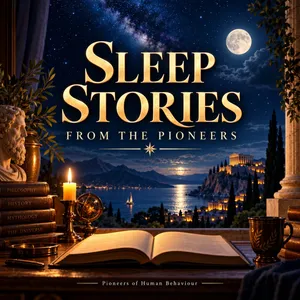
Free Daily Podcast Summary
Sleep Stories from the Pioneers: Daily Summaries Delivered
by Pioneers of Human Behaviour
Stories to fall asleep to. Ideas worth waking up with. Slow, immersive journeys through psychology, philosophy, history, mythology and science — from the lives of extraordinary thinkers to the mysteries of the universe. Calm narration and long-form storytelling made for sleep, relaxation and curious minds.Watch Sleep Stories from the Pioneers on YouTube:https://www.youtube.com/@SleepStoriesFromThePioneers
Latest Episodes
The most recent episodes — sign up to get AI-powered summaries of each one.
- Today43 min
What Makes a Good Explanation? | The Explanation of Explanation
What makes a good explanation?On a Paris stage in 1673, a man becomes a doctor by explaining that opium brings sleep because it has a sleep-making power, and a chorus sings that he has answered well. Tonight's story asks what a real explanation has to do.In first-century China, Wang Chong weighs the painted Thunder Lord against five proofs that thunder is fire. Shen Kuo explains the moon with a ball half dusted with powder. Al-Biruni gently questions an astronomer who defended the eclipse demon but calculated with shadows.Isaac Newton admits that he cannot find the cause of gravity. Rudyard Kipling tells bedtime stories just so. Philosophers puzzle over a flagpole's shadow, children ask why again, and psychologists find how thin our understanding of a zip can be.Nothing needs explaining tonight. The night can keep its sleep-making power, and nobody needs to ask how it works.This podcast edition contains the narration on its own, with no background music.Sleep Stories from the PioneersStories to fall asleep to. Ideas worth waking up with.Explore The Idea of Ideas series:https://www.youtube.com/playlist?list=PLd5WzOPdClFYListen to more Sleep Stories from the Pioneers:https://www.youtube.com/playlist?list=PLRypv-XVJDZkExplore Sleep Stories from the Pioneers:https://pioneersofhumanbehaviour.com/sleep-stories/Support the project:https://ko-fi.com/pioneersofhumanbehaviourThis episode includes AI-generated content.
- 3 days ago37 min
What Happens When Anthropology Looks at Itself? | The Anthropology of Anthropology
What happens when anthropology looks at itself?Settle into The Anthropology of Anthropology, a thoughtful sleep story about the people who study other people, and the people who have been watching them all along.In 1956, a scholarly report described the curious daily rites of the Nacirema. There were shrines in every house and a bundle of hog hairs used in the mouth. Read the name backwards, and a familiar bathroom comes into view.Tonight we follow anthropology as it turns the lens back on itself.From Malinowski's tent in the Trobriand Islands to Franz Boas and the people who helped make his books, the story asks who gets to observe, describe and explain another way of life.Zora Neale Hurston goes home to collect stories. Ella Deloria shows why being a good relative belongs inside the work. Ishi watches the visitors who have come to watch him.A telling of Hamlet meets a different understanding among Tiv elders. Annette Weiner returns to the Trobriands and pays attention to women's wealth. Laura Nader asks what happens when anthropology studies people with power.The notebooks can close now. The village is quiet, the lamp in the tent is out, and nothing you do tonight needs explaining to anyone.Let the story keep you company as you settle down to rest.This sleep story is told slowly and gently for sleep, relaxation and quiet late-night listening.Explore The Idea of Ideas series:https://www.youtube.com/playlist?list=PLd5WzOPdClFYListen to more Sleep Stories from the Pioneers:https://www.youtube.com/playlist?list=PLRypv-XVJDZkExplore Sleep Stories from the Pioneers:https://pioneersofhumanbehaviour.com/sleep-stories/Support the project:https://ko-fi.com/pioneersofhumanbehaviourSleep well. 🌙Stories to fall asleep to. Ideas worth waking up with.
- 4 days ago37 min
The Idea of Ideas | Where Do Ideas Come From?
Where do ideas come from, and why do some arrive when we least expect them? Settle into The Idea of Ideas, a gently narrated philosophy sleep story about creativity, the mind and the strange border between waking and sleep.A mathematician steps onto an omnibus and suddenly sees the answer to a problem. A young writer lies awake beside Lake Geneva as an extraordinary story begins to form. An artist holds a key above a plate, hoping to catch the fleeting thoughts that arrive just before sleep.Tonight, we follow ideas through philosophy, history and the science of insight. From Plato and John Locke to Henri Poincaré, Mary Shelley and Salvador Dalí, we explore how inspiration takes shape, why stepping away from a problem can sometimes reveal its answer, and what researchers have discovered about creativity at the edge of sleep.Along the way, we consider how ideas travel between minds, how imagination connects things that once seemed unrelated, and why some of our most interesting thoughts appear when we stop trying to find them.You don't need to solve anything tonight. Let the questions drift by, allow your thoughts to wander, and settle gently into rest. The ideas can wait until morning.This podcast edition contains approximately 37 minutes of gentle narration, without the extended music of the YouTube edition.Sleep Stories from the PioneersStories to fall asleep to. Ideas worth waking up with.Explore more sleep stories:https://pioneersofhumanbehaviour.com/sleep-stories/Support the Pioneers:https://ko-fi.com/pioneersofhumanbehaviour
- 5 days ago44 min
What Makes Evidence Worth Believing? | The Evidence of Evidence
Content note: This episode includes historical accounts of hot-iron ordeals, violent death and forensic examinations, suicide, terrorism, wartime deprivation and infant mortality.What makes evidence worth believing, and how do we know when something is true?Settle into The Evidence of Evidence, a thoughtful sleep story for adults exploring the philosophy of evidence, the history of scientific reasoning, and the fascinating ways people have learned to investigate claims, evaluate testimony and question their own methods.Our journey begins in medieval Várad, where a trial by hot iron offers a glimpse into an earlier approach to determining truth. From these historical ordeals, we follow the gradual development of more systematic ways to establish what can reasonably be believed.Across the Islamic world, scholars develop careful methods for evaluating chains of testimony, asking who passed information along and whether those accounts could be trusted. In China, Song Ci's forensic examinations demonstrate the importance of careful observation and recorded evidence.The philosophers John Locke and David Hume explore the relationship between experience, testimony and belief, asking how we should judge competing claims and what makes one account more convincing than another.Thomas Bayes introduces a mathematical approach to reasoning under uncertainty. Through an imagined ball hidden on a level table, we encounter the foundations of Bayesian inference and the idea that evidence can change how strongly we should believe something.Our journey then turns towards forensic science. Fingerprints offer new possibilities for identification, while the work of researchers including Azizul Haque and Hem Chandra Bose contributes to the development of practical fingerprint classification.In medicine, clinical trials and controlled experiments help researchers distinguish genuine effects from misleading observations. The work of Archie Cochrane brings attention to the importance of reliable evidence in healthcare and the need to examine how medical knowledge is established.Along the way, we consider cognitive bias, the psychology of belief and the challenges of interpreting evidence when expectations may influence the person doing the judging.Together, these stories explore how evidence is gathered, weighed and tested, and why even the methods we rely upon to establish truth must remain open to examination.At last, we return to a quiet room. An empty brass balance rests upon a wooden table, its pans level and still. The calibration weights have been laid aside, and the day's register is closed.Beyond the room, a canal slowly freezes in the darkness. A ball lies motionless, and nothing needs to be measured or decided before morning.There is no case left to argue tonight. Whatever remains uncertain can wait until daylight.Let this gently narrated sleep story keep you company through a peaceful evening of philosophy, history, scientific discovery and rest.Explore The Idea of Ideas series:https://www.youtube.com/playlist?list=PLd5WzOPdClFYListen to more Sleep Stories from the Pioneers:https://www.youtube.com/playlist?list=PLRypv-XVJDZkExplore Sleep Stories from the Pioneers:https://pioneersofhumanbehaviour.com/sleep-stories/Support the project:https://ko-fi.com/pioneersofhumanbehaviourSleep well. 🌙Stories to fall asleep to. Ideas worth waking up with.
- 6 days ago38 min
Can Two Things Be Exactly Alike? | The Difference of Difference
Content note: This episode includes brief references to death and bereavement, the Holocaust and prejudice, and an old story involving an axe near a person's face.Can two things ever be exactly alike, and what makes a difference truly matter?Settle into The Difference of Difference, a thoughtful sleep story for adults exploring the philosophy of difference, the psychology of perception, and the fascinating ways we learn to distinguish one thing from another.Our journey begins in a princess's garden, where the philosopher Gottfried Wilhelm Leibniz searches for two leaves that are perfectly identical. The simple challenge opens one of philosophy's most intriguing questions: could two separate things exist without differing in any way?Leibniz and Samuel Clarke disagree about the nature of identity and difference, revealing how even the smallest distinctions can raise profound questions about the structure of reality.From philosophy, we turn towards mathematics and physics. Satyendra Nath Bose develops a remarkable way of counting particles of light without treating each particle as individually distinguishable, while Charles Babbage designs his Difference Engine around the mathematical relationships between numbers.The anthropologist Gregory Bateson asks which differences become meaningful to a mind, inviting us to consider why some changes capture our attention while countless others pass unnoticed.Along the way, we explore the psychology of social identity and the work of Henri Tajfel, examining how seemingly small distinctions can influence the groups we form and the ways we understand ourselves and others.In ancient Chinese philosophy, Hui Shi and Zhuangzi explore the relationship between likeness and difference, finding questions that resist simple divisions. Their reflections lead us towards another tradition of philosophical inquiry in India, where salt dissolving into water becomes part of a deeper conversation about what is one and what is many.These stories bring together philosophy, mathematics, physics and psychology to explore how differences shape our understanding of the world, and why the distinctions we make are not always as simple as they first appear.At last, we return to the quiet garden. Two leaves rest close together, their shapes almost identical, their smallest differences no longer asking to be examined.The leaves move gently together in the darkness. There is nothing left to compare, measure or distinguish tonight.The minutes are alike enough. Whatever differences remain can wait until morning.Let this gently narrated sleep story keep you company through a peaceful evening of philosophy, psychology, curiosity and rest.Explore The Idea of Ideas series:https://www.youtube.com/playlist?list=PLd5WzOPdClFYListen to more Sleep Stories from the Pioneers:https://www.youtube.com/playlist?list=PLRypv-XVJDZkExplore Sleep Stories from the Pioneers:https://pioneersofhumanbehaviour.com/sleep-stories/Support the project:https://ko-fi.com/pioneersofhumanbehaviourSleep well. 🌙Stories to fall asleep to. Ideas worth waking up with.
- 1 weeks ago38 min
Who Gets to Decide What Words Mean? | The Definition of Definition
Content note: This episode includes brief references to death from illness and a fictional example involving a gun and theft.Who gets to decide what words mean, and what happens when the world refuses to fit our definitions?Settle into The Definition of Definition, a thoughtful sleep story for adults exploring the philosophy of language, the history of definitions, and the fascinating ways people have tried to draw boundaries around the things they understand.Our journey begins with an ancient boundary stone in Athens, where the simple act of marking a boundary opens a much larger question: how do we decide where one thing ends and another begins?The philosopher Plato introduces his famous description of a human being as a featherless biped, revealing how even apparently straightforward definitions can lead to unexpected difficulties. Aristotle develops a more systematic approach to defining things, examining the distinctions that allow us to organise knowledge.In ancient India, philosophers of the Nyaya tradition explore the careful reasoning needed to construct reliable definitions. Confucius considers what happens when a familiar vessel no longer seems to match the name it has been given.Along the way, dictionaries attempt to capture the meanings of words in a language that never quite stands still. Familiar objects become surprisingly difficult to classify, as cups blur into bowls and the boundaries of everyday categories begin to soften.Even the courtroom becomes a place for philosophical questions. Disputes involving tomatoes and Jaffa Cakes reveal how definitions can carry practical, legal and economic consequences.Our journey then turns towards the science of measurement. Surveyors travel across France and Spain, helping establish the metre as a standard of length. Later, a small cylinder made from platinum and iridium becomes the international reference for the kilogram.For generations, the mass of this carefully protected object serves as the standard against which other masses are measured. Eventually, advances in physics allow the kilogram to be defined using a fundamental constant of nature instead of depending upon a single physical object.The cylinder that once defined the kilogram can now be measured like any other object. It remains approximately itself, even as the definition around it changes.Together, these stories explore how definitions shape our understanding of language, philosophy, science and everyday life, while reminding us that the boundaries we create sometimes need to change as our knowledge grows.At last, we return to a quiet room. A small polished cylinder rests beneath glass, the measuring bar has been laid aside, and the books are closed.There is nothing left to define, classify or measure tonight. Words can soften at the edges, and whatever remains uncertain can wait until morning.Let this gently narrated sleep story keep you company through a peaceful evening of philosophy, language, curiosity and rest.Explore The Idea of Ideas series:https://www.youtube.com/playlist?list=PLd5WzOPdClFYListen to more Sleep Stories from the Pioneers:https://www.youtube.com/playlist?list=PLRypv-XVJDZkExplore Sleep Stories from the Pioneers:https://pioneersofhumanbehaviour.com/sleep-stories/Support the project:https://ko-fi.com/pioneersofhumanbehaviourSleep well. 🌙Stories to fall asleep to. Ideas worth waking up with.
- 1 weeks ago42 min
What Is It Like to Be Conscious? | The Consciousness of Consciousness
Content note: This episode discusses historical surgery, pain and awareness under anaesthesia, and patients with disorders of consciousness.What is it like to be conscious, and can the mind ever fully understand its own awareness?Settle into The Consciousness of Consciousness, a thoughtful sleep story for adults exploring the philosophy of mind, the science of consciousness, and one of humanity's most enduring mysteries: what does it mean to have a subjective experience?Our journey begins with the psychologist and philosopher William James, who reflects on the difficulty of observing consciousness while it is happening. A gas lamp turned up too late to reveal the darkness offers a gentle illustration of the problem: how can we study an experience without changing it through the act of observation?John Locke considers the relationship between sleep and awareness, while Gottfried Wilhelm Leibniz invites us inside an enormous imaginary mill. Its mechanisms can be inspected, yet the question remains whether examining every moving part could reveal what it feels like to experience the world.From Western philosophy, we turn towards the Mandukya Upanishad, an ancient Indian text exploring waking, dreaming and deep sleep. Through the sacred syllable Om and the silence that follows, it offers a different way of contemplating the nature of awareness.Along the way, we enter sleep laboratories and explore the wandering mind, introspection and the challenges scientists face when trying to measure subjective experience.Experiments involving perception and competing visual interpretations reveal how difficult it can be to separate consciousness itself from the ways we observe and report it.The philosopher David Chalmers introduces the hard problem of consciousness: why should physical processes in the brain be accompanied by felt experience at all?We consider competing scientific theories of consciousness, the search for neural correlates of awareness, and the careful question of whether other animals might experience the world in ways we cannot directly understand.Together, these ideas invite us to explore the relationship between the brain, awareness and subjective experience, while recognising how much remains uncertain about the nature of consciousness.At last, the questions can rest. The lamp can stay low, the machinery can become still, and beyond the window, the sea continues gathering its countless small sounds.There is nothing left to observe, measure or explain tonight. The mind does not need to catch itself in the act of being aware.Let this gently narrated sleep story keep you company through a peaceful evening of psychology, philosophy, quiet reflection and rest.Explore The Idea of Ideas series:https://www.youtube.com/playlist?list=PLd5WzOPdClFYListen to more Sleep Stories from the Pioneers:https://www.youtube.com/playlist?list=PLRypv-XVJDZkExplore Sleep Stories from the Pioneers:https://pioneersofhumanbehaviour.com/sleep-stories/Support the project:https://ko-fi.com/pioneersofhumanbehaviourSleep well. 🌙Stories to fall asleep to. Ideas worth waking up with.
- 1 weeks ago41 min
Can Change Itself Change? | The Change of Change
Content note: This episode includes historical accounts of famine, death, fire and earthquakes, alongside discussions of smoking and nightmares.Can change itself change?Settle into The Change of Change, a thoughtful sleep story for adults exploring the philosophy of change, the nature of impermanence, and the fascinating ways people have tried to understand a world that never quite stands still.Our journey begins in the hills near Kyoto, where the Japanese writer Kamo no Chōmei builds a tiny wooden house, carefully designed so that it can be taken apart and moved. His reflections on impermanence open a gentle question: if everything changes, can the very nature of change change too?From Buddhist ideas about impermanence to the moving lines of the ancient Chinese I Ching, we explore how different traditions have understood transformation, uncertainty and the passage of time.The philosopher Aristotle asks whether there can be a change of change itself, leading us towards questions that would occupy mathematicians and scientists for centuries.Galileo studies a bronze ball rolling down an inclined plane, revealing how motion can change as time passes. Later developments in mathematics offer new ways to describe changing quantities and the changing rates at which they move.Our journey then turns towards the Earth itself. Three ancient columns at Pozzuoli in Italy bear marks left by marine organisms, preserving evidence of a shoreline that has shifted over time. Their weathered surfaces help illustrate how apparently solid ground can have a history of rising and falling.From Charles Lyell's investigations of geological change to the recognition of enormous ancient floods, we encounter the relationship between gradual processes and sudden transformations. The world can change slowly, dramatically, and sometimes in ways that challenge our expectations.Along the way, we explore the psychology of change, including the difference between changing a familiar habit and changing the rules or assumptions that keep a problem in place.Together, these stories invite us to consider how change shapes the natural world, human understanding and everyday life, and why even the ways we think about change can evolve.At last, we return to Kamo no Chōmei's quiet hillside. Water runs gently into a stone basin. The little house remains where it stands, its wooden joints resting in the evening stillness.The house is light enough to move, but tonight it isn't going anywhere.There is nothing left to rearrange, measure or understand before morning. Whatever needs changing can wait.Let this gently narrated sleep story keep you company through a peaceful evening of philosophy, history, reflection and rest.Explore The Idea of Ideas series:https://www.youtube.com/playlist?list=PLd5WzOPdClFYListen to more Sleep Stories from the Pioneers:https://www.youtube.com/playlist?list=PLRypv-XVJDZkExplore Sleep Stories from the Pioneers:https://pioneersofhumanbehaviour.com/sleep-stories/Support the project:https://ko-fi.com/pioneersofhumanbehaviourSleep well. 🌙Stories to fall asleep to. Ideas worth waking up with.
Get Sleep Stories from the Pioneers summaries in your inbox
Free AI-powered daily recaps. Key takeaways, quotes, and mentions — in a 5-minute read.
Get Free Summaries →Free forever for up to 3 podcasts. No credit card required.
You Might Also Like
Podcasts in similar categories.

Dateline NBC
True-crime mysteries, documentaries, and in-depth investigations from NBC News.

Casefile True Crime
Casefile Presents

The Dr. John Delony Show
A therapist answers callers' questions about relationships, mental health, and personal struggles with practical advice.

This American Life
True stories exploring weekly themes with emotional depth, humor, and narrative twists, capturing the complexities of contemporary life.

The Headlines
A daily news podcast offering global headlines and analysis from New York Times reporters.

The Megyn Kelly Show
Provocative conversations with influential figures in politics, law, and culture, featuring candid and fearless dialogue.

Sword and Scale
Raw audio from 911 calls, court testimony, and interviews reveals the realities of violent crime and the justice system.

Matt and Shane's Secret Podcast
Two comedians deliver irreverent, unfiltered humor in a chaotic and improvisational format.
About Sleep Stories from the Pioneers
Stories to fall asleep to. Ideas worth waking up with. Slow, immersive journeys through psychology, philosophy, history, mythology and science — from the lives of extraordinary thinkers to the mysteries of the universe. Calm narration and long-form storytelling made for sleep, relaxation and curious minds.Watch Sleep Stories from the Pioneers on YouTube:https://www.youtube.com/@SleepStoriesFromThePioneers
Customized Recaps
AI-powered recaps with compact key takeaways, quotes, and insights.
Straight to Your Inbox
Get key takeaways from Sleep Stories from the Pioneers in a 5-minute read.
Save Hours Every Week
Stay current on your favorite podcasts without falling behind.
Frequently Asked Questions
What is Podzilla's Sleep Stories from the Pioneers daily summary?
It's a free AI-powered email that summarizes new episodes of Sleep Stories from the Pioneers as soon as they're published. You get the key takeaways, notable quotes, and links & mentions — all in a quick read.
How does the Sleep Stories from the Pioneers podcast summary work?
When a new episode drops, our AI transcribes and analyzes it, then generates a personalized summary tailored to your interests and profession. It's delivered to your inbox every morning.
Is this an official Sleep Stories from the Pioneers product?
No. Podzilla is an independent service that summarizes publicly available podcast content. We're not affiliated with or endorsed by Pioneers of Human Behaviour.
Can I get summaries of other podcasts too?
Absolutely! The free plan covers up to 3 podcasts, any in the catalog. Basic raises that to 15, Pro to 40 and Max to 100. Browse our full catalog at /podcasts.
What topics does Sleep Stories from the Pioneers cover?
Sleep Stories from the Pioneers covers topics including History, Education, Philosophy, Culture, Society & Culture, Self-Improvement. Our AI identifies the specific themes in each episode and highlights what matters most to you.
Start getting Sleep Stories from the Pioneers summaries tomorrow morning.
Free forever for up to 3 podcasts. No credit card required.
Free forever for up to 3 podcasts. No credit card required.