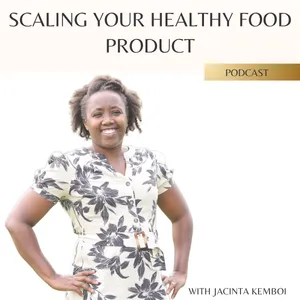
Free Daily Podcast Summary
Scaling Your Healthy Food Product: Daily Summaries Delivered
by Jacinta Kemboi
If you are an enterepreneur or solopreneur selling healthy/ "Better-for you" product to the world looking to scale and commercialize, this podcast is for you.In this podcast you will learn from a food scientist with 12 years plus experience in the food industry. I have successfully helped companies develop, scale and launch their healthy food products.If you are looking to scale your healthy food product by having it listed in more healthy food stores and displayed on more grocery store chains shelves, you are in the right place. This podcast will provide you with actionable steps and tips to help you succeed. You will learn how to correctly prepare your product to scale and commercialize like a pro.Stay tuned.
Latest Episodes
The most recent episodes — sign up to get AI-powered summaries of each one.
- 1 weeks ago35 min
Founder Spotlight: Carobium — How Kadeem Built a Healthier Hot Chocolate Alternative
#85 In this Founder Spotlight, Jacinta interviews Kadeem George, founder of Carobium, on how a personal family moment sparked a product idea — and how he moved from recipe development to a real retail-ready brand. Kadeem shares his biggest lessons on building systems, pricing properly, and why asking for help (even when you're nervous) can change everything. 💡 In This Episode You'll Learn The story that started Carobium: a family visit, a hot chocolate label, and 75% sugar What carob is (and how it compares to cocoa) The moment Kadeem realized, "This is a real business" (hint: it involved label design and a print shop) How he approached early production runs and moved into a commercial kitchen The power of making one phone call — and how it led to unexpected mentorship and opportunities Kadeem's experience inside the Retail Readiness Program (what he struggled with before + what changed after) Why understanding COGS and margins is non-negotiable How he learned to think about independent retail vs. bigger retailers A surprising early-stage growth lever: private label + collaboration Final advice: Plan — but take action Key Takeaways Don't let "polite fear" block the phone call. The call you're avoiding might be the one that opens the next door. Retail readiness requires systems, not just a good product. Understanding compliance, traceability, and operations becomes essential as you scale. Know your numbers. COGS and margin clarity impacts wholesale pricing, distributor pricing, and profitability decisions. Independent retail can be a powerful first step. Kadeem highlights the value of understanding multiple retail paths — not just big-box. About Carobium Carobium creates a healthier hot chocolate alternative using carob — a naturally sweet ingredient Kadeem describes as "if chocolate and caramel had a baby." Where to Find Carobium Website: https://carobium.com Email: hello@carobium.com Ships nationwide in Canada (free shipping) 📖 Retail Readiness Program — Enrollment is Open If you're an emerging food founder already selling and ready to scale into specialty retail with structure, apply for the Retail Readiness Program. 👉 Apply to Join — Spots Limited Enrollment closes Sept 30 at 11:59pm EST. 10-founder intake. 📣 READY TO SCALE? ➡️ Loved this episode? Leave a review and share it with a food founder who needs to hear it. Links & Resources Retail Readiness Program — apply here Carobium website Join the Emerging Food Business Newsletter here About Your Host Jacinta is a food scientist and founder mentor, coaching better-for-you food founders toward one million healthier products in retail. Connect With Me Instagram: @jacintakemboim Website: https://camaresearch.com Email: info@camaresearch.com #Food Business #Founder Spotlight #CPG #Smallbusinessgrowth #Carobium #Founderspotlight #ETSMethod
- 2 weeks ago10 min
Pause… Are You Structurally Retail-Ready? (The ETS Checklist)
#84 If you're an emerging food or beverage founder selling at pop-ups, online, or farmers markets and aiming for specialty retail (or foodservice), this episode is your reset. Jacinta breaks down the 3-part "Retail Ready in 15 Minutes" check and introduces the ETS Method—Evaluate → Transform → Scale so you can stop guessing and start building real retail structure. In This Episode, You'll Learn p]:inline" data-streamdown="list-item"> Why "a good product" isn't the same as being structurally retail-ready p]:inline" data-streamdown="list-item"> The 3 checks buyers and account managers quietly evaluate (even if they don't say it) p]:inline" data-streamdown="list-item"> How to pressure-test your readiness around profit, shelf life, and scale p]:inline" data-streamdown="list-item"> What the ETS Method looks like in real life: Evaluate → Transform → Scale p]:inline" data-streamdown="list-item">A quick beverage founder example: what changed after the Evaluate phase (pricing, shelf life plan, manufacturing approach, launch strategy) The Retail Ready in 15 Minutes Checklist p]:inline" data-streamdown="list-item"> Profit: Do your numbers work for wholesale (true COGS + margin layers)? p]:inline" data-streamdown="list-item"> Shelf life: Do you have a shelf-life testing plan (not assumptions)? p]:inline" data-streamdown="list-item"> Scale: Can your production method scale without chaos? Mentioned in This Episode Retail Readiness Program (6 months, weekly calls) Enrollment opens September 5 at 9:00am EST and closes September 12 at 11:59pm EST. This intake is capped at 10 founders. ✅ Fast-action bonus available until September 6 at 9:00am EST (or until 5 founders enroll—whichever comes first). Details on the application page. Apply here: Apply to Join Who This Episode Is For p]:inline" data-streamdown="list-item"> Food & beverage founders already selling (pop-ups, farmers markets, online) p]:inline" data-streamdown="list-item"> Launch-ready founders working from a commercial kitchen p]:inline" data-streamdown="list-item"> Founders tired of pitching and not getting replies—wanting a clear sequence and structure About Jacinta Jacinta is a food scientist and founder mentor with 12+ years of industry experience, coaching better-for-you founders toward one million healthier products in retail. Call to Action If retail (or foodservice) is on your roadmap this year, don't guess. Run the checklist, then apply for the September intake while spots are open:Apply to Join #specialtyretail #foodstartup #cpggrowth #foodfoun
- 3 weeks ago12 min
Focus Groups on a Budget: How Food Entrepreneurs Can Get Real Feedback Without a Sensory Lab
#83 You don't need a $10,000 sensory lab to know if your product actually works. In this episode, Jacinta shares innovative and cost-effective ways for food entrepreneurs to gather customer feedback through focus groups, especially for those who can't afford expensive sensory labs. Using a real kombucha case study, she walks through exactly how to organize a focus group with friends and regional groups, what questions actually get useful answers, and how the process does double duty: sharpening product development and building community. 💡 In This Episode You'll Learn Why focus groups matter — and why you don't need an expensive sensory lab to run one A real case study: testing a kombucha product with a focus group How to organize a focus group using friends and regional customers The fastest way to gather quick, valuable feedback from tasters How focus groups double as a tool for building community and brand ambassadors Why recharging and taking breaks matters just as much as the hustle Running targeted focus groups with your existing customer base Using focus groups to guide scale-up decisions and refine your product Why this should be a regular part of your product development process — not a one-time thing 🎧 Chapters 00:00 — Introduction to focus groups and their importance 02:25 — Case study: testing a kombucha product with a focus group 03:22 — Organizing a focus group with friends and regional customers 04:49 — Gathering quick, valuable feedback from customers 06:15 — Building community and brand ambassadors through focus groups 07:45 — Recharging and the importance of taking breaks 08:12 — Targeted focus groups with existing customers 09:10 — Using focus groups for scale-up and product refinement 09:40 — Encouragement to implement focus groups regularly 10:08 — Upcoming retail readiness cohort and avoiding costly mistakes 📖 Retail Readiness Cohort — Opens September Jacinta gives a first look at the upcoming Retail Readiness Cohort — a hands-on program to help food founders get structurally ready for retail and avoid the costly mistakes that come from going in unprepared. 👉 Apply to Join — Spots Limited. 📣 READY TO SCALE? ➡️ Loved this episode? Leave a review and share it with a food founder who needs to hear it. ➡ Take the Scale Up & Retail Readiness Quiz to find out exactly where you are — and what to focus on next. [Take Quiz Here] Links & Resources Apply to Join Retail Readiness Cohort -Starting September Plant trial podcast episode:What a plant trial actually is Why Skipping it is the most expensive shortcut in food. Join Emerging Food Business Newsletter here Connect With Me Instagram: @jacintakemboim Website: https://camaresearch.com Email: info@camaresearch.com
- Aug 15, 202612 min
What I Wished I Knew Before Starting My Food Business Series
#82 If you started your food business without a clear read on your margins, your ingredient list, or how many SKUs you actually need — you're not alone. Jacinta revisits a listener-submitted clip from Betsy, a gluten-free food founder, recorded as part of a series asking food founders what they wish they'd known before starting. Betsy's answer centers on margins, the challenge of ingredient-heavy gluten-free formulations, and how many SKUs a brand actually needs. Jacinta walks through why margins tend to shrink once you're already committed to a retailer, how multifunctional ingredients can help you simplify a gluten-free formulation without losing what customers love about the product, and how to think through SKU rationalization — including a real example from a private-label client who had to discontinue underperforming SKUs after launch. 💡 In This Episode You'll Learn Why margins should be locked down before saying yes to a retailer, not after Why margins naturally shrink over time — and how to plan for it from day one The challenge of gluten-free formulation: replacing wheat's bulking and structural role often means stacking many ingredients How to evaluate whether an ingredient is doing double duty — and when it's worth paying more for a multifunctional one to protect your product's "gold standard" attributes (texture, mouthfeel, etc.) How to figure out how many SKUs you actually need, and how to spot when one SKU is cannibalizing another A real client example: a private-label brand that launched with four SKUs, cut it to three, and is now consolidating further to focus marketing on the top performer Why revisiting your SKU lineup and margins regularly — not just at launch — is critical as you scale from small batch to large batch 🎧 Episodes Mentioned Episode 69 — Margins and why they always trend downward Episode 71 — Multifunctional ingredients and maximizing your product's potential Episode 73 — How many SKUs you really need 📖 Coming Soon: Book Jacinta announced she's writing a book as part of the ETS Method framework, built to help you scale your food product. She'll be calling for founding/first readers to review the first chapter — details and sign-up link coming soon. 📣 READY TO SCALE? ➡️ Loved this episode? Leave a review and share it with a food founder who needs to hear <h2 class="text-text-
- Aug 8, 202620 min
Why You Need to Be a Proactive Food Founder — How to Build Toward Retail Instead of Reacting to It Runtime
There's a specific kind of moment every food founder hits — a buyer reaches out, or an opportunity lands out of nowhere, and suddenly you're deciding whether to say yes on the spot. In this episode, I'm talking about the difference between a reactive founder and a proactive founder — and why retail doesn't reward the best product, it rewards the founder who was actually prepared for the yes. I walk through what it really means to know your ultimate goal, a six-point retail readiness checklist, and answer listener questions on timing, margins, and when it's smart to stay DTC on purpose. What We Cover [0:45] Retail Readiness Cohort 2 — who it's for and what it covers [1:30] The real difference between a reactive founder and a proactive founder — and why retail rewards prepared founders, not just good products [4:00] What "knowing your ultimate goal" actually means — three questions to ask before you chase retail [7:00] The 6-point Retail Readiness Checklist: margin math, proof of velocity, right-sizing your channel, infrastructure, trade spend tolerance, and a broker/distributor strategy [10:00] Listener Q&A — how to know if you're actually ready, what to do when a buyer approaches you early, staying DTC on purpose vs. out of fear, and how to calculate your real retail margin Key Takeaways Retail doesn't happen to you — it's a strategy you build toward. The founders who thrive are prepared before the opportunity shows up, not after. "I want to be in stores" isn't a goal, it's a wish. Know whether retail is the endgame or a means to something else, and know which retail before you chase it. If you can't hit roughly 50–55% gross margin at retail pricing after slotting, distributor cuts, and trade spend, retail will bleed your business, not grow it. Staying DTC-only can be the proactive move, not the fallback — as long as it's a decision, not avoidance. Retail Readiness Program Cohort 2 — For Better-For-You Food Founders Opens September | Limited to 10 Founders A hands-on program to get your product structurally ready for retail so you can maximize growth without the costly mistakes that come from going in unprepared. I'll walk each of you through implementing my ETS Method — Evaluate, Transform, Scale — directly on your own business. 👉 [Apply / join the waitlist here] Only 10 spots — this fills up fast. Links & Resources Retail Readiness Program Cohort 2 is Starting in September: Submit Application <li class= "font-claude-response-body whitespace-normal break-w
- Jul 31, 202616 min
3 Things Your Ingredient Supplier Could be Doing For You- A Kombucha Case Study
Most product developers treat their ingredient supplier as a line item. This week, we break down three things a good supplier can actually do for you — ingredient interaction insights, flavor compatibility guidance, and co-manufacturer connections — and walk through a real, in-progress kombucha project where all three made a measurable difference. Key Takeaways Ingredient suppliers often have real-world interaction data (pH sensitivity, stability, off-notes) that can save weeks of blind trial-and-error. Flavor compatibility guidance from a supplier can shortcut the back-and-forth of working with multiple flavor houses. Established supplier relationships can fast-track co-manufacturer vetting by pointing to facilities that already run the ingredient successfully. Sample access to adjacent/complementary ingredients allows faster side-by-side formulation testing. Treating suppliers as technical partners — not just vendors — can meaningfully compress product development timelines. Timestamps (adjust to actual recording) 00:00 — Intro: 3 things your supplier can do for you 02:15 — The kombucha project setup 04:00 — Part 1: Ingredient interaction insights & fermentation stability 09:30 — Part 2: Flavor compatibility and cutting down trial-and-error 14:45 — Part 3: Co-manufacturer connections & ingredient sampling 19:00 — Wrap-up and key takeaways Links & Resources Plant trial podcast episode:What a plant trial actually is Why Skipping it is the most expensive shortcut in food. Join Emerging Food Business Newsletter here Connect With Me Instagram: @jacintakemboim Website: https://camaresearch.com Email: info@camaresea
- Jul 24, 202615 min
Believing in Your Product (And What to Focus On to Stay the Course)
There's a specific kind of doubt that hits at 11pm — the dashboard isn't what you wanted, a review stings, a competitor just launched something shinier, and the voice in your head starts asking if this is even worth it. In this episode, I'm talking honestly about what it actually means to believe in your product, why that belief naturally erodes over time, and more importantly the four specific things to focus on so doubt doesn't derail you before the work has a chance to pay off. What We Cover [2:00] The real difference between believing in your product and being in denial about it — and the one question that tells you which one you're actually doing [5:00] Why belief gets shaky: comparison, slow feedback loops, and being too close to your own flaws [8:00] The four things to focus on instead — the problem (not the product), the few signals that actually matter, direct contact with your users, and a definition of success you write down before the storm hits [12:00] A real story from the messy middle — what almost made me quit, and what I focused on instead [14:00] Staying the course vs. staying stuck — how to tell real warning signs apart from normal founder fatigue [16:00] Free training: Unlock the Secret to Retail Success with the ETS Method Key Takeaways Belief and denial can look similar from the outside — the difference is whether you're still listening to evidence that might contradict your original idea. Doubt isn't always data. Comparison, slow feedback loops, and proximity to your own flaws can manufacture doubt that has nothing to do with whether the product actually works. Anchor to four things when doubt shows up: the underlying problem, a small set of signals that matter, direct conversations with real users, and a definition of success you set before things got hard. The skill isn't "never doubt" — it's telling the difference between doubt that's just fatigue and doubt that's real evidence something fundamental is broken. Free Training Unlock the Secret to Retail Success with the Exclusive ETS Method 📅 July 27th | 🕐 1:00–2:00 PM EST | Live & Free Join me for a live walkthrough of the exact framework I use to get a food product genuinely retail-ready — how manufacturing, distribution, and retail positioning fit together into one repeatable system. 👉 <a class= "underline underline underlin
- Jul 17, 202621 min
4 Things I'm Tracking Right Now in My Mid-Year Food Product Launch Strategy
We're at the mid-year mark, and if you're building a food product business, this is the moment things stop being theoretical. In this episode, I'm giving you an honest, behind-the-scenes look at four things I'm tracking right now: our September/October launch window, narrowing down our co-manufacturer, growing local retail distribution, and how it's all building toward a bigger retail launch next year. Plus — I'm sharing details on a free training I'm running later this month on the exact framework I use to get retail-ready. What We Cover [00:45] Why mid-year is actually a more important planning checkpoint than January [02:30] The September/October launch window — why it's really an August deadline in disguise, and the four things that have to be locked first (production lead time, packaging & compliance, marketing runway, retail readiness) [05:30] Narrowing down our co-manufacturer — the five-part framework I'm using (MOQs, quality consistency, capacity to grow, communication, geographic/logistics fit) [08:30] Growing local retail distribution — why independent stores matter beyond the revenue, and what we're doing to expand our footprint [11:00] The bigger picture — how this year's decisions are building the track record for next year's retail launch [13:30] Free training: Unlock the Secret to Retail Success with the ETS Method Key Takeaways A fall launch date is really an earlier deadline in disguise — everything meaningful (production, packaging, compliance) has to be locked 6–8 weeks out. Choosing a co-manufacturer is one of the highest-leverage decisions you'll make all year — vet in parallel, not sequentially, and prioritize consistency and capacity over a single great sample batch. Local retail accounts aren't just revenue — they're proof points that make the bigger retail pitch credible. Everything happening this year (co-man, fall launch, local stores) should be sequenced toward one goal: walking into next year's retail conversations with a track record, not a pitch deck. Free Training Unlock the Secret to Retail Success with the Exclusive ETS Method 📅 July 27th | 🕐 1:00–2:00 PM EST | Live & Free Join me for a live walkthrough of the exact framework I use to get a food product genuinely retail-ready — how manufacturing, distribution, and retail positioning fit together into one repeatable system. 👉 [<a title= "Unlock the Secret to Retail Success wit
About Scaling Your Healthy Food Product
If you are an enterepreneur or solopreneur selling healthy/ "Better-for you" product to the world looking to scale and commercialize, this podcast is for you.In this podcast you will learn from a food scientist with 12 years plus experience in the food industry. I have successfully helped companies develop, scale and launch their healthy food products.If you are looking to scale your healthy food product by having it listed in more healthy food stores and displayed on more grocery store chains shelves, you are in the right place. This podcast will provide you with actionable steps and tips to help you succeed. You will learn how to correctly prepare your product to scale and commercialize like a pro.Stay tuned.
Customized Recaps
AI-powered recaps with compact key takeaways, quotes, and insights.
Straight to Your Inbox
Get key takeaways from Scaling Your Healthy Food Product in a 5-minute read.
Save Hours Every Week
Stay current on your favorite podcasts without falling behind.
Frequently Asked Questions
What is Podzilla's Scaling Your Healthy Food Product daily summary?
It's a free AI-powered email that summarizes new episodes of Scaling Your Healthy Food Product as soon as they're published. You get the key takeaways, notable quotes, and links & mentions — all in a quick read.
How does the Scaling Your Healthy Food Product podcast summary work?
When a new episode drops, our AI transcribes and analyzes it, then generates a personalized summary tailored to your interests and profession. It's delivered to your inbox every morning.
Is this an official Scaling Your Healthy Food Product product?
No. Podzilla is an independent service that summarizes publicly available podcast content. We're not affiliated with or endorsed by Jacinta Kemboi.
Can I get summaries of other podcasts too?
Absolutely! The free plan covers up to 3 podcasts. Upgrade to Pro for 15, or Premium for 50. Browse our full catalog at /podcasts.
What topics does Scaling Your Healthy Food Product cover?
Scaling Your Healthy Food Product covers topics including Business, Entrepreneurship, Nutrition, Fitness, Health & Fitness. Our AI identifies the specific themes in each episode and highlights what matters most to you.
Start getting Scaling Your Healthy Food Product summaries tomorrow morning.
Free forever for up to 3 podcasts. No credit card required.
Free forever for up to 3 podcasts. No credit card required.