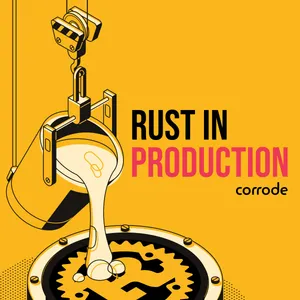
Free Daily Podcast Summary
Rust in Production: Daily Summaries Delivered
by Matthias Endler
This is "Rust in Production", a podcast about companies who use Rust to shape the future of infrastructure. We follow their journey in pursuit of more reliable and efficient software as they solve some of the most challenging technical problems in the world. Each episode dives deep into real-world applications of Rust, showcasing how this powerful systems programming language is revolutionizing the way we build and maintain critical infrastructure. From startups to tech giants, we explore the diverse landscape of organizations leveraging Rust's unique features to create safer, faster, and more scalable systems. Our guests share their experiences, challenges, and triumphs in adopting Rust for production environments. Listen in as we discuss topics such as concurrent programming, memory safety, performance optimization, and how Rust's ownership model contributes to building robust software systems. Whether you're a seasoned Rust developer, an infrastructure engineer, or a tech leader
Latest Episodes
The most recent episodes — sign up to get AI-powered summaries of each one.
- Jul 30, 202652 min
RustRover with Orhun Parmaksız
Welcome to the final episode of this season of Rust in Production. My guest is Orhun Parmaksız from JetBrains, and we talk about building developer tools with Rust.JetBrains is best known for IntelliJ IDEA, Kotlin, and a long line of IDEs for professional software teams. In the Rust world, that now includes RustRover: a commercial IDE built on the IntelliJ platform, with deep Rust support for navigation, refactoring, debugging, testing, and large codebases.This episode is about where Rust fits into that world. We talk about why JetBrains does not plan to rewrite the IntelliJ platform in Rust, why Fleet used Rust for its File System Daemon, how Air builds on parts of Fleet's architecture, and why JetBrains prefers out-of-process Rust helpers over JNI inside the JVM. We also get into RustRover's internals: PSI, THIR, MIR-based expression evaluation in the debugger, procedural macro sandboxing, library stubs, parser regression testing, cargo-nextest support, and the practical trade-offs between JetBrains' indexing model and rust-analyzer's Salsa-based approach.
- Jul 16, 202654 min
Rust Foundation with Bec Rumbul, Lori Lorusso, and David Wood
Mood: Strange / Bizarre, Uplifting, Sci-Fi / Future; BPM: 126; ISRC: CA0EK2302421; Audio Type: Shorts; URL Commercial Information: https://www.premiumbeat.com
- Jul 2, 202642 min
Rising with Dylan Brown
Most Rust in Production stories are about scale and performance. This one is a story about low-cost phones and patchy mobile connections in Africa, where a student is learning maths over WhatsApp. The whole point is to support hundreds of thousands of students cheaply enough to run at government scale.My guest is Dylan Brown, a Senior Engineering Manager at Rising Academies, and he comes at Rust from an angle of being the person who signs off on using Rust for a new project.For Dylan, it's about what Rust enables: lower compute costs, boring deployments, painless refactors, and code reviews that focus on business logic instead of null checks.
- Jun 18, 20261h 0m
ClickHouse with Alexey Milovidov and Austin Bonander
There's a particular kind of pressure that comes with maintaining software at the very bottom of someone else's stack. ClickHouse lives in exactly that spot: roughly 1.5 million lines of mostly C++ and tens of millions of tests every single day.So what happens when you start introducing Rust into a codebase like that? Not as a rewrite, but linked into a C++ server with a CMake build process that has to be reproducible and FIPS compliant? In today's episode, we get into the messy, interesting reality. We talk about the question of whether the hardest part is Rust the language or Rust the ecosystem.My guests come at this from two very different angles. Alexey Milovidov is the creator of ClickHouse and its CTO. He started the project back in 2009 and has spent decades thinking about performance, correctness, and what it actually takes to build a production database. Austin Bonander is a Senior Software Engineer at ClickHouse and a renowned open-source maintainer of sqlx. He works close to the Rust tooling and the CLI. Together we talk about where Rust fits inside a C++ monolith, what it would take for Rust to earn a rewrite of core components, supply-chain and compliance headaches, and whether Rust is heading for the same accumulation of regrets that every "trendy" language eventually accumulates.
- Jun 4, 20261h 11m
Veo with Anders Hellerup Madsen and Gorm Casper
I don't know about you, but to me there are few things as interesting as the hardware/software interface: the point where carefully written code meets the messy, physical world of sensors, lenses, and real-time constraints. It's where a clever abstraction either holds up or falls apart the moment a real signal hits it.That makes Veo a perfect guest. The Copenhagen-based company builds AI-powered cameras that record and analyze sports matches, from grassroots football pitches to professional clubs, and then turn hours of raw footage into something coaches and players can actually use: automatic highlights, player tracking, and match analysis. To get there, they have to capture panoramic video on a custom camera, follow the action without an operator, and crunch an enormous amount of data, reliably and at scale.My guests sit on both sides of that interface. Anders Hellerup Madsen works close to the metal on the camera itself, on the embedded firmware and the GStreamer media pipeline that turns raw sensor data into video. Gorm Casper works further up the stack, on the backend that ingests, processes, and analyzes those matches in Rust. Together we talk about where Rust fits across that whole journey, the trade-offs of doing media and computer vision work in a systems language, and what convinced a sports-tech company to bet on Rust for the parts that absolutely cannot fall over.
- May 21, 202649 min
Rust for Linux with Alice Ryhl and Greg Kroah-Hartman
Hot off the press: this episode is a live recording from Rust Week in Utrecht, just two days ago. On stage with me are two people who hardly need an introduction in the Linux world: Greg Kroah-Hartman, Linux Foundation Fellow, stable kernel maintainer and an ambassador for the kernel, and Alice Ryhl, core maintainer of Tokio and one of the driving forces behind Rust for Linux at Google.I have to admit a bit of personal history here: I first wrote about Greg more than 20 years ago for the German online newspaper Pro-Linux. Getting to sit down with him, and with Alice, in front of a live audience to talk about how Rust is reshaping the most important piece of infrastructure on the planet, was a genuine career highlight.We get into the big questions: Why does Alice believe that interop, not rewrites, is how Rust wins inside Linux? How do you carefully weave in Rust while maintaining a 35-million-line C codebase? And what does it actually feel like, day to day, to write kernel code in Rust?“Rust is gonna save the Linux kernel.” — Greg Kroah-Hartman
- May 7, 20261h 21m
NLnet Labs with Arya Khanna and Martin Hoffmann
Every time you load a website, send an email, or update an app, you're quietly relying on a handful of unglamorous services that route your packets to the right place: DNS to translate names into addresses, and BGP to figure out how to actually get there. When these systems break, or get attacked, the Internet doesn't just slow down but stops working.For more than 25 years, NLnet Labs has been one of the small, non-profit teams keeping that core infrastructure running. Their software, including the DNS servers NSD and Unbound, the RPKI tools Krill and Routinator, and the new DNSSEC signer Cascade, is deployed everywhere from hobbyist Pi-Hole setups to Let's Encrypt and major Internet operators. And increasingly, it's written in Rust!In this episode, I talk to Arya Khanna and Martin Hoffmann from NLnet Labs about what it takes to maintain critical Internet infrastructure as a small team, why they bet on Rust for new projects like the domain crate and Cascade and what the rest of us can learn from a codebase whose users include the people who keep your routes flowing.
- Apr 23, 20261h 33m
Helsing with Jon Gjengset
Jon Gjengset is one of the most recognizable names in the Rust community, the author of Rust for Rustaceans, a prolific live-streamer, and a long-time contributor to the Rust ecosystem. Today he works as a Principal Engineer at Helsing, a European defense company that has made Rust a foundational part of its engineering stack. Helsing builds safety-critical software for real-world defense applications, where correctness, performance, and reliability are non-negotiable. In this episode, Jon talks about what it means to build mission-critical systems in Rust, why Helsing bet on Rust from the start, and what lessons from his years of Rust education have shaped the way he writes and thinks about production code.
Get Rust in Production summaries in your inbox
Free AI-powered daily recaps. Key takeaways, quotes, and mentions — in a 5-minute read.
Get Free Summaries →Free forever for up to 3 podcasts. No credit card required.
You Might Also Like
Listeners also like.
The Magnus Archives
A haunted archivist investigates supernatural cases that blur into a growing cosmic horror.
The Pragmatic Engineer
Insightful interviews with engineers and tech leaders on real-world software development challenges and best practices.
The Engineering Leadership Podcast
Discusses essential practices and insights from top software engineering leaders to advance leadership skills in tech.

Latent Space: The AI Engineer Podcast
Explores AI engineering breakthroughs in foundation models, code generation, and AI agents through interviews with researchers and developers.

Lenny's Podcast: Product | Career | Growth
Conversations with top product and growth leaders offering practical strategies for building, launching, and scaling successful products.

We Fixed It, You're Welcome
A panel debates real corporate crises, proposing solutions for well-known companies and then evaluating their own advice.
The Restless Ones
Executives at the intersection of technology and business discuss innovation, leadership, and driving change in fast-evolving industries.

Better Offline
Ed Zitron investigates how tech’s powerful players shape society, from crypto scams to venture capital, through interviews and critical analysis.

TechSurge: Deep Tech Podcast
Explores emerging technologies, startup challenges, and investment trends through interviews with tech leaders, founders, and investors.

The AI in Business Podcast
Executives discuss practical AI adoption in business through interviews focused on strategy, use-cases, and ROI.

This Machine Kills
Critiques the intersection of technology, capitalism, and power through a leftist political lens.
Invest Like the Best with Patrick O'Shaughnessy
Interviews with top investors and business leaders reveal strategies and insights for smarter investing and decision-making.
About Rust in Production
This is "Rust in Production", a podcast about companies who use Rust to shape the future of infrastructure. We follow their journey in pursuit of more reliable and efficient software as they solve some of the most challenging technical problems in the world. Each episode dives deep into real-world applications of Rust, showcasing how this powerful systems programming language is revolutionizing the way we build and maintain critical infrastructure. From startups to tech giants, we explore the diverse landscape of organizations leveraging Rust's unique features to create safer, faster, and more scalable systems. Our guests share their experiences, challenges, and triumphs in adopting Rust for production environments. Listen in as we discuss topics such as concurrent programming, memory safety, performance optimization, and how Rust's ownership model contributes to building robust software systems. Whether you're a seasoned Rust developer, an infrastructure engineer, or a tech leader
Customized Recaps
AI-powered recaps with compact key takeaways, quotes, and insights.
Straight to Your Inbox
Get key takeaways from Rust in Production in a 5-minute read.
Save Hours Every Week
Stay current on your favorite podcasts without falling behind.
Frequently Asked Questions
What is Podzilla's Rust in Production daily summary?
It's a free AI-powered email that summarizes new episodes of Rust in Production as soon as they're published. You get the key takeaways, notable quotes, and links & mentions — all in a quick read.
How does the Rust in Production podcast summary work?
When a new episode drops, our AI transcribes and analyzes it, then generates a personalized summary tailored to your interests and profession. It's delivered to your inbox every morning.
Is this an official Rust in Production product?
No. Podzilla is an independent service that summarizes publicly available podcast content. We're not affiliated with or endorsed by Matthias Endler.
Can I get summaries of other podcasts too?
Absolutely! The free plan covers up to 3 podcasts. Upgrade to Pro for 15, or Premium for 50. Browse our full catalog at /podcasts.
How often does Rust in Production release new episodes?
Rust in Production publishes biweekly. Our AI generates a summary within hours of each new episode.
What topics does Rust in Production cover?
Rust in Production covers topics including Technology, Education. Our AI identifies the specific themes in each episode and highlights what matters most to you.
Start getting Rust in Production summaries tomorrow morning.
Free forever for up to 3 podcasts. No credit card required.
Free forever for up to 3 podcasts. No credit card required.