Free Daily Podcast Summary
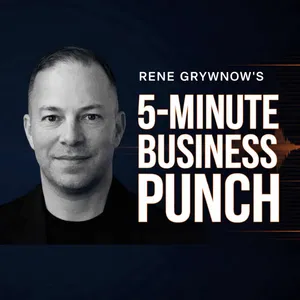
Rene Grywnow’s 5-Minute Business Punch: Daily Summaries Delivered
by Rene Grywnow, DBA
5-minute business insights on AI, energy, supply chain & leadership.No fluff. Just actionable ideas for real-world results.Built for people in industry who want to stay ahead, not catch up.Every episode delivers practical, high-impact ideas on AI, energy systems, engineering, supply chain strategy, sustainability, and leadership under pressure.No theory. No buzzwords.Just real-world insights you can use the same day.New episodes every Tuesday and Thursday, plus special episodes when markets move. renegrywnow.substack.com
Latest Episodes
The most recent episodes — sign up to get AI-powered summaries of each one.
- Yesterday4 min
After the AI Omnibus — The Two Dates That Now Govern European Robotics
The AI Omnibus rewrote the regulatory calendar for European industrial robotics. Two design gates now matter, 2 December 2027 (Annex III stand-alone systems) and 2 August 2028 (AI in Annex I products, machinery included). The bigger story is structural: the Machinery Regulation moved to Section B of Annex I, collapsing two parallel tracks into one conformity path. René explains what’s already live, how grandfathering really works, and three ways to position your programme. Full breakdown at renegrywnow.com.Reflection Questions* Which two dates is your robot roadmap actually built on, and is either still a pre-Omnibus date?* Every model update decides which calendar you’re on. Who in your organization knows that?* Are you still budgeting for two compliance tracks when the Omnibus left you one?Bloglink This is a public episode. If you would like to discuss this with other subscribers or get access to bonus episodes, visit renegrywnow.substack.com
- 6 days ago5 min
Machinery Regulation Meets Physical AI: Why Compliance Is Becoming Product Design
Once AI sits inside a machine’s safety architecture, compliance stops being the last stage and becomes a design constraint. René walks through what the Machinery Regulation already demands of self-learning safety functions, bounded task envelopes, recorded safety decisions, third-party assessment, and the four items that belong in the first architecture review: task envelope, non-bypassable log, controlled update path, examinable override. Plus the integrator trap: fine-tune or modify, and you may become the manufacturer. Full article at renegrywnow.com.Reflection Questions* Who in your organization decides what the physical AI is allowed to learn, log and do?* If you fine-tune a model next quarter, do you know whether you just became the manufacturer?* Is your safety case an architectural property — or a document someone writes at the end?Bloglink This is a public episode. If you would like to discuss this with other subscribers or get access to bonus episodes, visit renegrywnow.substack.com
- 1 weeks ago4 min
After the AI Omnibus — The Two Dates That Now Govern European Robotics
The AI Omnibus rewrote the regulatory calendar for European industrial robotics. Two design gates now matter, 2 December 2027 (Annex III stand-alone systems) and 2 August 2028 (AI in Annex I products, machinery included). The bigger story is structural: the Machinery Regulation moved to Section B of Annex I, collapsing two parallel tracks into one conformity path. René explains what’s already live, how grandfathering really works, and three ways to position your programme. Full breakdown at renegrywnow.com.Reflection Questions* Which two dates is your robot roadmap actually built on — and is either still a pre-Omnibus date?* Every model update decides which calendar you’re on. Who in your organization knows that?* Are you still budgeting for two compliance tracks when the Omnibus left you one?Bloglink This is a public episode. If you would like to discuss this with other subscribers or get access to bonus episodes, visit renegrywnow.substack.com
- 1 weeks ago5 min
Diagnosis Before Tool Choice: Lessons from Rumelt’s Good Strategy / Bad Strategy
This week named two obstacles worth diagnosing, data that cannot leave and decisions that cannot wait. Part III supplies the discipline, through Richard Rumelt’s Good Strategy / Bad Strategy (Crown Business, 2011): most AI strategies are shopping lists with a growth target on top.Rumelt’s kernel has three parts in order: a diagnosis that names the critical challenge and simplifies the mess; a guiding policy that sets the approach and rules things out; and coherent actions that carry it, not a shopping list. Most “AI strategies” skip the first, opening with tools, platforms or a growth percentage, goals and fluff with no obstacle named, which is bad strategy in Rumelt’s sense. In a plant the obstacle is rarely “we lack an LLM”, it’s latency, data that can’t leave, integration debt, or an unseen constraint. The quality-suite example shows it: write the diagnosis first and the tools become consequences; skip it and the same budget buys a chatbot and a dashboard. Four recurring bad-strategy patterns, goals mistaken for strategy, fluff, obstacle not faced, incoherent actions, each avoid the same thing: stating the obstacle.The test costs two sentences. Your action this week: take your AI roadmap and write the obstacle in two sentences, the policy that addresses it, and the actions that follow, if they contradict each other, or you can’t write the first sentence, that’s where to start. Full kernel at renegrywnow.com.Reflection questions* Can you state your AI strategy’s obstacle in two sentences, before the next vendor meeting?* Does your current roadmap’s actions cohere, or does a cloud agent sit next to an air-gapped PLC with no write-back owner?* Is your strategy deck leading with a diagnosis, or with vendors and model names?BloglinkSeries: Energy Dominance · Week 45 · Part IIIPrevious: Part I — Data Sovereignty · Part II — Edge AI: Latency, Power, On-Premise. This is a public episode. If you would like to discuss this with other subscribers or get access to bonus episodes, visit renegrywnow.substack.com
- 1 weeks ago5 min
Edge AI for Factories: Latency, Power, and What Must Stay On-Premise
Part I asked what may leave the fence. Part II asks what cannot wait for the trip. Line-speed decisions are made in milliseconds next to the machine, inside a power and thermal budget, and a single network hop can consume the whole window. Where inference runs is part of the control design, not an IT preference.Three tiers, set by the decision window and what the data reveals: device/edge (vision reject, safety, robot guidance; under ~10–20 ms; data never leaves), plant server room (twin sync, OEE, predictive inference on sensitive OT; tens of ms; data stays inside), and cloud (multi-site training, historical analytics, non-critical copilots; seconds, after classification only). The field has moved: edge systems co-located with equipment are reported at 15–45 ms against 800–2,400 ms for cloud, with line-speed vision targets under 10–20 ms, and low-power accelerators make always-on inference viable at single-digit to low-tens of watts. Edge isn’t only speed: it keeps running when the WAN doesn’t.Four categories stay on-premise: safety interlocks and zone monitoring, line-speed reject, closed-loop write-backs, and any prompt or image revealing process IP. The test for each use case: does delay or data exit have a safety, quality or IP consequence? Your action this week: ask what the maximum allowable latency is for your next vision project, and whether anyone wrote it down. Full tier model at renegrywnow.com.Reflection questions* What’s the maximum allowable latency for your next vision or robot-guidance project, and has anyone written it down?* Would your line degrade safely if the cloud link were cut mid-shift?* Are safety interlocks, line-speed reject and write-back loops confirmed as on-premise, with no cloud path?BloglinkSeries: Energy Dominance · Week 45 · Part IIPrevious: Part I — Data Sovereignty in Industrial AI: Cloud vs. Plant Control. This is a public episode. If you would like to discuss this with other subscribers or get access to bonus episodes, visit renegrywnow.substack.com
- 2 weeks ago5 min
Data Sovereignty in Industrial AI: Cloud Convenience vs. Plant Control
Week 44 asked what the model understands. Week 45 asks something plainer: where does it run, and who can prove it? The cloud is the default because it’s easy, but for industrial data, easy isn’t controlled. Process recipes, defect images and operator prompts are competitive IP, and sooner or later a regulator, customer or competitor will ask where the model saw them.Sovereignty isn’t a slogan; it’s the ability to choose and prove four things: where data is stored, where the model runs, who can access it, and that it isn’t training a public foundation model. The pressure is real: BARC’s 2026 study (329 respondents) found 76% say running AI outside the cloud has grown in importance over twelve months; an NTT DATA survey puts ~60% of AI leaders citing cross-border restrictions as a major challenge. Vendors have noticed, sovereign instances, private-cloud AI, and the Schneider/NVIDIA/HPE edge-agents announcement all market isolation explicitly.The decision that matters is a sequence: classify the workload first (prototype vs production, latency-critical vs batch, IP-sensitive vs shareable), choose the venue second. A platform that ships every image and tag to a multi-tenant region is an unexamined default, not a strategy. Your action this week: ask which plant data has left the site in the last twelve months, and who approved it. Full framework at renegrywnow.com.Reflection questions* Which plant data has left your site in the last twelve months, and who approved it?* Can you prove, as a document, where your model saw your data?* Are you classifying workloads before choosing cloud vs edge vs on-prem, or defaulting everything to one platform?BloglinkSeries: Energy Dominance · Week 45 · Part INext: Part II — Edge AI for Factories: Latency, Power, and What Must Stay On-Premise. This is a public episode. If you would like to discuss this with other subscribers or get access to bonus episodes, visit renegrywnow.substack.com
- 2 weeks ago5 min
Why Autonomy Without Checklists Fails in Safety-Critical Plants: Lessons from Gawande’s The Checklist Manifesto
This week asked what the model understands and which data may vouch for it. Part III asks what stops the system when both answers are good and the step is still missed, through Atul Gawande’s The Checklist Manifesto (Metropolitan Books, 2009).Gawande separates ignorance (not knowing) from ineptitude (knowing and failing under pressure), and in complex work the second is the bigger problem, because knowledge has outrun any individual’s ability to apply it flawlessly. An autonomous agent is the purest version: it acts at machine speed, confident, every cycle. The remedy isn’t brilliance but a short checklist with pause points; the eight-hospital WHO surgical-checklist study cut major complications from 11.0% to 7.0% and deaths from 1.5% to 0.8%. Two kinds of checklist: bureaucracy (long, ticked for the record, quietly skipped) and a pause (short, killer items only, tied to the moment before the risk). The running example, a restart after a quality hold, with a three-line pause: isolation status, zone clear, supervisor/interlock confirm, the pause doesn’t judge the quality call, it guards the irreversible step.Four design rules: short, pause-tied, agent-bound (no pass without the check in the system of record), maintained. Your action this week: pick one autonomous cell, list its irreversible actions, write the three lines that must be true before each, and find where the agent sees them. Full design at renegrywnow.com.Reflection questions* Which irreversible step in your current autonomy scope still has no checklist and no pause?* Can your best operator, or the agent, be stopped at the pause until the check is satisfied in the system of record?* Is your checklist designed as a pause that turns attention on, or bureaucracy people learn to skip?* Blog-LinkSeries: Energy Dominance · Week 44 · Part IIIPrevious: Part I — World Models: Physics Not Language · Part II — Synthetic vs. Real Plant Data. This is a public episode. If you would like to discuss this with other subscribers or get access to bonus episodes, visit renegrywnow.substack.com
- 2 weeks ago5 min
Synthetic Data vs. Real Plant Data: Who Trusts the Training Set?
Part I asked whether the model understands physics. Part II asks which data you trust about what it learned. “Trained on synthetic data” says how a model learned, not whether it may run, and a training set and an acceptance set do two different jobs. Blur them and you send a model to the line that passed every test except the ones the line would have given it.Synthetic data is for coverage: rare faults, class balance, development before production data exists, edge cases you won’t stage live. Real plant data is for truth: evaluation, acceptance, drift detection. The evidence supports synthetic as a tool, not a verdict, ~24% recall uplift from added synthetic clips, ~0.95 mAP at Corning from eight real images plus synthetic, but an independent spill study shows the catch: models scored 0.81–0.84 on a public set and 0.64–0.71 on 100 of a plant’s own proprietary images. Accuracy often peaks near a 25% synthetic share and falls below real-only once synthetic dominates.The vendor owns the generator; the plant owns the acceptance set, labeled real data, held out, refreshed when lighting, suppliers or fixturing change. Three records make it auditable: what was real, what share was synthetic, which real evaluation authorized release. Your action this week: ask who owns your real hold-out set and when it was last refreshed. Full framework at renegrywnow.com.Reflection questions* Who owns your real plant hold-out set, and when was it last refreshed?* Could your last go-live reproduce its numbers on your own proprietary images, not just a public or synthetic set?* Is the synthetic share of your final training mix capped and documented?Keywords: Synthetic Data, Real Plant Data, Hold-Out Set, Acceptance Testing, Data Provenance, Sim-to-Real, Defect Detection, Evaluation Protocol, Go-Live Gate, Industrial AIBlog-LinkSeries: Energy Dominance · Week 44 · Part IIPrevious: Part I — World Models in Manufacturing: Physics, Not Language. This is a public episode. If you would like to discuss this with other subscribers or get access to bonus episodes, visit renegrywnow.substack.com
Get Rene Grywnow’s 5-Minute Business Punch summaries in your inbox
Free AI-powered daily recaps. Key takeaways, quotes, and mentions — in a 5-minute read.
Get Free Summaries →Free forever for up to 3 podcasts. No credit card required.
You Might Also Like
Listeners also like.

The AI in Business Podcast
Interviews with AI executives reveal practical applications and strategic insights for business leaders adopting AI.

What Comes Next with Arun
Explores how data and AI strategy create competitive advantage in business, based on real-world enterprise experience.

Right About Now - Legendary Business Advice
Raw business insights from founders and industry leaders, revealing real wins, failures, and actionable strategies without the fluff.
The AI Daily Brief: Artificial Intelligence News and Analysis
A daily analysis of artificial intelligence news, exploring its creative potential, industry impacts, and ethical challenges.

Wrenches n Robots
A practical guide for HVAC, plumbing, and electrical contractors using AI and automation to streamline operations and grow their businesses.

This Week in AI
Four AI experts analyze the latest news and trends in artificial intelligence each week.

Everyday AI Podcast – An AI and ChatGPT Podcast
Covers practical uses of AI tools like ChatGPT and Midjourney to help people work more efficiently and advance their careers.

The AI Power Podcast
Explores AI policy, regulation, and global power dynamics shaping artificial intelligence’s impact on security, economy, and geopolitics.

Global News Podcast
Global News Podcast AI

AI Business Daily
Daily insights into AI, tech trends, and digital innovation for entrepreneurs and professionals navigating the future of business.

AI For Humans: Weekly AI News, Tools & Trends
A weekly breakdown of major AI news, tools, and breakthroughs for both newcomers and seasoned enthusiasts.

Me, Myself, and AI
Leaders from top companies share real-world strategies for turning artificial intelligence into measurable business results.
About Rene Grywnow’s 5-Minute Business Punch
5-minute business insights on AI, energy, supply chain & leadership.No fluff. Just actionable ideas for real-world results.Built for people in industry who want to stay ahead, not catch up.Every episode delivers practical, high-impact ideas on AI, energy systems, engineering, supply chain strategy, sustainability, and leadership under pressure.No theory. No buzzwords.Just real-world insights you can use the same day.New episodes every Tuesday and Thursday, plus special episodes when markets move. renegrywnow.substack.com
Customized Recaps
AI-powered recaps with compact key takeaways, quotes, and insights.
Straight to Your Inbox
Get key takeaways from Rene Grywnow’s 5-Minute Business Punch in a 5-minute read.
Save Hours Every Week
Stay current on your favorite podcasts without falling behind.
Frequently Asked Questions
What is Podzilla's Rene Grywnow’s 5-Minute Business Punch daily summary?
It's a free AI-powered email that summarizes new episodes of Rene Grywnow’s 5-Minute Business Punch as soon as they're published. You get the key takeaways, notable quotes, and links & mentions — all in a quick read.
How does the Rene Grywnow’s 5-Minute Business Punch podcast summary work?
When a new episode drops, our AI transcribes and analyzes it, then generates a personalized summary tailored to your interests and profession. It's delivered to your inbox every morning.
Is this an official Rene Grywnow’s 5-Minute Business Punch product?
No. Podzilla is an independent service that summarizes publicly available podcast content. We're not affiliated with or endorsed by Rene Grywnow, DBA.
Can I get summaries of other podcasts too?
Absolutely! The free plan covers up to 3 podcasts, any in the catalog. Basic raises that to 15, Pro to 40 and Max to 100. Browse our full catalog at /podcasts.
What topics does Rene Grywnow’s 5-Minute Business Punch cover?
Rene Grywnow’s 5-Minute Business Punch covers topics including Business, Management. Our AI identifies the specific themes in each episode and highlights what matters most to you.
Start getting Rene Grywnow’s 5-Minute Business Punch summaries tomorrow morning.
Free forever for up to 3 podcasts. No credit card required.
Free forever for up to 3 podcasts. No credit card required.