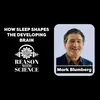
How sleep shapes the developing Brain with Mark Blumberg I Infant sleep neuroscience I Podcast
How sleep shapes the developing Brain with Mark Blumberg This conversation is with Mark Blumberg, a neuroscientist at the University of Iowa whose work has fundamentally reshaped how we understand infant sleep, movement, and early brain development. Mark’s research reveals that sleep is not a passive state, but an active, self-organizing process essential for building the brain’s earliest sensory and motor circuits.We begin by asking a basic yet surprisingly difficult question: What is sleep, really? Mark explains why defining sleep across development and across species is far more complex than it seems, and why the brain during sleep—especially during REM sleep—is often more active than during wakefulness.Together, we explore why infants spend so much of their early life in REM sleep, how sleep unfolds in distinct stages, and why the tiny, jerky movements known as sleep twitches are not meaningless byproducts of dreams, but powerful developmental signals that help wire the brain and body. We discuss how these movements contribute to building internal models of the body, how sleep supports plasticity and learning, and what happens when these processes are disrupted early in life.Finally, we turn to broader questions about development, neurodiversity, and the limits of genetic explanations. Mark argues for the importance of studying typical development in order to understand developmental disorders, and reflects on what infant sleep can teach us about plasticity, embodiment, and the foundations of human cognition.Guests infoWebsite: https://blumberg.lab.uiowa.edu/X: https://x.com/canadiancharityEpisode links: Website: https://reasonwithscience.com/how-sleep-shapes-the-developing-brain-with-mark-blumbergYoutube: https://www.youtube.com/watch?v=YNDcpIq2B98Spotify: https://open.spotify.com/episode/4ASTAAKKlokphbOc2TJxCi?si=a44044dd89554571Apple podcast: YouTube music: https://music.youtube.com/watch?v=YNDcpIq2B98&si=Alxad9KU-RtJn78SFollow Reason with Science: Website: https://www.reasonwithscience.com/ Youtube: https://www.youtube.com/@ReasonwithScience Spotify: https://open.spotify.com/show/5qFLGsPWjL4GAGidmF2nKh Apple podcast: https://podcasts.apple.com/us/podcast/reason-with-science/id1641776894 YouTube music: https://music.youtube.com/playlist?list=PLila1Jm-QEwKu4xXtNpYFAsSDmPR9mlZB&si=5ehXeZhZ-z181G5bTimestamps:00:00:00 – Why sleep is one of the greatest unsolved problems in neuroscience 00:01:22 – What is sleep? Scientific challenges in defining sleep 00:04:05 – Is sleep a single state or a collection of components? 00:06:40 – Why sleep is not a passive state: brain activity during REM 00:08:37 – The major stages of sleep: REM vs non-REM 00:11:10 – Why dreaming is not the core function of REM sleep 00:12:22 – How scientists study sleep in humans and animals 00:15:10 – Sleep deprivation, stress, and experimental limits 00:19:48 – Why babies sleep so much more than adults 00:24:10 – The science of twitching during infant sleep 00:30:05 – How twitches help build the brain’s internal body maps 00:36:01 – Does twitching continue into adulthood? 00:43:28 – Learning during sleep vs learning during wake 00:50:04 – Sleep, memory, and real-world policy implications 01:21:47 – What infant sleep reveals about development and the future of research #reasonwithscience #science #health #lifescience #podcast #sciencepodcasts #trending #trendingvideo #viralvideo
Podzilla Summary coming soon
Sign up to get notified when the full AI-powered summary is ready.
Free forever for up to 3 podcasts. No credit card required.
Listen to This Episode
More from Reason with Science

Why evolution explains more than we think

The Metabolic Truth: Rethinking Calories and Energy with Herman Pontzer | Lifestyle | Health | Food

Predicting future of the Planet with J. Doyne Farmer I Reason with Science | Complexity Economics
Is evolution predictable? with Simon Conway Morris | Reason with Science | Emergence | Convergence
Get summaries like this every morning.
Free AI-powered recaps of Reason with Science and your other favorite podcasts, delivered to your inbox.
Free forever for up to 3 podcasts. No credit card required.