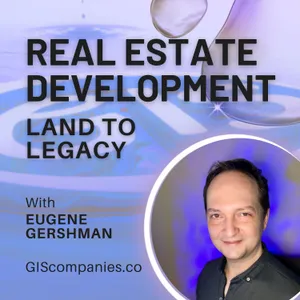
Free Daily Podcast Summary
Real Estate Development: Land to Legacy: Daily Summaries Delivered
by Eugene Gershman
Get key takeaways, quotes, and insights from Real Estate Development: Land to Legacy in a 5-minute read. Delivered straight to your inbox.
Latest Episodes
The most recent episodes — sign up to get AI-powered summaries of each one.
- 1 weeks ago34 min
One Deal Changes Everything
Overview One disciplined opportunity can change everything, but forcing ten years of progress into one deal is how developers get hurt. Forth Heffner joins Eugene Gershman to talk about the business lessons behind real estate execution: why failures are often the tuition, why collecting 100 no's can make outreach less fragile, how culture and operating systems shape a company, and why leaders need to understand their own highest and best use before piling more complexity onto the business. Guest Bio Forth Heffner is an Executive Leadership Team Guide and business coach behind Heffner Leadership Coach and The Faculty Resource. His public bio describes a path into coaching shaped by firsthand experience in a family business, where he and his brother stepped into leadership after their father's sudden passing, learned through consultants and coaches, and later recognized culture, vision, values, and communication as critical ingredients for sustainable growth. His site describes his earlier work helping grow the family business before selling his majority position, and his current work guiding leadership teams through operating systems, strategy, culture, and execution. Episode Highlights and Chapters 00:00 Opening highlights: failure as a lesson, one opportunity changing everything, highest and best use, and the danger of cramming ten years of progress into one deal. 01:19 Land to Legacy intro. 01:31 Forth explains how he came into commercial real estate from the vendor side and why that gave him a different view of developers, owners, and leadership teams. 02:42 Forth reframes failure as part of the learning process and compares business development to cold calling: collecting 100 no's can reset the pressure around every attempt. 04:20 Eugene explains why he often talks about what went wrong in development, because preventing expensive mistakes is more useful than pretending the business is easy. 07:10 Forth describes the importance of slowing down, clarifying who the business serves, defining shared vision and values, and staying disciplined about the chosen path. 11:31 Forth explains why one out of 100 opportunities may hit, but one disciplined and strategic deal can change the entire business. 13:31 The conversation shifts to coaching, why it can be hard to sell as a service, and why the real value is helping leaders pursue the endgame they actually want. 17:36 Eugene and Forth discuss highest and best use, not just for assets, but for people, leadership teams, and the roles founders should or should not keep carrying themselves. 18:55 Eugene explains why GIS shut down its construction company and how development plus construction can create too much operational and risk complexity for a growing business. 28:56 Forth and Eugene talk about building a legacy instead of only building an asset, including the pride that comes from pointing to real projects in a community. 30:19 Forth names one of the biggest mistakes developers make: trying to cram ten years of progress into one deal instead of committing to a path, mastering a niche, and building repeatable discipline. 32:32 Forth explains why even strong leaders need coaches, how outside accountability can push people past self-imposed limits, and what a prospective client should ask before choosing a coach. 34:00 Forth shares where listeners can find him and connect after the episode. Contact Information Forth Heffner Website: https://heffneriv.com/ The Faculty Resource: https://www.thefacultyresource.com/ LinkedIn: https://www.linkedin.com/in/forthheffner Host: Eugene Gershman GIS Companies: https://giscompanies.co/ Download the free Feasibility Study Checklist to pressure-test a development opportunity before committing serious time and capital:https://giscompanies.co/development/feasibility-study/ Interested in being a guest on Real Estate Development: Land to Legacy? Visit:https://giscompanies.co/podcast/ Hosted by Simplecast, an AdsWizz company. See pcm.adswizz.com for information about our collection and use of personal data for advertising.
- 1 weeks ago34 min
The Cash Flow Trap
Accounting may be boring, but Richard Boyd makes the case that boring is exactly where developers get protected. A growing real estate business can look profitable and still run into trouble if the owner does not understand cash flow, capital structure, debt service, work-in-progress accounting, and worst-case planning before the market changes. Guest Bio Richard Boyd started an accounting practice in 2021 to help small businesses and real estate developers get clarity around their books, cash flow, payroll planning, debt, and financial forecasting. His work focuses on helping owners understand the health of the business, build better reporting, and put financial controls in place as the business scales. Episode Highlights and Chapters 00:00 Eugene introduces Richard Boyd and frames accounting as the boring topic developers still need to understand. 00:54 Richard explains why owners avoid accounting, and why clean books reduce stress by making payroll, debt, and cash-flow questions clear. 02:49 Richard breaks down the difference between rear-view accounting and forward-looking financial forecasting. 03:41 Eugene and Richard discuss why starting entrepreneurs and developers often focus too much on profit and not enough on cash flow. 05:10 Richard explains why developers need accurate numbers to present a compelling story to lenders and support a viable development plan. 07:32 Richard describes what developers overlook as they scale from a small operation into a more complex business. 09:54 Richard shares the cautionary story of a $16M real estate investor who grew quickly, lacked visibility into cash flow and DSCR, and was forced to sell inventory at a discount after the market shifted. 13:02 Richard explains how deal assumptions can change, and why developers need contingency planning, exit strategies, and controls before the downside scenario arrives. 15:46 Richard describes how accounting support can scale from basic back-office bookkeeping into scenario modeling and financial planning. 18:39 Richard explains how early startup costs should be tracked when a landowner and partners are still testing whether a project is viable. 21:09 Richard discusses revenue recognition, project-cost capitalization, and why development costs belong on the balance sheet until the project is complete. 23:53 Richard explains why many owners misclassify development costs, then have to fix their books during tax season. 25:38 Eugene asks how AI is changing accounting, and Richard explains where AI helps with task-oriented work but still falls short on strategic CFO-level judgment. 30:07 Richard shares his core advice: it costs nothing to plan, and developers should pressure-test worst-case scenarios before they become real. 33:07 Richard shares how listeners can contact Atlantic Business Advisors. Contact Information Richard Boyd / Atlantic Business Advisors Website: https://atlbusinessadvisors.com/ Email: richard.boyd@atlbusinessadvisors.com Host: Eugene Gershman / GIS Companies https://giscompanies.co/ GIS Companies has a free Feasibility Study Checklist available here: https://giscompanies.co/development/feasibility-study/ To be a guest on the podcast, visit https://giscompanies.co/podcast/. Hosted by Simplecast, an AdsWizz company. See pcm.adswizz.com for information about our collection and use of personal data for advertising.
- 3 weeks ago32 min
The Hidden Housing Edge
Mobile home parks are not really mobile, and the best operators are not just collecting rent from a row of trailers. Leo Young breaks down why manufactured housing communities can be a recession-resilient, infrastructure-heavy, relationship-driven asset class, and why the biggest fear is not sewer, roads, insurance, or resident issues. It is the problem no one budgeted for. Guest Bio Leo Young is the founder and managing partner of Cornell Communities, a company focused on acquiring, operating, and turning around manufactured housing communities across eight states. Cornell Communities focuses on providing affordable housing to hardworking Americans while targeting risk-adjusted returns for investors. Before building the company, Leo worked at Tesla during a high-pressure period in the company's history, an experience he says shaped his work ethic, mission-driven mindset, and approach to entrepreneurship. Episode Highlights and Chapters 00:00 Eugene introduces Leo Young, founder and managing partner of Cornell Communities, and sets up the conversation around manufactured housing communities. 00:30 Leo explains Cornell Communities' two-part mission: provide affordable housing and generate strong risk-adjusted returns for investors. 01:04 Leo talks about moving from Tesla to trailer parks, including how Tesla's intense environment and near-bankruptcy period influenced the way he approaches entrepreneurship. 02:13 Leo explains how he found real estate, why passive cash flow caught his attention, and how a friend's investment thesis led him into mobile home parks. 04:49 The conversation turns to acquisition, underwriting, diligence, and what actually happens after closing when a new operator takes over a community. 07:31 Eugene and Leo compare land development feasibility work with manufactured housing due diligence, including utilities, public water connections, and business-plan assumptions. 08:07 Leo describes the biggest operational fear for investors and operators: an unaccounted-for event that blows up the budget. 08:57 Leo walks through resident management, road conditions, utility issues, collections, violations, and the day-to-day work behind operating manufactured housing communities. 10:29 Leo explains the diligence process, including municipal records, test ads, vendor checks, and a detailed checklist before closing. 12:01 Leo describes a cost-control approach to due diligence: start with the free or low-cost items, then move into more expensive third-party studies only when the deal still makes sense. 13:25 Leo explains how seller renegotiations happen when new information changes the economics of a deal. 14:07 The discussion covers the wide range of mobile home park pricing, from small properties to large institutional assets. 15:13 Leo explains why Cornell Communities prefers long-term holds, including the role of depreciation and tax consequences when selling. 16:10 Leo describes how deals are sourced, why brokered deals have become more competitive, and why proprietary outreach matters. 17:26 Eugene challenges the return profile, and Leo explains why the asset class can offer strong risk-adjusted returns compared with new development. 19:23 Leo talks about local contractor networks, small-market relationships, and why good vendors are often found through referrals rather than Google. 20:49 Leo explains the regions Cornell Communities likes, including the Southeast and Midwest, and how tornado risk interacts with a land-lease business model. 23:25 Leo describes typical deal financing, including fixed-rate loans, investor equity, reserves, capex budgets, and depreciation benefits. 24:19 Leo explains that Cornell Communities is primarily an operator, with in-house property management, asset management, and acquisitions. 24:58 Eugene and Leo discuss whether it is still feasible to build a new manufactured housing community from raw land, and why infrastructure costs and municipal resistance can make the numbers difficult. 27:05 Leo compares manufactured homes, park models, tiny homes, and container homes, and explains why manufactured homes are often the easiest for municipalities to understand and approve. 29:10 Leo gives his core lesson for landowners and operators: measure twice, cut once, get more bids than you think you need, and do the diligence before committing. 30:31 Leo shares how listeners can learn more about Cornell Communities, connect with him, and request his free mini-course on manufactured housing communities. Contact Information Leo Young / Cornell Communities https://cornellcommunities.com LinkedIn: https://www.linkedin.com/in/
- Mar 12, 202633 min
Land Development Tips
A failed motivational blog, a risky early move with retirement money, and a career setback all became part of the path that led Brandon Cobb into one of real estate’s most overlooked value-creation plays: land entitlement. In this conversation with Eugene Gershman, Brandon breaks down how raw land can be taken from a simple parcel to a 50-, 100-, or 200-home community, why builders often prefer buying finished lots instead of taking on development risk themselves, and what landowners should understand before selling too early and leaving serious money on the table. Guest Bio Brandon Cobb is a real estate entrepreneur focused on land development, paper development, affordable housing, and selling individual lots to builders. Eugene introduces him as someone who has completed more than 180 transactions. In the episode, Brandon shares how he moved from a successful career in medical device sales into entrepreneurship, then into flipping houses, building homes, and eventually developing land after national homebuilders began approaching him to buy projects he was working on. Episode Highlights and Chapters 01:29 Eugene sets up the conversation around how value is actually created in land development, with a focus on paper development, affordable housing, and the real leverage behind entitlement work. 02:50 Brandon shares how losing his medical device sales job became the turning point that pushed him toward entrepreneurship and real estate. 05:44 After getting inspired by a Shark Tank pitch, Brandon experiments with several failed business ideas before discovering real estate, flipping his first house, and learning through costly mistakes. 21:33 Brandon explains the layered value creation in land deals, from entitlement to infrastructure to vertical construction, and why multiple exit strategies make the model so attractive. 24:16 The conversation turns to why national builders often prefer entitled or finished lots over raw land, especially when speed, timing, and return on capital matter more than taking development risk themselves. 26:31 Brandon breaks down what builders typically want in a project, why around 50 lots can be a meaningful threshold in his market, and how smaller communities can still work when they fit a builder’s pipeline. 28:25 One of Brandon’s biggest lessons for landowners is to understand what their land could be worth after entitlement, instead of selling as-is and potentially leaving major upside behind. 29:42 Eugene adds the owner’s perspective, explaining the tradeoff between certainty and upside, since developers often take on the work and risk but also delay the seller’s payoff until approvals are complete. 32:08 Brandon shares the two main ways people can work with him: education and coaching for people who want to learn land development, and passive investment opportunities for those who want exposure to the strategy without operating deals themselves. Contact Information Brandon Cobbhttps://learnlanddevelopment.com Investment opportunities:https://hbgcapital.net/waitlist Interested in being a guest on our podcast? Contact us at:https://giscompanies.co/podcast/ Download the Feasibility Study Checklist to assess your project’s potentialhttps://giscompanies.co/development/feasibility-study/ Hosted by Simplecast, an AdsWizz company. See pcm.adswizz.com for information about our collection and use of personal data for advertising.
- Feb 26, 202630 min
The Airbnb Moment for Commercial Space
A five-year lease signed right before lockdown turns into an 1,800-square-foot “soccer field” of emptiness and a million-dollar headache. That pain sparks an idea with a big question behind it: if Airbnb unlocked the value of spare bedrooms, what’s the value of all the unused nooks and slices of commercial space hiding in plain sight? The conversation explores a “Craigslist-style” approach to commercial listings, designed to make fractional and unconventional spaces feel approachable, searchable, and actually monetizable. Guest Bio Steve Taylor is the founder of SoCommercial, a platform built to help owners list and monetize commercial spaces of any type or size, especially the odd, fractional, or overlooked ones that don’t fit neatly on traditional listing sites. Episode Highlights and Chapters 00:03 The origin story of a pandemic-timed lease and an 1,800-square-foot empty office 05:50 Why traditional commercial listing sites felt clunky and overpriced, and what a better experience looks like 06:28 The Airbnb comparison and the bigger question about “unmonetized” commercial space 07:43 Real-world use cases from warehouse racks to spare chairs, basements, display space, and collaboration concepts 09:57 The brutal reality of building a marketplace and why traction matters more than perfect tech 14:31 If everything is free to list, how does the business eventually make money 16:04 How developers can use flexible leasing and “artisan mix” thinking to enhance retail and office projects 18:21 The problem with small ground-floor retail in residential buildings and why brokers often ignore it 21:13 Why the platform stays focused on listings instead of consulting, and when to use AI for ideas 22:37 Not a broker, not a competitor, just another option for visibility and exposure 25:12 Launch timing, bootstrapping, and why this kind of startup is a long marathon 28:23 The ask to listeners, plus the tease of a jingle you have to hear on the site Contact Information SoCommercial website: https://socommercial.com Contact Eugene Gershman for real estate development advice and guidance. Download the free feasibility study checklist at https://giscompanies.co/development/feasibility-study/ If you’d like to be a guest on the show, visit https://giscompanies.co/podcast/. Hosted by Simplecast, an AdsWizz company. See pcm.adswizz.com for information about our collection and use of personal data for advertising.
- Feb 19, 202636 min
1031 Exchange and DST Investing Basics
A big real estate sale can create an even bigger tax bill, and that’s where Ashley Romiti steps in. She walks through how investors use a 1031 exchange to defer capital gains and depreciation recapture, what the “45 days to identify and 180 days to close” timeline really feels like in practice, and why many long-time owners eventually trade hands-on management for passive ownership through Delaware Statutory Trusts (DSTs). Eugene and Ashley also explore the gray areas developers run into, why investor intent matters, how DST restrictions shape risk and return, and what due diligence looks like when picking sponsors and properties. Guest BioAshley Romiti is the founder of GCA 1031 and works with real estate investors who want to transition from active ownership into passive real estate investments using tax-deferred 1031 exchange strategies. She frequently uses DSTs as a fractional-ownership structure that can help investors pursue capital preservation and income while deferring capital gains and depreciation recapture. Ashley is a registered representative affiliated with a broker-dealer relationship through which these offerings are made. Episode Highlights and Chapters00:00 Ashley’s niche: helping investors move from active ownership to passive investments using 1031 exchanges and DSTs 02:54 A plain-English definition of the 1031 exchange and why taxes can be so painful on a sale 06:01 The core timeline: 45 days to identify replacement property and 180 days to close 06:27 What happens at death and how step-up in basis affects long-term strategy 07:09 Development and 1031 exchanges: where the gray areas appear and why CPA guidance matters 10:50 What a DST is, how fractional ownership works, and why “Delaware” is about the trust structure 12:49 Why DST properties often concentrate in landlord- and tax-friendly states 14:32 DSTs versus syndications, including how ownership and economics differ 19:11 SEC framework and disclosures, including how offerings are presented and documented 21:05 Sponsor incentives, exit decisions, hold periods, and DST rules that shape operational flexibility 24:03 Where DSTs can fit for developers, including “takeout” concepts and solving for leftover exchange boot 26:17 How Ashley screens deals: sponsor track record, fundamentals, structure, and investor goals 30:20 Common DST asset classes today and why office remains challenging 32:07 Typical minimums, accredited investor requirements, and diversification across multiple DSTs 35:51 How to reach Ashley and where to download her 1031/DST ebook Contact InformationAshley Romiti / GCA 1031 https://gca1031.comFree ebook available.949-235-5606 HostEugene Gershman / GIS Companieshttps://giscompanies.co/If you’re a developer or investor evaluating a deal, download Eugene’s free Feasibility Study Checklist to pressure-test assumptions, costs, timelines, and returns before you commit capital. If you’re interested in being a guest on the show, visit the podcast page to connect and apply.https://giscompanies.co/podcast/ Ashley Romiti offers securities through Concorde Investment Services, LLC (CIS), member FINRA/SIPC. GCA 1031 is independent of CIS. Concorde is headquartered at 3909 Research Park Drive, Suite 200, Ann Arbor, MI 48108. This podcast is for informational purposes only, does not constitute as investment advice, and is not legal or tax advice. Please consult the appropriate professional regarding your individual circumstance. Hosted by Simplecast, an AdsWizz company. See pcm.adswizz.com for information about our collection and use of personal data for advertising.
- Feb 12, 202646 min
Digital Nomads are Coming: How to Develop Overseas
Digital nomads aren’t just a trend—they’re a demand shift that’s changing what “success” looks like for overseas real estate. Michael K. Cobb shares how his team thinks about building the right product for renters who stay three to six months at a time, why “clusters” create momentum for entire markets, and what it really takes to develop across borders without getting “skinned alive.” Along the way, he breaks down the mindset that keeps projects (and reputations) intact: treat mistakes as tuition, lead with humility, and build local trust the hard way—without bribes.   Guest BioMichael K. Cobb has been building communities and working on real estate development across Latin America for over 25 years, with experience in places like Belize, Nicaragua, and Panama.  He also consults with investors and developers on overseas due diligence and execution, and he’s the author of “How to Buy Your Home Overseas.”   Earlier in his international career, he helped start a mortgage company in Belize that later became a bank, giving foreign buyers access to financing in-market and adding liquidity for developers after sales close. Episode Highlights and Chapters00:00 Humility as the “biggest asset” when you leave your home turf 01:16 The real question: how to avoid getting destroyed building overseas 01:47 Horror stories, getting ripped off, and reframing mistakes as “tuition” 03:47 How to enter a new country: test every assumption, and use multiple lawyers (including a hyper-local one) 06:44 “We’ve never paid a bribe” and the CSR strategy that builds local advocates 08:59 Timelines and entitlements: a Panama “horror story,” and what “a long time” can mean 10:27 Project size and phasing: the Panama plan (110 acres, smaller phase one) and an anchor continuing-care concept 13:53 The demand shift: digital nomad visas, renters (not buyers), and why this wave is “exploding” 16:44 Build-and-sell vs. hold-and-rent, and how “easy button” services change long-term demand 19:10 Financing overseas: why it’s mostly private equity/private lending, plus buyer financing as liquidity 21:14 Pre-sales: how projects get stranded half-built, and when pre-sales can make sense 40:32 Belize as an “easy button,” and a 1,600-acre project looking for development partners 44:52 Mike’s book offer: email to get a free Amazon coupon 45:53 Where to find Mike and ECI Development online Contact InformationMichael K. Cobb / ECI Developmentpodcast@ecidevelopment.com (email to request the free Amazon coupon for “How to Buy Your Home Overseas”) www.ecidevelopment.comHost: Eugene Gershmanhttps://www.linkedin.com/in/eugenegershman/To learn more about GIS and our real estate development services, explore our website and see what we’re building.www.giscompanies.coInterested in being a guest on the show? Visit our podcast page for details and how to connect: https://giscompanies.co/podcast/ Hosted by Simplecast, an AdsWizz company. See pcm.adswizz.com for information about our collection and use of personal data for advertising.
- Feb 12, 202625 min
Preserving Affordable Housing with 75% Returns
Preserving affordable housing doesn’t have to mean sacrificing investor returns. Dr. Canaan Van Williams breaks down how his firm targets naturally occurring affordable housing properties—older, often overlooked apartments, manufactured home communities, and SRO motels—and keeps rents 20–30% below market while still structuring “sustainable bonds” that (at the top tier) advertise a 75% total return profile over 36 months. The conversation gets into how these private, unlisted debt securities work, who they’re for (accredited investors), why the strategy focuses on preservation instead of new construction, and how factory-built homes can be deployed quickly to bring more units online without the waste of traditional site-built development. Guest BioDr. Canaan Van Williams is the managing founder of Proactive Sustainable Bonds and describes his organization as a Reg D 506C fund issuing sustainable bonds through the Proactive Realty Income Fund II to LLC. He works in the affordable housing and social impact housing space, focusing on low-income and workforce residents across multiple states, and notes third-party impact verification efforts including Morningstar Sustainalytics, UNPRI, BlueMark, and an Impact Evaluation Lab assessment. Episode Highlights and Chapters00:00 – The episode’s focus: affordable housing, manufactured homes, and raising capital. 01:55 – Dr. Van introduces Proactive Sustainable Bonds and the Reg D 506C structure. 02:28 – What the “sustainable bonds” are: private, unrated debt securities for accredited investors tied to affordable housing outcomes. 04:12 – How the bonds are secured: real estate hard assets and property insurance (not a public rating or guarantee). 05:22 – How capital is used, bridge debt takeout, and Dr. Van’s personal investment in the fund. 06:39 – Hybrid approach: mostly funding their own strategy, with some allocation possible to aligned projects/managers under the PPM. 07:26 – UN Sustainable Development Goals discussed and how the strategy aligns with specific SDGs. 08:24 – Why a bond structure instead of a typical private debt fund: proving a profitable-and-impactful model. 08:43 – Liquidity and duration: private, unlisted, illiquid; commonly 2–3 year terms with longer options. 09:23 – Target assets: manufactured housing communities, multifamily, SRO motels; prioritizing “impact rate of return.” 11:36 – Defining NOAH (naturally occurring affordable housing) and why it matters. 13:38 – Why new construction rarely replaces NOAH and why preservation is a key strategy. 14:46 – For-profit vs nonprofit: how a for-profit social impact mandate intentionally preserves affordability. 16:46 – The nonprofit support layer: housing essentials, transportation support, and behavioral workbooks for second-chance populations. 18:59 – Manufactured homes in the model: sourcing factory-direct homes, rapid deployment, and passing savings to residents. 20:05 – “We don’t build anything”: focusing on distressed properties and infrastructure upgrades in existing parks. 21:02 – Investor programs and tiers: accredited-only, minimums, current income approach, and the headline 75% return tier details as described. 24:10 – Closing thoughts: execution, claimed investor repayments to date, where to learn more, and Dr. Van’s book. Contact InformationProactive Sustainable Bonds website: www.sustainablebonds.com Email: invest@sustainablebonds.comPhone: 1-800-626-2089 Direct: 803-989-8264 LinkedIn: https://www.linkedin.com/in/dr-canaan-williams-aa3924b/Host: Eugene Gershman – https://giscompanies.co/podcast/Interested in real estate investing frameworks, underwriting insights, and episodes like this one? Head to https://giscompanies.co/podcast/ to get resources and connect with GIS. Hosted by Simplecast, an AdsWizz company. See pcm.adswizz.com for information about our collection and use of personal data for advertising.
Get Real Estate Development: Land to Legacy summaries in your inbox
Free AI-powered daily recaps. Key takeaways, quotes, and mentions — in a 5-minute read.
Get Free Summaries →Free forever for up to 3 podcasts. No credit card required.
You Might Also Like
Listeners also like.
The Land Development Podcast with Ryan Glick
Ryan Glick
Real Estate Development Insights
Payam Noursalehi
The Regenerative Real Estate Podcast
Neal Collins
The REtipster Podcast | Land Investing & Real Estate Strategies
Seth Williams
The Land Geek Podcast Archive
Mark Podolsky helps you understand Land Investing in the spirit of real est
The Art of Passive Income
Mark Podolsky
Real Estate Investing Mastery Podcast
Joe McCall
Real Estate Mogul, M.D.
Brett Riggins
How Did They Do It? Real Estate
Seyla and Aileen Prak
Land Stories
Dave Denniston
MIT/CRE Meet the Visionaries
MIT Center for Real Estate
Go Big! Live Podcast
Matt Drouin
About Real Estate Development: Land to Legacy
Real Estate Development: Land to Legacy is hosted by Eugene Gershman, who scaled his company to $30M/year before the market forced a reset. Now rebuilding with deeper clarity, he shares real stories of growth, failure, and leadership. This podcast breaks down the real-life lessons and steps behind turning land into lasting value—educating listeners on what it truly takes to develop real estate. Guests include developers, investors, architects, land use consultants, and more. If you've lived the lessons and bounced back, we want to hear from you.
Customized Recaps
AI-powered recaps with compact key takeaways, quotes, and insights.
Straight to Your Inbox
Get key takeaways from Real Estate Development: Land to Legacy in a 5-minute read.
Save Hours Every Week
Stay current on your favorite podcasts without falling behind.
Frequently Asked Questions
What is Podzilla's Real Estate Development: Land to Legacy daily summary?
It's a free AI-powered email that summarizes new episodes of Real Estate Development: Land to Legacy as soon as they're published. You get the key takeaways, notable quotes, and links & mentions — all in a quick read.
How does the Real Estate Development: Land to Legacy podcast summary work?
When a new episode drops, our AI transcribes and analyzes it, then generates a personalized summary tailored to your interests and profession. It's delivered to your inbox every morning.
Is this an official Real Estate Development: Land to Legacy product?
No. Podzilla is an independent service that summarizes publicly available podcast content. We're not affiliated with or endorsed by Eugene Gershman.
Can I get summaries of other podcasts too?
Absolutely! The free plan covers up to 3 podcasts. Upgrade to Pro for 15, or Premium for 50. Browse our full catalog at /podcasts.
How often does Real Estate Development: Land to Legacy release new episodes?
Real Estate Development: Land to Legacy publishes weekly. Our AI generates a summary within hours of each new episode.
What topics does Real Estate Development: Land to Legacy cover?
Real Estate Development: Land to Legacy covers topics including Business, Entrepreneurship. Our AI identifies the specific themes in each episode and highlights what matters most to you.
Start getting Real Estate Development: Land to Legacy summaries tomorrow morning.
Free forever for up to 3 podcasts. No credit card required.
Free forever for up to 3 podcasts. No credit card required.