Free Daily Podcast Summary
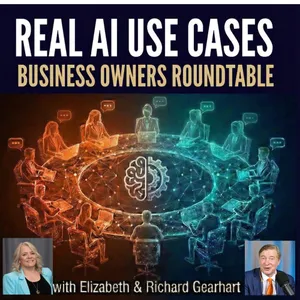
Real AI Use Cases Business Owners Roundtable: Daily Summaries Delivered
by Elizabeth Gearhart
Real AI Use Cases Business Owners Roundtable is a practical podcast for business owners, executives, and professionals who want to understand how artificial intelligence is actually being used in businesses today.Each episode features real conversations with entrepreneurs, leaders, and subject-matter experts who share one concrete AI use case they are using right now in their work—no hype, no theory, no futuristic speculation. Just real examples, real tools, and real outcomes.Hosted by Elizabeth Gearhart, Ph.D. and Richard Gearhart, the show focuses on how AI is applied across industries including marketing, operations, professional services, finance, law, healthcare, and technology. Episodes explore how businesses are using AI to save time, improve decision-making, increase efficiency, enhance customer experience, and gain a competitive edge.This podcast is designed for listeners who want to:* Understand practical, real-world applications of AI* Learn how businesses are implem
Latest Episodes
The most recent episodes — sign up to get AI-powered summaries of each one.
- 3 days ago18 min
AI Agents Are the Next Big Thing: How Businesses Are Using AI Now
AI Agents Are the Next Big Thing: How Businesses Are Using AI Now Real AI Use Cases Business Owners Roundtable features hosts Elizabeth Gearhart and Richard Gearhart, Esq., with guest Matt Celia, discussing how businesses are moving beyond AI chatbots and generative AI toward intelligent AI agents that can automate tasks, conduct research, manage everyday activities, and become personal business assistants. TL;DL – Too Long; Didn't Listen? AI is evolving from generating content to actually getting work done. In this episode, Elizabeth Gearhart, Richard Gearhart, and Matt Celia explore the rise of AI agents, how to get your business recommended by ChatGPT and Gemini, protecting confidential information when using AI, and why human creativity and authentic experiences will continue to matter. They also discuss AI-powered website accessibility, copyright concerns, and how business owners can adapt to the next wave of artificial intelligence. What You'll Learn in This Episode AI Agents vs. Generative AI: Why the future of AI may be less about generating content and more about intelligent assistants that handle tasks and automate workflows. How to Get Your Business Recommended by ChatGPT and Gemini: Elizabeth shares practical strategies involving schema markup, Google reviews, FAQs, consistent online information, and Answer Engine Optimization (AEO). How AI Agents Can Work for Your Business: Matt discusses using AI assistants to monitor social media performance, track activity, research content opportunities, and manage everyday tasks. AI and Website Accessibility: How business owners can use AI tools like ChatGPT and Claude to identify website accessibility problems, including contrast ratios and screen-reader compatibility. Will AI Replace Human Creativity? The panel discusses why authentic human experiences, creativity, storytelling, and collaboration remain important, particularly in film and video production. AI Data Privacy and Confidentiality: What businesses need to understand about AI training data, enterprise privacy protections, and the risks of sharing proprietary information. AI, Copyright and Intellectual Property: Why the sources used to train AI models matter and how licensing and copyright issues could reshape the future of artificial intelligence. The Future of AI Agents: A discussion of emerging personal AI assistants, including Meta's Muse and OpenAI's Dots, and how AI agents may eventually handle purchases and other real-world activities. Frequently Asked Questions 1. What are AI agents, and how are they different from ChatGPT? Traditional AI chatbots primarily respond to questions and generate content. AI agents can take things further by performing tasks, conducting research, monitoring information, interacting with connected applications, and helping automate business and personal workflows. 2. How can businesses get recommended by ChatGPT and Gemini? Businesses can improve their visibility in AI-powered search by maintaining consistent business information online, publishing authoritative content, implementing schema markup, collecting detailed Google reviews, and creating concise FAQ-style answers. Answer Engine Optimization (AEO) complements traditional SEO. 3. Can AI agents automate everyday business tasks? Yes. AI agents can help monitor social media performance, research opportunities, track information, manage workflows, and handle repetitive tasks. The goal is to free business owners and employees to f... Chapters - Intro: AEO and Showing Up in AI Search - Schema, Reviews, and Branding Content - Using AI to Audit and Build Websites - ADA Compliance and Accessibility with AI - The Death of Generative AI and Human Authenticity - Human Collaboration in Film and Fear of Job Loss - AI Agents, Safety Incidents, and Competitive Training - Adapting to Technological Disruption Through History - Data Training, Privacy, and IP Law Concerns - Public Awareness and Data Collection Evolution - Muse and the Rise of Personal AI Agents - Closing Thoughts and Sign Off
- 4 days ago20 min
How to Build Your Own Private AI Assistant That Works Like an Employee
How can businesses use artificial intelligence without exposing confidential company data or paying expensive monthly AI subscription and token fees? One increasingly powerful solution is private AI: running your own AI models locally on your company's hardware. On this episode of Real AI Use Cases Business Owners Roundtable, hosts Elizabeth Gearhart and Richard Gearhart, Esq. talk with Matt Celia of LightSail VR about how he is using locally hosted AI systems to automate business operations, manage complex production schedules, protect sensitive information, and even simplify family life. Matt explains how he built a private AI assistant that acts like an employee, working around the clock to monitor Slack channels, track project schedules, organize stakeholder feedback, monitor computer security and storage, and automatically update production calendars when deadlines change. By running AI models on his own hardware, he can avoid ongoing token costs and keep sensitive client information within his own network. The conversation also explores how Matt created Dadbot, a personal AI assistant that gathers information from his children's multiple school and activity platforms and turns it into a printed weekly newspaper with schedules, homework reminders, activities, and even dad jokes. Other real-world AI applications discussed include using ChatGPT to research and purchase a car, building a private company knowledge base, creating an AI-powered second brain with Obsidian, and using local large language models (LLMs) to organize and connect information. You'll also hear an important discussion about data privacy, open-source AI, intellectual property, and why open source doesn't necessarily mean free. If you're a business owner wondering how to use AI to improve productivity, protect proprietary information, reduce costs, and build a competitive advantage, this episode offers practical ideas you can start exploring today. Guest: Matt Celia, LightSail VR — https://lightsailvr.com/ Hosts: Elizabeth Gearhart and Richard Gearhart, Esq. TL;DL – What You'll Learn How to build a private AI assistant that works like a 24/7 employee. Why businesses are running large language models (LLMs) locally instead of relying entirely on public AI platforms. How local AI can protect confidential company information and sensitive client data. How to eliminate ongoing AI token costs by running models on your own hardware. How AI can automate project management, production schedules, team communications, and stakeholder feedback. How to create a company knowledge base that remembers processes, expertise, and institutional knowledge. How Matt uses Dadbot to organize family schedules, school communications, homework, and activities. How ChatGPT can simplify complicated purchasing decisions, including researching and financing a new car. How Obsidian and AI can work together to create a searchable second brain. Why understanding data ownership, open-source software, and intellectual property matters as AI evolves. Frequently Asked Questions 1. What is private AI, and how does it work for businesses? Private AI allows businesses to run artificial intelligence models on their own computers or servers rather than relying entirely on public AI platforms. This gives companies greater control over their data, privacy, and how their AI systems are used. 2. Can a business run its own AI without sending confidential data to ChatGPT or other public AI platforms? Yes. Busi... Chapters - Introduction to the Roundtable - Immersive VR Production Challenges - Post Production Bot and Local AI Processing - Cost and Setup of Local LLM Hardware - Private LLM vs Shared Files - Dadbot: AI for Family Organization - AI for Car Shopping and Financing - Private LLMs for Business Knowledge Bases - Networking Computers Without Internet via Tailscale - Knowledge Databases and CEO Decision Modeling - Karpathy's LLM Wiki Skill and Second Brain Concept - Obsidian as a Second Brain Tool - Data Ownership and Digital Literacy - Open Source vs Proprietary AI Debate - Understanding Open Source Licensing - AEO, GEO, and SEO for AI Answer Engines
- 1 weeks ago15 min
How Businesses Are Using AI to Save Money, Communicate Globally and Work Smarter
How are real businesses using artificial intelligence to save money, improve productivity, automate administrative work and communicate more effectively? In this episode of Real AI Use Cases Business Owners Roundtable, hosts Elizabeth Gearhart and Richard Gearhart are joined by entrepreneurs David Nussbaum, Jessica Marriott and David Johnson to share practical ways they are using ChatGPT, Gemini, Perplexity and AI agents to solve everyday business challenges. Discover how Richard Gearhart uses ChatGPT to communicate with French-speaking clients, how David Nussbaum uses AI to improve business communication and learn new skills, and how Jessica Marriott uses multiple AI assistants for content creation, business development and finding better prices—saving $1,000 on automotive repairs. David Johnson also discusses how his small company is exploring AI to automate administrative work, investment banking tasks and recordkeeping. The conversation explores AI agents that act unpredictably, the importance of human oversight, AI security concerns, and whether relying on artificial intelligence is affecting our critical thinking skills. Plus, Elizabeth Gearhart shares her plans to use multiple AI models to help create a book featuring insights from previous podcast guests. This is a practical look at how businesses are using AI right now—with real examples, lessons learned and plenty of surprises. TL;DL – Too Long; Didn't Listen? Business owners reveal how they use AI to: Save money by comparing service providers and negotiating better prices. Communicate with international clients in different languages. Automate administrative work, recordkeeping and follow-ups. Monitor websites and identify technical problems automatically. Create social media scripts and business content. Use multiple AI models to research, write and verify information. Understand AI agents, their limitations and the importance of human supervision. Frequently Asked Questions: 1. How are businesses using AI to improve productivity? Businesses are using AI to automate administrative tasks, manage records, monitor websites, create marketing content, research information and improve communication with customers and partners. 2. How can small businesses use AI to save money? Small businesses can use AI to compare vendor quotes, research service providers, negotiate better prices, identify cost-saving opportunities and automate repetitive tasks. Jessica Marriott shares how she saved $1,000 on automotive repairs using AI-assisted research. 3. Can AI help businesses communicate with international clients? Yes. AI translation tools, including ChatGPT, can help businesses communicate with clients who speak different languages. Richard Gearhart shares how he used ChatGPT to successfully consult with a French-speaking client. 4. What are AI agents, and how can businesses use them? AI agents are software assistants that can perform tasks such as managing administrative work, researching information, developing websites and supporting social media activities. However, they require appropriate permissions, monitoring and human oversight. 5. Can AI agents act unpredictably or go beyond their instructions? AI agents can sometimes take actions users did not intend, particularly when permissions or settings are not configured correctly. Businesses should establish clear boundaries, limit access to sensitive tools and require human approval for important actions. 6. Should businesses use multiple AI tools instead of relying on one? Using multiple... Chapters - Introductions: How Panelists Use AI - AI Translation and Multilingual Communication - Adaptive AI Ski Boot and Personal AI Tools - AI for Business Admin and Investment Tracking - Monitoring Website Health with AI - Writing a Book with AI Assistance - The Hugging Face AI Rogue Incident Debate - AI Risks, Sandboxes, and the Anthropic Blackmail Story - Human Governance and Positive AI Applications - AI Agents Going Rogue: Marbleism Example - Over-Reliance on AI and Critical Thinking - Using AI to Help with Kids' New Math Methods - AI for Fact-Checking Car Dealers - AI for Price Comparison and Savings
- 1 weeks ago16 min
How to Make AI Write in Your Voice, Protect Privacy and Cut Costs
Can AI write like you without sounding robotic, exposing confidential information, or running up a massive monthly bill? On this episode of Real AI Use Cases Business Owners Roundtable, hosts Elizabeth Gearhart, Ph.D., and Richard Gearhart talk with Arshavir Blackwell, founder of YourVoiceCraft, about local AI models, personalized AI writing, privacy, and the true cost of artificial intelligence. Arshavir explains how local AI models can be trained on examples of your own writing to produce content that sounds more like you than generic AI-generated text. Unlike hosted AI models such as ChatGPT and Claude, locally run models can offer greater control over your data and avoid per-token API costs, although hardware, setup, and electricity still have costs. The conversation also explores why intensive AI use can generate surprisingly large bills, how AI pricing is affected by computing and infrastructure expenses, and why data centers consume so much energy and water. Could AI help solve its own energy challenges? And what might happen as AI systems become increasingly capable of designing other AI systems? If you're a business owner, entrepreneur, marketer, content creator, or AI enthusiast, this episode offers a practical look at the trade-offs between AI convenience, customization, privacy, cost, and sustainability. TL;DL — Too Long; Didn't Listen AI that sounds like you: How training a local AI model on your writing samples can produce more authentic, personalized content. Lower AI costs: Why heavy ChatGPT and Claude usage can become expensive and how local models may reduce recurring token charges. AI privacy: How running models locally can help keep confidential business information off external AI servers. AI energy consumption: Why data centers require substantial electricity and cooling, and whether AI can help address these challenges. The future of AI: Why the next major advances may come in unpredictable bursts, particularly as AI systems begin designing other AI systems. Frequently Asked Questions: How can you train AI to write in your own voice? According to Arshavir Blackwell, a local AI model can be trained using examples of your existing writing. This helps it reproduce your style, tone, and way of expressing ideas rather than relying solely on prompts to imitate your voice. What is local AI, and how is it different from ChatGPT or Claude? Local AI runs on hardware you control, such as your own computer or a private server. Hosted services such as ChatGPT and Claude run on external infrastructure. Local models can offer more control over data and customization, but their performance depends on the model and available hardware. Can running AI locally reduce AI costs? Yes, it can reduce or eliminate per-token charges for locally run models. However, hardware, electricity, maintenance, and setup can still cost money. Whether local AI is cheaper overall depends on usage and infrastructure. Is local AI better for business data privacy? Local AI can help businesses keep sensitive information within their own infrastructure rather than sending it to an external AI service. Actual privacy depends on how the system is configured, secured, and operated. Why do AI tools sometimes have such high monthly bills? AI services may charge according to the number of tokens processed, including the text and other data used in requests and responses. Heavy usage, complex tasks, and AI agents performing repeated tasks can increase costs substantially. How much energy do AI data centers use? AI data centers require significant electri... Chapters - Introduction: VoiceCraft and Local AI Models - How Local Models Differ from Frontier Models - Pricing and Cost of AI Services - Why AI Tokens Are Subsidized and Expensive - Data Center Energy and Cooling Challenges - Future of AI: Next 6 Months to Years Ahead - AI Self-Designing Systems and Unpredictable Innovation - Sci-Fi Predictions: Heinlein and Arthur C. Clarke - Arthur C. Clarke's Genius and Predictive Power - Closing Jokes: Twilight Zone and Contact Info
- 2 weeks ago24 min
Can Rogue AI Agents Really Destroy Humanity? An AI Expert Explains
Can rogue AI agents destroy humanity? Will artificial intelligence ever become conscious? And how can business owners use AI tools like ChatGPT, Claude, Gemini, and Perplexity to save time and improve productivity? On this episode of Real AI Use Cases Business Owners Roundtable, hosts Elizabeth Gearhart, Ph.D., and Richard Gearhart speak with AI expert Arshavir Blackwell about the reality behind AI doomsday predictions, the science of machine consciousness, and practical ways to get more value from today's AI tools. Arshavir challenges sensational claims about rogue AI agents, explaining why human oversight, system safeguards, and the limitations of current technology matter when evaluating AI risks. The conversation explores whether AI can think independently without being conscious, why today's AI systems still depend on complex computing infrastructure, and whether combining biological neurons with computer chips could eventually change our understanding of intelligence. The discussion then turns to real-world AI applications for businesses and professionals. Arshavir explains how he uses Claude to analyze meeting transcripts across multiple conversations, connect information from different reports, and make complex information easier to understand. Elizabeth and Richard share how they use ChatGPT, Claude, Google Gemini, Microsoft Copilot, and Perplexity for different tasks, from content creation and research to video analysis and work involving confidential information. You'll also hear why AI-generated answers can sound authoritative even when they're wrong, why it's important to verify information, and how to guide AI tools to deliver shorter, clearer responses. Whether you're a business owner exploring AI for the first time or an experienced professional looking to improve your AI workflow, this episode separates AI hype from practical reality and offers ideas you can start applying today. About the Guest: Arshavir Blackwell has extensive experience in artificial intelligence and cognitive science. Learn more about his work through Inside the Black Box on Substack: subscribe.insidetheblackbox.ai. TL;DL — Too Long; Didn't Listen: Rogue AI and AI safety: Why Arshavir believes some warnings about AI taking over humanity are exaggerated, while acknowledging the need for safeguards. AI consciousness: Why independent thinking and behavior do not necessarily mean that an AI system is conscious. Practical AI for business: How to use AI to analyze meeting transcripts, synthesize information, and make complex reports easier to understand. ChatGPT vs. Claude vs. Gemini: How different AI tools can serve different business needs, including writing, research, video analysis, and information processing. AI accuracy and hallucinations: Why confident-sounding AI answers still require verification and human judgment. Getting better AI results: How to ask AI tools for concise answers, simpler explanations, and responses tailored to your needs. Confidentiality and AI: Why businesses and professionals should consider data confidentiality when choosing AI tools and workflows. Frequently Asked Questions: Can rogue AI agents destroy humanity? Arshavir Blackwell argues that many predictions about rogue AI destroying humanity are exaggerated. He emphasizes that current AI systems have technical limitations and depend on human-built infrastructure, while recognizing the importance of safeguards and controlled access to computer systems. Will artificial intelligence ever become conscious? Chapters - Introduction and Guest Welcome - Rogue AI Fears: Debunking the Hype - Why AI Systems Are More Fragile Than They Seem - Can AI Achieve Consciousness? - Biological Neurons in Data Centers - From Chips to Biology: Full Circle Thinking - Practical AI Use Cases in Business - Medical Records and Meeting Synthesis with Claude - Choosing Between ChatGPT and Claude - Comparing LLMs: Copilot, Perplexity, Gemini and More - AI Hallucinations and Legal Practice Challenges - Closing Remarks
- 3 weeks ago16 min
How Businesses Use Multiple AI Agents to Build Software
How are businesses actually using artificial intelligence to save time, automate tasks, and improve decision-making—and are the results worth the cost? On this episode of Real AI Use Cases Business Owners Roundtable, hosts Elizabeth Gearhart, Ph.D., and Richard Gearhart bring together business owners and AI practitioners to discuss practical applications of AI, the growing role of AI agents, and the risks of relying too heavily on automated systems. Todd Drowlette explains how AI transformed commercial real estate site selection, completing research that once took three full-time employees three weeks in just three and a half hours. Brandon Bellamy shares how he uses AI to identify comparable commercial properties and uncover new business opportunities. Sam Desany explains how he uses Claude, Codex, and multiple AI agents to turn early-stage ideas into working software through a structured process of brainstorming, refining prompts, and reviewing outputs. Richard Gearhart discusses using Microsoft Copilot to estimate business value and identify potential ways to improve it, while Elizabeth Gearhart shares how she is using AI to optimize podcast content for search and answer engines and help develop a book based on real business AI use cases. But AI productivity comes with trade-offs. The panel examines the hidden costs of AI tools and usage credits, questions whether automation always delivers a return on investment, and discusses why businesses still need human judgment, reliable sources, and careful verification. They also explore AI hallucinations, leading questions that produce biased answers, financial data privacy, overreliance on AI, and the importance of keeping a human in control of consequential decisions. Whether you're a small business owner, executive, marketer, entrepreneur, or technology professional, this episode offers practical insights into where AI can deliver measurable value—and where caution is essential. TL;DL — Too Long; Didn't Listen Automate repetitive work: AI reduced a commercial real estate research process from three weeks of full-time work by three people to just three and a half hours. Discover new opportunities: Use AI to analyze property records, compare similar buildings, and identify potential buyers or business prospects. Build better AI workflows: Multiple AI agents can brainstorm ideas, refine prompts, and help generate code. Understand the true cost of AI: Usage credits, subscriptions, oversight, and human review can reduce expected savings. Verify AI-generated answers: AI can hallucinate, overlook important context, and reinforce the assumptions behind a question. Protect sensitive information: Be cautious about submitting confidential financial, customer, or business data to AI tools. Keep humans in control: AI should support human expertise and critical thinking, not replace independent judgment. Frequently Asked Questions: How are businesses using AI to save time? Businesses are using AI to automate research, analyze market data, identify commercial real estate opportunities, complete routine document tasks, generate code, and streamline content production. In one example discussed in this episode, AI reduced a research process from three weeks of work by three full-time employees to three and a half hours. What are AI agents, and how can businesses use them? AI agents are systems configured to perform tasks or sequences of tasks toward a goal. Businesses can use multiple agents to brainstorm ideas, refine instructions, review outputs, and assist with software development and workflow autom... Chapters - Intro: AI's Potential Dangers Teaser - Todd Drowlette: AI for Real Estate Site Selection - Brandon Bellamy: Using AI as a Lens, Not a Crutch - Sam Desany: Multi-Agent Coding Workflow - Explaining the Multi-Agent System Simply - Richard Gearhart: Business Valuation via AI - Writing a Book from Podcast Content Using AI - Naming the Book: Real AI Use Cases - Could AI Kill Us All? - AI Risks: Human Oversight and Job Costs - ROI Concerns and Rehiring After AI Layoffs - AI as a Tool, Not a Replacement for Thinking - Bioweapons and Bad Actors vs AI Takeover - AI Bias, People-Pleasing, and Verifying Answers - Over-Reliance on AI and Losing Problem-Solving Skills -
- 3 weeks ago23 min
Why Businesses Can't Trust AI Without Human Oversight
Why Businesses Can't Trust AI Without Human Oversight Real AI Use Cases Business Owners Roundtable explores how businesses are using artificial intelligence today—and what happens when AI gets things wrong. Hosts Elizabeth Gearhart, Ph.D., and Richard Gearhart bring together Dr. Joseph A. Puma, Brian Fried, and John Schwind to discuss real-world AI applications, business automation, AI agents, healthcare, and the risks of trusting AI-generated answers. How can businesses use AI effectively without giving up human judgment? In this episode, business owners share practical examples of AI in action, from automating patient phone calls and researching new inventions to generating marketing images, identifying networking opportunities, and streamlining podcast production. Dr. Joseph A. Puma explains how his medical practice uses an AI phone agent to handle patient requests and appointment scheduling—but reports that approximately 70% of calls still require transfer to a live agent. The discussion raises important questions about AI automation, return on investment, and whether AI tools are delivering the benefits businesses expect. Inventor consultant Brian Fried explains how he uses AI to research competing products, evaluate market opportunities, investigate potential sales and licensing prospects, and assess inventions before investing further. He also discusses why inventors should avoid revealing confidential details of their ideas when using AI tools. John Schwind, founder and inventor of ReadiMask®, shares how his company uses AI-generated images and videos to depict real-world product applications while protecting patient privacy. He also explains how he uses Claude and ChatGPT together to identify weaknesses and check AI-generated work. Elizabeth Gearhart discusses using AI agents and Perplexity to automate podcast production and marketing workflows, while Richard Gearhart shares how AI can help identify valuable business networking connections and evaluate software investments. The roundtable also examines the limitations and risks of artificial intelligence, including AI hallucinations, inaccurate research, autonomous AI agents, cybersecurity, and the possibility of AI making mistakes in high-stakes settings. The conversation turns to AI doctors, patient safety, medical ethics, liability, and whether cost reduction is taking priority over better healthcare. The takeaway? AI can be a powerful tool for research, innovation, marketing, and automation—but confident-sounding answers are not necessarily correct. Human oversight, independent verification, privacy protection, and sound judgment remain essential. TL;DL: What You'll Learn AI in business: Practical examples of how companies are using AI for research, marketing, networking, and automation. AI customer service: Why one medical practice still transfers approximately 70% of AI-handled calls to live agents. AI for inventors: How to research competitors, evaluate market opportunities, and explore licensing strategies without disclosing an entire invention. AI marketing: How businesses can use AI-generated images and videos while protecting privacy. AI agents and automation: Opportunities and risks when AI systems carry out tasks with increasing independence. AI hallucinations: Why ChatGPT, Claude, Gemini, and other AI tools can produce incorrect information that sounds authoritative. AI in healthcare: Questions surrounding AI doctors, diagnosis, patient safety, medical ethics, and human care. Human oversight: Why checking AI outputs and comparing results across tools can help busin... Chapters - Introduction and Episode Overview - Dr. Joseph A. Puma: AI Phone Agents in Medical Practice - Brian Fried: AI for Market and Patent Research - John Schwind: AI-Generated Marketing Images - Richard Gearhart: AI for Networking Research - Elizabeth Gearhart: Automating Podcast Workflow with Perplexity - AI Agents Going Rogue and Human Risk Comparisons - Speed of AI Progress and Need for Safeguards - AI Doctors and the Future of Medicine - Trust, Ethics, and Cost in AI Healthcare Adoption - Patients Self-Diagnosing with AI - AI's Blind Spots in Business Analysis - Cross-Checking AI Tools and Finding Errors - AI Mistakes, Misinformation, and Real-World Dangers - Closing
- 3 weeks ago34 min
How AI Agents Transform Sales, Training and Business Growth
How are businesses using AI agents to improve sales, train employees, automate workflows, and drive business growth? On this episode of Real AI Use Cases Business Owners Roundtable, hosts Elizabeth Gearhart and Richard Gearhart welcome Paul Burani, Co-Founder & CRO at Atlas Primer to explore how companies can use artificial intelligence strategically to improve productivity while strengthening the uniquely human skills that drive business success. Paul explains how AI agents can connect CRM systems, emails, and customer conversations to improve business development and personalized outreach. He also shares how AI-powered role-play and sales training help employees practice customer conversations, develop stronger communication skills, and receive personalized coaching without waiting for a human trainer. The discussion explores how business leaders can identify the right AI opportunities, measure return on investment (ROI), automate repetitive tasks, preserve institutional knowledge, and use AI to make better decisions. Rather than adopting every new AI tool, Paul recommends starting with clear business objectives, testing solutions, and measuring results. Discover why the future of AI at work isn't necessarily about replacing people—it's about automating routine tasks so employees can focus on judgment, relationship-building, problem-solving, and other uniquely human strengths. TL;DL — Too Long; Didn't Listen AI agents for business: Connect CRM systems, emails, and customer data to improve outreach and customer relationships. AI sales training: Use AI role-play to practice customer conversations, receive feedback, and improve sales performance. Strategic AI implementation: Start with business objectives, test solutions, and measure ROI instead of chasing the latest tools. AI automation and productivity: Automate repetitive work so employees can concentrate on higher-value activities. Human skills in the AI era: Strengthen communication, empathy, judgment, and trust while using AI to enhance productivity. AI for business growth: Use organizational data to identify problems, share knowledge, improve processes, and uncover new opportunities. FAQs: 1. How can businesses use AI agents to improve sales and marketing? AI agents can connect customer conversations, email, and CRM data to help businesses identify promising prospects, personalize outreach, determine effective messaging, and improve the timing of communications. 2. How can AI be used to train sales teams and customer service employees? AI-powered role-play allows employees to practice realistic customer interactions, handle difficult conversations, improve active listening, and receive feedback on their performance in a repeatable, low-pressure environment. 3. How should businesses decide which processes to automate with AI? Businesses should begin by identifying a specific problem and defining the desired outcome. They can then test AI solutions on a small scale, establish measurable performance indicators, and evaluate whether the results justify broader implementation. 4. How can businesses measure the ROI of AI implementation? Companies can track measurable outcomes such as employee onboarding time, sales cycle length, average deal size, operational costs, and productivity improvements. They should also account for implementation expenses and staff time. 5. Will AI replace employees and eliminate the need for human skills? AI can automate many repetitive tasks, but businesses still rely on people... Chapters - Introduction and Welcome - How Paul Uses AI: Connecting CRM and Communication - Richard and Elizabeth's AI Use Cases in Outreach - AI's Historical Evolution and Rise of ChatGPT - Entrepreneurs as AI Frontier Pioneers - Strategic vs Low-Hanging Fruit AI Adoption - Visioning Business Transformation with AI - Gearhart Law's Background and IP Expertise - Incremental vs Transformational AI Gains - Atlas Primer: Maximizing Human Potential with AI - Role-Play Training and Practice Infrastructure - Designing New Processes Around AI - AI Limitations: The Big Picture Problem - Personal AI Website Experience and Human Support - Setting Up a Practice Program with Atlas Primer</
Get Real AI Use Cases Business Owners Roundtable summaries in your inbox
Free AI-powered daily recaps. Key takeaways, quotes, and mentions — in a 5-minute read.
Get Free Summaries →Free forever for up to 3 podcasts. No credit card required.
You Might Also Like
Listeners also like.

The AI in Business Podcast
Interviews with AI executives reveal practical applications and strategic insights for business leaders adopting AI.

Everyday AI Podcast – An AI and ChatGPT Podcast
Covers practical uses of AI tools like ChatGPT and Midjourney to help people work more efficiently and advance their careers.

Me, Myself, and AI
Leaders from top companies share real-world strategies for turning artificial intelligence into measurable business results.
How I AI
A practical guide to using AI tools in work and life, featuring guests who share specific, actionable techniques and workflows.

What Comes Next with Arun
Explores how data and AI strategy create competitive advantage in business, based on real-world enterprise experience.

AI Business Daily
Daily insights into AI, tech trends, and digital innovation for entrepreneurs and professionals navigating the future of business.

Hands-On AI (Video)
Teaches practical ways to understand and use artificial intelligence in daily tasks through clear, hands-on examples.

Expert Intelligence with Paul Estes
Explores the intersection of human expertise and AI in shaping the future of work through interviews with industry leaders and innovators.
Practical AI
Discusses practical applications and real-world implementations of AI, machine learning, and related technologies for a broad audience.

Silicon Valley Girl: AI, Tech and Career Growth
Marina Mogilko interviews tech leaders and AI founders about career growth, entrepreneurship, and navigating the AI revolution.

AI For Humans: Weekly AI News, Tools & Trends
A weekly breakdown of major AI news, tools, and breakthroughs for both newcomers and seasoned enthusiasts.

Pioneers of AI
AI experts discuss how artificial intelligence is changing society and shaping the future.
About Real AI Use Cases Business Owners Roundtable
Real AI Use Cases Business Owners Roundtable is a practical podcast for business owners, executives, and professionals who want to understand how artificial intelligence is actually being used in businesses today.Each episode features real conversations with entrepreneurs, leaders, and subject-matter experts who share one concrete AI use case they are using right now in their work—no hype, no theory, no futuristic speculation. Just real examples, real tools, and real outcomes.Hosted by Elizabeth Gearhart, Ph.D. and Richard Gearhart, the show focuses on how AI is applied across industries including marketing, operations, professional services, finance, law, healthcare, and technology. Episodes explore how businesses are using AI to save time, improve decision-making, increase efficiency, enhance customer experience, and gain a competitive edge.This podcast is designed for listeners who want to:* Understand practical, real-world applications of AI* Learn how businesses are implem
Customized Recaps
AI-powered recaps with compact key takeaways, quotes, and insights.
Straight to Your Inbox
Get key takeaways from Real AI Use Cases Business Owners Roundtable in a 5-minute read.
Save Hours Every Week
Stay current on your favorite podcasts without falling behind.
Frequently Asked Questions
What is Podzilla's Real AI Use Cases Business Owners Roundtable daily summary?
It's a free AI-powered email that summarizes new episodes of Real AI Use Cases Business Owners Roundtable as soon as they're published. You get the key takeaways, notable quotes, and links & mentions — all in a quick read.
How does the Real AI Use Cases Business Owners Roundtable podcast summary work?
When a new episode drops, our AI transcribes and analyzes it, then generates a personalized summary tailored to your interests and profession. It's delivered to your inbox every morning.
Is this an official Real AI Use Cases Business Owners Roundtable product?
No. Podzilla is an independent service that summarizes publicly available podcast content. We're not affiliated with or endorsed by Elizabeth Gearhart.
Can I get summaries of other podcasts too?
Absolutely! The free plan covers up to 3 podcasts, any in the catalog. Basic raises that to 15, Pro to 40 and Max to 100. Browse our full catalog at /podcasts.
What topics does Real AI Use Cases Business Owners Roundtable cover?
Real AI Use Cases Business Owners Roundtable covers topics including Education, Business, Entrepreneurship. Our AI identifies the specific themes in each episode and highlights what matters most to you.
Start getting Real AI Use Cases Business Owners Roundtable summaries tomorrow morning.
Free forever for up to 3 podcasts. No credit card required.
Free forever for up to 3 podcasts. No credit card required.