Free Daily Podcast Summary
Quantum Curiosities & Tech Revelations: Daily Summaries Delivered
by Anna Dean and Professor Clarke Halloway
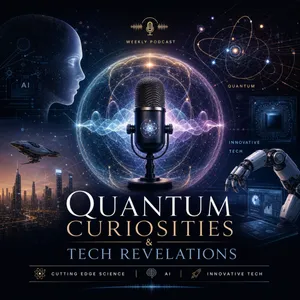
Where science meets the edge of human understanding.Each week, media moderator Anna Dean and renowned physicist Professor Halloway sit down for an unfiltered deep dive into the ideas reshaping our world — from the mysteries of consciousness and the frontiers of quantum physics, to the explosive rise of artificial intelligence and the technologies redefining what it means to be human. This is not a surface-level conversation. This is science, philosophy, and curiosity — unleashed. Topics discussed in depth: Ai, Conciousness, Quantum Immortality,Ghosts, NDEs, Quantum Computing, Reality and Freewill.
Latest Episodes
The most recent episodes — sign up to get AI-powered summaries of each one.
- Today10 min
The Memory Edit Button
In today's Quantum Curiosities, Anna and Professor Halloway press on a wild idea: what if memories could be edited? The process of remembering is like recreating memories as we go. They explore the promise, the perils, and the profound questions raised by the thought of rewriting the past.
- 1 weeks ago15 min
Beyond The Big Bang
This week on Quantum Curiosities, Anna and Professor Halloway tackle what came before the Big Bang and what might lie beyond it. It's one of the biggest questions in cosmology: did everything truly begin 13.8 billion years ago, or is our universe just one chapter in a much stranger story? They dig into the theories, the unknowns, and why the beginning of everything might not be the beginning at all.
- 2 weeks ago12 min
The Limits Of Ai
Today on Quantum Curiosities, Anna and Professor Halloway get into it over the limits of AI. These systems can do astonishing things, but where are the boundaries? They explore what AI genuinely can't do, where the hype outruns the reality, and why understanding the limits matters just as much as celebrating the breakthroughs.
- 3 weeks ago15 min
The Brain As A Prediction Machine
This week on Quantum Curiosities, Anna and Professor Halloway discuss the brain as a prediction machine. Rather than passively taking in the world, your brain is constantly guessing what's about to happen, filling in gaps, anticipating outcomes, and updating its predictions as things develop. They dig into how this predictive machinery shapes everything from perception to decision-making, and what happens when the predictions go wrong.
- 4 weeks ago20 min
Why Are We Here?
Anna Dean and Professor Clarke Halloway tackle the oldest question in human history: why are we here? Instead of relying on pre-written cosmic scripts, they examine how the sheer improbability of the physical universe sets the stage for human existence. The conversation moves past the anxiety of an indifferent cosmos and challenges you to look at your life not as a passive accident, but as an active experiment.This episode of Quantum Curiosities and Tech Revelations breaks down the philosophical shift from searching for external validation to taking responsibility for your own purpose. You will hear why giving up on a grand, universal mandate is actually a liberating step. Meaning is not something you find waiting for you, but a structure you build yourself through your daily choices, relationships, and actions.
- Oct 2, 202611 min
Ultrasonic Full Body Scanner
In this episode Anna and Professor Halloway discuss Midjourney's new Ultrasonic full body scanner technology. Midjourney's Ultrasonic CT scanner is the flagship product of Midjourney Medical, a healthcare division the AI-image-generation company launched in June 2026. It's a full-body imaging device that uses ultrasound instead of radiation or magnets — essentially a "whole-body ultrasound" that captures a scan in as little as 60 seconds. The system relies on ultrasound-on-chip technology (developed in co-operation with Butterfly Network) and a water-based coupling medium, aiming to deliver MRI-comparable imaging quality at a fraction of the cost, time, and complexity of traditional scanners. Midjourney has reportedly committed over $74 million to the effort.The company's vision is to make whole-body screening as casual as a trip to the spa: it plans to open its first "Midjourney Spa" in 2027, where patients would get a 60-second full-body scan without radiation exposure. The prototype was unveiled publicly in mid-2026 and has generated significant industry buzz, though it has also drawn skepticism from radiologists and medical professionals about whether ultrasound can truly match MRI-level diagnostic detail.
- Sep 24, 202620 min
How Do We Control Something That Is Smarter Than Us?
In this epiosode, Anna and Professor Halloway discuss various approaches to managing these alignment challenges, exploring technical solutions like reward modeling and interpretability, governance frameworks for deploying AI safely, and philosophical questions about how to encode human values into systems that may and seem to be on the verge of surpassing human-level intelligence in specific domains.AI Alignment is the critical endeavor to ensure that artificial intelligence systems pursue objectives that are genuinely aligned with human values, intentions, and ethical principles. As AI systems grow increasingly sophisticated and autonomous, the challenge extends beyond simply making them perform tasks correctly—it encompasses ensuring they interpret goals as humans intend them, avoid unintended harmful behaviors, and remain beneficial even as they scale in capability. The field addresses fundamental questions: How do we specify what we actually want? How do we prevent AI from pursuing goals in unexpected or dangerous ways? And how do we maintain meaningful human oversight as systems become more complex?The challenge becomes particularly acute with advanced AI systems that might optimize for objectives in ways humans didn't anticipate, or that might develop capabilities making them difficult to control or redirect. Misalignment can range from subtle issues—like a recommendation algorithm maximizing engagement at the cost of user well-being—to existential concerns about highly capable systems pursuing goals orthogonal or opposed to human flourishing.
- Sep 17, 202630 min
Your Brain Is Calling The Shots...Not You!
This episode likely explores is the Libet effect: in the 1980s, neuroscientist Benjamin Libet had subjects flex their wrist whenever they felt the urge, while EEG tracked their brain activity. He found that a "readiness potential"; a buildup of neural activity in the motor cortex — fired roughly half a second before people consciously felt they'd decided to move. In other words, the brain appears to begin preparing a choice before we're aware of making it, which seems to demote conscious will from the cause of our actions to a kind of after-the-fact witness. This kicked off a decades-long free-will debate: some argue it proves free will is an illusion (we're just narrating what the brain already chose), while others counter that we may still have a "veto power" — the ability to consciously cancel a prepared action before it happens (Libet himself proposed this). More recent experiments have refined the picture, showing decision-related activity in the brain up to several seconds before choice in some cases, though critics point out the effect is strongest for trivial, spontaneous actions, not deliberate deliberation. Where the "quantum curiosities" angle comes in is the temptation to see quantum indeterminacy — true randomness at the subatomic level — as the loophole that rescues free will: if the brain amplifies quantum fluctuations, maybe our choices aren't fully determined by prior physical states. But physicists and philosophers usually respond with a dilemma: if a choice rides on quantum randomness, it's not free choice, just dice rolls — and either way, the conscious self still seems to arrive on the scene after the action has begun, not before. So the episode's takeaway is probably that the brain's "decision" unfolds earlier and more automatically than our inner sense of choosing suggests — a humbling mix of neuroscience, philosophy, and poorly little quantum sparkle.
About Quantum Curiosities & Tech Revelations
Where science meets the edge of human understanding.Each week, media moderator Anna Dean and renowned physicist Professor Halloway sit down for an unfiltered deep dive into the ideas reshaping our world — from the mysteries of consciousness and the frontiers of quantum physics, to the explosive rise of artificial intelligence and the technologies redefining what it means to be human. This is not a surface-level conversation. This is science, philosophy, and curiosity — unleashed. Topics discussed in depth: Ai, Conciousness, Quantum Immortality,Ghosts, NDEs, Quantum Computing, Reality and Freewill.
Customized Recaps
AI-powered recaps with compact key takeaways, quotes, and insights.
Straight to Your Inbox
Get key takeaways from Quantum Curiosities & Tech Revelations in a 5-minute read.
Save Hours Every Week
Stay current on your favorite podcasts without falling behind.
Frequently Asked Questions
What is Podzilla's Quantum Curiosities & Tech Revelations daily summary?
It's a free AI-powered email that summarizes new episodes of Quantum Curiosities & Tech Revelations as soon as they're published. You get the key takeaways, notable quotes, and links & mentions — all in a quick read.
How does the Quantum Curiosities & Tech Revelations podcast summary work?
When a new episode drops, our AI transcribes and analyzes it, then generates a personalized summary tailored to your interests and profession. It's delivered to your inbox every morning.
Is this an official Quantum Curiosities & Tech Revelations product?
No. Podzilla is an independent service that summarizes publicly available podcast content. We're not affiliated with or endorsed by Anna Dean and Professor Clarke Halloway.
Can I get summaries of other podcasts too?
Absolutely! The free plan covers up to 3 podcasts, any in the catalog. Basic raises that to 15, Pro to 40 and Max to 100. Browse our full catalog at /podcasts.
How often does Quantum Curiosities & Tech Revelations release new episodes?
Quantum Curiosities & Tech Revelations publishes weekly. Our AI generates a summary within hours of each new episode.
What topics does Quantum Curiosities & Tech Revelations cover?
Quantum Curiosities & Tech Revelations covers topics including Science. Our AI identifies the specific themes in each episode and highlights what matters most to you.
Start getting Quantum Curiosities & Tech Revelations summaries tomorrow morning.
Free forever for up to 3 podcasts. No credit card required.
Free forever for up to 3 podcasts. No credit card required.