Free Daily Podcast Summary
Qualitative Research Methods for Everyone Podcast: Daily Summaries Delivered
by Policy Press
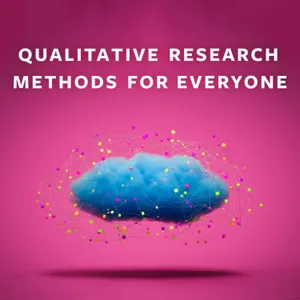
The Qualitative Research Methods for Everyone podcast features lively discussions with Bristol University Press author Karen O'Reilly as she chats with students, academics and professionals worldwide about how the toolkit approach can make navigating today’s complex world of qualitative research easier and more exciting. Hosted on Acast. See acast.com/privacy for more information.
Latest Episodes
The most recent episodes — sign up to get AI-powered summaries of each one.
- Mar 25, 202529 min
Communicating
The Qualitative Research Methods for Everyone podcast brings author and professor Karen O’Reilly into challenging conversations with students, academics and practitioners around the world. Together, they explore how the toolkit approach - a curated collection of expert skills, knowledge, procedures, tools and information - can help navigate the complex terrain of contemporary qualitative research methods. For this final episode, I have the delightful company of long-term friend and colleague Professor Michaela Benson. Michaela is Professor of Public Sociology at Lancaster University and an expert in migration, citizenship and identity. She has vast experience in qualitative methods, project management and writing and communicating for diverse audiences. She is also the Chief Executive of The Sociological Review Foundation.Focusing on Chapter 9, Communicating, we have an in-depth conversation about writing with style, writing for different audiences and producing different kinds of output.Michaela shares an insightful example of one of her recent publications that has emerged out of stacking together (or building up) content from other outputs such as blogs, reports and podcasts. It is a neat example of higher-level analysis and the work that must go into preparing research for communication. This was based on her current research, Rebordering Britain and Britons after Brexit. You can check it out at **https://migzen.net** — definitely worth a look if you are interested in different forms of research communication.We also spend some time talking about how people read, listen and think in different ways, emphasizing the value of diverse communication methods for different audiences. I especially love that Michaela thinks calling the chapter “Communicating” was “a stroke of genius”. I will take that. Special thanks to Bahar Celik Muller, Senior Marketing Executive and Martha Gleeson, Digital Marketing Executive, for their support, advice and expertise. Find out more about the book: https://policy.bristoluniversitypress.co.uk/qualitative-research-methods-for-everyoneIntro music: Good Times Are Coming by Bohdan Kuzmin from Pixabay. Hosted on Acast. See acast.com/privacy for more information.
- Mar 25, 202526 min
Analysing and Interpreting
The Qualitative Research Methods for Everyone podcast brings author and professor Karen O’Reilly into challenging conversations with students, academics and practitioners around the world. Together, they explore how the toolkit approach - a curated collection of expert skills, knowledge, procedures, tools and information - can help navigate the complex terrain of contemporary qualitative research methods. This week, I am excited to welcome Lucy Dwyer as my guest. Lucy is a specialist nurse in urogynaecology at Manchester University NHS Foundation Trust and a final year PhD student at the University of Manchester, funded by Health Education England and the National Institute for Health Research. She is particularly passionate about research in women’s health, supported self-management and conservative management of pelvic floor dysfunction.We focus on Chapter 8, Analysing and Interpreting. Lucy is in the thick of her PhD analysis as we speak and she kindly and openly shares her anxieties, self-doubt and moments of clarity.I explain why I use the term ‘interpretive analysis’ in the book—highlighting that we do more than simply look for themes. We discuss how we work on interpreting our data for specific readers, aiming to produce something meaningful for our participants and our readers.Lucy gives great examples from her own analyses—for example reflecting analytically on why one participant kept repeating that something “didn’t matter to her”. We discuss the importance of immersion, of listening to what is not being said as well as what is.I outline the nine heuristics (or ways of thinking about analysis) and really enjoy listening to Lucy’s interpretations of her data, including the typologies she is developing using iteration. Special thanks to Bahar Celik Muller, Senior Marketing Executive and Martha Gleeson, Digital Marketing Executive, for their support, advice and expertise. Find out more about the book: https://policy.bristoluniversitypress.co.uk/qualitative-research-methods-for-everyoneIntro music: Good Times Are Coming by Bohdan Kuzmin from Pixabay. Hosted on Acast. See acast.com/privacy for more information.
- Mar 25, 202525 min
Being Creative
The Qualitative Research Methods for Everyone podcast brings author and professor Karen O’Reilly into challenging conversations with students, academics and practitioners around the world. Together, they explore how the toolkit approach - a curated collection of expert skills, knowledge, procedures, tools and information - can help navigate the complex terrain of contemporary qualitative research methods. My guest this week is Dr Brenda Herbert. Brenda is the recipient of the prestigious Sociological Review Fellowship for 2024/25. Her PhD research was a multimodal ethnography with children who had experienced domestic abuse and social work intervention. She is also a counsellor with over 15 years experience working with children and young people who have experienced domestic abuse. Having worked in both social work and third-sector settings, she currently works for a local authority.Brenda speaks passionately about the creative approach in Chapter 7, Being Creative. She outlines her own approach to multimodal ethnography and explains how similar it is to the perspective on creativity presented in Qualitative Research Methods for Everyone.We emphasise how important it is to be responsive, ethical and caring, and also discuss the value of engaging in activities that don’t feel like research. Brenda’s creative approach included online methods, chats, playing Minecraft, playing virtual hide-and-seek, walks in the park and more. These approaches led to fascinating insights that always respect the child who has suffered trauma as first and foremost a child with a whole life, not (just) a victim.We wrap up with a brief discussion on the transformative potential of research— and ask, transformative for whom? Special thanks to Bahar Celik Muller, Senior Marketing Executive and Martha Gleeson, Digital Marketing Executive, for their support, advice and expertise. Find out more about the book: https://policy.bristoluniversitypress.co.uk/qualitative-research-methods-for-everyoneIntro music: Good Times Are Coming by Bohdan Kuzmin from Pixabay. Hosted on Acast. See acast.com/privacy for more information.
- Mar 25, 202530 min
Being Ethnographic
The Qualitative Research Methods for Everyone podcast brings author and professor Karen O’Reilly into challenging conversations with students, academics and practitioners around the world. Together, they explore how the toolkit approach - a curated collection of expert skills, knowledge, procedures, tools and information - can help navigate the complex terrain of contemporary qualitative research methods. My long-time friend and colleague, Dr Karen Lumsden, joins me today. Karen is a sociologist, criminologist and qualitative research trainer and consultant. Her research expertise includes the sociology of policing, emotional labour, death work and bereavement, victims' experiences, cybercrime and qualitative methods including narratives, autoethnography, ethnography and reflexivity.Karen is the perfect guest to discuss Chapter 6, Being Ethnographic. We begin with a self-indulgent chat about how we both started out on our own ethnographic research journeys—me in the Costa del Sol, Karen in Aberdeen with boy racers and local communities. Karen’s research was flexible and responsive, using multi-modal and online approaches long before they were widely recognized as distinctive methodologies. We cover rapport and trust, emphasizing how ethnographers often assist our participants in ways that might not be directly related to our research. We also touch on AI and discuss the various emerging approaches to ethnography, sharing concerns that the core quality of ethnography might be at risk. Finally, we start to think about how decolonizing ethnography might make us rethink its principles, revisit its flexibility and reaffirm its commitments. Listen if you want to hear what we think remains central to ethnography despite its evolving methods and creative expansions.Special thanks to Bahar Celik Muller, Senior Marketing Executive and Martha Gleeson, Digital Marketing Executive, for their support, advice and expertise. Find out more about the book: https://policy.bristoluniversitypress.co.uk/qualitative-research-methods-for-everyoneIntro music: Good Times Are Coming by Bohdan Kuzmin from Pixabay. Hosted on Acast. See acast.com/privacy for more information.
- Mar 25, 202527 min
Group Discussions and Focus Groups
The Qualitative Research Methods for Everyone podcast brings author and professor Karen O’Reilly into challenging conversations with students, academics and practitioners around the world. Together, they explore how the toolkit approach - a curated collection of expert skills, knowledge, procedures, tools and information - can help navigate the complex terrain of contemporary qualitative research methods. Today I am fortunate to have Dr Nick Osbaldiston joining me from Australia. Nick is Associate Professor at James Cook University and a research fellow at the Cairns Institute. His research work focuses on lifestyle migration, internal migration, social theory, Australia's coasts, higher education labour and climate change adaptation.Our chat centred around Chapter 5, Group Discussions. Nick teaches focus group methods to social work students, who enjoy using the approach to investigate policy. Nick also has unique insights because he uses diverse quantitative and diverse qualitative methods in his own research.He raises the issue of power in group interviews and surprisingly tells us he sometimes finds it more valuable to observe power dynamics in a group rather than trying to manage them. For example, he has brought government officials, NGOs and community members together to see how they interact and to note the nature of dominant voices.We also touch on body language and emotional reflexivity, highlighting how emotions—not necessarily negative ones—can inspire fantastic group discussions. It is great to hear some of Nick’s anecdotes from his applied and coastal research. A fantastic insight insight he offers: you can teach methods for decades, but you only really learn them with experience. Special thanks to Bahar Celik Muller, Senior Marketing Executive and Martha Gleeson, Digital Marketing Executive, for their support, advice and expertise. Find out more about the book: https://policy.bristoluniversitypress.co.uk/qualitative-research-methods-for-everyoneIntro music: Good Times Are Coming by Bohdan Kuzmin from Pixabay. Hosted on Acast. See acast.com/privacy for more information.
- Mar 25, 202532 min
Interviewing
The Qualitative Research Methods for Everyone podcast brings author and professor Karen O’Reilly into challenging conversations with students, academics and practitioners around the world. Together, they explore how the toolkit approach - a curated collection of expert skills, knowledge, procedures, tools and information - can help navigate the complex terrain of contemporary qualitative research methods. This week’s guest is the wonderful and tireless Dr Zsuzsanna Iyizoba-Ebozue. Zsuzsanna is Clinical Oncologist at the Leeds Cancer Centre with research interests in radiotherapy trials, survivorship and quality of life in head and neck cancers. She also works with the Royal College of Radiologist to promote diversity, equality and inclusion in clinical oncology education and research. I have been working with her recently on qualitative research about differential attainment and a reverse mentoring scheme she has been piloting.Our discussion centers on Chapter 4, Interviewing. Zsuzsanna talks about her research with oncology patients and professionals and how adapted her original approach to interviewing to be more open and flexible. We discuss what objectivity and interpretivism mean in practice and conclude that an interview that proceeds as a conversation involves learning on both sides.Zsuzsanna reflects on how her interview participants must have seen her—as either a fellow professional or as a clinician—and how this may have shaped their responses. We agree this is something to think about before, during and after an interview. We share a great discussion about creative and alternative approaches to interviewing and I give a few examples from my own work, including photo elicitation and online interviews. Special thanks to Bahar Celik Muller, Senior Marketing Executive and Martha Gleeson, Digital Marketing Executive, for their support, advice and expertise. Find out more about the book: https://policy.bristoluniversitypress.co.uk/qualitative-research-methods-for-everyoneIntro music: Good Times Are Coming by Bohdan Kuzmin from Pixabay. Hosted on Acast. See acast.com/privacy for more information.
- Mar 25, 202530 min
Being Ethical and Reflexive
The Qualitative Research Methods for Everyone podcast brings author and professor Karen O’Reilly into challenging conversations with students, academics and practitioners around the world. Together, they explore how the toolkit approach - a curated collection of expert skills, knowledge, procedures, tools and information - can help navigate the complex terrain of contemporary qualitative research methods. I’m delighted to be joined this week by Professor Line Nyhagen. Line is Professor of Sociology and Head of Department at Loughborough University, working in the areas of religion, gender, feminism and citizenship. She has authored several books and peer-reviewed articles and I especially want to draw attention to her recent book Intersectional Feminist Research Methodologies: Applications in the Social Sciences and Humanities (co-edited with Jennifer Cooke) , which sadly I heard about too late to mention in Qualitative Research Methods for Everyone.In this podcast, focusing on Chapter 3, Being Ethical and Reflexive, we talk about how we both understand reflexive practice as an ongoing approach to reflexivity that takes place throughout a research project. Drawing on examples of reflexive practice in our own research engagements, we explore the notions of positionality and positioning, considering the extent to which our research might be limited or enhanced by who we are.Both of us are driven by the desire to engage in ethical practice and to learn from our research participants with humility, so we also touched on issues of trust, rapport, risk and harm. Line shares a great example from her new book of what she terms a positionality statement—you will need to listen to the podcast to hear more about that.Special thanks to Bahar Celik Muller, Senior Marketing Executive and Martha Gleeson, Digital Marketing Executive, for their support, advice and expertise. Find out more about the book: https://policy.bristoluniversitypress.co.uk/qualitative-research-methods-for-everyoneIntro music: Good Times Are Coming by Bohdan Kuzmin from Pixabay. Hosted on Acast. See acast.com/privacy for more information.
- Mar 25, 202524 min
Developing the Design
The Qualitative Research Methods for Everyone podcast brings author and professor Karen O’Reilly into challenging conversations with students, academics and practitioners around the world. Together, they explore how the toolkit approach - a curated collection of expert skills, knowledge, procedures, tools and information - can help navigate the complex terrain of contemporary qualitative research methods. My guest this week is Dr Jakub Stachowski. Jakub is Associate Professor of Sociology at the Norwegian University of Science and Technology. We’ve known each other for a few years having worked together on the amazing Glarus project (Global Labour in Rural Societies). His PhD used ethnographic methods to understand the processes of integration among Polish migrants in rural areas in Norway and his research interests are in migration and mobility, urban and rural areas, prison sociology, social theory and qualitative research methods. While chatting about Chapter 2, Developing the Design, we hear more about Jakub’s current work in war-affected border zones, in northern Norway and in Poland. We talk about how we both understand an interpretivist approach to sampling and explore the new concepts in Qualitative Research Methods for Everyone: initial, ongoing and final samples, as well as sample fitness. Jakub explains how he selected people and places for his research in an ongoing way, starting with communities, ethnicity and nationality as key ‘variables’, but adapting these choices as he learned more about the communities. He describes locating people through key informants as well as simply being there and finding different people. We hear about how ethnography can proceed through ongoing return visits to places, as well as through analysis of online forums. Jakub emphasises how sampling and other decisions must be reflexive but also rigorous and trustworthy. Special thanks to Bahar Celik Muller, Senior Marketing Executive and Martha Gleeson, Digital Marketing Executive, for their support, advice and expertise. Find out more about the book: https://policy.bristoluniversitypress.co.uk/qualitative-research-methods-for-everyoneIntro music: Good Times Are Coming by Bohdan Kuzmin from Pixabay. Hosted on Acast. See acast.com/privacy for more information.
Get Qualitative Research Methods for Everyone Podcast summaries in your inbox
Free AI-powered daily recaps. Key takeaways, quotes, and mentions — in a 5-minute read.
Get Free Summaries →Free forever for up to 3 podcasts. No credit card required.
You Might Also Like
Listeners also like.
Nature Podcast
Covers breakthrough research from Nature journal across all scientific fields, with insights from scientists and science journalists.

QUESTION EVERYTHING
Journalist Danielle Robay conducts in-depth interviews with prominent figures, exploring their personal journeys and beliefs through thoughtful questioning.

The Women's Research Collective
Interviews with women in research discussing their personal and professional experiences in academia and scientific fields.

Scope Conditions Podcast
A podcast showcasing cutting-edge research in comparative politics.
The Curiosity Shop with Brené Brown and Adam Grant
Two researchers examine leadership, connection, and change by combining qualitative and quantitative insights.

Queer Chronicles
Teens share intimate stories of growing up LGBTQ+ in hostile environments, exploring identity, community, and self-acceptance.

Speaking of Psychology
Explores recent psychological research and its applications to daily life.

Periodically
A University of Oxford podcast exploring how menstruation impacts undergraduate life in chemistry, from tutorials to labs.

The Quanta Podcast
A weekly discussion on groundbreaking science and math stories with Quanta's editorial team.

The Contextual Electronics Podcast
People share how they use electronics to solve real-world problems, teaching practical techniques and applications.

The Joy of x
A mathematician explores the lives and ideas of leading scientists through in-depth conversations.

Inquiring Minds
Explores the intersection of science and society through critical thinking and in-depth analysis.
About Qualitative Research Methods for Everyone Podcast
The Qualitative Research Methods for Everyone podcast features lively discussions with Bristol University Press author Karen O'Reilly as she chats with students, academics and professionals worldwide about how the toolkit approach can make navigating today’s complex world of qualitative research easier and more exciting. Hosted on Acast. See acast.com/privacy for more information.
Customized Recaps
AI-powered recaps with compact key takeaways, quotes, and insights.
Straight to Your Inbox
Get key takeaways from Qualitative Research Methods for Everyone Podcast in a 5-minute read.
Save Hours Every Week
Stay current on your favorite podcasts without falling behind.
Frequently Asked Questions
What is Podzilla's Qualitative Research Methods for Everyone Podcast daily summary?
It's a free AI-powered email that summarizes new episodes of Qualitative Research Methods for Everyone Podcast as soon as they're published. You get the key takeaways, notable quotes, and links & mentions — all in a quick read.
How does the Qualitative Research Methods for Everyone Podcast podcast summary work?
When a new episode drops, our AI transcribes and analyzes it, then generates a personalized summary tailored to your interests and profession. It's delivered to your inbox every morning.
Is this an official Qualitative Research Methods for Everyone Podcast product?
No. Podzilla is an independent service that summarizes publicly available podcast content. We're not affiliated with or endorsed by Policy Press.
Can I get summaries of other podcasts too?
Absolutely! The free plan covers up to 3 podcasts. Upgrade to Pro for 15, or Premium for 50. Browse our full catalog at /podcasts.
How often does Qualitative Research Methods for Everyone Podcast release new episodes?
Qualitative Research Methods for Everyone Podcast publishes daily. Our AI generates a summary within hours of each new episode.
What topics does Qualitative Research Methods for Everyone Podcast cover?
Qualitative Research Methods for Everyone Podcast covers topics including Science, Social Sciences. Our AI identifies the specific themes in each episode and highlights what matters most to you.
Start getting Qualitative Research Methods for Everyone Podcast summaries tomorrow morning.
Free forever for up to 3 podcasts. No credit card required.
Free forever for up to 3 podcasts. No credit card required.