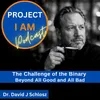
We like to believe we see ourselves and others clearly. Yet under stress, uncertainty, shame, or relational threat, the mind often reaches for simpler conclusions: good or bad, safe or dangerous, success or failure, worthy or unworthy.In this episode of Project I Am, Dr. David J. Schlosz explores all-or-nothing thinking not merely as a cognitive distortion, but as a survival strategy. Binary labels can create temporary certainty and protect us from disappointment, ambiguity, and grief. Yet they also flatten our humanity, turning behaviors into identities and complicated people into fixed categories.Drawing from psychological research, contemporary culture, and the wisdom of poets including John Keats, Walt Whitman, and Robert Frost, this episode invites us to make room for a wider truth, one that allows for accountability without shame, compassion without compliance, and firm boundaries without denying another person’s humanity.Perhaps healing does not require us to decide whether we are good or bad. Perhaps it asks us to become spacious enough to recognize that we are complex, unfinished, accountable, and still becoming.
Podzilla Summary coming soon
Sign up to get notified when the full AI-powered summary is ready.
Free forever for up to 3 podcasts. No credit card required.
Listen to This Episode
More from Project I Am
Staying on My Own Side: A 20-Minute Meditation on Not Abandoning Yourself

Two Things Can Be True - A Conversation with Megan Yale, LMFT-S, LPC-S
When Burnout Is Prolonged Self-Betrayal

The Contraction After Expansion: When a Dream Makes us Visible.
Get summaries like this every morning.
Free AI-powered recaps of Project I Am and your other favorite podcasts, delivered to your inbox.
Free forever for up to 3 podcasts. No credit card required.