Free Daily Podcast Summary
Prime Lenses: Daily Summaries Delivered
by Iain Farrell
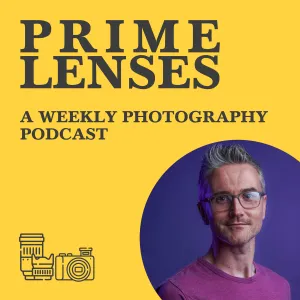
A camera is just a tool, but spend enough time with photographers, and you'll see them go misty-eyed when they talk about their first camera or a small, fast prime that they had in their youth. Prime Lenses is a series of interviews with photographers talking about their photography by way of three lenses that mean a lot to them. These can be interchangeable, attached to a camera, integrated into a gadget. I'm interested in the sometimes complex relationship we have with the tools we choose, why they can mean so much, and how they make us feel.
Latest Episodes
The most recent episodes — sign up to get AI-powered summaries of each one.
- 6 days ago
Episode 138 - Simon King
138. Simon KingSimon King, a London based documentary photographer and teacher, and the director of Everything Happens All the Time · Instagram · Blog · 35mmc author pageIn this episodeSimon King spent about four months shooting Everything Happens All the Time, a free, feature-length film of 27 London street photographers talking to him and, in the edit, to each other. I'd watched it before we sat down and loved it, so this conversation started early and wandered: why the film lets photographers talk about whatever they like, what a photography community looks like when nobody is lurking in a doorway with a long lens, and why cheap kit isn't the barrier it's made out to be. Then it gets harder. What do you become once the thing is finished? Simon is candid about the slump that follows a project, about not caring whether anyone sees his work, and about why he thinks the making has to be the part you enjoy. There's also a very good story about a portrait that ended up on somebody's mum's fridge.HighlightsPositions are approximate (percentage of the way through the conversation) until real timestamps are added.• [~7%] Why the film shows photographers as people hanging out, not noir detectives with long lenses• [~11%] The production company that bought the cheapest CCTV tape going so marginalised communities could see themselves on TV• [~12%] Why the easiest film to make on a phone tends to be an aggro one, and the £3 karaoke-toy microphone going to India instead• [~25%] Around 35 interviews shot, 27 kept, and why street photography is a niche of a niche that most people only meet through controversy• [~42%] "So I'm making it for no one": the problem with a second film• [~47%] The slump after finishing, and why he doesn't buy the romantic version of it• [~64%] Why leaving your work behind sounds to him like litter, and the print that ended up on a fridge• [~72%] The electrician on a film set, and why the process has to be the enjoyable bitChaptersApproximate positions, not timestamps. Replace with real times from the edit before pasting into a host that reads chapter markers.~0% Warm-up: swearing, Scotland and first reactions to the film~3% The film lets photographers talk about what they want to talk about~6% Community, loneliness and "go outside"~9% Is cheap kit a barrier? Camcorders, phones and the CCTV-tape story~12% Why accessible filmmaking drifts to aggro, a £3 microphone and a trip to India~16% Krishnamurti, dissatisfaction and the problem with gear talk~19% The mock sign-off ("a great 17 minutes")~20% The proper start: why make a film about this group of people~24% 27 interviews kept, around 35 shot~25% Street photography's image problem and Tatsuo Suzuki~29% One voice, many versions of themselves~32% Joey, and London as an overlooked photographic city~35
- 1 weeks ago
Episode 137 - Ron Timehin
Prime Lenses Episode 136 – Colin PriorFour decades of Scottish landscapes, the camera he sold and never went back to, and thoughts on the future of photography and AI.Guest: Colin Prior — Scottish landscape photographer, best known for his panoramas · colinprior.co.ukIn this episodeColin Prior has spent four decades photographing Scotland’s mountains, much of it on a Fuji 6x17 panoramic film camera, and he opens this conversation with the one thing he says to everyone: it’s not what’s in the picture, it’s where it takes you. From there we talk about the eye path, which he’d like you to think about instead of leading lines, and why he’ll take a few stray white dots out of a frame. He explains why he sold the camera that got his early work noticed and never went back, and he’s blunt about the world it left behind: magazines that no longer pay, video eating stills, and inkjet ink that costs more than a good whisky. His case for books, and for handing yours to a publisher and a designer, runs through the middle of the episode. We finish on AI, an AI-made Odyssey, and the book he’s been working on for ten years and isn’t in a hurry to finish.Highlights~9:00 “Leading lines” is the wrong idea. Colin calls it the eye path, and he’s happy to remove a few stray white dots to protect it.~15:00 If you have to ask yourself whether you got the picture, you didn’t.~16:20 Why he sold the 6x17 camera behind his panoramas, and why stitching digital panoramas never tempted him.~22:20 The brain stores a still image as a single moment. Video, he says, goes in one ear and out the other.~24:50 Inkjet ink that costs more than a 21-year-old single malt, and the case for letting a lab do your printing.~29:10 Why he has never self-published: you sell to the choir and the congregation never sees it.~40:20 On his workshops: the camera stays in the bag while he walks the landscape looking for evidence.~56:30 The book he has been making for ten years, and why he doesn’t want an end date.Chapters0:00 Cold open: “It’s where it takes you”~0:20 Iain’s introduction~1:20 October light, and four winters without snow~5:30 Why landscape? Birds came first~9:00 The eye path, rogue highlights and what editing really is~14:00 Self-taught, and what failures teach~15:40 Selling the Fuji 6x17~21:00 Magazines, video and the brain that stores single moments~23:50 Megapixels, prints and the inkjet problem~27:40 Books: design, distribution and why not to self-publish~37:20 Running workshops: critiques, and the camera that stays in the bag~42:00 Thinking in layers~44:40 Undisturbed places, Skye as a theme park, and Munros~49:00 &
- 2 weeks ago
What I’ve Seen with Nicklas Pettersson
- 2 weeks ago
Episode 136 - Colin Prior
- 3 weeks ago
Episode 135 - James Popsys
135. James PopsysWhat if the goal isn't to make photography easy - what if the difficulty is the whole point?Guest: James Popsys. Photographer, YouTuber and author based in Snowdonia, North Wales · jamespopsys.com · YouTube and Instagram: search "James Popsys" (P-O-P-S-Y-S)In this episodeJames has been on my list of dream guests for ages, so I was thrilled to finally sit down with him. We start, as these things do, with lawnmowers and film scanners, before getting into the real story: a marketing job in London, weekend photo walks, a conceptual composite of the London Eye as a bicycle wheel, and a move to Sydney that somehow led to a YouTube channel he started almost by accident in New Zealand. James talks about guarding his own individuality by deliberately not watching other photographers' videos, connecting the dots backwards to find the worldview running through his work, and what it took to commit thousands of prints to paper for his book Human Nature. We get into his one-lens, one-body philosophy, why he thinks difficulty is a feature of photography rather than a bug, and why he'd still rather be surprised by an ordinary place than get the photo 3,000 other people already have. He's off to East Greenland in a few days to experiment with a more hybrid, video-forward workflow, and this conversation is a lovely primer for anyone who wants to know how he got there.Highlights[Opening] Film scanners, darkroom chemistry, and a cold open about finding surprise in unremarkable places[Opening] A very serious digression into battery-powered lawnmowers[First third] The London Eye as a bicycle wheel, and the Sydney-to-YouTube origin story[First third] "You can't connect the dots going forward" - finding the worldview that was there all along[Middle] Making Human Nature: watching the zeroes stack up on a 15-metre printer[Middle] The horses-through-the-window print, and why James is a "one body, one lens" traveller[Middle] A Leica SL3's peeling grip, and 21-year-old Leica R8 and R9 bodies that still work[Second half] Guarding individuality by not watching other people's videos[Second half] AI, disclosure scandals, and why nobody's asking for more of it[Late] Street photography, Britt Bradley's Gen-AI-vs-wet-plate test, and heading to East GreenlandChaptersPositions are approximate. The transcript has no timestamps.Opening Cold open: finding surprise in unremarkable placesOpening Film scanning setups and darkroom chemistryOpening Kit Young's 400-roll film habitOpening North Wales weather and the lawnmower tangentFirst third James's origin story: London, Sydney, and an accidental YouTube channelFirst third Connecting the dots backwards to find a worldviewFirst third Guarding individuality; avoiding other photographers' and podcasters' workFirst third Human Nature: starting the book, and the RISD-style question of what comes af
- Oct 4, 2026
Episode 134 - Daria Zlobinski
What do you do when the best trip of your life makes every photo after it feel smaller?Guest: Daria Zlobinski. London-based photographer, macro and nature obsessive, never without a Leica · Instagram: @dariazlb (main) and @d.zlobinski (photography)In this episodeDaria messaged me a while back to say she was burned out and worried she was falling out of love with photography, and would I like to talk about it. That sounded like exactly the right kind of Prime Lenses conversation. We start at the beginning: windsurfing holidays, her dad's cameras, a Tumblr surf blog, and a RISD summer workshop where everyone else photographed people and she found a plant house. Then the harder part: how an Antarctica trip set a bar she isn't sure she can reach again, what Instagram rewards versus what she actually loves, and the small, silly challenges that got her shooting again, from an iPhone walk in Regent's Park to Sunday mornings at a farmer's market. Along the way: a Leica Q3 that got rained on, a salt-crusted Canon 5D Mark II with a black strip across the sensor, the sound of a Leica R9 shutter, and a pop-up show she'd love to hold in the Barbican Conservatory before it closes. And yes, we carried on talking after I said we'd finished.- Episode Sponsorship - BestPodcasts.co.uk is a free podcast player that works in your browser on any device. You can listen to episodes from your favourite hosts. You do not need an account, an app, or to download anything to listen to the best free podcasts.ChaptersPositions are approximate. The transcript has no timestamps.Opening Cold open: the iPhone challengeOpening Intro and why Daria is hereFirst third Windsurfing, her dad's cameras, Tumblr, and a Canon 60DFirst third RISD workshop, the plant house, Henry HorensteinFirst third London, consent, and carrying a Leica everywhereFirst third Travelling as a different version of yourselfMiddle Q3 vs D-Lux 8 in IcelandMiddle My kitchen, a Spider-Man web made of wool, and Day OneMiddle 200,000 photos, iCloud panic, and stock photographyMiddle Prints, books, and making something just for youMiddle Slop reels, likes, and doing it for yourselfMiddle Postcards, cyanotypes, and slow mailSecond half Burnout, comparison, and the self-criticism cycleSecond half Photo walks, small challenges, and Sunday farmer's marketsSecond half Scotland trip talk, spontaneity, and projects that assemble themselvesSecond half Photographers who shaped her, and Dolly PartonSecond half The pop-up dream and the Barbican ConservatoryLate The 5D Mark II storyLate The R9 and its shutter, favourite cameras, retro lenses, and Osmo Pocket videoClose Where to find Daria, and the customary extra ten minu
- Sep 27, 202659 min
Episode 133 - Anthony Prince Leslie
My guest this week is Anthony Prince Leslie, a photographer and filmmaker from Brooklyn. He has made a name for himself shooting behind the scenes footage for films like The Drama and Spider-Man Brand New Day. I wanted to speak to him to learn all about shooting behind the scenes on a modern movie set, and on film. This conversation involves some fairly hard-core cameras of the stills and moving picture variety and an impromptu fit check so you might want to watch this one on YouTube.Mentioned in this episodePeopleZendaya — connected AP to The Drama and later to Spider-Man: Brand New Day · WikipediaLaw Roach — celebrity stylist AP worked with on the Bringing It Forward series, including a Tommy Hilfiger campaign · WikipediaTom Holland — star of Spider-Man: Brand New Day, who told AP he loved the sound of his camera on set · WikipediaSadie Sink — mentioned as the subject of new images AP is preparing to release · WikipediaDestin Daniel Cretton — director of Spider-Man: Brand New Day, credited by AP for giving him access on set · WikipediaGreg Williams — behind-the-scenes photographer known for his work on the James Bond films, cited for a Matt Damon film image printed in Hollywood Authentic · gregwilliams.comFilms and projectsSpider-Man: Brand New Day — the film AP shot special unit stills for; his medium-format and Bolex images from set are the reason Iain invited him on · WikipediaThe Drama — A24 film starring Zendaya and Robert Pattinson, directed by Kristoffer Borgli, that first connected AP to feature productions · WikipediaSugar Honey Iced Tea — AP's own feature film in development, about gentrification in Brooklyn, which he now plans to shoot on filmBringing It Forward — AP's editorial series with Law Roach, including the Tommy Hilfiger campaign that helped lead to his film workGear and toolsMamiya RB67 — AP's favourite stills camera, prized for its square format · WikipediaBolex H16 — his hand-cranked 16mm film camera, used to steal moments between takes on set · WikipediaFujifilm GFX 100 — his discreet, medium-format digital go-to for campaigns and editorials · fujifilm-x.comLeica M11 — his everyday carry camera, paired with a Zeiss 35mm lens · leica-camera.comLeica R9 with digital back — a film-era body converted to a 10-megapixel digital camera, which AP recently discovered · WikipediaARRI 416 — the Super-16 camera AP calls his "graduation" from the Bolex, used briefly on the Spider-Man set · <
- Sep 23, 202615 min
Foto Walks 2026 with Michael Howard
A little mid-week episode to let you all know about some photo walks taking place this week in conjunction with Foto, the photo sharing app. You can join one of the many walks this weekend, 26th September, taking place all over the world. To find out more head over to their website or listen to my conversation with Michael from Foto.Support the show on Patreon.More about this show:A camera is just a tool but spend enough time with photographers and you’ll see them go misty eyed when they talk about their first camera or a small fast prime that they had in their youth. Prime Lenses is a series of interviews with photographers talking about their photography by way of three lenses that mean a lot to them. These can be interchangeable, attached to a camera, integrated into a gadget, I’m interested in the sometimes complex relationship we have with the tools we choose, why they can mean so much and how they make us feel.
Get Prime Lenses summaries in your inbox
Free AI-powered daily recaps. Key takeaways, quotes, and mentions — in a 5-minute read.
Get Free Summaries →Free forever for up to 3 podcasts. No credit card required.
You Might Also Like
Listeners also like.

Classic Camera Revival
Alex Luyckx

The Lensrentals Podcast
A bi-weekly discussion on photography, videography, film, history, and technology aimed at educating and inspiring visual creators.

The PetaPixel Photography Podcast
A weekly discussion covering photography news, camera gear, technology, and industry culture.
The Art of Photography
Explores photography techniques, composition, and philosophy across digital and film formats, including darkroom practices.
The Beginner Photography Podcast
Photographers share lessons and insights from their journeys to help beginners improve their creative skills and avoid common pitfalls.

Photography for Beginners | Learn the Basics of Photography
Learn photography fundamentals like exposure, composition, and visual storytelling from experienced instructors.
The MOOD Podcast
Long-form conversations with artists exploring creativity, identity, and the inner lives behind photographic and artistic practice.
Summer School - A Photography + Creative Podcast
Explores creativity and entrepreneurship through conversations with professionals across diverse fields, from artists to business owners.
Astronomie Pratique : les Coulisses
Astronomie Pratique
Through the Telescope
Two hosts explore key astronomy topics in digestible episodes, making the cosmos accessible and engaging for all knowledge levels.

From First Principles
Breaks down major science stories weekly, explaining the mechanics behind physics, space, AI, and biotech developments.

From First Principles
Breaks down major science stories weekly, explaining the mechanics behind physics, space, AI, and biotech developments.
About Prime Lenses
A camera is just a tool, but spend enough time with photographers, and you'll see them go misty-eyed when they talk about their first camera or a small, fast prime that they had in their youth. Prime Lenses is a series of interviews with photographers talking about their photography by way of three lenses that mean a lot to them. These can be interchangeable, attached to a camera, integrated into a gadget. I'm interested in the sometimes complex relationship we have with the tools we choose, why they can mean so much, and how they make us feel.
Customized Recaps
AI-powered recaps with compact key takeaways, quotes, and insights.
Straight to Your Inbox
Get key takeaways from Prime Lenses in a 5-minute read.
Save Hours Every Week
Stay current on your favorite podcasts without falling behind.
Frequently Asked Questions
What is Podzilla's Prime Lenses daily summary?
It's a free AI-powered email that summarizes new episodes of Prime Lenses as soon as they're published. You get the key takeaways, notable quotes, and links & mentions — all in a quick read.
How does the Prime Lenses podcast summary work?
When a new episode drops, our AI transcribes and analyzes it, then generates a personalized summary tailored to your interests and profession. It's delivered to your inbox every morning.
Is this an official Prime Lenses product?
No. Podzilla is an independent service that summarizes publicly available podcast content. We're not affiliated with or endorsed by Iain Farrell.
Can I get summaries of other podcasts too?
Absolutely! The free plan covers up to 3 podcasts, any in the catalog. Basic raises that to 15, Pro to 40 and Max to 100. Browse our full catalog at /podcasts.
How often does Prime Lenses release new episodes?
Prime Lenses publishes weekly. Our AI generates a summary within hours of each new episode.
What topics does Prime Lenses cover?
Prime Lenses covers topics including Technology, Arts, Visual Arts. Our AI identifies the specific themes in each episode and highlights what matters most to you.
Start getting Prime Lenses summaries tomorrow morning.
Free forever for up to 3 podcasts. No credit card required.
Free forever for up to 3 podcasts. No credit card required.