Free Daily Podcast Summary
Power and Consequences: Daily Summaries Delivered
by Third Clumber Productions
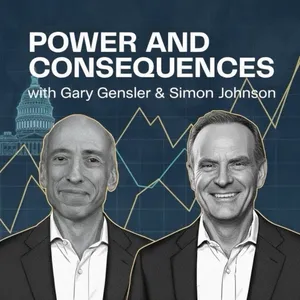
Every day seems to bring unprecedented news in the political sphere. But what exactly is happening, what is most important, and what is likely to stick around or provoke backslash? Professors Gary Gensler (former SEC chair) and Simon Johnson (Nobel Prize-winning economist) tackle a single policy topic each week, explaining how the events of today will affect you tomorrow.
Latest Episodes
The most recent episodes — sign up to get AI-powered summaries of each one.
- 3 days ago39 min
Episode 39: Bubbles, Chips & AI
Gary and Simon discuss the so-called “AI trade” and the economic challenges on the horizon from the AI capital expenditure boom — up fivefold this year in the last three years — to $800 billion. They explore the AI trade in the aftermath of Anthropic’s record IPO, Nvidia’s CEO Jensen Huang resignation, and the stock markets' recent swoon. Is the boom a bubble about to burst? Is today’s AI investment boom sustainable? Is it being financed in a way that could cause problems down the road (and soon)? Has slippage in lending terms, transparency, corporate governance, and financial reporting added to the investment boom and risks to the economy?A video version of Power and Consequences is now available on YouTube. Please visit that channel and subscribe for more episodes, including additional bonus short content: www.youtube.com/@PowerConsequencesFor bonus thoughts and recommended reading for each episode, visit powerandconsequences.com, where you can sign up for our newsletter!Host bios:Gary Gensler, former Chair of the Securities and Exchange Commission, is Professor of the Practice of Global Economics and Management, and Professor of the Practice of Finance, at MIT Sloan School of Management. His research focuses on artificial intelligence, finance, and economic policy. He previously served as Chairman of the Commodity Futures Trading Commission, Under Secretary of the Treasury for Domestic Finance, Assistant Secretary of the Treasury, Chair of the Maryland Financial Consumer Protection Commission, and Senior Advisor to Senator Paul Sarbanes. Earlier, Gensler was at Goldman Sachs for 18 years, where he became a partner.Simon Johnson, a 2024 Nobel laureate in economics and former Chief Economist at the International Monetary Fund, is the Ronald A. Kurtz Professor of Entrepreneurship at MIT Sloan School of Management, head of its Global Economics and Management group, and Co-Director of MIT’s Stone Center for Inequality and Shaping the Future of Work. He co-chairs the CFA Institute Systemic Risk Council and is an AI Ambassador for the UK. Simon is the author of 13 Bankers, Jump-Starting America, and Power and Progress: Our Thousand-Year Struggle Over Technology and Prosperity.Gary & Simon also recently co-edited, with Ugo Panizza and Beatrice Weder di Mauro, The Economic Consequences of the Second Trump Administration.
- 1 weeks ago38 min
Episode 38: Would You Bet Against Prediction Markets?
Gary and Simon discuss the latest developments—economic and legal—surrounding prediction markets. Lots has happened in the last eight months. Volumes have grown significantly. Traditional financial firms are partnering with prediction markets, and the public closely followed the betting on the midterm elections. Yet multiple insider trading cases have been brought. Legislation has been introduced to ban members of Congress and government from trading on the markets, and dozens of lawsuits are raging between states and tribal authorities on the one side and the Trump administration and prediction markets on the other. Will the current administration find new ways to put its thumb on the scales of justice?A video version of Power and Consequences is now available on YouTube. Please visit that channel and subscribe for more episodes, including additional bonus short content: www.youtube.com/@PowerConsequencesFor bonus thoughts and recommended reading for each episode, visit powerandconsequences.com, where you can sign up for our newsletter!Host bios:Gary Gensler, former Chair of the Securities and Exchange Commission, is Professor of the Practice of Global Economics and Management, and Professor of the Practice of Finance, at MIT Sloan School of Management. His research focuses on artificial intelligence, finance, and economic policy. He previously served as Chairman of the Commodity Futures Trading Commission, Under Secretary of the Treasury for Domestic Finance, Assistant Secretary of the Treasury, Chair of the Maryland Financial Consumer Protection Commission, and Senior Advisor to Senator Paul Sarbanes. Earlier, Gensler was at Goldman Sachs for 18 years, where he became a partner.Simon Johnson, a 2024 Nobel laureate in economics and former Chief Economist at the International Monetary Fund, is the Ronald A. Kurtz Professor of Entrepreneurship at MIT Sloan School of Management, head of its Global Economics and Management group, and Co-Director of MIT’s Stone Center for Inequality and Shaping the Future of Work. He co-chairs the CFA Institute Systemic Risk Council and is an AI Ambassador for the UK. Simon is the author of 13 Bankers, Jump-Starting America, and Power and Progress: Our Thousand-Year Struggle Over Technology and Prosperity.Gary & Simon also recently co-edited, with Ugo Panizza and Beatrice Weder di Mauro, The Economic Consequences of the Second Trump Administration.
- 2 weeks ago39 min
Episode 37: The Midterm Elections: What Just Happened?
Gary and Simon discuss the causes & policy implications of the US midterm elections. What are the political ramifications Democratic ‘blue tsunami’ for affordability, inflation, the rule of law, AI regulation, immigration, healthcare, and the Iran war? Is there potential for an impeachment vote of President Trump or has that ship sailed? How will this all play into the now just begun 2028 presidential election? They also discuss how the elections may affect consequential decisions facing the Federal Reserve on controlling inflation.A video version of Power and Consequences is now available on YouTube. Please visit that channel also for additional short content.For bonus thoughts and recommended reading for each episode, visit powerandconsequences.com, where you can sign up for our newsletter!Host bios:Gary Gensler, former Chair of the Securities and Exchange Commission, is Professor of the Practice of Global Economics and Management, and Professor of the Practice of Finance, at MIT Sloan School of Management. His research focuses on artificial intelligence, finance, and economic policy. He previously served as Chairman of the Commodity Futures Trading Commission, Under Secretary of the Treasury for Domestic Finance, Assistant Secretary of the Treasury, Chair of the Maryland Financial Consumer Protection Commission, and Senior Advisor to Senator Paul Sarbanes. Earlier, Gensler was at Goldman Sachs for 18 years, where he became a partner.Simon Johnson, a 2024 Nobel laureate in economics and former Chief Economist at the International Monetary Fund, is the Ronald A. Kurtz Professor of Entrepreneurship at MIT Sloan School of Management, head of its Global Economics and Management group, and Co-Director of MIT’s Stone Center for Inequality and Shaping the Future of Work. He co-chairs the CFA Institute Systemic Risk Council and is an AI Ambassador for the UK. Simon is the author of 13 Bankers, Jump-Starting America, and Power and Progress: Our Thousand-Year Struggle Over Technology and Prosperity.Gary & Simon also recently co-edited, with Ugo Panizza and Beatrice Weder di Mauro, The Economic Consequences of the Second Trump Administration.
- 3 weeks ago39 min
Episode 36: The Midterm Elections: What’s Next?
Gary and Simon discuss the U.S. midterm elections, focusing on consequences for Congress, the 2028 presidential elections, President Trump, and the public. Topics cover political messaging, congressional oversight (including possible impeachment efforts), legislative priorities, the 2028 elections, presidential primaries, and President Trump’s next two years. What will the elections mean on affordability, AI, healthcare, immigration, trade, and the Iran war? How will the midterms shift power dynamics going forward? How is Corporate America adapting its strategies in response? Most importantly, how might the next two years be crucial for American politics, governance, and you?A video version of Power and Consequences is now available on YouTube. Please visit that channel also for additional short content.For bonus thoughts and recommended reading for each episode, visit powerandconsequences.com, where you can sign up for our newsletter!Host bios:Gary Gensler, former Chair of the Securities and Exchange Commission, is Professor of the Practice of Global Economics and Management, and Professor of the Practice of Finance, at MIT Sloan School of Management. His research focuses on artificial intelligence, finance, and economic policy. He previously served as Chairman of the Commodity Futures Trading Commission, Under Secretary of the Treasury for Domestic Finance, Assistant Secretary of the Treasury, Chair of the Maryland Financial Consumer Protection Commission, and Senior Advisor to Senator Paul Sarbanes. Earlier, Gensler was at Goldman Sachs for 18 years, where he became a partner.Simon Johnson, a 2024 Nobel laureate in economics and former Chief Economist at the International Monetary Fund, is the Ronald A. Kurtz Professor of Entrepreneurship at MIT Sloan School of Management, head of its Global Economics and Management group, and Co-Director of MIT’s Stone Center for Inequality and Shaping the Future of Work. He co-chairs the CFA Institute Systemic Risk Council and is an AI Ambassador for the UK. Simon is the author of 13 Bankers, Jump-Starting America, and Power and Progress: Our Thousand-Year Struggle Over Technology and Prosperity.Gary & Simon also recently co-edited, with Ugo Panizza and Beatrice Weder di Mauro, The Economic Consequences of the Second Trump Administration.
- Oct 26, 202638 min
Episode 35: What Will The Fed Do Next?
Gary and Simon explore what’s next for the Federal Reserve - given inflation continues to be above their 2% target. How should the Fed navigate the Iran conflict continuing to keep energy and fertilizer prices elevated; the AI investment booming pushing up prices for chips, electricity, and construction; and high tariff rates? With bond yields pushing up borrowing costs while Europe grabbles with unrest over fiscal and debt imbalances, what might it mean for US inflation and employment growth. With sticky inflation and the US economy still running strong, when might the Fed raise rates again? How could a retrenchment of the AI investment boom or a new European debt crisis impact the US and Fed policy?A video version of Power and Consequences is now available on YouTube. Please visit that channel also for additional short content.For bonus thoughts and recommended reading for each episode, visit powerandconsequences.com, where you can sign up for our newsletter!Host bios:Gary Gensler, former Chair of the Securities and Exchange Commission, is Professor of the Practice of Global Economics and Management, and Professor of the Practice of Finance, at MIT Sloan School of Management. His research focuses on artificial intelligence, finance, and economic policy. He previously served as Chairman of the Commodity Futures Trading Commission, Under Secretary of the Treasury for Domestic Finance, Assistant Secretary of the Treasury, Chair of the Maryland Financial Consumer Protection Commission, and Senior Advisor to Senator Paul Sarbanes. Earlier, Gensler was at Goldman Sachs for 18 years, where he became a partner.Simon Johnson, a 2024 Nobel laureate in economics and former Chief Economist at the International Monetary Fund, is the Ronald A. Kurtz Professor of Entrepreneurship at MIT Sloan School of Management, head of its Global Economics and Management group, and Co-Director of MIT’s Stone Center for Inequality and Shaping the Future of Work. He co-chairs the CFA Institute Systemic Risk Council and is an AI Ambassador for the UK. Simon is the author of 13 Bankers, Jump-Starting America, and Power and Progress: Our Thousand-Year Struggle Over Technology and Prosperity.Gary & Simon also recently co-edited, with Ugo Panizza and Beatrice Weder di Mauro, The Economic Consequences of the Second Trump Administration.
- Oct 19, 202640 min
Episode 34: Where Is the Global Economic Cycle Headed?
Gary and Simon discuss the global economic cycle in the wake of IMF / World Bank annual meeting. Are growth and income still heading in a positive direction or is a worldwide slowdown imminent? With interest rates rising, high stock market valuations, inflation persistent, energy prices elevated, and unsustainable federal deficits, there are signs of growing economic and financial fragility in numerous economies currently dependent on the AI boom. Could we be facing a potential repeat of the bust after the Internet investment boom of the late 1990s? Or from the housing boom of 2005–8? While all global economic upswings share happy similarities, each global economic downswing is unhappy in its own way.A video version of Power and Consequences is now available on YouTube. Please visit that channel also for additional short content.For bonus thoughts and recommended reading for each episode, visit powerandconsequences.com, where you can sign up for our newsletter!Host bios:Gary Gensler, former Chair of the Securities and Exchange Commission, is Professor of the Practice of Global Economics and Management, and Professor of the Practice of Finance, at MIT Sloan School of Management. His research focuses on artificial intelligence, finance, and economic policy. He previously served as Chairman of the Commodity Futures Trading Commission, Under Secretary of the Treasury for Domestic Finance, Assistant Secretary of the Treasury, Chair of the Maryland Financial Consumer Protection Commission, and Senior Advisor to Senator Paul Sarbanes. Earlier, Gensler was at Goldman Sachs for 18 years, where he became a partner.Simon Johnson, a 2024 Nobel laureate in economics and former Chief Economist at the International Monetary Fund, is the Ronald A. Kurtz Professor of Entrepreneurship at MIT Sloan School of Management, head of its Global Economics and Management group, and Co-Director of MIT’s Stone Center for Inequality and Shaping the Future of Work. He co-chairs the CFA Institute Systemic Risk Council and is an AI Ambassador for the UK. Simon is the author of 13 Bankers, Jump-Starting America, and Power and Progress: Our Thousand-Year Struggle Over Technology and Prosperity.Gary & Simon also recently co-edited, with Ugo Panizza and Beatrice Weder di Mauro, The Economic Consequences of the Second Trump Administration.
- Oct 12, 202639 min
Episode 33: The IMF Annual Meetings - Why Should You Care?
Gary and Simon discuss the IMF / World Bank October annual meetings, why they matter and the history of these multilateral organizations. What do the world’s leading central bankers, finance ministers, and economic policy actors come together to discuss? What are the US, Europe, China & the Global South looking to achieve? Will there be any relevant action on continued energy price shocks; global sovereign debt levels, inflation, or AI’s economic effects? Will the US succeed in narrowing the World Bank's consideration of climate change when lending, and might other nations make progress on efforts to revise IMF quotas and voting - possibly diminishing US and Europe’s influence over IMF decisions?A video version of Power and Consequences is now available on YouTube. Please visit that channel also for additional short content.For bonus thoughts and recommended reading for each episode, visit powerandconsequences.com, where you can sign up for our newsletter!Host bios:Gary Gensler, former Chair of the Securities and Exchange Commission, is Professor of the Practice of Global Economics and Management, and Professor of the Practice of Finance, at MIT Sloan School of Management. His research focuses on artificial intelligence, finance, and economic policy. He previously served as Chairman of the Commodity Futures Trading Commission, Under Secretary of the Treasury for Domestic Finance, Assistant Secretary of the Treasury, Chair of the Maryland Financial Consumer Protection Commission, and Senior Advisor to Senator Paul Sarbanes. Earlier, Gensler was at Goldman Sachs for 18 years, where he became a partner.Simon Johnson, a 2024 Nobel laureate in economics and former Chief Economist at the International Monetary Fund, is the Ronald A. Kurtz Professor of Entrepreneurship at MIT Sloan School of Management, head of its Global Economics and Management group, and Co-Director of MIT’s Stone Center for Inequality and Shaping the Future of Work. He co-chairs the CFA Institute Systemic Risk Council and is an AI Ambassador for the UK. Simon is the author of 13 Bankers, Jump-Starting America, and Power and Progress: Our Thousand-Year Struggle Over Technology and Prosperity.Gary & Simon also recently co-edited, with Ugo Panizza and Beatrice Weder di Mauro, The Economic Consequences of the Second Trump Administration.
- Oct 5, 202637 min
Episode 32: How Much Trouble is Europe In?
Gary and Simon explore the economic & political challenges facing Europe, tackling the impact of the Euro and the tensions arising from immigration and energy dependence. Why hasn't the EU's project to create a unified economy fully succeeded? Why have Europe's capital markets remained fragmented and how has the Euro possibly held Europe back? What has led to the rise of nationalist, euro-sceptic, anti-immigration political parties and what does it mean for Europe’s future? As Europe has fallen behind US IT for decades now, what will the rise of AI mean for Europe and its challenges?A video version of Power and Consequences is now available on YouTube. Please visit that channel also for additional short content.For bonus thoughts and recommended reading for each episode, visit powerandconsequences.com, where you can sign up for our newsletter!Host bios:Gary Gensler, former Chair of the Securities and Exchange Commission, is Professor of the Practice of Global Economics and Management, and Professor of the Practice of Finance, at MIT Sloan School of Management. His research focuses on artificial intelligence, finance, and economic policy. He previously served as Chairman of the Commodity Futures Trading Commission, Under Secretary of the Treasury for Domestic Finance, Assistant Secretary of the Treasury, Chair of the Maryland Financial Consumer Protection Commission, and Senior Advisor to Senator Paul Sarbanes. Earlier, Gensler was at Goldman Sachs for 18 years, where he became a partner.Simon Johnson, a 2024 Nobel laureate in economics and former Chief Economist at the International Monetary Fund, is the Ronald A. Kurtz Professor of Entrepreneurship at MIT Sloan School of Management, head of its Global Economics and Management group, and Co-Director of MIT’s Stone Center for Inequality and Shaping the Future of Work. He co-chairs the CFA Institute Systemic Risk Council and is an AI Ambassador for the UK. Simon is the author of 13 Bankers, Jump-Starting America, and Power and Progress: Our Thousand-Year Struggle Over Technology and Prosperity.Gary & Simon also recently co-edited, with Ugo Panizza and Beatrice Weder di Mauro, The Economic Consequences of the Second Trump Administration.
About Power and Consequences
Every day seems to bring unprecedented news in the political sphere. But what exactly is happening, what is most important, and what is likely to stick around or provoke backslash? Professors Gary Gensler (former SEC chair) and Simon Johnson (Nobel Prize-winning economist) tackle a single policy topic each week, explaining how the events of today will affect you tomorrow.
Customized Recaps
AI-powered recaps with compact key takeaways, quotes, and insights.
Straight to Your Inbox
Get key takeaways from Power and Consequences in a 5-minute read.
Save Hours Every Week
Stay current on your favorite podcasts without falling behind.
Frequently Asked Questions
What is Podzilla's Power and Consequences daily summary?
It's a free AI-powered email that summarizes new episodes of Power and Consequences as soon as they're published. You get the key takeaways, notable quotes, and links & mentions — all in a quick read.
How does the Power and Consequences podcast summary work?
When a new episode drops, our AI transcribes and analyzes it, then generates a personalized summary tailored to your interests and profession. It's delivered to your inbox every morning.
Is this an official Power and Consequences product?
No. Podzilla is an independent service that summarizes publicly available podcast content. We're not affiliated with or endorsed by Third Clumber Productions.
Can I get summaries of other podcasts too?
Absolutely! The free plan covers up to 3 podcasts, any in the catalog. Basic raises that to 15, Pro to 40 and Max to 100. Browse our full catalog at /podcasts.
What topics does Power and Consequences cover?
Power and Consequences covers topics including News, Technology, Education, Politics. Our AI identifies the specific themes in each episode and highlights what matters most to you.
Start getting Power and Consequences summaries tomorrow morning.
Free forever for up to 3 podcasts. No credit card required.
Free forever for up to 3 podcasts. No credit card required.