Free Daily Podcast Summary
Policing In America: Daily Summaries Delivered
by Tom Datro
Get key takeaways, quotes, and insights from Policing In America in a 5-minute read. Delivered straight to your inbox.
Latest Episodes
The most recent episodes — sign up to get AI-powered summaries of each one.
- Apr 7, 20261h 44m
Inside the Kill Zone - The Psychology of Police Deadly Force.
David A. Klinger is a professor of Criminology and Criminal Justice at the University of Missouri-St. Louis, a researcher of deadly force, and the author of Into the Kill Zone: A Cop's Eye View of Deadly Force, His publications are numerous and a simple Google search will reveal several incredible papers and articles penned by Prof Klinger. I hope you enjoy the episode as much as I enjoyed recording it!
- Mar 23, 20261h 8m
When Justice Fails Survivors: Punishment, Healing, and the Truth We Avoid
This episode I had the honor of speaking with the wonderful and amazing Marlee Liss. Marlee is single-handedly changing how justice looks and feels - depsite centuries of traditional punishment systems. Marlee's work has been featured in Forbes, Huff Post, Buzzfeed, the Mel Robbins Show and more. As an award-winning speaker, she's delivered talks for: National Sexual Assault Conference, Vanderbilt University, University of Toronto, Action Trauma Summit, Women's Mental Health Conference at Yale and more. Her story was made into a documentary directed by Kelsey Darragh titled, 'The Limits of Forgiveness,' and her book on re-imagining justice will be released with Penguin Random House in Spring 2027. Learn more at @marleeliss and @survivors4justicereform learn more about Marlee and support her work here: instagram - https://www.instagram.com/marleeliss/ https://www.instagram.com/survivors4justicereform/ https://www.marleeliss.com/speaking https://www.survivors4justicereform.com/
- Feb 19, 20261h 42m
When biology meets the badge.
In this episode, I sit down with Professor Steven James of Washington State University to explore one of the most overlooked variables in modern policing: sleep. We talk about what happens when human physiology collides with high-stakes decision-making — and how chronic fatigue quietly shapes reaction time, emotional regulation, judgment, and public safety outcomes. If we demand professionalism, restraint, and precision from officers, are we designing systems that support those expectations — or undermine them? This conversation challenges leaders to rethink accountability, scheduling, and what evidence-based policing really requires. https://medicine.wsu.edu/directory/wsu-profile/stevejames/
- Dec 1, 20251h 2m
The Future of Police is Already Here
In this episode we speak with James Bueermann. Chief Jim Bueermann (ret.) is the Founder and President of the Future Policing Institute, a think tank dedicated to advancing policing that is effective, empathetic and just. He has been involved in various aspects of policing since 1978. From 1978 to 2011 he was a member of the Redlands Police Department (CA). His last 13 years with the RPD he served as the Chief of Police and Director of Housing, Recreation and Senior Services. After his retirement in 2011, he worked for a year for the USDOJ, National Institute of Justice as an Executive Fellow. In 2012 he was appointed the president of the National Police Foundation (now the National Policing Institute), America's oldest non-partisan, non-profit police research organization. He retired from the Foundation in late 2018. James now runs the Future Policing Institute and what he has to say about policing and the future is sure to excite and scare you!
- Oct 27, 20251h 17m
The RISE of Rashmi Airan
In this gripping episode, I sit down with Rashmi Airan, whose fall from grace exposed the quiet power of rationalization, cultural pressure, and the slow erosion of integrity. From the courtroom to a prison camp, Rashmi's story is a masterclass in how smart people can make devastating choices—and how redemption starts with radical honesty. For law enforcement professionals, this isn't just a cautionary tale—it's a mirror. We explore: The slippery slope of "just this once" How ethical drift sneaks into every profession Why accountability isn't about punishment—it's about prevention And what it really means to lead with values when no one's watching If you think it can't happen to you... tune in.
- May 1, 20251h 25m
The Real Operative: Inside Child Trafficking with Paul Hutchinson
By far the most emotional podcast I have done. Paul Hutchinson is a modern day hero. He has walked through the gates of hell to meet the Devil himself in order to save the most innocent among us. Please enjoy this episode! If you want to support Paul (see below) Get the first 3 chapters of Paul's book for free: soundoffreedombook.com Websites: Liberating Humanity Website: liberating-humanity.com Child Liberation Foundation Website: childliberation.org Social: Instagram: instagram.com/liberating.humanity Facebook: facebook.com/liberating.humanity TikTok: tiktok.com/@liberating.humanity X: x.com/paulhutchinson Youtube: youtube.com/@liberatinghumanity LinkedIn: linkedin.com/in/paulhutch
- Apr 10, 20251h 4m
Leaving the X - Lessons from a CIA Operator
Former CIA counterterrorism officer Michele Rigby Assad joins us to talk espionage, fear, intuition, and how to own your presence in the world's most dangerous places. This isn't Jason Bourne, because that's Hollywood. Michele lived that life without any safety nets. Often times she was alone and her only "weapons" were her abilities to read the situation and make the best decisions available; to get off the X and act. You can find Michele here https://michelerigbyassad.com/ You can fund her book here https://www.amazon.com/s?k=get+off+the+x+book&adgrpid=1344705197077485&hvadid=84044349456447&hvbmt=be&hvdev=c&hvlocphy=48792&hvnetw=o&hvqmt=e&hvtargid=kwd-84045198700376%3Aloc-190&hydadcr=22537_13494504&mcid=2777b98fad5c3c2ea27572c6945247d4&msclkid=0e7c973bfdb31a839009f0cc4539e9cc&tag=mh0b-20&ref=pd_sl_2fznzhylmu_e
- Mar 25, 20251h 2m
Too Many Rules, Too Little Thinking
In this episode, Sgt Tom sits down with Professor, philosopher, and martial artist Barry Lam to unpack the hidden costs of rule-heavy systems in high-stakes professions like policing. Together, they explore why too many rules can actually undermine judgment, initiative, and moral reasoning on the front lines. From the ethics of discretion to the neuroscience of decision-making, this conversation challenges the idea that more policy equals better outcomes. What if better training in judgment—not more rules—is the key to better policing? Tune in for a conversation that bridges street-level experience with deep philosophical insight. Find Barry here https://www.linkedin.com/in/barry-lam-54ba0b15/ Find Barry's book here https://www.amazon.com/s?k=fewer+rules+better+people&crid=2DTXP9X3R0OP9&sprefix=fewer%2Caps%2C286&ref=nb_sb_ss_mvt-t9-ranker_1_5 Listen to Barry's podcast here https://hiphination.org/
Get Policing In America summaries in your inbox
Free AI-powered daily recaps. Key takeaways, quotes, and mentions — in a 5-minute read.
Get Free Summaries →Free forever for up to 3 podcasts. No credit card required.
You Might Also Like
Listeners also like.
Street Cop Podcast
Street Cop Training
Things Police See: Firsthand Accounts
Steven Gould: Police Officer, Background Investigator
Behind the Police
Cool Zone Media and iHeartPodcasts

The Coptimizer Podcast
Patrick Flannelly, Bleav
Guardian Mindset Podcast
Attorney Eric Daigle
Cops, Criminals, and Christ
Dale Sutherland
Chapter Blue
Tyra Valeriano
Law Enforcement Talk: True Crime and Trauma Stories
John "Jay" Wiley, Bleav

Beyond The Barrel Podcast
Beyond The Barrel Podcast
Headlong: Running from COPS
Topic / Pineapple Street Media / Dan Taberski
Police Off The Cuff/Real Crime Stories
Bill Cannon Police off the Cuff/Real Crime Stories

The Blue Light Diaries
Sharon Williams - Blue Light Counselling
About Policing In America
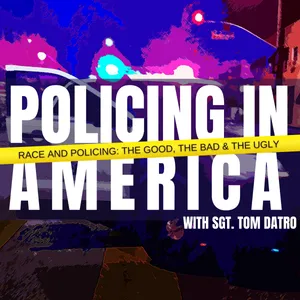
Welcome to Policing in America – a podcast about race and policing: the good, the bad and the ugly. The goal? To have, at times, uncomfortable conversations to spark positive change. Your host is currently the Officer in Charge of a unit that creates, delivers and maintains police training in the largest urban police department on the west coast of America: Sergeant Tom Datro.
Customized Recaps
AI-powered recaps with compact key takeaways, quotes, and insights.
Straight to Your Inbox
Get key takeaways from Policing In America in a 5-minute read.
Save Hours Every Week
Stay current on your favorite podcasts without falling behind.
Frequently Asked Questions
What is Podzilla's Policing In America daily summary?
It's a free AI-powered email that summarizes new episodes of Policing In America as soon as they're published. You get the key takeaways, notable quotes, and links & mentions — all in a quick read.
How does the Policing In America podcast summary work?
When a new episode drops, our AI transcribes and analyzes it, then generates a personalized summary tailored to your interests and profession. It's delivered to your inbox every morning.
Is this an official Policing In America product?
No. Podzilla is an independent service that summarizes publicly available podcast content. We're not affiliated with or endorsed by Tom Datro.
Can I get summaries of other podcasts too?
Absolutely! The free plan covers up to 3 podcasts. Upgrade to Pro for 15, or Premium for 50. Browse our full catalog at /podcasts.
How often does Policing In America release new episodes?
Policing In America publishes monthly. Our AI generates a summary within hours of each new episode.
What topics does Policing In America cover?
Policing In America covers topics including News, Commentary, Philosophy, Culture, Society & Culture. Our AI identifies the specific themes in each episode and highlights what matters most to you.
Start getting Policing In America summaries tomorrow morning.
Free forever for up to 3 podcasts. No credit card required.
Free forever for up to 3 podcasts. No credit card required.