Free Daily Podcast Summary
Playful Nature Podcast by WildStrong: Daily Summaries Delivered
by WildStrong
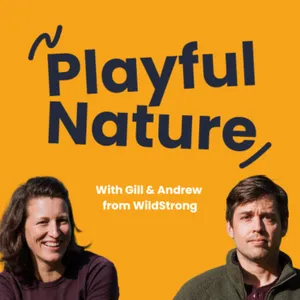
A Podcast that explores connection through movement, nature & community, with Gill Erskine & Andrew Telfer from WildStrong. A mix of discussions on questions that come up a lot during our movement courses and classes and some long form chats with people we admire. Music by our long time supporter, Mary Erskine @meforqueen 🌐 www.wildstrong.co
Latest Episodes
The most recent episodes — sign up to get AI-powered summaries of each one.
- 4 days ago1h 9m
#53. Lydia Durkin George. Pelvic Floor Health Across Your Lifetime
Lydia Durkin George is a physiotherapist, researcher and former international kickboxer. She represented Great Britain for more than a decade and has since worked across the NHS, private practice and elite sport. She is also the founder of Form.at.Physio, an online physiotherapy practice supporting people across the UK.We wanted to have this conversation because pelvic health comes up regularly among women taking part in Strong for Life. People often assume that leaking, prolapse or other pelvic-floor symptoms mean strength training, running and higher-impact movement are no longer available to them.It is also personal for Gill. After having children, she stopped running partly because of leaking and gradually accepted that this was simply how things were now. Years later, working with a pelvic-health physiotherapist showed her that change was possible. The process - finding a starting point, gradually building capacity and working towards something meaningful - had much more in common with ordinary strength and movement training than she had realised.Gill and Lydia discuss what the pelvic floor is and what it does; symptoms that aren’t always recognised as pelvic-health issues; the difference between a weak and a non-relaxing pelvic floor; and what effective rehabilitation can involve. They also talk about the effect these symptoms can have on confidence, independence and everyday life, and how people can work towards returning to running, lifting and the activities that matter to them.This conversation provides general information and is not a substitute for an individual assessment or medical advice. If you are concerned about pelvic-health symptoms, speak to your GP or a suitably qualified pelvic-health physiotherapist.LinksLydia Durkin George and Form.at.Physio About LydiaBook an online physiotherapy appointmentFind a pelvic-health physiotherapistPOGP physiotherapist directoryPelvic-floor muscle exercise supportSqueezy appMusic by Me for Queen
- 1 weeks ago38 min
#52. Gill & Andrew. What makes exercise stick?
How do you actually keep going?Last week we ran our webinar “What can you do in 20 minutes?” We covered what the research tells us about strength and impact for bone density, what an effective strength programme might actually look like, three movements we’d choose as a starting point, and how to add or take away challenge depending on where you are.Beforehand, we’d sent out a questionnaire asking what gets in the way. And well over half the answers came back to the same thing: consistency. How on earth do you keep going when life throws in its usual selection of spanners?We touched on it in the webinar, but there was much more we wanted to say. So this week’s podcast is the more detail.Andrew and I are VERY different when it comes to exercise. He can happily exercise by himself. I can’t. I need other people, whether that’s in person or online. I need people to show up with, talk to, hear their stories and generally make the whole thing part of something bigger than me and my good intentions.We talk about why short-term goals can be much more useful than the idea of training for “future you.” Training for your health in 20 years is absolutely valid, but it doesn't necessarily get you out of bed this morning. Something a few months away that feels exciting and just slightly out of reach might.We also look at the friction between fitness messaging, which so often puts everything on the individual, and what behaviour-change research tells us about how much our environment and social context influence what we actually do.And we look at a few models you can use to work out what's standing in your way, and what you might change to make exercise an easier choice rather than something you constantly have to make yourself do.Because motivation will only get any of us so far.How can you make it NEAR (Normal, Easy, Attractive, Routine)?Hope it’s helpful. You also get to meet Sarah the Cockerel, who makes himself known in the background.Here's the link to the webinar we ran.Seligman’s PERMA+ Model Explained: A Theory of WellbeingThe home of the COM-B ModelNEAR Framework
- 2 weeks ago1h 19m
#51 Beth Kelley- Who Decided Adults Should Stop Playing?
At what age does playing outside start to feel embarrassing? Beth Kelley is a play researcher and anthropologist whose early research explored parkour as a form of free-form adult play. She has spent nearly 20 years thinking about how and why we play - and what happens when the environments and cultures around us make play increasingly difficult.We talk about risky play and parenting, why teenagers and adults can feel conspicuous playing in public, and how different cultures have created spaces where adult play is normal. Beth also tells the story of a video of herself playing on some bike racks that went viral - and why the reaction wasn't really about whether she was good or bad at it, but whether an adult should be doing it at all.That leads us into the fear of looking "cringe", why social media gives us endless examples of experts and spectacular failures but surprisingly little ordinary participation, and Beth's idea that play is a process rather than a performance.Towards the end, we talk about technology, community, why Beth chose to leave the tech industry, and the small acts of "rogue play" that can make our neighbourhoods feel like places we're allowed to play again.Conversation outline02:23 — Beth’s background, anthropology and studying adult play through parkour09:51 — What is play? Choice, motivation, enjoyment and flow12:29 — Video games, gamification and the quantified self18:42 — Risky play, parenting and the pressure to keep children safe22:08 — Playgrounds, neighbourhoods and the built environment26:23 — When do teenagers and adults lose permission to play?29:10 — Adult play in other cultures and throughout history32:03 — Strength in numbers: making adult play socially acceptable36:51 — Why you can’t simply tell adults to “go and play”40:51 — When play becomes another thing to optimise and perform43:39 — Beth’s viral bike-rack video and the reaction to it46:28 — Experts, failures and the missing middle online47:58 — Fear of “cringe”, being messy and getting things wrong49:33 — Surveillance, smart glasses and what happens when we’re always observable53:07 — Remote work, physical presence and everyday social contact57:11 — Third spaces, weak ties and the small interactions we’ve lost1:01:11 — AI, technology and the loss of human interaction1:05:11 — Why Beth decided to leave the tech industry1:07:53 — Analogue life, community and opting out of optimisation1:13:02 — Building physical spaces for play and community1:14:57 — “Rogue play”: small ways to invite play into our neighbourhoodsBeth's writing: https://substack.com/@bethkelleyBeth on Instagram: https://www.instagram.com/mbethkelley/Beth's website: https://bethkelleyportfolio.com/Beth's research, Moving Like a Kid Again: An Analysis of Parkour as Free-Form Adult Play: https://cedar.wwu.edu/wwuet/165
- Aug 23, 202657 min
#50 Dr Katie Fitton Davies. Rethinking how we teach movement in childhood
Dr Katie Fitton Davies joins Andrew Telfer to explore how nonlinear pedagogy and gamification can make movement more meaningful for children and adults.Katie explains how coaches, teachers and parents can create playful environments that encourage people to experiment, adapt and discover their own movement solutions - instead of prescribing a single “correct” technique.Together they explore:The principles of nonlinear pedagogyRepresentative learning design and perception-action couplingUsing constraints to encourage exploration and adaptabilityThe STEP framework: space, time, equipment and peopleUsing questions and analogies to create an external focusGamification beyond points and badgesIntrinsic motivation, autonomy and lifelong physical activityCreating psychologically safe environments for movementKatie also shares a space-themed, parent-led intervention in which children completed movement missions and earned stars. The programme improved both stability and cognitive skills.When people have opportunities to play, explore and solve problems, they can build confidence, physical literacy and a lasting relationship with movement.Dr Katie Fitton Davies is a Senior Lecturer in Physical Education and Movement Sciences at Liverpool John Moores University. Her research explores physical education, nonlinear pedagogy, motivation, motor competence and physical activity, with a particular focus on creating meaningful movement experiences for children. Before joining LJMU, Katie worked as a Research Fellow at Coventry University, developing school-based physical activity and exercise interventions.
- Aug 8, 20261h 10m
#48 Dan Tatton. Does the fitness industry do more harm than good?
How can we get non-movers moving?Is marketing in the fitness industry counterproductive?How can we expand people’s capabilities in a way that doesn’t feel like too much work?Dan grew up in a small town in Canada and fell in love with movement from a young age, playing every sport he could at school. He later earned a masters in Education, discovered entrepreneurship and fitness, and went on to found the company Seven Movements, the company that pioneered movement snacking and delivering accessible exercise programming to individuals facing barriers to traditional fitness routines.When Dan wanted to help his grandma to feel better and stronger, but realised the gym would be too intimidating for her, he started giving her small, one-minute movement sessions to prepare her for workouts. The aim was to avoid overwhelming her and help her step outside of her “movement bubble.” This is where the idea of “movement snacking” came into play.Andrew and Dan discuss the importance of giving the right dose of exercise at the right time and taking the individual into consideration, rather than focusing on the content that creates attention.How often there is too much focus on optimality, while ignoring the fact that something is always better than nothing.How Movement snacking is a tool that helps people successfully participate in forms of exercise they may previously have felt unable to do.If you’d like to learn more about Dan Tattons work, follow him on LinkedInVisit the Seven movements website.Music from Me for Queen
- Jul 5, 202657 min
#48. Erin Eleu. We Stay Active When We Stay Connected
Movement is about far more than muscles, mobility or exercise programmes. At its best, it helps people build confidence, connection and a greater sense of belonging.In this returning conversation, Andrew sits down once again with Erin Eleu, founder of Agents of Movement, to explore how her thinking has evolved over the past 18 months. Together they discuss why movement leaders should think beyond sets and reps, why community may be one of our most powerful health interventions, and why the way we deliver movement experiences often matters just as much as the activities themselves.They also explore why traditional "fall prevention" messaging often misses the mark, and how reframing the conversation around confidence, capability and resilience could encourage far more people to stay active throughout later life.Why movement is a vehicle for connection, not just exerciseThe difference between what we teach and how we teach itBuilding communities that people genuinely want to return toThe role of language in shaping confidence and self-beliefWhy "suitable for all levels" is rarely helpfulThe concept of social frailty and how isolation affects physical capabilityMoving beyond fear-based approaches to fall preventionWhy learning to fall should be considered a lifelong movement skillThe importance of playful movement throughout adulthoodHelping people become more adaptable, confident moversWhy older adults should be viewed as creators and leaders, not just consumersCreating movement experiences that foster belonging, curiosity and joyIf you'd like to learn more about Erin's work, visit Agents of Movement and explore her podcast, webinars and learning community.Enjoyed this conversation?We also recommend Erin's previous appearance on the Playful Nature Podcast (See Episode 7), where we explored play, movement, ageing and creating richer movement experiences. Together, the two conversations provide a fascinating look at how Erin's thinking has developed over the past 18 months.Music from Me For Queen.
- Jun 25, 202646 min
#47 Gill & Andrew. The Body Image Industry
It's one of the questions we're asked most often, especially around our strength courses. Will I lose weight? Will I tone up? Will this change my body?In this episode, Andrew and I go for a walk and talk through the many reasons why we deliberately avoid making those promises.We talk about growing up in the 90s and the era of Heat magazine, celebrity "circle of shame" features and the diet culture, before exploring how today's fitness industry continues to market health through insecurity, before-and-after photos and unrealistic body ideals.Drawing on Andrew's experience working in commercial gyms and then moving into public health, we discuss the difference between pain-point marketing and what the evidence tells us about lasting behaviour change. We ramble around a few bit and touch on bodybuilding, social media, steroids, GLP-1 drugs, optimisation culture, AI-generated fitness content.Rather than asking "How can I change my body?", perhaps a better question is:"What do I want my body to help me do?"In this episodeWhy WildStrong doesn't use before-and-after photosGrowing up with 1990s diet culture and celebrity magazinesHow commercial gyms are taught to market through people's insecuritiesPain points versus opportunity: what behaviour change research actually saysThe illusion of control in modern fitness cultureOrthorexia, optimisation and the "spreadsheetification" of healthWhy today's physique standards are so different from previous generationsSteroids, bodybuilding and changing expectationsHugh Jackman, Hollywood and social media physiquesGLP-1 drugs, AI influencers and the future of body imageWhat people really mean when they ask if a programme will "tone" themWhy capability may be a more meaningful goal than aestheticsMentioned in this episodeHeat magazine's "Circle of Shame"Kate Winslet and media coverage following TitanicJoe WicksEugene SandowMr Universe and Mr OlympiaHugh JackmanGLP-1 medications (including Ozempic)OrthorexiaCOM-B behaviour change modelSocial determinants of healthKill All Normies by Angela NagleIf you enjoyed this episode, we'd love it if you subscribed, left a review or shared it with someone who might find it useful.Thank you!
- Jun 19, 20261h 1m
#46. Dr Nikita Rowley. The Gap Between Knowing & Doing
Why do so many of us struggle to become more active when we already know exercise is good for us?In this episode, Andrew speaks with Dr Nikita Rowley, Chartered Psychologist and researcher at Coventry University, about the psychology of behaviour change, exercise referral schemes, physical activity pathways and which interventions help people move more.Drawing on her PhD research evaluating exercise referral schemes across England, Nikita shares surprising findings about who these programmes are reaching, why confidence may be one of the most important outcomes we can measure, and why a gym membership isn't necessarily the answer for everyone.The conversation explores the gap between intention and action, the importance of creating multiple pathways into movement, and how healthcare professionals, coaches and communities can better support people to become more active.Towards the end of the episode, Andrew and Nikita discuss GLP-1 medications, sustainable behaviour change and why meaningful activities often matter more than fitness metrics.If you’re a practitioner, this episode is a great listen.Resources that came up:NICE PH54: Exercise Referral Schemes to Promote Physical Activity - NICE PH54 Exercise Referral Schemes GuidancePhysical Activity Guidelines - World Health Organization (WHO) Physical Activity Guidelines - WHO Physical Activity GuidelinesSusan Michie and the Behaviour Change Wheel - Nikita and Andrew discuss the challenge of turning intention into action. Behaviour Change WheelInternational Physical Activity Questionnaire (IPAQ) - One of the tools discussed in relation to measuring physical activity levels within exercise referral schemes. International Physical Activity Questionnaire (IPAQ)If you enjoyed this episode, please subscribe, leave a review and share it with someone interested in movement, health, behaviour change or helping more people become active.
About Playful Nature Podcast by WildStrong
A Podcast that explores connection through movement, nature & community, with Gill Erskine & Andrew Telfer from WildStrong. A mix of discussions on questions that come up a lot during our movement courses and classes and some long form chats with people we admire. Music by our long time supporter, Mary Erskine @meforqueen 🌐 www.wildstrong.co
Customized Recaps
AI-powered recaps with compact key takeaways, quotes, and insights.
Straight to Your Inbox
Get key takeaways from Playful Nature Podcast by WildStrong in a 5-minute read.
Save Hours Every Week
Stay current on your favorite podcasts without falling behind.
Frequently Asked Questions
What is Podzilla's Playful Nature Podcast by WildStrong daily summary?
It's a free AI-powered email that summarizes new episodes of Playful Nature Podcast by WildStrong as soon as they're published. You get the key takeaways, notable quotes, and links & mentions — all in a quick read.
How does the Playful Nature Podcast by WildStrong podcast summary work?
When a new episode drops, our AI transcribes and analyzes it, then generates a personalized summary tailored to your interests and profession. It's delivered to your inbox every morning.
Is this an official Playful Nature Podcast by WildStrong product?
No. Podzilla is an independent service that summarizes publicly available podcast content. We're not affiliated with or endorsed by WildStrong.
Can I get summaries of other podcasts too?
Absolutely! The free plan covers up to 3 podcasts. Upgrade to Pro for 15, or Premium for 50. Browse our full catalog at /podcasts.
How often does Playful Nature Podcast by WildStrong release new episodes?
Playful Nature Podcast by WildStrong publishes biweekly. Our AI generates a summary within hours of each new episode.
What topics does Playful Nature Podcast by WildStrong cover?
Playful Nature Podcast by WildStrong covers topics including Fitness, Health & Fitness. Our AI identifies the specific themes in each episode and highlights what matters most to you.
Start getting Playful Nature Podcast by WildStrong summaries tomorrow morning.
Free forever for up to 3 podcasts. No credit card required.
Free forever for up to 3 podcasts. No credit card required.