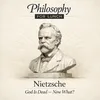
Nietzsche is probably the most misread philosopher in the Western tradition. He has been claimed by Nazis, nihilists, self-help gurus, and people who have read a sentence or two and decided they understood the argument. In this episode, Shawn and Claire try to read him honestly.The death of God is not a celebration of atheism. It is a description of a cultural catastrophe — the collapse of the metaphysical foundation that gave Western civilization its framework of meaning, its account of objective value, its story of human purpose. The madman is not triumphant. He is horrified. And his warning is that most people have not yet understood what has actually happened.What follows from that collapse is Nietzsche's real philosophical project: the question of whether values can be rebuilt on a genuinely human foundation — not inherited from a divine authority, not grounded in comfortable mediocrity, but created through what he calls self-overcoming. The episode covers what Nietzsche actually meant by the will to power (not domination of others but mastery of oneself), what the Übermensch is and is not, why eternal recurrence is best understood as an ethical test rather than a metaphysical claim, and what amor fati — love of fate — asks of a person who takes it seriously.The Nazi appropriation of Nietzsche was a deliberate distortion. The episode explains how it happened, why it was wrong, and what the actual texts say — drawing on Walter Kaufmann's essential scholarly recovery of Nietzsche's real work.His questions are still the most urgent ones that Western civilization has not yet answered. We are still, in important ways, living in the transitional fog he described.Shawn and Claire together. No prior philosophy required.SHOW NOTESPrimary SourcesNietzsche, F. (2001). The Gay Science (B. Williams, Ed.; J. Nauckhoff, Trans.). Cambridge University Press. (Original work published 1882)Nietzsche, F. (2006). Thus Spoke Zarathustra (A. Del Caro, Trans.). Cambridge University Press. (Original work published 1883–1885)Nietzsche, F. (2002). Beyond Good and Evil (J. Norman, Trans.). Cambridge University Press. (Original work published 1886)Nietzsche, F. (1998). On the Genealogy of Morality (M. Clark & A. Swensen, Trans.). Hackett Publishing. (Original work published 1887)Nietzsche, F. (1998). Twilight of the Idols (D. Large, Trans.). Oxford University Press. (Original work published 1889)Biographical & ContextualKaufmann, W. (1974). Nietzsche: Philosopher, Psychologist, Antichrist (4th ed.). Princeton University Press. (The essential scholarly recovery of Nietzsche from distortion — still the best starting point.)Safranski, R. (2002). Nietzsche: A Philosophical Biography (S. Frisch, Trans.). Norton.Accessible Starting PointsKaufmann, W. (Ed. & Trans.). (1954). The Portable Nietzsche. Viking. (The best single-volume introduction to Nietzsche's actual texts.)Camus, A. (1991). The Myth of Sisyphus (J. O'Brien, Trans.). Vintage. (Camus's response to the same problem Nietzsche diagnosed.)New episodes every Monday. Philosophy for Lunch · Big ideas. Human conversations.
Podzilla Summary coming soon
Sign up to get notified when the full AI-powered summary is ready.
Free forever for up to 3 podcasts. No credit card required.
Listen to This Episode
More from Philosophy for Lunch
Episode #023 - Wittgenstein: Language, Meaning, and the Limits of What Can Be Said
Episode #022 - The Golden Rule Across Cultures
Episode #021 - Sartre: Existence, Freedom, and Bad Faith
Episode #020 - Was Mathematics Invented or Discovered?
Get summaries like this every morning.
Free AI-powered recaps of Philosophy for Lunch and your other favorite podcasts, delivered to your inbox.
Free forever for up to 3 podcasts. No credit card required.