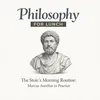
Episode #002 - The Stoic's Morning Routine: Marcus Aurelius in Practice
There's a book that has been in print for nearly two thousand years — and it was never meant to be published. Marcus Aurelius, emperor of Rome, wrote the Meditations entirely for himself: no audience, no posterity, no performance. Just a man on a military campaign, before dawn, talking himself into facing the day.In this episode, Shawn and Claire dig into what the Meditations actually says — and it's not what most people expect. This is not a serene philosopher-king who had it figured out. This is an anxious, grieving, endlessly self-correcting human being who happened to run the most powerful empire on earth. His morning practice wasn't about achieving peace. It was about trying to become the person he wanted to be, one day at a time.We cover the Stoic dichotomy of control (what's up to you vs. what isn't), why memento mori is a tool for gratitude and not despair, the "view from above" technique for stopping a mental spiral, and why Marcus's daily practice looks a lot like what modern cognitive behavioral therapy discovered two thousand years later.If you've ever woken up with your mind already running ahead of you — already anxious, already rehearsing grievances — this episode is for you.No prior philosophy required.SHOW NOTESPrimary SourcesAurelius, M. (2002). Meditations (G. Hays, Trans.). Modern Library. (The best modern translation — readable, precise, and beautifully introduced.)Epictetus. (2008). Discourses and Selected Writings (R. Dobbin, Trans.). Penguin Classics.Epictetus. (1983). Handbook (Enchiridion) (N. P. White, Trans.). Hackett Publishing.Biographical & ContextualMcLynn, F. (2009). Marcus Aurelius: A Life. Da Capo Press.Birley, A. R. (1987). Marcus Aurelius: A Biography (rev. ed.). Yale University Press.Works Referenced in This EpisodeRobertson, D. (2019). How to Think Like a Roman Emperor. St. Martin's Press. (Excellent bridge between Stoicism and modern CBT.)Holiday, R., & Hanselman, S. (2016). The Daily Stoic. Portfolio/Penguin.Oettingen, G. (2014). Rethinking Positive Thinking. Current. (The research behind implementation intention and mental contrasting.)Accessible Starting PointsPigliucci, M. (2017). How to Be a Stoic. Basic Books.Irvine, W. B. (2009). A Guide to the Good Life: The Ancient Art of Stoic Joy. Oxford University Press.New episodes every Sunday. Philosophy for Lunch · Big ideas. Human conversations.
Podzilla Summary coming soon
Sign up to get notified when the full AI-powered summary is ready.
Free forever for up to 3 podcasts. No credit card required.
Listen to This Episode
More from Philosophy for Lunch
Episode #008 - Cognitive Bias: The Philosophy Behind the Shortcuts
Episode #007 - Gödel's Incompleteness Theorem: The Proof That Broke Mathematics
Episode #006 - Aristotle's Happiness: Why Feeling Good Is Not the Same as Living Well
Episode #005 - The Philosophy of Grief: What the Best Thinkers Actually Said About Loss
Get summaries like this every morning.
Free AI-powered recaps of Philosophy for Lunch and your other favorite podcasts, delivered to your inbox.
Free forever for up to 3 podcasts. No credit card required.