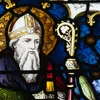
These stories likely seem silly today.They’re not real, right? Like, did they really happen? What does the historical record say?My answer to these aligns pretty closely with why I’m sharing them. There’s a lot we have to untangle first, though. For my part, I’m going to have to over-extend a bit, and tread a little past where my toes can touch. I hope you’ll bear with me; I think these are places we all really need to go, and the sooner we wade out into the water, the better.So let’s suppose a few things, okay? Let’s use our imaginations and suppose a few things.The Trade for Artistic ClarityLet’s start with the Council of Trent, because Back to School is still funny to me after all these years, and also because some interesting things started to happen afterward. The Church was doubling down on its defense of sacred art and stories—and let me tell you, they went nuts over the Baroque stuff—but there was also a narrowing of what might be called “artistic possibility”: clearly religious artwork was ay-okay, but there was also a call for bishops to remove art they felt was confusing in its message, borderline superstitious, inappropriate, or unclear in its purpose.Were these always clear calls to make? After all, many great stories and works of art are more embodied than they are clear. Some are mysterious, profound, provocative, fun, and contain elements of truth that cannot easily be codified. When demanding clarity, these are the things that can get left behind.Now let’s suppose something a little more heavy: let’s try to pinpoint where the world shifted on its axis.The Trade for ReasonWe’ll move up to the late 1800s, when the Age of Reason was bringing us into the Modern. Pope Leo XIII starts freaking out over what he saw as false philosophical conclusions spreading through public and private life. (Hardly the first time this has been a problem; philosophical sophistry was old and problematic even in his time.) So the Church decides to fight fire with fire. Leo writes Aeterni Patris, urging Catholics to return to scholasticism and “the golden wisdom” of St. Thomas Acquinas. This brings the Church into a more organized, rational, and definition-focused approach to faith.This didn’t happen in a vacuum. At the time, the entire western world was bringing itself into a more organized, rational and definition-heavy approach to how it perceives reality. People demanded proof, records, documentation and a scientific approach to navigating the world.Ideas that could be standardized, defined, measured and repeated at scale became the focus. In turn, the Church continued to spread, and we were able to achieve wonderful things like steam engines, latticework skyscrapers, X-rays and other advancements that helped humanity to flourish.But let’s suppose there may have been some casualties in this universal march toward progress.Inside the Church, some of the first to go were wakes, pattern days and local mysteries. These weren’t so much sworn off so much as ignored because they were seen as embarrassing. Embarrassing because they were hard to defend to a public who became increasingly trained on scientific thinking. This led to saints shifting in their roles. Instead of reminding us that we inhabit a vivid world of mystery, spiritual relationships and sacred landscapes, saints were now used as a safe model for how one should behave.A lot more could be said and suggested about the Church’s further trajectory and its parallels to the rest of the west, but let’s leave them for now and move over to post-war America.The Trade for SpaceSuppose that prior to the Great Wars, rural and urban life enjoyed overlaps that today are difficult to find.In prior centuries, urban parishes weren’t just a group of folks who all went to the same place on Sundays. They were a community brought together by a connected neighborhood, a school, a government and an ethnic identity. Out in the sticks, you had much the same. Village festivals were attended by all who lived there. People passed their parish on foot when they went to the market. They knew the name of the carpenter who constructed the doors.For these folks, the stories about their saints weren’t just some moral story—locals could show you the very spot where their great-gran told them Ciaran first met the stag. You could likely speak to Oengus’ descendants who lived not too far from Ciaran’s field.But in America, two things happened. One of course was immigration, which saved countless families from war, famine and economic hardship, but it also severed their ancestry from their sense of place. Kids could no longer point to the place where their great grandparents built their home.And then there came post-war American housing.Suppose that in addition to being kitschy, the suburbs created a radical new way to l
Podzilla Summary coming soon
Sign up to get notified when the full AI-powered summary is ready.
Free forever for up to 3 podcasts. No credit card required.
Listen to This Episode


Get summaries like this every morning.
Free AI-powered recaps of Penny Wagers and your other favorite podcasts, delivered to your inbox.
Free forever for up to 3 podcasts. No credit card required.