Free Daily Podcast Summary
PBS Space Time: Daily Summaries Delivered
by PBS
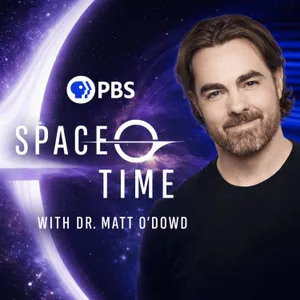
Space Time explores the outer reaches of space, the craziness of astrophysics, the possibilities of sci-fi, and anything else you can think of beyond Planet Earth with our astrophysicist host: Matthew O’Dowd. Matt O'Dowd spends his time studying the universe, especially really far-away things like quasars, super-massive black holes, and evolving galaxies. He uses telescopes in space to do it. Matt completed his Ph.D. at NASA's Space Telescope Science Institute, followed by work at the University of Melbourne and Columbia University. He's now a professor at the City University of New York's Lehman College and an Associate at the American Museum of Natural History's Hayden Planetarium. Previous host Gabe Perez-Giz is an astrophysicist who studies black hole physics. He received his Ph.D. from Columbia University and also hosted PBS Infinite Series.
Latest Episodes
The most recent episodes — sign up to get AI-powered summaries of each one.
- Today21 min
Quantum Theory's Most Incredible Prediction | Space Time
Viewers like you help make PBS (Thank you 😃) . Support your local PBS Member Station here: https://to.pbs.org/DonateSPACE Let’s talk about the best evidence we have that the theories of quantum physics truly represent the underlying workings of reality. You can signup for your trial to The Great Courses Plus at: http://ow.ly/bugR30hIvbu Quantum field theory is notoriously complicated, built from mind-bendingly abstract mathematics. But are the underlying rules of reality really so far from human intuition? Or are physicists just showing off? For better or worse, the physicists are definitely on the right track. We know this because the predictions of quantum field theory stand up to experimental test time and time again. The Great Courses Plus is currently available to watch through a web browser to almost anyone in the world and optimized for the US, UK, and Australian markets. The Great Courses Plus is currently working to both optimize the product globally and accept credit card payments globally. You can further support us on Patreon at https://www.patreon.com/pbsspacetime Get your own Space Time t-shirt at http://bit.ly/1QlzoBi Tweet at us! @pbsspacetime Facebook: facebook.com/pbsspacetime Email us! pbsspacetime [at] gmail [dot] com Comment on Reddit: http://www.reddit.com/r/pbsspacetime Help translate our videos! https://www.youtube.com/timedtext_cs_... Previous Episode: How Close To The Sun Can Humanity Get? https://www.youtube.com/watch?v=cOzaGEAGzzA&t=1s Hosted by Matt O'Dowd Written by Graeme Gossel and Matt O'Dowd Graphics by Luke Maroldi Assistant Editing and Sound Design by Mike Petrow Made by Kornhaber Brown (www.kornhaberbrown.com) Special thanks to our Patreon Big Bang, Quasar and Hypernova Supporters: Big Bang Anton Lifshits CoolAsCats David Nicklas Fabrice Eap Quasar Dean Fuqua Mark Rosenthal Mayank M. Mehrota Roman Pinchuk Tambe Barsbay Vinnie Falco Hypernova Chuck Zegar Donal Botkin Edmund Fokschaner Eugene Lawson John Hofmann Jordan Young Joseph Salomone Matthew O’Connor Ratfeast Thanks to our Patreon Gamma Ray Burst Supporters: Alexey Eromenko Asa Hood Benoit Pagé-Guitard Brandon Cook Brandon Labonte Daniel Lyons David Crane Deborah Whittaker Fabian Olesen Greg Allen Greg Weiss Ian Anoan James Flowers James Hughes JJ Bagnell Jon Folks Kevin Warne Malte Ubl Mark Vasile Nicholas Rose Nick Virtue Scott Gossett Shannan Catalano سلطان الخليفي Learn more about your ad choices. Visit megaphone.fm/adchoices
- Yesterday23 min
How Will the Universe End? | Space Time
Viewers like you help make PBS (Thank you 😃) . Support your local PBS Member Station here: https://to.pbs.org/DonateSPACE Thanks to Wix for supporting PBS Digital Studios. You can go to https://bit.ly/2o1DSHZ to get started on Wix Code! In 100 trillion years the era of stars will be over. We live in an unusual age – the age when the stars still shine. We should count ourselves lucky – nearly all of future history will be dark. But events will still unfold in that long, cooling darkness, and civilizations may endure. So how will the universe and its far-future denizens spend eternity? You can further support us on Patreon at https://www.patreon.com/pbsspacetime Get your own Space Time t-shirt at http://bit.ly/1QlzoBi Tweet at us! @pbsspacetime Facebook: facebook.com/pbsspacetime Email us! pbsspacetime [at] gmail [dot] com Comment on Reddit: http://www.reddit.com/r/pbsspacetime Help translate our videos! https://www.youtube.com/timedtext_cs_... Previous Episode: Quantum Theory's Most Incredible Prediction https://www.youtube.com/watch?v=7UwigY4SjKY What does the future of our Universe hold? Alas Lewis & Barnes https://youtu.be/hCXRnwpmJTc Hosted by Matt O'Dowd Written by Matt O'Dowd Graphics by Luke Maroldi Assistant Editing and Sound Design by Mike Petrow Made by Kornhaber Brown (www.kornhaberbrown.com) In 100 trillion years the last star in the universe will expand the final atoms of its hydrogen fuel and settle quietly into a dim white dwarf, before slowly fading to black over as it radiates away its remnant heat. The era of stars will be over. That 100 trillion years is 10,000 times the current age of the universe, and so the days of starlight and warmth have a way to go. But even when they are done, the universe will be young in comparison to the long, dark ages to follow. In fact our universe will spend almost all of its infinite time in darkness, slowly crawling towards maximum entropy and ultimate heat death. Special thanks to our Patreon Big Bang, Quasar and Hypernova Supporters: Big Bang Anton Lifshits CoolAsCats David Nicklas Fabrice Eap Quasar Dean Fuqua Mark Rosenthal Mayank M. Mehrota Roman Pinchuk Tambe Barsbay Vinnie Falco Hypernova Chuck Zegar Donal Botkin Edmund Fokschaner Eugene Lawson John Hofmann Jordan Young Joseph Salomone Matthew O’Connor Ratfeast Thanks to our Patreon Gamma Ray Burst Supporters: Alexander Rodriguez Alexey Eromenko Benoit Pagé-Guitard Brandon Cook Brandon Labonte Daniel Lyons David Crane Deborah Whittaker Fabian Olesen Greg Allen Greg Weiss Ian Anoan James Flowers James Hughes JJ Bagnell Jon Folks Kevin Warne Malte Ubl Mark Vasile Nicholas Rose Nick Virtue Scott Gossett Shannan Catalano سلطان الخليفي Learn more about your ad choices. Visit megaphone.fm/adchoices
- Yesterday18 min
Is There Life on Mars?
Viewers like you help make PBS (Thank you 😃) . Support your local PBS Member Station here: https://to.pbs.org/DonateSPACE There is no greater hero in our search for life on mars than a little robot named Opportunity. You can further support us on Patreon at https://www.patreon.com/pbsspacetime Get your own Space Time t-shirt at http://bit.ly/1QlzoBi Tweet at us! @pbsspacetime Facebook: facebook.com/pbsspacetime Email us! pbsspacetime [at] gmail [dot] com Comment on Reddit: http://www.reddit.com/r/pbsspacetime Help translate our videos! https://www.youtube.com/timedtext_cs_... Previous Episode: How Will the Universe End? https://www.youtube.com/watch?v=Qg4vb-KH5F4 What does the future of our Universe hold? Alas Lewis & Barnes https://youtu.be/hCXRnwpmJTc Hosted by Matt O'Dowd Written by Drew Rosen & Matt O'Dowd Graphics by Luke Maroldi Assistant Editing and Sound Design by Mike Petrow Made by Kornhaber Brown (www.kornhaberbrown.com) Otherwise landed in 2004 with its twin - MER-A, better known as Spirit. These six-wheeled golf-cart-sized robots were Swiss army knives of geological lab instruments. Opportunities most spectacular discovery where these cute little so-called berries. They turned out to be concretions of hematite - which means they were grown in wet environments with dissolved iron. Wet means water FYI. Both rovers found a variety of other geological signs of past water activity, really solidifying the picture of Mars' much more liquid past. Both rovers were supposed to shut down after around 90 days as Martian dust accumulated on their solar panels, cutting of their power supply. Special thanks to our Patreon Big Bang, Quasar and Hypernova Supporters: Big Bang Anton Lifshits CoolAsCats David Nicklas Fabrice Eap Quasar Dean Fuqua Mark Rosenthal Mayank M. Mehrota Roman Pinchuk Tambe Barsbay Vinnie Falco Hypernova Chuck Zegar Donal Botkin Edmund Fokschaner Eugene Lawson John Hofmann Jordan Young Joseph Salomone Matthew O’Connor Ratfeast Thanks to our Patreon Gamma Ray Burst Supporters: Alexander Rodriguez Alexey Eromenko Benoit Pagé-Guitard Brandon Cook Brandon Labonte Daniel Lyons David Crane Deborah Whittaker Fabian Olesen Greg Allen Greg Weiss Ian Anoan James Flowers James Hughes JJ Bagnell Jon Folks Kevin Warne Malte Ubl Mark Vasile Nicholas Rose Nick Virtue Scott Gossett Shannan Catalano سلطان الخليفي Learn more about your ad choices. Visit megaphone.fm/adchoices
- 2 days ago16 min
The Black Hole Entropy Enigma
Viewers like you help make PBS (Thank you 😃) . Support your local PBS Member Station here: https://to.pbs.org/DonateSPACE Thanks to CuriosityStream for supporting PBS Digital Studios. You can learn more at https://www.curiositystream.com/spacetime and use the code "spacetime" during the sign-up process. You can further support us on Patreon at https://www.patreon.com/pbsspacetime Get your own Space Time t-shirt at http://bit.ly/1QlzoBi Tweet at us! @pbsspacetime Facebook: facebook.com/pbsspacetime Email us! pbsspacetime [at] gmail [dot] com Comment on Reddit: http://www.reddit.com/r/pbsspacetime Help translate our videos! https://www.youtube.com/timedtext_cs_... Previous Episode: Is There Life on Mars? https://www.youtube.com/watch?v=VmEY6T5Wc-Q Hosted by Matt O'Dowd Written by Matt O'Dowd Graphics by Luke Maroldi Assistant Editing and Sound Design by Mike Petrow Made by Kornhaber Brown (www.kornhaberbrown.com) Black Holes should have no entropy, but they in fact hold most of the entropy in the universe. Let’s figure this out. If black holes exist – which, apparently, they do – they contradict other theories in physics as sacred as general relativity. They cause all sorts of problems with quantum theory, which we’ve talked about and will review in a sec. But they also present an apparent conflict with the notion of entropy and the second law of thermodynamics. It was while pondering that conflict that Jacob Bekenstein realized an incredible connection between black holes and thermodynamics. His insight launched an entire new way of thinking about the universe in terms of information theory, and ultimately led to the holographic principle. Which I promise we’re getting to and we’re almost there. We just need to understand string theory first and to understand that, you’re going need to know about why Black Holes contain most of the universe’s entropy. Special thanks to our Patreon Big Bang, Quasar and Hypernova Supporters: Big Bang Anton Lifshits CoolAsCats David Nicklas Fabrice Eap Quasar Dean Fuqua Mark Rosenthal Mayank M. Mehrota Roman Pinchuk Tambe Barsbay Vinnie Falco Hypernova Brent Mullins Chuck Zegar Donal Botkin Edmund Fokschaner John Hofmann Jordan Young Joseph Salomone Matthew O’Connor Ratfeast Thanks to our Patreon Gamma Ray Burst Supporters: Alexander Rodriguez Alexey Eromenko Benoit Pagé-Guitard Brandon Cook Brandon Labonte Daniel Lyons David Crane Deborah Whittaker Fabian Olesen Greg Allen Greg Weiss James Flowers James Hughes JJ Bagnell Jon Folks Kevin Warne Malte Ubl Mark Vasile Nicholas Rose Nick Virtue Scott Gossett Shannan Catalano سلطان الخليفي Learn more about your ad choices. Visit megaphone.fm/adchoices
- 3 days ago20 min
How Much Information is in the Universe?
Viewers like you help make PBS (Thank you 😃) . Support your local PBS Member Station here: https://to.pbs.org/DonateSPACE There’s quite a bit of stuff in the universe, to put it mildly. You can further support us on Patreon at https://www.patreon.com/pbsspacetime Get your own Space Time t-shirt at http://bit.ly/1QlzoBi Tweet at us! @pbsspacetime Facebook: facebook.com/pbsspacetime Email us! pbsspacetime [at] gmail [dot] com Comment on Reddit: http://www.reddit.com/r/pbsspacetime Help translate our videos! https://www.youtube.com/timedtext_cs_... Previous Episode: The Black Hole Entropy Enigma https://www.youtube.com/watch?v=Ab8JIzckx_M Hosted by Matt O'Dowd Written by Matt O'Dowd Graphics by Luke Maroldi Assistant Editing and Sound Design by Mike Petrow Made by Kornhaber Brown (www.kornhaberbrown.com) Twitter: @pbsspacetime Instagram: @matt_of_earth Hundreds of billions of galaxies, each with hundreds of billions of stars, each with … rather a lot of particles in them. And then there’s all the stuff that isn’t stars. The dark matter, black holes, planets, and the particles and radiation in between the stars and galaxies. Stuff EVERYWHERE! But… is the universe actually made of stuff? An increasing number of physicists view the universe – view reality as informational at its most fundamental level. But how big a memory bank would you even need to compute a universe? Seriously, let’s figure it out. Computational Capacity of the Universe (2001), by Seth Lloyd https://arxiv.org/abs/quant-ph/0110141 Special thanks to our Patreon Big Bang, Quasar and Hypernova Supporters: Big Bang Anton Lifshits CoolAsCats David Nicklas Fabrice Eap Quasar Dean Fuqua Mark Rosenthal Mayank M. Mehrota Roman Pinchuk Tambe Barsbay Vinnie Falco Hypernova Brent Mullins Chuck Zegar Donal Botkin Edmund Fokschaner John Hofmann Jordan Young Joseph Salomone Matthew O’Connor Ratfeast Thanks to our Patreon Gamma Ray Burst Supporters: Alexander Rodriguez Alexey Eromenko Benoit Pagé-Guitard Brandon Cook Brandon Labonte Daniel Lyons David Crane Deborah Whittaker Fabian Olesen Greg Allen Greg Weiss James Flowers James Hughes JJ Bagnell Jon Folks Kevin Warne Malte Ubl Mark Vasile Nicholas Rose Nick Virtue Scott Gossett Shannan Catalano سلطان الخليفي Learn more about your ad choices. Visit megaphone.fm/adchoices
- 4 days ago21 min
Quantum Gravity and the Hardest Problem in Physics | Space Time
Viewers like you help make PBS (Thank you 😃) . Support your local PBS Member Station here: https://to.pbs.org/DonateSPACE Between them, general relativity and quantum mechanics seem to describe all of observable reality. You can further support us on Patreon at https://www.patreon.com/pbsspacetime Get your own Space Time t-shirt at http://bit.ly/1QlzoBi Tweet at us! @pbsspacetime Facebook: facebook.com/pbsspacetime Email us! pbsspacetime [at] gmail [dot] com Comment on Reddit: http://www.reddit.com/r/pbsspacetime Help translate our videos! https://www.youtube.com/timedtext_cs_... Previous Episode: How Much Information is in the Universe? https://www.youtube.com/watch?v=XxVlGAFX7vA Hosted by Matt O'Dowd Written by Matt O'Dowd Graphics by Luke Maroldi Assistant Editing and Sound Design by Mike Petrow Made by Kornhaber Brown (www.kornhaberbrown.com) The first few decades of the 20th century was a time of miracles for physics. First, Einstein’s relativity utterly changed the way we think about space, time, motion and gravity. Then the quantum revolution of the 20s and 30s overturned all of our intuitions about the subatomic world. Together, general relativity and quantum mechanics have allowed us to explain nearly every fundamental phenomenon observed, and have predicted many unexpected phenomena that have since been verified. And yet the two theories contradict each other in fundamental ways. In the century since that golden era of physics, we’ve been trying to reconcile the two … without success. But today on space-time I’m going to begin our discussion of the great quest for this union – the quest for a theory of quantum gravity, and for a theory of everything. Special thanks to our Patreon Big Bang, Quasar and Hypernova Supporters: Big Bang Anton Lifshits CoolAsCats David Nicklas Fabrice Eap Quasar Dean Fuqua Mark Rosenthal Mayank M. Mehrota Roman Pinchuk Tambe Barsbay Vinnie Falco Hypernova Brent Mullins Chuck Zegar Donal Botkin Edmund Fokschaner John Hofmann Jordan Young Joseph Salomone Matthew O’Connor Ratfeast Thanks to our Patreon Gamma Ray Burst Supporters: Alexander Rodriguez Alexey Eromenko Benoit Pagé-Guitard Brandon Cook Brandon Labonte Daniel Lyons David Crane Deborah Whittaker Fabian Olesen Greg Allen Greg Weiss James Flowers James Hughes JJ Bagnell Jon Folks Kevin Warne Malte Ubl Mark Vasile Nicholas Rose Nick Virtue Scott Gossett Shannan Catalano سلطان الخليفي Learn more about your ad choices. Visit megaphone.fm/adchoices
- 4 days ago20 min
How to Detect Extra Dimensions
Viewers like you help make PBS (Thank you 😃) . Support your local PBS Member Station here: https://to.pbs.org/DonateSPACE On this Space Time Journal Club we look at how gravitational waves can be used to search for extra dimensions of space! To learn more about CuriosityStream you can go to: https://www.curiositystream.com/space... and use the code "spacetime" during the sign-up process. "Limits on the number of spacetime dimensions from GW170817" Pardo, Fishbach, Holz & Spergel 2018 https://arxiv.org/abs/1801.08160 You can further support us on Patreon at https://www.patreon.com/pbsspacetime Get your own Space Time t-shirt at http://bit.ly/1QlzoBi Tweet at us! @pbsspacetime Facebook: facebook.com/pbsspacetime Email us! pbsspacetime [at] gmail [dot] com Comment on Reddit: http://www.reddit.com/r/pbsspacetime Help translate our videos! https://www.youtube.com/timedtext_cs_... Previous Episode: Quantum Gravity and the Hardest Problem in Physics https://www.youtube.com/watch?v=YNEBhwimJWs Hosted by Matt O'Dowd Written by Matt O'Dowd Graphics by Luke Maroldi Assistant Editing and Sound Design by Mike Petrow Made by Kornhaber Brown (www.kornhaberbrown.com) Special thanks to our Patreon Big Bang, Quasar and Hypernova Supporters: Big Bang Justin Lloyd Anton Lifshits CoolAsCats David Nicklas Fabrice Eap Quasar Dean Fuqua Mark Rosenthal Mayank M. Mehrota Roman Pinchuk Tambe Barsbay Vinnie Falco Hypernova Brent Mullins Chuck Zegar Donal Botkin Edmund Fokschaner John Hofmann Jordan Young Joseph Salomone Matthew O’Connor Ratfeast Thanks to our Patreon Gamma Ray Burst Supporters: Alexander Rodriguez Alexey Eromenko Benoit Pagé-Guitard Brandon Cook Brandon Labonte Daniel Lyons David Crane Deborah Whittaker Fabian Olesen Greg Allen Greg Weiss James Flowers James Hughes JJ Bagnell Jon Folks Kevin Warne Malte Ubl Mark Vasile Nicholas Rose Nick Virtue Scott Gossett Shannan Catalano سلطان الخليفي Learn more about your ad choices. Visit megaphone.fm/adchoices
- 5 days ago19 min
Computing a Universe Simulation
Viewers like you help make PBS (Thank you 😃) . Support your local PBS Member Station here: https://to.pbs.org/DonateSPACE Physics seems to be telling us that it’s possible to simulate the entire universe on a computer smaller than the universe. You can further support us on Patreon at https://www.patreon.com/pbsspacetime Space Time Challenge Winners Jin Du Loren Booker Kevin Selva Prasanna May Awbin John Reza Ian Grams Challenge Winners: Please PBSspacetime@gmail.com with your name, address, US t-shirt size – small, medium, large, extra large, or extra-extra-large and let us know which T you’d like. Get your own Space Time t-shirt at http://bit.ly/1QlzoBi Tweet at us! @pbsspacetime Facebook: facebook.com/pbsspacetime Email us! pbsspacetime [at] gmail [dot] com Comment on Reddit: http://www.reddit.com/r/pbsspacetime Help translate our videos! https://www.youtube.com/timedtext_cs_... Previous Episode: How to Detect Extra Dimensions https://www.youtube.com/watch?v=3HYw6vPR9qU Hosted by Matt O'Dowd Written by Matt O'Dowd Graphics by Luke Maroldi Assistant Editing and Sound Design by Mike Petrow Made by Kornhaber Brown (www.kornhaberbrown.com) I’m not saying the universe is a simulation. I mean it might be – I’m just not saying it. And perhaps it doesn’t make any difference. Even if this is the prime, the original physical universe, rather than somewhere deep in a simulation nest, we can STILL think of our universe’s underlying mechanics as computation. Imagine a universe in which the most elementary components are stripped of all properties besides some binary notion of existence or non-existence. Like, if the tiniest chunks of spacetime, or chunks of quantum fields, or elements in the abstract space of quantum-mechanical states can either be full or empty. These elements interact with their neighbors by a simple set of rules, leading to oscillations, elementary particles, atoms, and ultimately to all of the emergent laws of physics, physical structure, and ultimately the universe. Special thanks to our Patreon Big Bang, Quasar and Hypernova Supporters: Big Bang Justin Lloyd Anton Lifshits CoolAsCats David Nicklas Fabrice Eap Quasar Dean Fuqua Mark Rosenthal Mayank M. Mehrota Roman Pinchuk Tambe Barsbay Vinnie Falco Hypernova Brent Mullins Chuck Zegar Donal Botkin Edmund Fokschaner John Hofmann Jordan Young Joseph Salomone Matthew O’Connor Ratfeast Thanks to our Patreon Gamma Ray Burst Supporters: Alexander Rodriguez Alexey Eromenko Benoit Pagé-Guitard Brandon Cook Brandon Labonte Daniel Lyons David Crane Deborah Whittaker Fabian Olesen Greg Allen Greg Weiss James Flowers James Hughes JJ Bagnell Jon Folks Kevin Warne Malte Ubl Mark Vasile Nicholas Rose Nick Virtue Scott Gossett Shannan Catalano سلطان الخليفي Learn more about your ad choices. Visit megaphone.fm/adchoices
About PBS Space Time
Space Time explores the outer reaches of space, the craziness of astrophysics, the possibilities of sci-fi, and anything else you can think of beyond Planet Earth with our astrophysicist host: Matthew O’Dowd. Matt O'Dowd spends his time studying the universe, especially really far-away things like quasars, super-massive black holes, and evolving galaxies. He uses telescopes in space to do it. Matt completed his Ph.D. at NASA's Space Telescope Science Institute, followed by work at the University of Melbourne and Columbia University. He's now a professor at the City University of New York's Lehman College and an Associate at the American Museum of Natural History's Hayden Planetarium. Previous host Gabe Perez-Giz is an astrophysicist who studies black hole physics. He received his Ph.D. from Columbia University and also hosted PBS Infinite Series.
Customized Recaps
AI-powered recaps with compact key takeaways, quotes, and insights.
Straight to Your Inbox
Get key takeaways from PBS Space Time in a 5-minute read.
Save Hours Every Week
Stay current on your favorite podcasts without falling behind.
Frequently Asked Questions
What is Podzilla's PBS Space Time daily summary?
It's a free AI-powered email that summarizes new episodes of PBS Space Time as soon as they're published. You get the key takeaways, notable quotes, and links & mentions — all in a quick read.
How does the PBS Space Time podcast summary work?
When a new episode drops, our AI transcribes and analyzes it, then generates a personalized summary tailored to your interests and profession. It's delivered to your inbox every morning.
Is this an official PBS Space Time product?
No. Podzilla is an independent service that summarizes publicly available podcast content. We're not affiliated with or endorsed by PBS.
Can I get summaries of other podcasts too?
Absolutely! The free plan covers up to 3 podcasts. Upgrade to Pro for 15, or Premium for 50. Browse our full catalog at /podcasts.
How often does PBS Space Time release new episodes?
PBS Space Time publishes daily. Our AI generates a summary within hours of each new episode.
What topics does PBS Space Time cover?
Our AI identifies the specific themes in each episode and highlights what matters most to you.
Start getting PBS Space Time summaries tomorrow morning.
Free forever for up to 3 podcasts. No credit card required.
Free forever for up to 3 podcasts. No credit card required.