Free Daily Podcast Summary
PathBreakers: Daily Summaries Delivered
by The Kresge Foundation
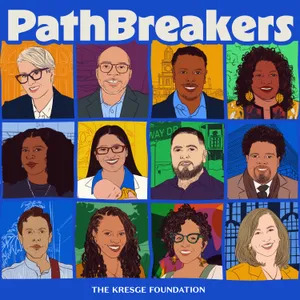
PathBreakers is a video podcast from The Kresge Foundation featuring community leaders who are reimagining what's possible in American cities. Hosted by Tracey Pearson and Jamie Bennett, with special guest hosting by Rip Rapson, each episode is an intimate conversation about the vision and determination it takes to create change. Season 2 goes into four cities with one central question: Who has power to shape what happens in their city? Detroit. New Orleans. Memphis. Fresno. Sixteen conversations with the community leaders and mayors building the future of their cities block by block.
Latest Episodes
The most recent episodes — sign up to get AI-powered summaries of each one.
- 1 weeks ago31 min
Dr. Jennifer Avegno is treating public health holistically
The office of Deputy Mayor of Health and Human Services sat empty for 8 years in New Orleans, until Mayor Helena Moreno reinstated the role when she took the Mayoral office in January of 2026. The person for the job? One of the most prominent New Orleans voices in public health: long-time emergency medicine practitioner, and previous Health Department Director, Dr. Jennifer Avegno. Dr. Jennifer Avegno is keenly aware of the interplay between climate change and public health – and the challenges her office faces in a city with infamously under-resourced infrastructure. The systems and resources that go down in the aftermath of a natural disaster are the same systems and resources that citizens – especially vulnerable communities – rely on most. As Dr. Avegno says, history shows us that vulnerable communities continually become more vulnerable in times of crisis, so the Department of Health and Human Services must intentionally develop new approaches to public health that do not repeat the patterns of the past.In this episode, Tracey and Jamie talk with Dr. Avegno about:Her “stop the problem before it starts” and “think of everyone as family” frameworks that shape the way she worksHow she zeroed in on the communities that needed Covid support the most during one of the earliest severe outbreaks of Covid19 in the USReducing disparity-driven health outcomes by looking at people, and the systems they are part of, holisticallyThe good signs she sees that more citizens are engaging with city governmentAll the ways emergency medicine is the perfect training for climate and disaster response workThank you so much for listening to Season 2 of PathBreakers. Please share this episode or our series with a colleague or friend who you think would benefit from these conversations. Subscribe to PathBreakers on [Spotify] | [Apple Podcasts] | [YouTube]Listen all of Season 2 at https://pathbreakers.kresge.orgCo-Hosts: Tracey Pearson and Jamie BennettProducer: Juliet HinelyManaging Editor: Krista JahnkeProduction support: Jennifer Kulczycki and Tracey PearsonSpecial thanks on this episode to Kresge’s American Cities, Health and Environment Programs, especially Monica Valdes Lupi, Alejandra Hernandez and Jan Delatorre. Thanks for listening! Stay tuned for future stories from Kresge at Kresge.org
- 2 weeks ago32 min
Tap Bui is strengthening green infrastructure with community heritage
When Vietnamese families resettled in the US after the war, many came to New Orleans with the idea that its subtropical delta climate, French influence, and sizable Roman Catholic community would feel familiar. Housing was primarily offered in Village De L’est and Algiers, two neighborhoods divided by the Mississippi River. The separation led to social isolation, and their urban coastal locations – while great for fishing like back home – made them especially vulnerable to flooding. When Hurricane Katrina hit in 2005, these communities were hit hard. Song Community Development Corporation (Song CDC) formed 15 years later, with goals to build community power and develop neighborhood climate solutions for the Vietnamese communities in New Orleans that hadn’t seen the same kind of reinvestment as other parts of the city. Tap Bui has been Co-Executive Director of Song CDC since 2022. In this episode, Tap talks with Tracey and Jamie about:--- Ways her early community organizing work, in response to a proposed landfill and the 2010 BP Oil Spill, shaped the work she does today-- How the waterways of New Orleans both connect and separate communities across the city-- What a Community Water Plan looks like and what Community Water Leaders do for the neighborhood-- How the big stormwater management park that Song CDC is designing with the community is blending engineering with cultural history-- Her belief that communities are experts of their own experience and how community self-determination has been at the core of Song CDC work all along Stay tuned next week for the final episode of our New Orleans City Series and the final episode of Season 2! Tracey and Jamie will be headed back to New Orleans City Hall, this time to talk with Dr. Jennifer Avegno, the Deputy Mayor of Health and Human Services who is treating New Orleans’ public health in a decidedly holistic way. Learn more about Song Community Development Corporation at https://SongCDC.orgListen all of Season 2 at https://pathbreakers.kresge.orgCo-Hosts: Tracey Pearson and Jamie Bennett Producer: Juliet Hinely Managing Editor: Krista Jahnke Production support: Jennifer Kulczycki and Tracey Pearson Special thanks on this episode to Kresge’s American Cities, Health and Environment Programs, especially Monica Valdes Lupi, Alejandra Hernandez and Jan Delatorre. Thanks for listening!
- 3 weeks ago29 min
Mina Seck is farming for food sovereignty
Food access is an on-going challenge in New Orleans – a city mapped by a history of segregation, and a city with a track record of inconsistent re-investment since Hurricane Katrina in 2005. Aside from issues like “food deserts” and “food swamps,” another question arises: When climate disaster strikes, and transportation infrastructure goes down, how do you get food for your family or community? Mina Seck, Community Food Director at Sprout, says that this is where small-scale local farms are essential. Sprout is a New Orleans-based organization that provides technical and social support to established and developing small-scale farmers, community gardeners, and farm workers in Louisiana. Their vision is a community food system rooted in equity — one that increases access to jobs, food, and land, particularly for farmers and growers who are Black, Indigenous, LGBTQ+, people of color, and women.In this episode, Tracey and Jamie talk with Mina Seck about:How working on food farms in other countries, and in several well-known restaurant kitchens in New Orleans, shaped her relationship to food and food farmersWhy small farms are necessary in a sustainable food system and to survive climate changeHow she got almost $100K worth of locally grown food into food banks in less than 2 months when community members lost suddenly lost SNAP benefitsWays that the Sprout farm can be a community safety hub in times of climate crisisHow Sprout ran a $500,000 reparations program that empowered 10 Black and Indigenous Louisiana-based farmers to invest in their businesses on their own terms. Stay tuned next week when Tracey and Jamie talk with Tap Bui of Song Community Development Corporation in New Orleans East and hear about how her neighborhood is developing a water management plan to protect their homes and community culture. Subscribe to PathBreakers on [Spotify] | [Apple Podcasts] | [YouTube]Learn more about Sprout at sproutnolafarm.orgListen all of Season 2 at https://pathbreakers.kresge.orgCo-Hosts: Tracey Pearson and Jamie BennettProducer: Juliet HinelyManaging Editor: Krista JahnkeProduction support: Jennifer Kulczycki and Tracey PearsonSpecial thanks on this episode to Kresge’s American Cities, Health and Environment Programs, especially Monica Valdes Lupi, Alejandra Hernandez and Jan Delatorre. Thanks for listening!
- Oct 7, 202631 min
Mayor Helena Moreno is closing financial deficits while supporting civic and cultural infrastructure
Cities across the country are confronting one of the defining questions of our era: Who has the power to decide how a city prepares for – and survives – climate change? And New Orleans is a city that lives on the direct shoreline of that question. It is a waterfront city below sea level, ringed by industrial corridors, and still managing the health and economic ripple effects of Hurricane Katrina 21 years later. Yet it is also a city of extraordinary cultural resilience and community ingenuity. To begin our New Orleans city series, Kresge President and CEO Rip Rapson sits down with Helena Moreno, the current and 63rd Mayor of New Orleans, to discuss:How stormwater management and ways of “living with water” are on the near-daily meeting docketThe opportunities she sees for New Orleans as an aerospace and biomedical hubThe importance, potential, and early successes of her investment in New Orleans East, including progress and success in small business developmentPrevention strategies that have brought violent crime to a historic lowFinding efficiencies and partnerships after inheriting a $200 million dollar budget deficit, and how she is supporting programs that don’t traditionally fit under the umbrella of “essential city services” How students are her biggest inspiration for keeping “this amazing historical magical city moving forward” Next episode (out October 14th) we meet the first of our three featured New Orleans PathBreakers. In this city series, we are talking to leaders across New Orleans who are building climate solutions with community self-determination. Next week Tracey and Jamie will be back in the host chairs and talking with Mina Seck, Community Food Director at Sprout, about who gets to control community land and build food sovereignty in New Orleans. Subscribe to PathBreakers on [Spotify] | [Apple Podcasts] | [YouTube]Learn more about Mayor Moreno: https://nola.gov/next/mayor/home/Listen to all of Season 2 at https://pathbreakers.kresge.orgHost: Rip Rapson, President & CEO, Kresge FoundationCo-Hosts: Tracey Pearson and Jamie BennettProducer: Juliet HinelyManaging Editor: Krista JahnkeProduction support: Jennifer Kulczycki and Tracey PearsonVideo interview captured and edited by by Gumbo ProductionsLogo animation: Collin LeixSpecial thanks on this episode to Frederick "Wood" Delahoussaye and the team at Gallier Hall, Jennifer Kulczycki Director of External Affairs and Communications at Kresge, and to Kresge’s American Cities, Health and Environment Programs, especially Monica Valdes Lupi, Alejandra Hernandez and Jan Delatorre. Thanks for listening! And please stay tuned for more from New Orleans.
- Sep 30, 202631 min
Danielle Bergstrom is building a newsroom around transparency
Danielle Bergstrom began her career as a city planner. That work, which she did in Fresno for 10 years, put her up close and personal with the goings-ons of City Hall. And seeing the “sausage making” there, as she says, convinced her that city residents needed the same insider understanding of what was happening in local government. That is when she started Fresnoland – a nonprofit, paywall-free investigative news platform now serving 1.5 million residents across Fresno and Madera County, dedicated to transparency in local politics. In this episode, Danielle shares:Why she left policy work to build a newsroomThe values that guide Fresnoland’s reporters and why they don’t aspire to be “objective” in the traditional journalistic senseThe challenges she and her staff face while reporting on City Hall, and how Fresnoland is taking on Fresno’s culture of closed-door governmentHow a new Fresnoland live event series is broadening the public’s civic imaginationPlus the backstory behind some big, recent local headlines and how Fresnoland got its name. Next Episode, we head to New Orleans. Stay tuned for conversations about climate justice in one of the most climate vulnerable cities in the country. Subscribe to PathBreakers on [Spotify] | [Apple Podcasts] | [YouTube]Learn more about Fresnoland at Fresnoland.orgListen all of Season 2 at https://pathbreakers.kresge.orgCo-Hosts: Tracey Pearson and Jamie BennettProducer: Juliet HinelyManaging Editor: Krista JahnkeProduction support: Jennifer Kulczycki and Tracey PearsonSpecial thanks on this episode to Kresge’s American Cities Program, especially Chantel Rush Tebbe and Anand Sharma.Thanks for listening! Our final stop on this Season 2 PathBreakers Tour is New Orleans, coming out in October.
- Sep 23, 202629 min
Dr. Sarait Martinez is leading with language justice
More than 200,000 immigrant farmworkers power Central California's agricultural industry, including over 60,000 people from many diverse and distinct Indigenous Mexican communities. Across those communities, more than 16 unique Indigenous Mexican languages are spoken, bringing issues of access and translation to the front and center of daily life – navigating work, civic engagement, and social services. When Latino communities are treated as linguistically homogeneous, much critical information remains out of reach. The Centro Binacional para el Desarrollo Indígena Oaxaqueño (the Binational Center for the Development of Oaxacan Indigenous Communities, or CBDIO) was founded in Fresno in 1993 because Indigenous farmworkers in California’s Central Valley could not access social services offered only in English and Spanish. Since 1993, their mission and services have grown tremendously beyond language justice to also include building community power through economic justice, education justice, health justice, immigration justice, and worker justice. The CBDIO has also entered its second generation of leadership with Dr. Sarait Martinez as Executive Director. In this episode, Dr. Martinez shares about:The invisibility that Indigenous Mexican communities face even within Latino spacesWhat “language justice” means in practice and how they work to ensure people can participate in decisions about their lives regardless of what language they speakHow the CBDIO transformed the “3 sisters” farming method into their “4 sisters” organizing frameworkCBDIO’s recent wins recovering over $50,000 in stolen wages and expanding interpreter access. Next Episode, meet Danielle Bergstrom. Danielle spent a decade as a city planner before deciding the most powerful way to shape Fresno was to start her own news platform and tell people what was actually happening in their city. Subscribe to PathBreakers on [Spotify] | [Apple Podcasts] | [YouTube]Learn more about the CBDIO at https://www.centrobinacional.org/Listen all of Season 2 at https://pathbreakers.kresge.orgCo-Hosts: Tracey Pearson and Jamie BennettProducer: Juliet HinelyManaging Editor: Krista JahnkeProduction support: Jennifer Kulczycki and Tracey PearsonSpecial thanks on this episode to Kresge’s American Cities and Arts Programs, especially Kara Elliott-Ortega and Katie Van Dusen.Thanks for listening!
- Sep 16, 202628 min
Hugo Morales is preserving culture and protecting community over the airwaves
Hugo Morales grew up picking produce in the farm fields of Fresno with his family. When he returned to Fresno after college, he saw that his community – the Central Valley’s half-million Latino farmworkers – barely had radio in their own language, much less a radio station controlled by their own community. In 1976, Hugo and a group of activists and artists set out to change that. And by 1980, Radio Bilengüe – the nation’s first multilingual news and cultural radio station built to empower the Latino community – was broadcasting live from Fresno. Over the last 45 years, Radio Bilengüe has grown into the largest public radio network of its kind in the United States with 30 public radio stations and 75 affiliate stations across five states. In this episode Hugo shares about:Flyering on telephone polls to get the station startedWhat it means for a community to own its narrative by owning its own airwavesHow the station blends music, culture, and hard news to support cultural preservation and community safetyHow his other organizing work in and around Fresno is interconnected with Radio BilengüeWays the radio station has literally saved livesAnd Radio Bilengüe’s plans for a bricks and mortar cultural center in downtown FresnoNext episode, meet Dr. Sarait Martinez, who leads the only Indigenous women-led organization serving Indigenous communities in the Fresno region. She's working to close the harmful structural gaps created when institutions don’t account for distinct Indigenous languages or cultural context. Subscribe to PathBreakers on [Spotify] | [Apple Podcasts] | [YouTube]Tune in to Radio Bilengüe at RadioBilengue.orgListen all of Season 2 at https://pathbreakers.kresge.orgCo-Hosts: Tracey Pearson and Jamie BennettProducer: Juliet HinelyManaging Editor: Krista JahnkeProduction support: Jennifer Kulczycki and Tracey PearsonSpecial thanks on this episode to Kresge’s American Cities Program, especially Chantel Rush Tebbe and Anand Sharma.Thanks for listening!
- Sep 9, 202632 min
Mayor Jerry Dyer is building Fresno’s economy beyond the farm
Fresno, California is smack-dab in the middle of the state, a city surrounded by farmland, seen by many as just the half-way point between San Francisco and Los Angeles. But Fresno is the 9th most diverse city in the nation. And its population and history is deeply shaped by Indigenous communities like Mixtecs and Zapotecs, Chicano farmworkers, and large Southeast Asian communities too. Fresno has historically been a city whose story has been told by outside forces — agribusiness interests, state planners, commercial media, national narratives that flatten its complexity. All season, we've been asking “who has the power to shape their city?” And a city like Fresno is the perfect place to ask: whose story gets to shape the way things work? Whose story is this city?To kick off our Fresno City Series, Kresge President and CEO, Rip Rapson, sits down with Jerry Dyer – Fresno’s 26th mayor and its longest-serving police chief before that – for a conversation at the historic Warnors Theater. Mayor Dyer shares:What makes Fresno “four cities in one,”How Interstate 5 was routed to bypass the Central Valley and the economic isolation that followedChanges, advancements and challenges in the agricultural economy that built the regionThe benefits he sees in blending the long-standing agricultural economy with a developing manufacturing economy. His ambitious downtown and Chinatown revitalization plans he hopes will define his legacy. Plus culinary districts, adaptive reuse housing projects, brewery districts, and more. And before Mayor Dyer and Rip Rapson dive in, Co-hosts Tracey and Jamie share some good news about the PathBreakers podcast.Next episode (out September 16th) we meet the first of our three featured Fresno PathBreakers. Each of our upcoming guests are leading projects and building systems across Fresno for cultural inclusion and preservation. Next week we’ll talk to Hugo Morales of Radio Bilingüe. Hugo built a community and cultural news radio station from scratch when he realized his community – and Fresno’s half-million farmworkers – couldn’t get programming in their own languages. Subscribe to PathBreakers on [Spotify] | [Apple Podcasts] | [YouTube]Learn more about Mayor Dyer: https://www.fresno.gov/mayor/Listen to all of Season 2 at https://pathbreakers.kresge.orgHost: Rip Rapson, President & CEO, Kresge FoundationCo-Hosts: Tracey Pearson and Jamie BennettProducer: Juliet HinelyManaging Editor: Krista JahnkeProduction support: Jennifer Kulczycki and Tracey PearsonVideo interview captured and edited by by Meza StudioLogo animation: Collin LeixSpecial thanks on this episode to Nicole Owens and her team at the Warnors Theater, Jennifer Kulczycki Director of External Affairs and Communications at Kresge, and to Kresge’s American Cities and Arts Programs, especially Kara Elliott-Ortega and Katie Van Dusen.Thanks for listening! And please stay tuned for more from Fresno.
Get PathBreakers summaries in your inbox
Free AI-powered daily recaps. Key takeaways, quotes, and mentions — in a 5-minute read.
Get Free Summaries →Free forever for up to 3 podcasts. No credit card required.
You Might Also Like
Listeners also like.
Community Catalysts
Leaders from local government and nonprofits share hard-won lessons and practical strategies for building stronger communities.
Build or Break
Conversations with innovators across fields about the risks, resilience, and choices behind building something meaningful.
Blaze Your Own Trail
Entrepreneurs and trailblazers share real stories and strategies for overcoming adversity and building success.
Here Comes the Break
A fictional story about a young host exploring creativity, mental health, and friendship through interviews with emerging artists.
Unbossing
Conversations with business and tech leaders about redefining leadership by unlearning outdated rules in times of change.
Brian Breaks Character
A spiritual guide for creatives seeking purpose and abundance through conversations with artists, activists, and unconventional thinkers.
Business for Good Podcast
Entrepreneurs and business leaders discuss building companies that solve global problems while generating profit.
Do Small Business Like a Big Boss Podcast
A lawyer offers practical legal and business strategies for small business owners to scale and compete effectively.
Leading By Example: Executives Making An Impact
Executives share pivotal moments and personal experiences that shaped their leadership and decision-making in real-world business environments.
Curb Enthusiasm
Explores innovations and challenges in transportation and urban planning with global experts and city leaders.
Nonprofit Hub Radio
Interviews with nonprofit leaders and experts offering practical insights to help organizations improve and grow.

Your Brand Amplified
Explores the strategies and mindsets of successful entrepreneurs in business growth, marketing, and personal branding.
About PathBreakers
PathBreakers is a video podcast from The Kresge Foundation featuring community leaders who are reimagining what's possible in American cities. Hosted by Tracey Pearson and Jamie Bennett, with special guest hosting by Rip Rapson, each episode is an intimate conversation about the vision and determination it takes to create change. Season 2 goes into four cities with one central question: Who has power to shape what happens in their city? Detroit. New Orleans. Memphis. Fresno. Sixteen conversations with the community leaders and mayors building the future of their cities block by block.
Customized Recaps
AI-powered recaps with compact key takeaways, quotes, and insights.
Straight to Your Inbox
Get key takeaways from PathBreakers in a 5-minute read.
Save Hours Every Week
Stay current on your favorite podcasts without falling behind.
Frequently Asked Questions
What is Podzilla's PathBreakers daily summary?
It's a free AI-powered email that summarizes new episodes of PathBreakers as soon as they're published. You get the key takeaways, notable quotes, and links & mentions — all in a quick read.
How does the PathBreakers podcast summary work?
When a new episode drops, our AI transcribes and analyzes it, then generates a personalized summary tailored to your interests and profession. It's delivered to your inbox every morning.
Is this an official PathBreakers product?
No. Podzilla is an independent service that summarizes publicly available podcast content. We're not affiliated with or endorsed by The Kresge Foundation.
Can I get summaries of other podcasts too?
Absolutely! The free plan covers up to 3 podcasts, any in the catalog. Basic raises that to 15, Pro to 40 and Max to 100. Browse our full catalog at /podcasts.
How often does PathBreakers release new episodes?
PathBreakers publishes weekly. Our AI generates a summary within hours of each new episode.
What topics does PathBreakers cover?
PathBreakers covers topics including Business, Non-Profit. Our AI identifies the specific themes in each episode and highlights what matters most to you.
Start getting PathBreakers summaries tomorrow morning.
Free forever for up to 3 podcasts. No credit card required.
Free forever for up to 3 podcasts. No credit card required.