Free Daily Podcast Summary
Particles of Thought: Daily Summaries Delivered
by GBH
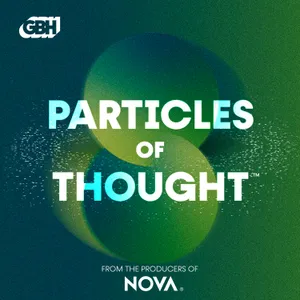
Ready to break your brain? Particles of Thought, the video podcast from the producers of NOVA, features host Hakeem Oluseyi diving into mind-expanding conversations with scientists on the edge. Explore how to hack your own anxiety, the surprising connection between dark matter and black holes, the secrets of animal communication, the hidden geometry shaping our world, and what it means to be human. Along the way, tackle big questions, uncover surprising answers, and discover entirely new ways to think.
Latest Episodes
The most recent episodes — sign up to get AI-powered summaries of each one.
- 2 days ago30 min
How to Build a Star
Dennis Whyte helped spark a multi-billion-dollar industry from a spool of tape. The nuclear scientist and entrepreneur explains the nitty gritty of nuclear fusion through the multitude of businesses that are chasing nuclear fusion. Dennis walks Hakeem through the origin story of Commonwealth Fusion Systems, the company he co-founded from a class assignment, and reveals how a new superconducting material discovered in the 1980s finally made compact fusion possible.Learn more about NOVA and visit our YouTube channel.--------------------------Guest Bio:Dennis Whyte is the Hitachi America Professor of Engineering at MIT and former director of the Plasma Science and Fusion Center. He co-founded Commonwealth Fusion Systems, the MIT spinout building a compact fusion reactor using record-breaking superconducting magnets, and is now the CEO of the United Kingdom's Atomic Energy Authority.
- 4 days ago35 min
Fusion Energy is Coming
Dennis Whyte studies the physics that powers every star in the universe, and he says it can power your house, too. Now the CEO of the UK’s Atomic Energy Authority and nuclear scientist at MIT, Dennis joins Hakeem to break down what fusion actually is, why it packs 10 million times the energy density of gasoline, and who is making the biggest investment in this massive energy field. Dennis unpacks the surprisingly direct link between a society's energy use and its economic prosperity, and reveals why fusion might change everything.Learn more about NOVA and visit our YouTube channel.--------------------------Guest Bio:Dennis Whyte is the Hitachi America Professor of Engineering at MIT and former director of the Plasma Science and Fusion Center. He co-founded Commonwealth Fusion Systems, the MIT spinout building a compact fusion reactor using record-breaking superconducting magnets, and is now the CEO of the United Kingdom's Atomic Energy Authority.
- 1 weeks ago1h 19m
Full Interview: Cracking Animal Language
Federico Rossano convinces Hakeem that animals have a lot more to say than we've given them credit for. The cognitive scientist shares the origin story behind his record-breaking study of talking dogs, the evidence that some pets may understand more than a human toddler, and what primates reveal about the roots of communication itself.Learn more about NOVA and visit our YouTube channel.Federico Rossano is an Associate Professor of Cognitive Science at UC San Diego and director of the Comparative Cognition Lab, where he studies communication and social cognition across humans, primates, dogs, and cats. He leads the world's largest study of button-trained pets, and his research is featured in the NOVA documentary Can Dogs Talk?
- 1 weeks ago21 min
Secret Language of Apes
Federico Rossano says the secret to speaking with apes is trust. For primates, the world is full of high-stakes friends and foes, and of course, there are always predators to worry about. Our closest relatives see the world a little differently than we do, and that can teach us a lot about our own communication. Federico is a cognitive scientist who questions the assumptions beneath human conversations, and in this episode, he shares lessons from the animal kingdom with Hakeem. From apes besting children in “the peanut puzzle” to baboons that seemingly sense how to travel together, there’s lots to learn.Learn more about NOVA and visit our YouTube channel.--------------------------Guest Bio:Federico Rossano is an Associate Professor of Cognitive Science at UC San Diego and director of the Comparative Cognition Lab, where he studies communication and social cognition across humans, primates, dogs, and cats. He leads the world's largest study of button-trained pets, and his research is featured in the NOVA documentary Can Dogs Talk?
- 2 weeks ago29 min
What Are Dogs Saying?
Federico Rossano caught dogs doing something that looks a lot like telling jokes. The cognitive scientist shares what he learned from speaking with dogs. Dogs can smell, hear, and in some ways see better than humans. So why wouldn’t they have something interesting to say if they could speak? Federico has found a dog's mind may be closer to a human toddler's than anyone previously believed and believes we are close to learning important lessons from our canine companions.Learn more about NOVA and visit our YouTube channel.--------------------------Guest Bio:Federico Rossano is an Associate Professor of Cognitive Science at UC San Diego and director of the Comparative Cognition Lab, where he studies communication and social cognition across humans, primates, dogs, and cats. He leads the world's largest study of button-trained pets, and his research is featured in the NOVA documentary Can Dogs Talk?
- 2 weeks ago32 min
How Dogs Talk
Federico Rossano didn't care about talking dogs until science made it impossible to ignore. The cognitive scientist joins Hakeem to reveal how a viral social media trend turned into the largest citizen-science study of animal communication ever conducted, tracking over 10,000 dogs and 700 cats across 47 countries. But how can you trust a study done by volunteers from around the world? Federico shares how he secured quantity and quality data and the messages dogs want to share. Learn more about NOVA and visit our YouTube channel.--------------------------Guest Bio:Federico Rossano is an Associate Professor of Cognitive Science at UC San Diego and director of the Comparative Cognition Lab, where he studies communication and social cognition across humans, primates, dogs, and cats. He leads the world's largest study of button-trained pets, and his research is featured in the NOVA documentary Can Dogs Talk?
- 3 weeks ago1h 28m
Full Interview: How to Save The “Doomsday Glacier”
Brent Minchew could have a plan to stop Thwaites Glacier, AKA the “Doomsday Glacier”, cold in its tracks. That’s good news because if this one glacier slips into the sea, it could flood coasts across the planet. The Caltech glaciologist covers what makes the “Doomsday Glacier” the single biggest wild card in sea level rise, the simple idea that could freeze it back to its bed, and his own improbable journey from 9/11 first responder to two of the world's top science institutions. It's a conversation about glaciers, courage, and what it takes to change the story.Learn more about NOVA and visit our YouTube channel.--------------------------Guest Bio:Brent Minchew is a glaciologist and geophysicist at Caltech, where he leads research on the dynamics of ice sheets and sea level rise, and Chief Scientist at Arête Glacier Initiative. A former U.S. Marine, he now co-leads efforts to test real-world interventions that could stabilize the world's most vulnerable glaciers.
- 3 weeks ago30 min
From Marine One to Mission Antarctica
Brent Minchew responded to the Pentagon on September 11th, 2001. Before he was a glaciologist at Caltech, he was a marine aboard the Marine One presidential helicopter and was one of the first on sight after the deadly attack. Brent joins Hakeem to trace his unlikely path from a working-class upbringing in Texas to a career studying the world's most extreme ice sheets. And he traces how his experience in the military informs his scientific mission planning and decision making. Learn more about NOVA and visit our YouTube channel.--------------------------Guest Bio:Brent Minchew is a glaciologist and geophysicist at Caltech, where he leads research on the dynamics of ice sheets and sea -level rise, and Chief Scientist at Arête Glacier Initiative. A former U.S. Marine, he now co-leads efforts to test real-world interventions that could stabilize the world's most vulnerable glaciers.
About Particles of Thought
Ready to break your brain? Particles of Thought, the video podcast from the producers of NOVA, features host Hakeem Oluseyi diving into mind-expanding conversations with scientists on the edge. Explore how to hack your own anxiety, the surprising connection between dark matter and black holes, the secrets of animal communication, the hidden geometry shaping our world, and what it means to be human. Along the way, tackle big questions, uncover surprising answers, and discover entirely new ways to think.
Customized Recaps
AI-powered recaps with compact key takeaways, quotes, and insights.
Straight to Your Inbox
Get key takeaways from Particles of Thought in a 5-minute read.
Save Hours Every Week
Stay current on your favorite podcasts without falling behind.
Frequently Asked Questions
What is Podzilla's Particles of Thought daily summary?
It's a free AI-powered email that summarizes new episodes of Particles of Thought as soon as they're published. You get the key takeaways, notable quotes, and links & mentions — all in a quick read.
How does the Particles of Thought podcast summary work?
When a new episode drops, our AI transcribes and analyzes it, then generates a personalized summary tailored to your interests and profession. It's delivered to your inbox every morning.
Is this an official Particles of Thought product?
No. Podzilla is an independent service that summarizes publicly available podcast content. We're not affiliated with or endorsed by GBH.
Can I get summaries of other podcasts too?
Absolutely! The free plan covers up to 3 podcasts. Upgrade to Pro for 15, or Premium for 50. Browse our full catalog at /podcasts.
How often does Particles of Thought release new episodes?
Particles of Thought publishes every few days. Our AI generates a summary within hours of each new episode.
What topics does Particles of Thought cover?
Particles of Thought covers topics including Science. Our AI identifies the specific themes in each episode and highlights what matters most to you.
Start getting Particles of Thought summaries tomorrow morning.
Free forever for up to 3 podcasts. No credit card required.
Free forever for up to 3 podcasts. No credit card required.