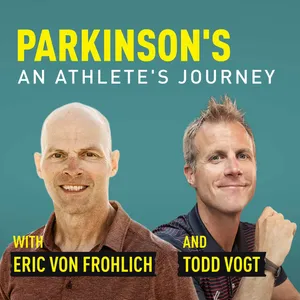
Free Daily Podcast Summary
Parkinson's: An Athlete's Journey: Daily Summaries Delivered
by Eric Von Frohlich and Todd Vogt
Parkinson’s: An Athlete’s Journey is for athletes navigating Parkinson’s, the coaches and clinicians who train them, and anyone who wants real-world strategies for performance and longevity. Hosted by Eric Von Frohlich and Todd Vogt, the show focuses on tactical takeaways: how to train, recover, manage symptoms, and stay consistent when the rules keep changing. Expect honest conversations, tested routines, and guest experts who go deeper on what works.
Latest Episodes
The most recent episodes — sign up to get AI-powered summaries of each one.
- 1 weeks ago55 min
How a Diagnosis Led to the Bigfoot Endurance Lacrosse Classic | Kate McLaughlin
Kate McLaughlin knows what it means to rely on sport when things get difficult.A former Division I lacrosse player and longtime coach, she still draws on many of the things she learned as an athlete: repetition, hard work, relying on a team, and adapting when circumstances change.Those lessons have taken on new meaning since Kate was diagnosed with young-onset Parkinson’s in 2023.Kate continues to train regularly, with boxing, strength, agility, and coordination work all part of her week. She and Eric reflect on how her diagnosis changed her approach to life, and how she’s had to adapt her mindset while finding her way forward. They also talk about adjusting expectations without losing the drive to keep pushing, the role her family and coaching community continue to play in her life, and how the Bigfoot Lacrosse Classic has allowed her to bring the sport she loves into the fight against Parkinson’s.Key Takeaways➡️ The athlete mindset carries beyond the field.Kate sees repetition, discipline, problem-solving, and learning to rely on a team as skills that prepared her to face obstacles well beyond sport, including Parkinson’s.➡️ Progress means adjusting what you compare yourself to.Kate still feels the frustration of not being able to do what she once could. She is learning to recognize what her body can do today while continuing to train and challenge herself.➡️ Training remains a priority.Boxing, strength, agility, and coordination work are regular parts of Kate’s week. Her family understands how important that training is and helps her protect the time to keep doing it.➡️ Community can turn uncertainty into action.Family, friends, coaches, fellow athletes, and the lacrosse community have given Kate support through difficult days. Through the Bigfoot Lacrosse Classic, that community has also become part of her work to raise awareness and funds for Parkinson’s research.Key Moments3:30 Lacrosse; First Signs Something Was Wrong5:40 Son’s College Recruitment; Parkinson’s Changing Perspective7:25 Athlete Mindset; Repetition, Obstacles & Adaptation8:40 Parkinson’s Diagnosis; Early Symptoms & Diagnosis Experience12:30 Community Support; Bigfoot Endurance & Finding Hope15:20 Confirming the Diagnosis; Friends & Support18:30 Family; Building the Right Parkinson’s Care Team20:50 Dystonia; Running & Changes After Diagnosis24:30 Second Opinion; Trying to Out-Train Parkinson’s25:50 Telling Her Children; Choosing to Fight27:15 Bigfoot Lacrosse Classic; Turning to Sport for Action30:45 Isolation, Community & Finding Other Athletes With Parkinson’s33:30 Family; Experiencing Parkinson’s as a Parent and a Daughter38:30 Vulnerability; Losing the Feeling of Being Invincible41:40 Comparing Past & Present Athletic Performance43:15 Boxing; Training With Parkinson’s46:30 Children, Young Athletes & Parkinson’s Advocacy48:30 Coaching; What Sport Teaches Young Athletes51:50 Bigfoot Endurance; Lacrosse, Fundraising & Parkinson’s ResearchConnect with KateInstagram: @cr.icket8596Bigfoot Endurance: http://bigfootendurance.com2026 Bigfoot Endurance Fundraiser: https://give.michaeljfox.org/event/2026-bigfoot-endurance/e744653About the HostEric Von Frohlich is a fitness entrepreneur, coach, and athlete living with Parkinson's who founded EVF Performance and Row House before his diagnosis in 2020. On the podcast he talks with athletes, experts, and people refusing to let a diagnosis be the end of the story.Parkinson’s: An Athlete’s Journey📩 Join our Community: https://evfmethod.com/subscribe-to-podcast-community🎧 Listen and Subscribe: Parkinson's An Athlete's Journey🎬 Watch on YouTube: @parkinsonsathletepodcast📸 Instagram: @parkinsonsathletepodcast📘 Facebook: Parkinson's An Athlete's Journey🤝 LinkedIn: Parkinson's An Athlete's Journey🌐 Website: www.evfmethod.comDisclaimerThis podcast shares persona
- 2 weeks ago49 min
The Second Wave: A 5,200-Mile Row for Parkinson’s | Ashley Ellis
Ashley Ellis is preparing to row more than 5,000 miles around the eastern United States as captain of the Human Powered Potential Second Wave crew.Beginning in spring 2027, the six-woman team will row America's Great Loop — the roughly 5,200-mile waterway from Florida up the Intracoastal, through the Great Lakes, down the Mississippi, and back around the Gulf. If successful, they will become the first crew to row the route.Ashley was diagnosed with early-onset Parkinson’s at 40. Since then, she has found herself saying yes to more things in life, from experiences with her family to challenges she might not have considered before. The Great Loop is the biggest example of that yet.Ashley and Eric talk about preparing for the Great Loop, adapting to endurance rowing, why she chose to row the same boat that made the first-ever Pacific crossing with a Parkinson's crew, and how she found the community that got her back on the water.Key Takeaways➡️ Diagnosis changed what Ashley was willing to say yes to.After being diagnosed with early-onset Parkinson’s at 40, Ashley began thinking differently about what she might otherwise put off. That has included more experiences with her family, returning to rowing, and now preparing for the Great Loop.➡️ Seeing another rower with Parkinson’s gave her proof she could return.When Ashley questioned whether balance and coordination changes would keep her from rowing, she found a video of Paralympic rower Todd Vogt. Seeing someone with Parkinson’s out on the water was enough for her to believe she could do it too.➡️ The Great Loop requires a different kind of athlete.Ashley and her crew are moving from short rowing efforts to months of endurance work, including two-hour rotations, overnight rowing, unfamiliar waterways, fueling, navigation, and learning how to function while tired.➡️ Community has been part of every stage of Ashley’s journey.Ashley sought out other women with Parkinson’s after her diagnosis, found support within rowing, and is now part of a six-woman crew learning how to rely on each other through fear, fatigue, and uncertainty.Key Moments0:00 Ashley’s early-onset Parkinson’s diagnosis and return to rowing3:30 Finding community after diagnosis7:00 Seeing another rower with Parkinson’s and believing she could row again8:45 Saying yes to more after Parkinson’s; living in the now12:00 Family, being present and saying yes13:00 Human Powered Potential and finding a bigger purpose for rowing15:00 The idea to row America’s Great Loop17:00 The 5,200-mile route and becoming the first crew to row it18:45 Adapting from short-distance to endurance rowing19:30 Training for the Great Loop; two-hour rotations and 48-hour sessions21:00 Navigating unfamiliar waterways, boat traffic and nighttime rowing23:00 Bioluminescence, dolphins and the realities of training on open water25:00 Parkinson’s, sleep disruption and managing the demands of the row26:00 Building trust, vulnerability and teamwork within the crew29:00 Exercise and having something she can actively do after diagnosis32:30 Finding meaning beyond reaching the finish line34:00 Four months on the water; rowing clubs and community along the route35:30 Fueling for around-the-clock endurance rowing37:00 Family support and partnering with The Michael J. Fox Foundation39:30 Becoming more open about living with Parkinson’s41:45 “Chosen suffering is a privilege”; Parkinson’s and taking on hard things42:30 Preparing herself and the crew for uncertainty on the water45:00 The 2027 launch and how to follow Human Powered Potential Second Wave46:00 Ashley’s message for someone newly diagnosed47:00 “Rowing the Ocean of Hope”Connect with AshleyWebsite: humanpoweredpotential.orgInstagram (Ashley): @shaky.but.unshakableInstagram (Human Powered Potential): @humanpoweredpotentialFacebook: Human Powered PotentialYouTube: @HumanPoweredPotentialLinkedIn: Human Powered PotentialStrava: https://www.strava.com/clubs/1095227About the HostEric Von Frohlich is a fitness entrepreneur, coach, and athlete living with Parkinson's who founded EVF Performance and Row House before his diagnosis in 2020. On the podcast he talks with athletes, experts, and people refus
- 3 weeks ago37 min
A Setback Doesn’t Mean You Stop | Michael Lu
Michael Lu has been playing hockey since he was four. In 2018, years after being diagnosed with young-onset Parkinson’s, he was recognized by the Anaheim Ducks as their honorary “21st Duck” and skated onto the ice with the team at Honda Center.Michael was diagnosed at 29, after experiencing symptoms as far back as high school. His younger brother was diagnosed even earlier, and the two have had very different experiences with the disease.Michael still plays hockey, trains regularly, and looks for ways to keep doing the things he enjoys as Parkinson’s changes what his body can do.In this conversation, he and Eric talk about adapting when the game plan stops working, the difficult side effects of medication, how years of sport prepared Michael for Parkinson’s, and why he no longer measures a good day by the numbers alone.Key Takeaways➡️ Sport gave Michael practice at adapting.Years of swimming, hockey and snowboarding taught him not to treat mistakes as the end. When something stops working, he changes the game plan, tries another approach and keeps going.➡️ Preparation helps, but Parkinson’s can still move the target.Michael builds extra time, medication, food and sleep into his routine, knowing that what works one day may not work the same way the next.➡️ The way he measures a good day has changed.Michael pays less attention to times and more to whether he enjoyed being out there. His body may not do everything it once could, but he still puts value on what it can do.Key Moments00:21 Michael and his brother’s young-onset Parkinson’s diagnoses02:53 Growing up with hockey, swimming and water polo05:10 Staying active to keep living life as himself06:16 Early symptoms and using medication to keep snowboarding07:34 Seeing how far Parkinson’s had progressed while off medication08:26 Preparing for unpredictable days with Parkinson’s09:56 Medication side effects, dyskinesia and impulsivity12:10 Sleepless nights, racing thoughts and the next-day impact13:37 Two brothers, two very different experiences with Parkinson’s16:19 Michael’s work as a school psychologist18:42 How being an athlete prepared Michael for Parkinson’s20:52 Focusing on what he can control22:11 Michael’s daily routine, training and adult hockey24:38 Training for the unexpected in sport and Parkinson’s27:15 Why Michael decided to share his Parkinson’s publicly28:38 Letting go of times and changing how he measures a good day30:25 Purpose, serving others and continuing to set goals31:12 Learning to live with discomfort instead of fighting itConnect with MichaelInstagram: @mikeyhasparkiesFacebook: @mikeyhasparkiesYouTube: @mikeyhasparkiesTikTok: @mikeyhasparkiesAbout the HostEric Von Frohlich is a fitness entrepreneur, coach, and athlete living with Parkinson's who founded EVF Performance and Row House before his diagnosis in 2020. On the podcast he talks with athletes, experts, and people refusing to let a diagnosis be the end of the story.Parkinson’s: An Athlete’s Journey📩 Join our Community: https://evfmethod.com/subscribe-to-podcast-community🎧 Listen and Subscribe: Parkinson's An Athlete's Journey🎬 Watch on YouTube: @parkinsonsathletepodcast📸 Instagram: @parkinsonsathletepodcast📘 Facebook: Parkinson's An Athlete's Journey🤝 LinkedIn: Parkinson's An Athlete's Journey🌐 Website: www.evfmethod.comDisclaimerThis podcast shares personal experience and general education, not medical advice. Always talk with a qualified healthcare professional before making changes to medication, treatment, or exercise.
- Aug 19, 202636 min
Still Choosing the Hard Climb | Chris Hamper
hris Hamper has been obsessed with climbing ever since he can remember.When he was diagnosed with Parkinson’s 13 years ago, one of his first thoughts was that he wouldn’t be able to climb anymore. He soon found that wasn’t the case. Chris has continued climbing throughout his diagnosis, even as Parkinson’s has made some movements and parts of the sport increasingly difficult.That experience became the subject of the documentary The Parkinson’s Project, which follows Chris and the role climbing continues to play in his life with Parkinson’s.Chris talks about the unexpected ways Parkinson’s has affected him, how he has kept climbing as his abilities have changed, and why he believes you can still get better at things after a diagnosis.Key Takeaways➡️ You can still get better at things after diagnosis.After 13 years with Parkinson’s, Chris still believes there is room to learn, improve, and take on new challenges. His own experience has included continuing to climb, rebuilding a car, learning new skills, and recently taking up cycling.➡️ Adaptation has kept Chris climbing.As his left hand became harder to use, Chris changed how he moved between holds, became more selective about routes, and relied on friends for parts of climbing that had become difficult.➡️ Effort can stay high even when performance changes.Chris still prefers attempting harder climbs over choosing something easy. He says he tries as hard now as he did when he was climbing at his best, even though the level has changed.➡️ Parkinson’s can affect the drive to do something you love.Chris talks about losing the anticipation he once felt around surfing and snowboarding, and how the data and gamification of Zwift have helped give him another reason to keep pushing himself.Key Moments06:00 Early Parkinson’s signs in the classroom and on the climbing wall07:10 Initial ALS concern and receiving a Parkinson’s diagnosis08:54 Early symptoms and expectations after diagnosis09:50 Returning to climbing after thinking it was over10:18 Adapting his climbing around changes in his left hand12:17 Changing how he taught physics with Parkinson’s14:36 Multitasking, apathy and everyday challenges16:25 Losing the ability and desire to snowboard and surf18:28 Finding a new challenge through Zwift20:52 Why harder climbs can sometimes be easier with Parkinson’s22:58 Freezing on the climbing wall23:18 Lead climbing, fear and continuing to try hard24:50 The story behind The Parkinson’s Project26:01 Advice for someone newly diagnosed26:25 Rebuilding a car and learning new skills after diagnosis27:28 Blackouts, vivid dreams and the decision to stop driving29:14 Balance problems and newer Parkinson’s symptoms32:06 Climbing identity and competing in paraclimbing34:19 What’s next: climbing at Rocklands in Africa35:11 Becoming the best climber, teacher and Parkinson’s patient he can beConnect with ChrisInstagram: @chris.mj.hamperMovie Website: The Parkinson’s ProjectAbout the HostEric Von Frohlich is a fitness entrepreneur, coach, and athlete living with Parkinson's who founded EVF Performance and Row House before his diagnosis in 2020. On the podcast he talks with athletes, experts, and people refusing to let a diagnosis be the end of the story.Parkinson’s: An Athlete’s Journey📩 Join our Community: https://evfmethod.com/subscribe-to-podcast-community🎧 Listen and Subscribe: Parkinson's An Athlete's Journey🎬 Watch on YouTube: @parkinsonsathletepodcast📸 Instagram: @parkinsonsathletepodcast📘 Facebook: Parkinson's An Athlete's Journey🤝 LinkedIn: Parkinson's An Athlete's Journey🌐 Website: www.evfmethod.comDisclaimerThis podcast shares personal experience and general education, not medical advice. Always talk with a qualified healthcare professional before making changes to medication, treatment, or exercise.
- Aug 12, 202655 min
Adaptability Is the New Resilience | Becky Johnson
Becky Johnson has spent decades pushing her limits.She has raced ultramarathons, trained in CrossFit for more than a decade, and recently earned a spot at the CrossFit Adaptive Games. Training has always been part of how she approaches challenges, long before she was diagnosed with Parkinson's.When subtle changes began affecting her running, grip strength, and coordination, Becky assumed they were unrelated. After months of appointments, spinal surgery, and eventually a Parkinson's diagnosis, she had to learn how to train in a body that no longer responded the way it once had.In this conversation, Becky shares how she has adapted her training, why the CrossFit community became an essential part of her recovery, and what it takes to keep showing up on the mornings when Parkinson's makes even getting out of bed feel difficult. She also reflects on learning to ask for help, balancing intensity with consistency, and why adaptability, more than resilience, has become the mindset that guides her forward.Key Takeaways➡️ Adaptability became the foundation for staying an athlete.Becky explains why resilience alone is not enough. Parkinson's constantly changes the equation, requiring athletes to adjust their training, routines, expectations, and even long-term plans without giving up on progress.➡️ Community made it possible to keep moving forward.From recovering after spinal surgery to competing at the CrossFit Adaptive Games, Becky describes how training alongside others kept her connected, accountable, and prevented the isolation that often follows a Parkinson's diagnosis.➡️ Consistency matters more than intensity.Instead of chasing personal records every day, Becky shares how she scales workouts, manages medication, prioritizes recovery, and focuses on showing up consistently so she can keep training for the long term.➡️ The first goal after diagnosis is simply the next step.Rather than thinking years into the future, Becky encourages newly diagnosed people to focus on the next breath, the next task, and the next decision. Breaking overwhelming moments into manageable steps helped her regain a sense of control.Key Moments:0:41 Finding CrossFit and the Adaptive Games3:50 Qualifying for the CrossFit Adaptive Games with Parkinson's5:35 Why getting to the gym starts with small wins10:11 The symptoms that didn't seem like Parkinson's13:54 A spinal surgeon changes the diagnosis19:07 Recovery, community, and learning to ask for help22:45 Rebuilding athleticism on a different path26:47 The invisible reality of living with Parkinson's27:53 Why CrossFit works so well for Parkinson's32:41 Training around medication and symptom fluctuations38:14 Finding belonging at the Adaptive Games40:35 Adaptability versus resilience41:50 Advice for someone newly diagnosed45:18 Protecting your energy and setting boundaries46:16 What's next: mobility, strength, and long-term training49:13 Balancing intensity with consistency51:42 Redefining identity beyond athletic achievementsConnect with BeckyInstagram: @beckyjohnson_1971About the HostEric Von Frohlich is a fitness entrepreneur, coach, and athlete living with Parkinson's who founded EVF Performance and Row House before his diagnosis in 2020. On the podcast he talks with athletes, experts, and people refusing to let a diagnosis be the end of the story.Parkinson’s: An Athlete’s Journey📩 Join our Community: https://evfmethod.com/subscribe-to-podcast-community🎧 Listen and Subscribe: Parkinson's An Athlete's Journey🎬 Watch on YouTube: @parkinsonsathletepodcast📸 Instagram: @parkinsonsathletepodcast📘 Facebook: Parkinson's An Athlete's Journey🤝 LinkedIn: Parkinson's An Athlete's Journey🌐 Website: www.evfmethod.comDisclaimerThis podcast shares personal experience and general education, not medical advice. Always talk with a qualified healthcare professional before making changes to medication, treatment, or exercise.
- Aug 5, 202629 min
Don't Bury Your Head in the Sand | Jodi Brown
Jodi Brown is the CEO of Parkinson Association of the Rockies (PAR), a nonprofit serving people with Parkinson's and their care partners across Colorado and Wyoming.After leaving a career in corporate marketing and finance, Jodi helped transform the organization, expanding exercise programs, support groups, educational events, equipment loans, and community services while doubling its revenue, services, and staff. Her work is built around a simple idea: the sooner people connect with resources and other people living with Parkinson's, the better equipped they are to keep moving forward.In this conversation, Jodi shares what she's learned from supporting thousands of people living with Parkinson's, why connecting with the right resources early matters, and how community, exercise, and education help people continue moving forward after diagnosis.Key Takeaways:➡️ Support looks different in every community.Parkinson Association of the Rockies builds programs around the needs of each community rather than using the same model everywhere, recognizing that access, geography, and local resources vary widely across Colorado and Wyoming.➡️ Connecting early can change the experience after diagnosis.Jodi explains why so many people wait months or even years before seeking support, and why finding exercise, education, and community early helps people better understand the condition and feel less alone.➡️ Exercise is only one part of living well with Parkinson's.While movement remains central, Jodi discusses the importance of support groups, education, care partner resources, and practical services that help people continue navigating life with Parkinson's.Key Moments:0:30 Jodi's Journey to Parkinson Association of the Rockies4:17 Why Every Community Needs Different Support6:43 The Five Pillars of Parkinson Association of the Rockies14:20 Research, Conferences & What's Changing17:00 Why the First Months After Diagnosis Matter20:20 Building the Future of Parkinson Association of the Rockies26:56 Jodi's Advice for the Newly Diagnosed29:04 Finding Your Way Back to MovementConnect with Parkinson Association of the RockiesWebsite: https://parkinsonrockies.orgInstagram: @parockiesFacebook: Parkinson Association of the RockiesYouTube: Parkinson Association of the RockiesLinkedIn: Parkinson Association of the RockiesAbout the HostEric Von Frohlich is a fitness entrepreneur, coach, and athlete living with Parkinson's who founded EVF Performance and Row House before his diagnosis in 2020. On the podcast he talks with athletes, experts, and people refusing to let a diagnosis be the end of the story.Parkinson’s: An Athlete’s Journey📩 Join our Community: https://evfmethod.com/subscribe-to-podcast-community🎧 Listen and Subscribe: Parkinson's An Athlete's Journey🎬 Watch on YouTube: @parkinsonsathletepodcast📸 Instagram: @parkinsonsathletepodcast📘 Facebook: Parkinson's An Athlete's Journey🤝 LinkedIn: Parkinson's An Athlete's Journey🌐 Website: www.evfmethod.comDisclaimerThis podcast shares personal experience and general education, not medical advice. Always talk with a qualified healthcare professional before making changes to medication, treatment, or exercise.
- Jul 15, 202619 min
Before You Decide You Can't
Eric and Todd are back together on the pod, catching up on everything that has changed since they last sat down.Todd has started a new full-time job, Eric has been recovering from a medical procedure, and both of them have been trying to find their footing with movement, training, and the usual unpredictability that comes with Parkinson’s.They talk about getting back into exercise, building routines that can survive real life, and Eric’s recent fishing trip to Alaska, where a little planning, a few adaptations, and support from the people around him made it possible to stay fully part of the experience.They reflect on how easily life can start to get smaller after diagnosis, and how friendship, preparation, and being willing to accept help can keep more of it open.Key Takeaways➡️ Life can get smaller before it has to.Eric and Todd talk about how Parkinson’s can lead people to step back from plans, travel, and everyday experiences before they know what is still possible.➡️ Adaptation keeps you in the experience.On Eric’s fishing trip to Alaska, support from family, help with the physical details, and clear expectations allowed him to stay involved instead of sitting the trip out.➡️ Accepting help is not the same as giving up independence.The conversation explores the discomfort of relying on others and how the right support can make it possible to keep training, traveling, and participating in the parts of life that matter.Key Moments00:00 Eric and Todd Catch Up; Moving, Recovery & Life Updates05:41 Todd’s New Work Routine; Making Exercise Automatic06:36 Eric Returns to the Rowing Machine After Three Months07:50 Alaska Trip; Doubt, Balance & Showing Up Anyway10:11 Learned Helplessness; How Life Can Start to Get Smaller11:53 Saying Yes When Parkinson’s Makes Plans Uncertain12:21 Asking for Help; Independence, Frustration & Daily Challenges14:50 Travel, Medication Timing & Disrupted Routines16:27 Adapting the Fishing Trip; Support That Keeps You Involved17:23 Family Support; Accepting Help Without Feeling Like a BurdenAbout the HostsEric Von Frohlich and Todd Vogt are athletes living with Parkinson’s, sharing the day to day reality of training, adapting, and figuring it out as they go. They explore what helps, what does not, and how to keep moving forward with purpose.Parkinson’s: An Athlete’s Journey📩 Join our Community: https://evfmethod.com/subscribe-to-podcast-community🎧 Listen and Subscribe: Parkinson's An Athlete's Journey🎬 Watch on YouTube: @parkinsonsathletepodcast📸 Instagram: @parkinsonsathletepodcast🤝 LinkedIn: Parkinson's An Athlete's Journey🌐 Website: www.evfmethod.comDisclaimerThis podcast shares personal experience and general education, not medical advice. Always talk with a qualified healthcare professional before making changes to medication, treatment, or exercise.
- Jul 8, 202650 min
Pedaling 1,010 Miles to Phoenix | Rob Warner
Rob Warner’s athletic life was built one challenge at a time.First it was climbing stairs. Then Mount Whitney. Then cycling. Then triathlons. Each step gave him a new way to measure effort, build confidence, and stay connected to what his body could do.When Parkinson’s symptoms first appeared, Rob thought he was dealing with an injury from a triathlon fall. Instead, after a long diagnostic process that included an early concern about ALS, he was diagnosed with Parkinson’s in 2008.Since then, Rob has kept adapting. He has trained, raced, raised money through Parkinson’s events, gone through DBS, dealt with freezing, falls, dyskinesia, a broken back from a bike crash, and still continued looking for ways to stay active.Rob talks with Eric about family, faith, humor, cycling, the Ride to Phoenix, and why movement still matters after nearly two decades with Parkinson’s.Key Takeaways➡️ Movement kept giving Rob a way forward.From Mount Whitney to cycling to triathlons, Rob kept finding new challenges that helped him stay connected to his body before and after diagnosis.➡️ Adaptation is not one decision. It keeps changing.Rob has adjusted through DBS, medication changes, freezing, dyskinesia, falls, injuries, and new tools like an e-bike. The work is ongoing.➡️ Support matters when it protects agency.Family, guides, doctors, and riding partners help Rob keep participating without turning him into someone who needs to be pitied or held back.➡️ Community turns effort into purpose.Through fundraising, Cycling to End Parkinson’s, the Ride to Phoenix, and the World Parkinson’s Congress, Rob uses movement to connect with others and build something larger than his own diagnosis.Key Moments0:59 Life before diagnosis; Lancaster, Edwards Air Force Base, flight test engineering2:33 First symptoms; left pinky movement, arm swing changes, triathlon fall3:22 Early ALS concern; waiting for answers with four young children4:18 Parkinson’s diagnosis; relief, uncertainty, and having something concrete to face5:05 Hiding symptoms at work; disclosure, coworkers, and relief after telling the truth7:08 Family response; humor, support, and not being treated with pity10:24 Athletic background; Mount Whitney, cycling, and finding triathlon14:28 Racing with symptoms; dystonia, running backward, and adapting mid-race18:00 Moving closer to care; family support and the realities of daily limitation22:51 Exercise becomes advocacy; fundraising through Parkinson’s events23:56 Choosing DBS to protect his ability to exercise24:13 DBS experience; medication changes, tuning, and symptom relief27:44 Parkinson’s risk; bike crash, broken back, falls, and challenging easy sayings31:14 E-bike support; adapting tools for long-distance riding32:25 Cycling to End Parkinson’s; Ride to Phoenix and family logistics35:45 Riding from Salt Lake to Phoenix; trikes, heat, support, and endurance37:33 Rock Steady Boxing, rock climbing, pickleball, and movement variety38:53 Freezing and sport; why pickleball can feel almost normal once play begins40:18 World Parkinson’s Congress; community, research, and being around people who understand41:41 New infusion therapy; managing on/off time and medication delivery45:21 Advice for the newly diagnosed; Parkinson’s is not life-ending48:08 Movement as the message; cycling, running, swimming, boxing, jujitsu, and doing somethingTeam Utah - Pedal for Parkinson'sFacebook Page: PedalForParkinsonsUT About the HostEric Von Frohlich is a fitness entrepreneur, coach, and athlete living with Parkinson's who founded EVF Performance and Row House before his diagnosis in 2020. On the podcast he talks with athletes, experts, and people refusing to let a diagnosis be the end of the story.Parkinson’s: An Athlete’s Journey📩 Join our Community: https://evfmethod.com/subscribe-to-podcast-community🎧 Listen and Subscribe: Parkinson's An Athlete's Journey🎬 Watch on YouTube: @parkinsonsathletepodcast📸 Instagram: @parkinsonsathletepodcast🤝 LinkedIn: Parkinson's An Athlete's Journey🌐 Website: www.evfmethod.comDisclaimerThis podcast shares personal experience and general education, not medical advice. Always talk with a qualified healthcare pr
About Parkinson's: An Athlete's Journey
Parkinson’s: An Athlete’s Journey is for athletes navigating Parkinson’s, the coaches and clinicians who train them, and anyone who wants real-world strategies for performance and longevity. Hosted by Eric Von Frohlich and Todd Vogt, the show focuses on tactical takeaways: how to train, recover, manage symptoms, and stay consistent when the rules keep changing. Expect honest conversations, tested routines, and guest experts who go deeper on what works.
Customized Recaps
AI-powered recaps with compact key takeaways, quotes, and insights.
Straight to Your Inbox
Get key takeaways from Parkinson's: An Athlete's Journey in a 5-minute read.
Save Hours Every Week
Stay current on your favorite podcasts without falling behind.
Frequently Asked Questions
What is Podzilla's Parkinson's: An Athlete's Journey daily summary?
It's a free AI-powered email that summarizes new episodes of Parkinson's: An Athlete's Journey as soon as they're published. You get the key takeaways, notable quotes, and links & mentions — all in a quick read.
How does the Parkinson's: An Athlete's Journey podcast summary work?
When a new episode drops, our AI transcribes and analyzes it, then generates a personalized summary tailored to your interests and profession. It's delivered to your inbox every morning.
Is this an official Parkinson's: An Athlete's Journey product?
No. Podzilla is an independent service that summarizes publicly available podcast content. We're not affiliated with or endorsed by Eric Von Frohlich and Todd Vogt.
Can I get summaries of other podcasts too?
Absolutely! The free plan covers up to 3 podcasts. Upgrade to Pro for 15, or Premium for 50. Browse our full catalog at /podcasts.
What topics does Parkinson's: An Athlete's Journey cover?
Parkinson's: An Athlete's Journey covers topics including Fitness, Health & Fitness. Our AI identifies the specific themes in each episode and highlights what matters most to you.
Start getting Parkinson's: An Athlete's Journey summaries tomorrow morning.
Free forever for up to 3 podcasts. No credit card required.
Free forever for up to 3 podcasts. No credit card required.