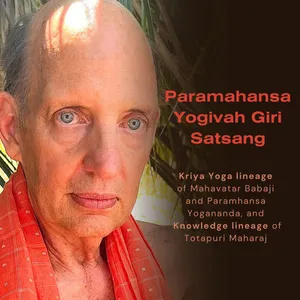
Free Daily Podcast Summary
Paramahansa Yogivah Giri Satsangs: Daily Summaries Delivered
by Paramahansa Yogivah Giri
Paramahansa Yogivah Giri Ji is a God-realized yogi dedicated to guiding sincere seekers on the path to Self and God-realization. He spent seven years under the personal guidance of Gurus and Mahatmas in the Himalayas and has been serving Gurus and sincere devotees for more than 55 years. He continues this service through initiation into Paramahansa Yogananda’s Kriya Yoga and the Knowledge as Given by Totapuri Maharaj, the Guru of Paramahansa Ramakrishna. Having obtained Divine enlightenment, he inspires and guides devotees from all around the world through spiritual writings and videos, weekly Satsangs, personal instructions and sacred initiations. Here you may listen the recording of Yogivah Giri’s satsangs.
Latest Episodes
The most recent episodes — sign up to get AI-powered summaries of each one.
- 2 days ago2h 3m
The Portable Paradise Within
Paramahansa Yogivah Giri explains why nothing in this world can stand between you and your meditation. Family, work, a crowded house or a difficult life are not obstacles. The only thing that can distract you is your own self. The wisdom, peace and love you are looking for are already within you, and the true scriptures and the practice of Kriya Yoga simply help you find them. Drawing on his own years of searching for real teachings, his initiation by a Mahatma, and decades of daily sadhana, he describes what meditation is and is not. It is not making the mind blank or sitting for a fixed time, but turning the senses inward through the spiritual eye. With vivid comparisons, such as choosing the best milk when you are thirsty, a Porsche that breaks down in the rain, and a turtle withdrawing its limbs, he shows why the techniques should be learned from a master and why communion with Om surpasses any worldly pleasure. Turning to the life of Ramakrishna's parents, who chose honesty even when it cost them their home, and to Lahiri Mahasaya's advice to let the fragrance of the flower speak for itself, he reminds us that spirituality does not remove problems from life but gives us the strength to face them. Make meditation a priority, give your life to God, wake up earlier, and you will carry a portable paradise within you wherever you go. Key insights include: • Nothing outside of yourself can interfere with your meditation • Look forward to sadhana the way a child looks forward to a free day • Meditation is not making the mind blank; it is opening the inner senses • How to deal with serious problems, then hand them over to God • Why the Kriya techniques are best learned from a master, not a book • Communing with Om goes far beyond repeating a mantra • Ramakrishna's parents: righteousness that brought hardship, yet never wavered • Let your life, not your words, tell others about Kriya Yoga • Your mind is not your enemy; sometimes it is trying to help you • Unpleasant experiences in meditation and how to rise above them • Waking earlier makes three hours of morning meditation possible Timestamps: 00:00:00 - The wisdom of the Vedas, Upanishads and the Gita 00:03:29 - Your essence versus your temporary body 00:07:03 - Perception, and why the world is not bad 00:09:39 - Family and the world are no obstacles to Kriya Yoga 00:11:05 - Looking forward to sadhana every morning 00:15:41 - Prahlad: devotion in a hostile family 00:17:11 - What initiation really is 00:22:48 - Spiritual senses: intuition and imagination 00:24:53 - What meditation is and what it is not 00:26:43 - Solving problems, then giving them to God 00:35:30 - Initiation by a Mahatma and the search for pure scripture 00:39:01 - The first result of meditation: bliss 00:46:00 - Why learn from a guru: the milk analogy 00:51:51 - Hong-Sau and communion with Om 00:55:00 - Om versus a Porsche 00:59:42 - Ramakrishna's parents and the price of honesty 01:09:01 - Lahiri Mahasaya: let the fragrance of the flower spread 01:11:00 - Giving your life to God 01:18:00 - The order of practice and the portable paradise within 01:25:57 - When the mind is trying to help you 01:31:01 - Structuring your day around meditation 01:41:02 - Like a turtle withdrawing its limbs 01:43:00 - Dark and frightening experiences in meditation 01:46:49 - Signs that meditation is truly your priority 01:49:33 - Waking earlier for three hours of meditation 01:53:00 - Kriya Yoga is internal, not organizational 01:57:15 - God as your companion in life and after death
- 5 days ago1h 41m
You Are What You Think You Are
Paramahansa Yogivah Giri explains why self-realization cannot be reduced to a definition you repeat or a feeling you chase. Many teachers can describe it beautifully, yet few speak from it. He reminds us that we become what we hold ourselves to be, and that true satsang is not meant to make you feel good, but to bring you face to face with your own ego. Drawing on his early years at the feet of self-realized and God-realized Mahatmas in the Himalayas, and on more than five decades of practicing the same meditation techniques, he dismantles the popular idea that meditation is simply a way to feel better. Using the archer's single-pointed focus, the simple mind of a child, and the recipe for a cake, he shows what real concentration is, why instruction should come from one trusted source, and why meditation is a vital ingredient but not the whole recipe. Turning to the lives of Ramakrishna, Swami Vivekananda, Lahiri Mahasaya and Paramahansa Yogananda, he stresses that every teaching must be verified by your own experience. True behavior lies in the thought behind the action, not the show of spirituality. Spiritual life rests on good behavior, proper diet and satsang, with daily, sincere practice slowly carrying the seeker to the higher ground of pure consciousness. Key insights include: • Why knowing about self-realization is not the same as being self-realized • You become what you think you are, so guard how you see yourself • Satsang is not about feeling good; it confronts the ego • Meditation is not a tool to feel better, but a discipline that purifies perception • Karma as a "highlight reel" of the experiences that made the deepest impression • Concentration taught through the archer, and through the simple mind of a child • Why mixing instructions from many sources complicates the path • Behavior, diet and satsang as the foundation that comes before meditation • Proper behavior is the intention behind the action, not the outward show • How techniques practiced for decades become inward and effortless Timestamps: 00:00:00 - Opening and a personal health update 00:09:39 - What is self-realization, really? 00:13:40 - "You are what you think you are" 00:15:17 - Satsang is not meant to make you feel good 00:16:06 - Facing the ego in the presence of the Mahatmas 00:24:59 - Why the seeker needs a guide or a pure scripture 00:30:33 - Meditation is not for feeling better 00:32:58 - Karma as a highlight reel of past experiences 00:38:37 - The archer and the meaning of concentration 00:42:36 - Why instructions from many sources confuse the path 00:47:34 - Ramakrishna: verify everything by your own experience 00:54:58 - Knowing a lot versus spiritual realization 00:58:15 - The same four techniques for 54 years 01:00:44 - Meditation as one essential ingredient 01:03:13 - Behavior, diet and satsang before meditation 01:05:35 - Proper behavior lies in the thought behind it 01:12:52 - The child's mind and true concentration 01:22:34 - When the techniques become inner 01:25:43 - Rising to the higher ground of pure consciousness 01:29:56 - Happiest when you are not thinking of yourself 01:34:50 - Kriya Yoga initiation and variations in teaching Listen on Youtube or your favorite Podcast platform.
- Aug 10, 20261h 57m
The Unfiltered Truth of Kriya Yoga
Paramahansa Yogivah Giri cuts through the common misconceptions surrounding spiritual practice, arguing that true yoga is far more than just sitting in meditation to stop your thoughts. Instead, he challenges listeners to be deeply thoughtful throughout the day, observing the world non-superficially to understand the profound energetic reality behind all life. Drawing from his direct experience living with enlightened Mahatmas in the Himalayas since the age of sixteen, he clarifies that spiritual organizations are merely gross structures meant to point toward an inner essence. He warns against militant attachments to a single “right” way of practicing, emphasizing that genuine spirituality is expansive, all-inclusive, and rooted in direct personal experience rather than blind belief in second-hand stories or rumors. Referencing the timeless wisdom of the Upanishads and the divine dialogue between Sri Krishna and Arjuna in the Mahabharata, this satsang brings the focus back to continuous, disciplined inner work. He explains that karma is an active, ongoing energetic process shaped by our present reactions, ultimately dictating our future reality and spiritual connection. Key insights include: • Why true yoga requires deep, non-superficial contemplation during waking hours, not just silencing the mind • The danger of relying on second-hand spiritual rumors instead of direct, personal experience • How spiritual organizations serve only as the initial, gross structure to finding the essence within • The expansive, inclusive nature of Kriya Yoga versus rigid, militant approaches to practice • How karmic tendencies continually shape our reality through our ongoing energetic reactions • The core message of Vedic scriptures as practical tools for continuous self-realization. Timestamps: 00:00:13 - The misconception of yoga as merely stopping thoughts 00:00:45 - Looking at the world non-superficially 00:08:44 - Seeking God-realization and questioning human existence 00:14:13 - Examining religious structures versus spiritual reality 00:15:56 - The danger of militant, rigid approaches to Kriya Yoga 00:18:46 - Learning directly from enlightened Mahatmas in the Himalayas 00:36:47 - Why spiritual rumors and second-hand stories are unreliable 01:48:10 - Understanding karmic activities and daily energetic reactions 01:51:03 - The divine dialogue between Sri Krishna and Arjuna 01:52:12 - Spiritual organizations as the gross structure of inner practice 01:54:17 - Connecting with the Guru spiritually rather than physically
- Jul 4, 20261h 59m
Contentment Is the True Empire
This talk centers on King Janaka’s awakening as a direct mirror for the listener’s own spiritual life. Paramahansa Yogivah Giri uses the Janaka story to show how worldly achievement, status, and even spiritual busyness all remain unstable when measured against the soul’s deeper reality. The core teaching is simple and repeated throughout: contentment is your true nature, and realization begins when attention turns inward. Desire, ambition, and identification with the body and mind create discontent because everything external changes. He also corrects several common misunderstandings about Kriya Yoga. He argues that Kriya is an inner, spiritual practice, not a set of outer routines, symbols, or social habits, and that true practice is done alone in quiet inwardness. He also stresses that wisdom comes from experience, not book learning or spiritual branding. Key insights include: • Janaka’s realization shows that the king, the body, and the mind are all witnessed, not the true self. • “Whatever is gained in time will be lost in time” is used as a constant reminder of impermanence. • Desire is presented as the poverty of the soul, while contentment is the true empire. • Kriya Yoga is defined as an inner spiritual action, not an external form or performance. • Group meditation is rejected as unnecessary for Kriya practice. • True teachers emphasize your realization, not their own image or status. • Spiritual life does not depend on outward renunciation, brand names, or added practices. • Real wisdom comes from direct inner experience, especially through meditation. Timestamps: • 00:00 — Opening conversation and bird imagery. • 02:30 — Why it is good to verify satsang teachings. • 03:50 — King Janaka’s story begins. • 06:40 — “Whatever is gained in time will be lost in time.” • 10:00 — Contentment as the true empire. • 14:30 — Why change and impermanence disturb the mind. • 20:00 — Desire as the poverty of the soul. • 24:50 — Realization as contentment. • 30:00 — Wisdom comes from experience, not books. • 34:00 — Kriya Yoga is spiritual, not physical. • 40:00 — Why true practice is inward and secret. • 46:00 — Group meditation is questioned and rejected. • 52:00 — What to emphasize in spiritual life. • 58:00 — False gurus and externalism. • 1:04:00 — Balancing worldly work with inner realization.
- Jun 28, 20261h 59m
Realization Beyond Ritual
In this satsang, Sri Paramahansa Yogivah Giri speaks plainly about the difference between outer spiritual activity and inner realization. He returns again and again to the same center: the truth of God, Kriya Yoga, and devotion is not found in borrowed opinions, formal labels, or public performance, but in direct experience. He draws a sharp distinction between teaching and guiding. A true guru does not merely give information; he points the seeker inward, toward consciousness, purity, and a living relationship with God. The talk emphasizes that technique alone is not the goal, and that even sincere practice only matters when it leads to inner change. The speaker also reflects on Ramakrishna, Yogananda, Lahiri Mahasaya, and other realized figures to show that authentic spiritual life is always rooted in realization, not imitation. He questions the habit of repeating traditions without verifying them in one’s own consciousness, and he warns against confusing organizational identity with spiritual depth. At the heart of the talk is a call to honesty. Look carefully at where your attention goes, what you truly love, and whether your practice is bringing you closer to God or merely adding more spiritual language. For serious practitioners who want truth, not performance. Key insights include: - Real progress begins with your own experience. - Kriya Yoga without realization becomes repetition. - A guru should guide inward, not just instruct outwardly. - Scripture makes sense after realization, not before it. - Devotion is shown by what you naturally return to. - Consciousness matters more than external activity. - Spiritual identity is not the same as spiritual depth. - Technique has value only when used sincerely. - The inner path is personal, direct, and uncompromising. - God-realization is the point, not the display. Timestamps: - 00:00 — Formless God and the power of a place. - 02:32 — Why personal experience matters. - 07:14 — Kriya Yoga in different traditions. - 12:31 — Ramakrishna and spontaneous realization. - 16:56 — Beyond “everything is one.” - 18:33 — Realization versus borrowed teaching. - 21:12 — AI, superstition, and false answers. - 23:14 — Initiation, energy, and transmission. - 26:44 — Scholars, scripture, and direct knowledge. - 30:53 — Organization, credibility, and assumptions. - 35:22 — Ignorance and the need for self-inquiry. - 40:50 — Energy in sacred places. - 45:08 — Progress through consciousness, not activities. - 49:33 — Falling in love with God. - 55:50 — Why guidance matters more than technique.
- Jun 15, 20261h 59m
Rama and the Wisdom of Dispassion
Sri Paramahansa Yogivah Giri uses the story of Rama to correct a common misunderstanding about spiritual life: realization is not about gaining powers, status, or a better worldly life. It is about removing what is false, becoming disinterested in the transient, and learning to see the Self within. The talk also distinguishes true practice from spiritual performance. Guruji stresses that Kriya Yoga is not a sales pitch, not a method for achieving samadhi as an acquisition, and not something to be done for results. It is a disciplined purification under the guidance of a real guru. Through Rama’s melancholy, the nature of impermanence, and examples from daily life, the teaching returns again and again to one point: the world cannot give lasting fulfillment. What matters is steadiness, surrender, and the willingness to let go of tendencies, distractions, and false identifications. Later Q&A covers how to recognize the mind, how to handle problems before meditation, how to understand pratyahara and samadhi, and how to stay firm in practice even when bodily sensations or fear arise. Key insights include: • Rama’s sadness is presented as spiritual dispassion, not ordinary weakness. • Spiritual realization is described as removing impurities, not attaining something new. • Powers, healings, and outward signs are not proof of holiness. • A guru is essential because a book cannot correct a student in real time. • Meditation should not be postponed until worldly problems are solved. • The mind is identified as the inner voice that creates doubt, distraction, and future anxiety. • Kriya Yoga practice is framed as purification and preparation, not a search for results. • Pratyahara is the withdrawal of the senses; after that, meditation can happen naturally. • The speaker repeatedly emphasizes obedience to the guru’s instructions and consistency in daily practice. • Q&A on mind versus self, breath practice, eyebrow focus, and evening meditation disturbances. Timestamps: • 00:00 Intro to Rama and obscure scriptures • 03:20 Gurus and avatars as human beings • 06:10 Spiritual powers and why they mislead • 09:00 True spirituality as removal, not attainment • 12:10 Rama’s melancholy begins • 15:20 Worldly life as impermanent and unsatisfying • 19:10 Kriya Yoga and dispassion • 23:00 Why the guru is necessary • 28:10 Trust in God versus worry • 31:20 Question on longing for God • 36:10 Tendencies and daily discipline • 41:30 Meditation is not for results • 47:20 Question on mind versus self • 55:00 Pratyahara and the start of meditation • 01:11:20 Evening meditation and bodily jerks
- Jun 7, 20261h 59m
When the False Self Falls Away
Paramahansa Yogivah Giri explains why self-realization is not a long spiritual project, but a direct recognition of what you already are. He contrasts outer religion, book study, and bodily identification with the clarity that comes through true knowledge and meditation. He returns again and again to Shankaracharya for his sharpness and practical language, especially on ignorance, the prison of samsara, and the release that comes when the mind stops mistaking passing thoughts and habits for the Self. He also stresses that bhakti, love of God, is the easiest path and that Kriya Yoga supports it when practiced correctly. The talk also includes strong warnings about misunderstanding spiritual practice: the techniques are not magic by themselves, and they are not meant to be used as a status display or a substitute for real inwardness. He emphasizes pratyahara, the withdrawal of the senses, as the essential doorway into meditation and says that clarity comes when the stench of worldliness is removed. He illustrates the teaching with stories from his own life: his parents, his practice in solitude, his initiation experience, and the way true guidance can transform one’s perception immediately. For serious practitioners who want direct instruction rather than spiritual fantasy. Key insights include: - Self-realization is immediate in principle, not a future reward after many lives. - Knowledge is not in books; understanding depends on perception and inner clarity. - Bhakti is presented as the easiest path, especially when joined with Kriya Yoga sadhana. - Pratyahara, the withdrawal of the senses, is the key step before true meditation. - The mind’s habits are not the Self, even when they still continue to appear. - Shankaracharya is praised for his clarity, especially on ignorance, samsara, and liberation. - A true guru shows the way clearly and can expose hidden tendencies through direct correction. - Outer appearances, labels, and spiritual status claims are unreliable without real realization. Timestamps: - 00:00:00 — Teeth, body, and a humorous opening. - 00:02:10 — Why Shankaracharya stands out. - 00:05:20 — The body, consciousness, and ignorance. - 00:09:40 — Knowledge, books, and misunderstanding. - 00:14:10 — The role of a guru. - 00:18:30 — The spiritual world and turning toward light. - 00:23:00 — “You are pure right now.” - 00:28:20 — The experience of karma being removed. - 00:34:10 — Shankaracharya on strong desires and bondage. - 00:39:30 — Fragrance, stench, and purification. - 00:44:00 — Bhakti as the easiest path. - 00:49:20 — Kriya Yoga and keeping practice private. - 00:55:10 — Superconsciousness and what others notice. - 01:02:00 — Realization, false claims, and true guidance. - 01:10:30 — Question on parents and spiritual practice.
- May 31, 20261h 59m
Pratyahara Is the Real Turning Point
This satsang draws a firm line between outer life and inner realization. Paramahansa Yogivah Giri begins with everyday examples—village labor, family outings, business pressure, and ordinary frustrations—to show that no worldly setting is free from difficulty. His larger point is simple: uncertainty, discomfort, and worry are built into life, so peace cannot be found by changing circumstances alone. He then turns to spirituality and challenges the habit of relying on secondhand teaching. Books, lectures, and philosophical opinions may contain information, but they are not the same as divine consciousness. What matters is direct knowledge from one who has actually realized the truth and can give authentic guidance. The talk gives special attention to meditation and pratyahara. He rejects the idea that meditation is mainly about forcing the mind to become quiet. Instead, he teaches that the seeker should turn toward God, attend to the breath, and move inward through pratyahara into true meditation. The mind is treated as commentary, while consciousness is presented as the real faculty of perception. A major theme is the role of memories, impressions, and karma. He explains that these shape perception in life and even in near-death experiences, which is why purification matters. Kriya Yoga is presented as the practical method for dissolving impressions, refining awareness, and moving toward the divine presence within. Key insights include: •Suffering and uncertainty follow us in every stage of life. •True spiritual knowledge comes from direct divine realization. •Meditation is not mind suppression, but God-conscious attention. •Pratyahara is the crucial withdrawal of the senses inward. •Breath awareness supports inner concentration. •Memories and impressions shape perception and must be purified. •Kriya Yoga is the practical method for inner transformation. •A true guru teaches from realization, not from theory. Timestamps: - 00:00 Village life and worldly worries - 09:40 No escape from pressure in life - 16:20 Why many spiritual sources are unreliable - 22:10 Divine consciousness as the true source - 28:30 Consciousness, robots, and near-death experiences - 35:50 Memories and impressions shaping perception - 43:20 Meditation is not quieting the mind - 49:10 Breath, desire, and inner turning - 56:40 False ideas about meditation - 01:03:10 Why true gurus teach plainly - 01:10:30 Om, prana, and the inner path - 01:18:20 Pratyahara explained in scripture - 01:26:00 Life, age, and the limits of sense enjoyment - 01:33:10 How pratyahara works in daily activity - 01:41:00 Bhakti, renunciation, and purification
Get Paramahansa Yogivah Giri Satsangs summaries in your inbox
Free AI-powered daily recaps. Key takeaways, quotes, and mentions — in a 5-minute read.
Get Free Summaries →Free forever for up to 3 podcasts. No credit card required.
You Might Also Like
Listeners also like.

Vedanta Society of Western Washington
Vedanta Society of Western Washington

SANATANA DHARMA - WAY OF LIFE
Sriram

The Lion-Faced Guru Podcast - Pragmatic Explorations of Nondual Tantra, Vajrayana & Dzogchen
Amrita Mandala Sangha

Wisdom from the Rishis ( Arsha Vidya Deepam )
Lakshmy
The Hindu/Yoga Dharma.
Dharma Yoga Ashram
Daily READINGS of Srila Prabhupada's Books
Kesava Bharati Dasa Goswami

Geeta Unraveled: Conversations on Timeless Wisdom
Explores the Bhagavad Gita verse by verse, translating its spiritual and philosophical teachings into practical guidance for modern life.

Nārāyaṇīyaṃ - Learn to Chant
A Sanskrit devotional chant from the Nārāyaṇīyaṃ scripture, broken down for learning and recitation.

Bhagavad Gita in Kannada; ಕನ್ನಡದಲ್ಲಿ ಭಗವದ್ಗೀತೆ
Shivaswamy KV

45 Vassas - Unpacking Theravada Buddhism Teachings
Explores the teachings of Theravada Buddhism and examines the life and philosophy of the Buddha.
Mahabharata Teaching Archives - Arsha Bodha Center
Swami Tadatmananda
Bhagavad Gita Discourses
About Paramahansa Yogivah Giri Satsangs
Paramahansa Yogivah Giri Ji is a God-realized yogi dedicated to guiding sincere seekers on the path to Self and God-realization. He spent seven years under the personal guidance of Gurus and Mahatmas in the Himalayas and has been serving Gurus and sincere devotees for more than 55 years. He continues this service through initiation into Paramahansa Yogananda’s Kriya Yoga and the Knowledge as Given by Totapuri Maharaj, the Guru of Paramahansa Ramakrishna. Having obtained Divine enlightenment, he inspires and guides devotees from all around the world through spiritual writings and videos, weekly Satsangs, personal instructions and sacred initiations. Here you may listen the recording of Yogivah Giri’s satsangs.
Customized Recaps
AI-powered recaps with compact key takeaways, quotes, and insights.
Straight to Your Inbox
Get key takeaways from Paramahansa Yogivah Giri Satsangs in a 5-minute read.
Save Hours Every Week
Stay current on your favorite podcasts without falling behind.
Frequently Asked Questions
What is Podzilla's Paramahansa Yogivah Giri Satsangs daily summary?
It's a free AI-powered email that summarizes new episodes of Paramahansa Yogivah Giri Satsangs as soon as they're published. You get the key takeaways, notable quotes, and links & mentions — all in a quick read.
How does the Paramahansa Yogivah Giri Satsangs podcast summary work?
When a new episode drops, our AI transcribes and analyzes it, then generates a personalized summary tailored to your interests and profession. It's delivered to your inbox every morning.
Is this an official Paramahansa Yogivah Giri Satsangs product?
No. Podzilla is an independent service that summarizes publicly available podcast content. We're not affiliated with or endorsed by Paramahansa Yogivah Giri.
Can I get summaries of other podcasts too?
Absolutely! The free plan covers up to 3 podcasts, any in the catalog. Basic raises that to 15, Pro to 40 and Max to 100. Browse our full catalog at /podcasts.
How often does Paramahansa Yogivah Giri Satsangs release new episodes?
Paramahansa Yogivah Giri Satsangs publishes weekly. Our AI generates a summary within hours of each new episode.
What topics does Paramahansa Yogivah Giri Satsangs cover?
Paramahansa Yogivah Giri Satsangs covers topics including Religion & Spirituality, Spirituality, Hinduism. Our AI identifies the specific themes in each episode and highlights what matters most to you.
Start getting Paramahansa Yogivah Giri Satsangs summaries tomorrow morning.
Free forever for up to 3 podcasts. No credit card required.
Free forever for up to 3 podcasts. No credit card required.