Free Daily Podcast Summary
Outside The Dollar: Daily Summaries Delivered
by Outside The Dollar
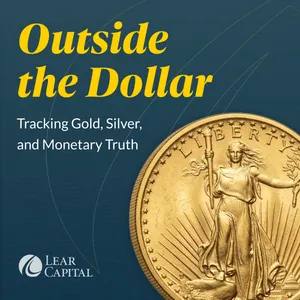
Outside The Dollar offers brief, 15-minute weekly updates on gold, silver, and the broader economic trends influencing the U.S. dollar and financial markets. Hosted by Kathrynn Ward of Lear Capital, the podcast provides straightforward insights designed to help listeners stay informed and protect their savings without all the noise. Information contained within Lear Capital's podcast is for general educational purposes and should not be construed as investment advice. Lear Capital does not provide legal or tax advice, or retirement-specific recommendations.
Latest Episodes
The most recent episodes — sign up to get AI-powered summaries of each one.
- 2 days ago13 min
10-Year Treasury: Breaking Above 5%
The 10-year Treasury yield crossing 5.04% in September 2026 is the single number tying together this week's economic pressures, from mortgage rates to precious metals prices. Kathrynn explores how CBS News' five economic warning signs—oil prices, inflation, interest rates, federal debt, and AI valuation concerns—connect to rising bond yields, and why higher yields make gold and silver face short-term competition from interest-bearing assets even as long-term reasons to hold precious metals remain unchanged. Listeners holding or considering gold and silver will learn how mortgage rates above 7%, falling home sales, and Federal Reserve decisions all trace back to Treasury market dynamics. The episode references CNBC's September 15 reporting on Treasury yields and CBS News' economic risk assessment.
- 3 days ago14 min
Roubini's 4 Risks: Gold, Oil & $40T Debt
Central banks continued adding to gold reserves in September 2026, with China and Poland among the buyers extending a multi-year accumulation trend even as the pace cools from last year's highs. Elena Reyes connects this reserve-building activity to oil prices approaching $100 a barrel, inflation data arriving ahead of the Federal Reserve's September meeting, and the rising cost of servicing federal debt. She also examines economist Nouriel Roubini's four flagged risks and what they mean for retirement savings losing ground to inflation. For anyone holding or considering gold, silver, or other precious metals, the episode frames these pressures as compounding rather than isolated. Figures cited include the World Gold Council's long-term gold performance data and Fidelity's retiree health-care cost estimate.
- 2 weeks ago14 min
$40T Debt: Growth, Gold & The Fed's Choice
The federal government's debt-servicing costs, not the $40 trillion headline figure, are the real strain on fiscal policy heading into September 2026. Elena Reyes examines Treasury Secretary Bessent's argument that economic growth could resolve the debt burden, contrasted with economist skepticism that growth alone offers no realistic path out. The episode also covers a new Texas law expanding how gold and silver can be used in transactions, and why the Federal Reserve faces a genuine no-win decision this month between cutting rates and holding steady. For listeners holding or considering precious metals, the discussion frames real assets like gold and silver as a way to diversify away from dependence on financial claims such as stocks and bonds. The analysis draws directly on Yahoo Finance reporting covering Bessent's growth argument and economist reaction.
- 2 weeks ago14 min
Debasement Trade: Debt, China & Gold's Rise
The same forces driving concern over U.S. debt are also pushing more people to look outside the dollar toward scarce assets like gold and silver. Host Elena Reyes connects Ray Dalio’s warning about America’s growing debt burden with China’s gradual build-out of alternative payment rails, the notable August 2026 moves in precious metals, and the latest signs that inflation remains elevated even as growth cools. She explains why these shifts matter for anyone holding or considering precious metals as a way to diversify against long-term currency risk rather than to chase short-term price moves. The conversation grounds these big-picture themes in concrete data on inflation, consumer spending, and economic growth that the Federal Reserve is weighing, helping listeners understand how macro trends can influence gold and silver over time. The episode references reporting and analysis from CNBC on Dalio’s debt concerns, China’s CIPS network, and renewed investor focus on scarce assets.
- Aug 21, 202611 min
$40 Trillion Debt: Gold and Silver Respond
The federal deficit hit $432 billion in July, the largest monthly shortfall since March 2021, and it's directly linked to this week's bond market turmoil pushing gold and silver higher in August 2026. Elena Reyes traces how rising Treasury borrowing sent the 30-year yield to 5.234%, its highest level since 2007, and explains what that means for mortgages, federal interest costs, and the $40 trillion national debt. She examines gold's roughly 10% monthly gain and silver's 16% surge, including Jeff Currie's shift toward bullish gold sentiment, offering listeners a framework for evaluating precious metals within a diversified portfolio. The episode references July's Treasury budget data and this week's Treasury buyback announcement dated August 19th.
- Aug 14, 202611 min
Jobs Miss, Gold Jumps 7%
Employers cut 23,000 jobs in July 2026 against forecasts for a 95,000 gain, exposing a widening split between labor data, inflation trends, and a surging gold market. Elena Reyes examines gold's sharpest weekly rally since February, survey data showing nearly half of central banks plan to add reserves, and Japan's yen intervention involving over a trillion dollars in Treasury holdings. She contrasts retail investors' short time horizons with the multi-year strategies driving institutional gold buying and dollar diversification. For anyone holding or considering precious metals, the discussion offers context on why central banks and households often read the same signals differently. Data referenced includes reporting from CBS News, Morningstar, Yahoo Finance, and a Fox News central bank survey.
- Aug 7, 202611 min
Jobs Fall 23,000: Gold's Next Move
U.S. employers lost 23,000 jobs in July 2026, a sharp miss against forecasts of 85,000 gains, exposing cracks in the labor market just as inflation pressure and AI valuation fears collide in August 2026. Elena Reyes examines Oracle's steep selloff and Larry Ellison's paper losses, questions claims that the AI trade is now far larger than the dot-com bubble, and unpacks ISM manufacturing data showing factory-floor cost pressure some call worse than the pandemic. She then turns to gold and silver, weighing Deutsche Bank's aggressive year-end gold target against historical drawdown risk and highlighting silver's dual investment-industrial demand. The discussion closes with why long-term positioning in precious metals may matter more than timing entry points. The episode references the July 2026 U.S. jobs report, the ISM manufacturing survey, and Deutsche Bank's gold price forecast from strategist Michael Hsueh.
- Jul 31, 202611 min
Fed Holds: Metals Reset and AI Debt Risk
Four major stories are converging this week: a Federal Reserve decision, record market leverage, AI financing concerns, and a sharp pullback in gold and silver prices. In July 2026, Elena Reyes examines Morningstar's Fed preview, warning that the hawkish tone under Kevin Warsh matters more than the meeting itself, before turning to Globalbankingandfinance's data on margin debt, Treasury yields above 5%, and rising oil prices. She then breaks down Jim Cramer's dot-com comparison to current AI data-center financing deals, testing whether today's cash-rich tech giants make the parallel weaker than it sounds. The episode closes with Economic Times' reporting on the metals drawdown, weighing whether it signals a reset or something more serious for anyone holding precious metals, and introduces Lear Capital's Lincoln coin program as a physical option to consider. Morningstar, Globalbankingandfinance, and Economic Times are cited throughout.
About Outside The Dollar
Outside The Dollar offers brief, 15-minute weekly updates on gold, silver, and the broader economic trends influencing the U.S. dollar and financial markets. Hosted by Kathrynn Ward of Lear Capital, the podcast provides straightforward insights designed to help listeners stay informed and protect their savings without all the noise. Information contained within Lear Capital's podcast is for general educational purposes and should not be construed as investment advice. Lear Capital does not provide legal or tax advice, or retirement-specific recommendations.
Customized Recaps
AI-powered recaps with compact key takeaways, quotes, and insights.
Straight to Your Inbox
Get key takeaways from Outside The Dollar in a 5-minute read.
Save Hours Every Week
Stay current on your favorite podcasts without falling behind.
Frequently Asked Questions
What is Podzilla's Outside The Dollar daily summary?
It's a free AI-powered email that summarizes new episodes of Outside The Dollar as soon as they're published. You get the key takeaways, notable quotes, and links & mentions — all in a quick read.
How does the Outside The Dollar podcast summary work?
When a new episode drops, our AI transcribes and analyzes it, then generates a personalized summary tailored to your interests and profession. It's delivered to your inbox every morning.
Is this an official Outside The Dollar product?
No. Podzilla is an independent service that summarizes publicly available podcast content. We're not affiliated with or endorsed by Outside The Dollar.
Can I get summaries of other podcasts too?
Absolutely! The free plan covers up to 3 podcasts. Upgrade to Pro for 15, or Premium for 50. Browse our full catalog at /podcasts.
How often does Outside The Dollar release new episodes?
Outside The Dollar publishes weekly. Our AI generates a summary within hours of each new episode.
What topics does Outside The Dollar cover?
Our AI identifies the specific themes in each episode and highlights what matters most to you.
Start getting Outside The Dollar summaries tomorrow morning.
Free forever for up to 3 podcasts. No credit card required.
Free forever for up to 3 podcasts. No credit card required.