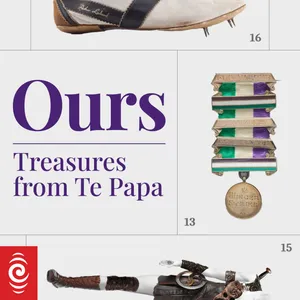
Free Daily Podcast Summary
Ours: Treasures from Te Papa: Daily Summaries Delivered
by RNZ
Get key takeaways, quotes, and insights from Ours: Treasures from Te Papa in a 5-minute read. Delivered straight to your inbox.
Latest Episodes
The most recent episodes — sign up to get AI-powered summaries of each one.
- Jun 25, 20186 min
Jody Wyllie and Te Hau ki Tūranga
Our last taonga is not just an object, but a sacred place, and an "encyclopedia" of the history, traditions and art and culture of the people of Rongowhakaata.We've come to the end of the series and to mark it, we have chosen a taonga that represents a vital link between New Zealand's past and future.Te Hau ki Tūranga is a historic whare whakairo, or carved meeting house, and is the oldest of its kind - dating back to the 1840s.It's a beautiful structure, completed by a master carver in the Tūranga style, but it's also special because of the community and people it belongs to - the Gisborne iwi of Rongowhakaata - and their ancestors.But due to its forced confiscation in 1867, this whare whakairo is also a reminder of New Zealand's complicated and often fraught history, as well as our ongoing efforts to face up to the injustices of the past and make amends.Te Papa Kaihautū (Māori co-leader), Dr Arapata Hakiwai, who is of Rongowhakaata descent, says he visits the whare at the museum almost every day."I greet my ancestors and say, you know, 'continue to look after us' and to say...'we have our people working here and they're working with you'..."Our ancestors would have slept in here. We have had the descendants here sleep in the meeting house as part of the process when it was brought to this museum in the late 1990s."Te Hau ki Tūranga was confiscated by the Crown in 1867 by then Minister of Native Affairs and Acting Director of the Colonial Museum, James Richmond."The language has been described - and it's so apt - it was ripped from the heart and roots, the umbilical cord really, wrenched from the heart of Ōrākaiapu pā," Hakiwai says.It was dismantled on site at Ōrākaiapu pā with the help of government troops and rebuilt at the Colonial Museum - one of the predecessors of Te Papa.Te Papa says the Colonial Museum was one of the first buildings constructed for the government after the capital city moved from Auckland to Wellington in 1865."It was loaded on the government steamer, the Sturt, and it was taken and even in the discussions in Parliament after that time there was great glee in recording the taking of this meeting house," says Hakiwai.The government apologised for the forcible removal of the whare in 2012, acknowledging the ownership of Rongowhakaata.Jody Wyllie has whakapapa to Rongowhakaata and is the iwi's lead negotiator in discussions with the Crown about the future of Te Hau ki Tūranga.He compares Te Hau ki Tūranga to an encyclopedia - albeit an encyclopedia that he says has had "its spine torn out" with its pages out of order…Go to this episode on rnz.co.nz for more details
- Jun 18, 20187 min
Lady Pippa Blake and NZL32
This is a story about one of the most magical victories in New Zealand's sporting history, and the inspiring legacy that it has left in its wake.When Team New Zealand won the America's Cup on 13 May 1995, their 5-0 victory over the US caught the nation's attention in a way that competitive yachting had never quite done before.It's a story that has all the necessary ingredients: a great sporting rivalry between nations, a charismatic leader overseeing a dream team, and a "rocket ship" of a boat that helped the New Zealand team sail to triumph.Oh, and don't forget about that lucky pair of red socks.For a country that was more used to supporting teams on the rugby field, Team New Zealand's win in San Diego against Stars and Stripes was a historic moment which inspired sailors and landlubbers alike."Particularly because we’re an island nation, I think it strikes a very deep, almost primal nerve in us that we can excel at sport on the water," Te Papa history curator Stephanie Gibson says.Team New Zealand's success demonstrated to the world that New Zealand excelled in design and technology, Gibson says, and could compete with the best.So, in this week's episode, we turn our attention to the special boat that Sir Peter Blake and his team used to sail to victory – NZL32 AKA Black Magic.To be clear, there were actually two boats called Black Magic, NZL38 and NZL32, but it was the latter which was kept under wraps and only unveiled towards the end of the competition."The New Zealanders were doing very well in NZL38 and the whole world thought that was the best boat," says Gibson. "And then for the finals they swapped to NZL32 and that really freaked everyone out. It was like – 'oh no, it’s older, it can’t be as good'."[image:141715:half] Sir Peter Blake.By the time Team New Zealand reached the finals, skippered by Russell Coutts, they had become firm favourites.But they were facing off against the US – headed by four-time winner Dennis Conner – an American known as Mr America’s Cup, who had already attracted a degree of notoriety in New Zealand after walking off the very first Paul Holmes show during a testy interview in 1989.Gibson says the team didn't want Conner and the challengers to know too early that NZL32 was, in the words of then Team New Zealand sailor Joey Allan, a "rocket ship."Sir Peter's widow, Lady Pippa Blake, says some fans were confused as to why Team New Zealand had decided to use NZL32 for the final round…Go to this episode on rnz.co.nz for more details
- Jun 11, 20185 min
Ema Tavola and the Isa Lei song
This is one of the most well-loved songs of the Pacific and its beautiful, wistful quality still endures - 100 years on from its debut.As she wanders through Te Papa, 16-year-old Ema Tavola hears the faint sounds of the Pacific hovering in the air.The murmuring and chatter of other visitors in the museum quickly fades into the background and she walks over to the row of red buttons.She picks one at random and soon a song of love and loss, underlined by the sound of Pacific voices in harmony, rises into the air.Far too soon, the tune fades to nothing but, feeling mesmerised by the song, she pushes the button once more and her reverie begins again.That was about 20 years ago, when Te Papa opened in 1998, and Tavola first encountered the famous Fijian song of farewell, Isa Lei.She says the song resonated with her immediately, sparking a feeling of nostalgia and connection with her Pacific heritage.So in this week's episode, rather than focussing on an object, we are looking at something far more intangible - a much-loved Pacific song and its power to move its listeners 100 years on from its creation."When I first moved to Wellington I was a teenager who'd just moved away from home, my family was all in Fiji, and I'd been living overseas. I grew up overseas and the sense of home was quite nostalgic," Tavola says.She wasn't exposed to much Fijian culture when she moved to New Zealand, she says, so Isa Lei made an impact."I grew up in a Fijian embassy house in Brussels so Fijian culture and representing your people and being aware of your country was very much part of who I am."Then when I moved here I guess Fiji became quite invisible so I guess that's why that exhibition and that song became such an anchor for me."That day in Te Papa, she felt compelled to play the song on repeat."I found this listening area where you could listen to sounds of the Pacific and there was this one button that started the song Isa Lei which is a kind of iconic Fijian farewell song," she says."It wasn't the whole song so I was always wanting more so I'd press it again, and press it again and then someone might come past and I'd pretend to look at other things - but that sharing and that moment is what I've always connected with Te Papa."And the song has a poignant story behind it, as Te Papa's senior curator of Pacific Cultures, Sean Mallon, explains."Isa Lei is a love song, or farewell song, that was written by a Fijian man. I think the first time it was composed and sung was around 1918…Go to this episode on rnz.co.nz for more details
- Jun 4, 20186 min
The Topp Twins and the dolls
These knitted creations are a Topp tribute to the beloved alter-egos of New Zealand's most famous folk-singing/yodelling/comedy duo.These miniature works of knitted art hail from Invercargill and might just be the ultimate Kiwiana tribute to two of New Zealand's most popular characters - Camp Mother and Camp Leader - the inspired creations of Lynda and Jools Topp; the Topp Twins.The activist sisters (and their woollen doppelgangers) have always displayed a 'girls can do anything' attitude that New Zealanders have embraced wholeheartedly.To top it off, the twins have just been made Dames Companion to the New Zealand Order of Merit for services to entertainment in the Queen's Birthday Honours.The careful, detailed work that went into creating the dolls reveals the dedication of their maker, who remains a mystery. But it also suggests something larger about the impact of the Topp Twins on this country's pop culture and even our politics.So this week we're admiring the knitted versions of Camp Mother and Camp Leader, which dames Lynda and Jools Topp gifted to Te Papa in 2000.Camp Mother's doll is magnificent in her trademark pink velour jumpsuit and matching turban. She sports a cardigan over the top and clutches a yellow handbag.Camp Leader pairs a dress with a lime green cardy, plus a headband, glasses and comes complete with her guitar.The characters were part of the Topp Twins' popular television series, The Topp Twins. The show ran from 1996 to 2000 and starred Camp Mother and Camp Leader, who ran the Happy Valley camping ground, and a host of other characters.The dolls were presented to the twins in Invercargill in 1999 while they were on tour."If anyone’s going to knit anything in New Zealand it has to come from Invercargill because knitting is still an art form down there, partly because of the weather," says Dame Lynda Topp, AKA Camp Mother."If you go out in Invercargill you’ve got to have a good cardy on or a nice jumper and you can’t beat a hand-knitted one. There’s always a lot of warmth in a hand-knitted one and also usually a lot of love, you know?”Topp says the sisters were so impressed with the knitted "icons" that they decided to include them in their show."We did a programme where Camp Mother and Camp Leader ended up at Te Papa with the dolls, so at the end of the show we gifted the dolls to Te Papa - and a beautiful thing happened because Te Papa actually just took them, they didn’t have to take them but they did, and every now and then they haul them out.”Te Papa's history curator Stephanie Gibson says the dolls tell many a yarn about New Zealand…Go to this episode on rnz.co.nz for more details
- May 28, 20188 min
Pauline Cowens and the Snell Shoe
This spiky item helped a relatively unknown New Zealand athlete seize gold, and instant fame, at the 1960 Rome Olympics.This shoe doesn't come with the bells and whistles of modern running shoes - there's no foam cushioning, titanium cooling spheres or fancy flex grooves.But take a closer look and you'll notice the inspired and innovative touches that make this shoe so special.It tells the story of one athlete's spectacular sporting success, and loyalty to the shoes his coach made him. But it's also part of a larger story about New Zealand's sporting and national identity and our ability to improvise and modify in the face of competition. And arguably the greatest day in our sporting history.In this week's episode, we turn our attention to the shoes that Peter Snell was wearing when he won the 800 metres at the Rome Olympic Games in 1960 at the age of 21.Snell gifted 14 pieces from his collection to Te Papa in 2017, including two Olympic gold medals and one of his famous shoes.But, where's the other shoe?It turns out Snell donated the left shoe to Tauranga Girls' College in the mid-60s."The left shoe is on top of a block of rimu, it's a beautiful trophy, and it lives in the principal's office at Tauranga Girls College," says former principal of the college, Pauline Cowens.Snell wanted to encourage competition between Tauranga Girls and Rotorua Girls High School in athletics."What he didn't probably appreciate was how it would make the whole history stay alive."Because every single year when the two schools do their two sports exchanges and we compete for the trophy we revisit Peter Snell, we revisit the Olympic movement and we revisit the importance of sport," says Cowens.Peter Snell sprints to win the 800m final on 2 September, 1960, during the Olympic Games in Rome.The shoe was made especially for Snell by brothers Arthur and Wally Lydiard. In fact, Arthur Lydiard's signature can be seen on the side in gold letters.Lydiard is considered a ground-breaking athletics coach due to his revolutionary endurance training methods for his students. His earlier training as a shoemaker is less known."I think it was the pattern of training and the distances, the sheer distances that he made Peter run - and Arthur himself ran in Auckland - the training was really intensive," Te Papa's head of New Zealand and Pacific Cultures Bronwyn Labrum says.Lydiard's students included not only Snell, but Murray Halberg and Barry Magee…Go to this episode on rnz.co.nz for more details
- May 21, 20186 min
Ngila Dickson and the Xena costume
What happens when Greek mythology meets modern pop culture feminism, with a bit of Kiwi battler thrown in?She's a character who hints at being from the Pantheon of ancient Greek mythology, but was in fact born entirely from modern imagination and brought to life not in the temples of the gods, but in west Auckland.Xena, the 'warrior princess', continues to inspire a cult following of ‘Xenites’ to this very day. Everyone needs a hero, or heroine, and this feminist icon, played by Kiwi actress Lucy Lawless, certainly fits the bill.So, in this week's episode we turn our attention to something a bit different – Xena’s costume, including her fabulous boots.Watch a video from the episode hereAccording to the show, Xena was a "mighty princess forged in the heat of battle”. After making friends with Hercules, Xena sought redemption from her dark and violent past and began fighting warlords and gods for the greater good.Xena's character was the full package – a strong and powerful woman, exceptional in combat, and with a signature battle cry that no doubt instilled fear in her enemies.Her partnership with sidekick and best friend Gabrielle also drew fans. Indeed, some have suggested the duo were more than just good friends.Xena’s character first appeared in an episode of Hercules: The Legendary Journeys, but she went on to star in her own spinoff series.One of the creators of Xena’s costume, Ngila Dickson, says Xena’s character underwent a makeover after getting her own show.“There already was an established costume for Xena. In that time she was quite light, blonde and we were wanting to go for this darker, tougher, stronger image.”The show, which was filmed in New Zealand, ran from 1995 to 2001. When it ended, producers Pacific Renaissance Pictures gifted Xena’s costume to Te Papa.Xena’s outfit includes a brown leather dress, armour, a breast plate, gauntlets, arm bands and boots. It was initially designed by Barbara Darragh, then reworked by Dickson.The costume would not be complete of course without her weapons -including her whip, chakram and trusty sword. Robert Gillies designed the weapons and other props.Te Papa’s Senior Curator New Zealand History and Culture, Claire Regnault, says the outfit is still very popular with visitors.“We’ve had designers from all over the world come and see it, wanting to see it up close in person to study it. It’s one of those objects when you say to people ‘We’ve got Xena’s outfit’, you immediately get a reaction.”…Go to this episode on rnz.co.nz for more details
- May 14, 20188 min
Googie Tapsell and the Patu Parāoa
This patu parāoa (whalebone hand weapon) used during the New Zealand Wars offers a window or "little cobweb” into New Zealand’s past.This patu parāoa (whalebone hand weapon) used during the New Zealand Wars offers a window or "little cobweb” into New Zealand’s past.The patu parāoa, now safely stored at Te Papa, may look ornamental, but do not be deceived.It has many stories to tell, including an unlikely connection with a British general.In Te Ao Māori, taonga resonate according to the events and people with whom they are associated.It’s believed this patu, a whalebone hand weapon, was used in the battle of Te Ranga in Tauranga Moana, on 21 June 1864.“After the Māori triumph at Gate Pā was the battle of Te Ranga, which we lost. The colonial forces overwhelmed us and overtook us,” Te Papa’s acting head of Mātauranga Māori, Puawai Cairns, says.“It’s a lot more complicated but I see Te Ranga as a huge tragedy and great sadness for the tribes of Tauranga.”For Cairns, who has tribal affiliations to the iwi of Tauranga Moana, Ngāi te Rangi, Ngāti Ranginui and Ngāti Pūkenga, this patu has personal significance.“As a descendant of Tauranga, as someone who will always have the soul tie back to my ancestors, this is like a little window or a little cobweb that helps me connect to home and to the stories I was brought up with,” she says.The patu has been well-handled and had a lot of wear, Cairns says, with a good patina on it.While we don’t know exactly who used the patu in battle, a paper label fixed to its surface in another century tells of a fleeting association with an English soldier, a collision of Māori and Pākehā worlds that echoes across time and space.His name was General Horatio Gordon Robley, and he fought at Gate Pā and Te Ranga.During his time in New Zealand, Robley sent sketches to the Illustrated London News, Victorian Britain’s most widely read weekly newspaper, communicating a vision of the New Zealand Wars to the seat of colonial power.That included a sketch of what is believed to be this very patu.Cairns says she has been trying to figure out this special object’s history, ever since she started working as a curator.“If it is one of the weapons in the sketch referred to on the label, this patu parāoa becomes a witness to a very profound event in my whakapapa,” Cairns says.The patu comes with a note saying it was illustrated by General Robley in the London Illustrated News, 24 September 1864.Tim Walker is an expert on Robley who’s been following his trail for four decades…Go to this episode on rnz.co.nz for more details
- May 7, 20187 min
Leah McFall and the Suffragette medal
This little object is so small it could fit in your pocket, yet it's a powerful symbol of one woman's courage and activism in very difficult conditions.Warning: The following includes graphic details of Frances Parker's treatment in prisonIn the midst of the #MeToo and Time's Up movement, this object is perhaps more relevant than it has been for decades.It takes us back to a time when women were seen as mad or hysterical for demanding to be treated as more than objects, sidekicks or second class citizens. A time that speaks to us in echoes even today.So, in this week's episode we turn our attention to the Suffragette medal, which was awarded to Frances Parker, a New Zealander who fought for women's suffrage in Britain.Te Papa bought the medal, known as the Women's Social and Political Union Medal for Valour, for about $40,000 in 2016 from auction house Dix Noonan Web in London.Newspaper columnist and occasional demonstrator, Leah McFall, says she's in awe of Parker's medal and what it represents."It's militaristic really, an emblem of incredible suffering and courage and valour."Parker, who was from Otago, grew up at a time of great political and social change. New Zealand, of course, was the first nation to give women the vote in 1893, with Kate Sheppard heading the movement. Three years later, at the age of 22, Parker left for Britain to study at Cambridge.In Britain, Emmeline Pankhurst was leading the charge and formed the women's political and social union in 1903. By 1908, protests began to turn more militant and Parker was involved.Te Papa's senior curator of history, Claire Regnault, says the group's acts were designed to attract publicity.She gives the example of a window smashing campaign in London that resulted in Parker's arrest."[It was] co-ordinated for a Friday at 5.45 [pm] exactly, all these women who seemed to be peacefully going around town shopping suddenly - and the newspaper descriptions are wonderful - from their handbags and their muffs came stones and batons and sticks and they began violently smashing windows," Regnault says.Parker eventually becoming a prominent leader of the Women's Political and Social Union in Scotland…Go to this episode on rnz.co.nz for more details
Get Ours: Treasures from Te Papa summaries in your inbox
Free AI-powered daily recaps. Key takeaways, quotes, and mentions — in a 5-minute read.
Get Free Summaries →Free forever for up to 3 podcasts. No credit card required.
You Might Also Like
Listeners also like.
History of Aotearoa New Zealand
Thomas Rillstone
New Books in Australian and New Zealand Studies
Marshall Poe

Hidden Figures
Hidden Figures

Whakamīere - Reo Māori Stories
Whakamīere

30 with Guyon Espiner
RNZ
Stuff The British Stole
ABC and CBC
The Week in Art
The Art Newspaper
Taringa Podcast
Te Wānanga o Aotearoa

The Front Page
NZ Herald

The Detail
RNZ
Black Sheep
RNZ
Kelly Tarlton's Final Treasure Hunt
RNZ
About Ours: Treasures from Te Papa
Unveiling taonga from high art to pop culture, from the natural world to the frontline of politics, with Kiwis who hold them dear and the Te Papa expert who can explain what it's all about.
Customized Recaps
AI-powered recaps with compact key takeaways, quotes, and insights.
Straight to Your Inbox
Get key takeaways from Ours: Treasures from Te Papa in a 5-minute read.
Save Hours Every Week
Stay current on your favorite podcasts without falling behind.
Frequently Asked Questions
What is Podzilla's Ours: Treasures from Te Papa daily summary?
It's a free AI-powered email that summarizes new episodes of Ours: Treasures from Te Papa as soon as they're published. You get the key takeaways, notable quotes, and links & mentions — all in a quick read.
How does the Ours: Treasures from Te Papa podcast summary work?
When a new episode drops, our AI transcribes and analyzes it, then generates a personalized summary tailored to your interests and profession. It's delivered to your inbox every morning.
Is this an official Ours: Treasures from Te Papa product?
No. Podzilla is an independent service that summarizes publicly available podcast content. We're not affiliated with or endorsed by RNZ.
Can I get summaries of other podcasts too?
Absolutely! The free plan covers up to 3 podcasts. Upgrade to Pro for 15, or Premium for 50. Browse our full catalog at /podcasts.
What topics does Ours: Treasures from Te Papa cover?
Ours: Treasures from Te Papa covers topics including History. Our AI identifies the specific themes in each episode and highlights what matters most to you.
Start getting Ours: Treasures from Te Papa summaries tomorrow morning.
Free forever for up to 3 podcasts. No credit card required.
Free forever for up to 3 podcasts. No credit card required.