Free Daily Podcast Summary
Origin Story: Daily Summaries Delivered
by Podmasters
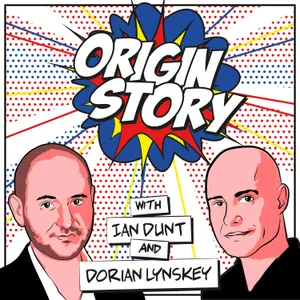
What are the real stories behind the most misunderstood and abused ideas in politics? From Conspiracy Theory to Woke to Centrism and beyond, Ian Dunt and Dorian Lynskey dig into the astonishing secret histories of concepts you thought you knew.
Latest Episodes
The most recent episodes — sign up to get AI-powered summaries of each one.
- 1 weeks ago2h 7m
Origin Story Live at Union Chapel
Hello listeners. This week’s episode is an audio recording of our live show at the Union Chapel in London on 1 September 2026. This time we did something different and made a live show out of a classic Origin Story narrative. It’s the story of how the Daily Telegraph’s deterioration from grey citadel of High Toryism to feral troll farm mirrors the cognitive decline of conservatism in Britain. In part one we tell the story of the Telegraph. Founded in 1855 by a crank army colonel to pursue an obscure vendetta, it was soon bought by the Levy-Lawson family, who turned into Britain’s liveliest newspaper and the world’s largest. During the 20th century, it became the heart of British conservatism: solidly — sometimes alarmingly — right-wing yet respectable and conscientious. It was proud to be boring: a safe harbour in a changing world. “Was, is, and will be,” its masthead boasted. The Telegraph took a strange turn after 2004, with its acquisition by the Barclay brothers and the rise of online journalism. Drawing more of its editors and energy from the Daily Mail, it began platforming more extreme voices in the hunt for clicks. By the time of Brexit in 2016, the viciousness and paranoia that characterised its online output had colonised the newspaper itself. Could its recent purchase by Germany’s Axel Springer trigger a return to normality? In part two we play headline tennis with some of the Telegraph’s barmiest articles, dig into the feverish, apocalyptic world view of columnist-editor Allister Heath, and explore what the paper’s decline says about the crumbling of the Tory mind. Then we take questions from the audience. Hope you enjoy listening to it as much as we enjoyed doing the show. Reading list Books Lord Burnham – Peterborough Court: The Story of The Daily Telegraph (1955) Colin Coote – Editorial: The Memoirs of Colin R. Coote (1965) W. F. Deedes – Dear Bill: A Memoir (2005) Duff Hart-Davis – The House The Berrys Built: Inside The Telegraph (1990) Max Hastings – Editor: A Memoir (2002) Jane Martinson – You May Never See Us Again: The Barclay Dynasty: A Story of Survival, Secrecy and Succession (2023) Peregrine Worsthorne – Tricks of Memory: An Autobiography (1993) Articles Stephen Bates – ‘Sir Peregrine Worsthorne obituary’, Guardian (5 October 2020) Jason Cowley – ‘The lost magic of England’, New Statesman (11 February 2016) Bryan Curtis – ‘Paper Tiger’, Slate (25 October 2006) Allister Heath – ‘Vast forces are mobilising to stop Britain’s only real chance of survival’, Telegraph (18 February 2026) Allister Heath – ‘The Fall of Britain: A tragedy in three horrifying acts’, Telegraph (19 April 2026) Liz Truss – ‘Trump has been proven right about pretty much everything’, Telegraph (14 April 2025) Jim Waterson – ‘“Toxic” Telegraph made me feel nauseous, says Graham Norton’, Guardian (7 October 2019) Peregrine Worsthorne – ‘The “Daily Telegraph”: No other British institution has been so badly degraded’, Independent (21 November 2005) Written and presented by Ian Dunt and Dorian Lynskey. Producer: Simon Williams. Music by Jade Bailey. Art by Jim Parrett. Logo by Mischa Welsh. Group Editor: Andrew Harrison. Origin Story is a Podmasters production www.podmasters.co.uk Learn more about your ad choices. Visit podcastchoices.com/adchoices
- 3 weeks ago1h 22m
Section 28 – Anatomy of a Moral Panic
Hello and welcome to a bonus episode of Origin Story. This time we tell the story of Section 28 of the Local Government Act 1988, the legislation that prohibited local councils from funding the “promotion” of homosexuality and cast a chilling shadow over the lives of gay men and lesbians in the UK for the next 15 years. How did it come about, what were the consequences, and is something similar happening to trans people today? The 1980s were a decade of rampant homophobia, fed by conservative anxieties about progressive education, “loony left” councils and the emergence of HIV/AIDS. One book (Jenny Lives with Eric and Martin) and one London council (Haringey) became the focus of a moral panic that spread like wildfire through the right-wing press and Margaret Thatcher’s Conservative government, with all the hysteria, bigotry and misinformation you would expect. Opposition to children learning about homosexuality in any way featured in the 1987 election campaign and led to the amendment that became Section 28: local authorities were forbidden to “intentionally promote homosexuality,” whatever that meant. While nobody was ever prosecuted under Section 28, these few vague and provocative lines created a climate of fear and self-censorship, from schools to broadcasters, and effectively legitimised homophobia. But the campaign against it mobilised gay men and lesbians like never before. Figures such as Ian McKellen, Michael Cashman and Peter Tatchell initiated a new era of activism, including the foundation of Stonewall, to ensure that something like this never happened again. Tony Blair’s Labour government finally repealed Section 28 in 2003, amid a slew of progressive reforms, and multiple Tory leaders apologised for ever supporting it. Now, though, government guidelines on the teaching of gender identity are echoing the intolerant logic of Section 28 and the media’s moral panic around trans people feels grimly familiar. How did a single copy of a Danish picture book lead to the most homophobic legislation in a century? Was the newspapers’ vicious campaign against the “loony left” Britain’s first experience of an “anti-woke” culture war? Who were the politicians, many of them still around today, who supported and opposed Section 28? How did the battle over it give birth to modern LGBTQ activism? How did Section 28 damage ordinary lives and why did it take so long to repeal? And why are some of the people who fought so hard against Section 28 now supporting its transphobic equivalent? • Find out if you’re owed on car finance at refundclub.co.uk/originstory • Refund Club is a trading style of Sandsford Law Limited, authorised and regulated by the Solicitors Regulation Authority (SRA no. 8008114). Checking is free. A fee is payable only if your claim is successful. Eligibility: car finance taken out in the UK between 2007 and 2021. The average claim is around £829 per agreement; this is an average and not a guarantee of the amount you will receive. You can also claim yourself for free by contacting your lender or the Financial Ombudsman Service. refundclub.co.uk/originstory • See Origin Story live at the Union Chapel, London on September the 1st • Support Origin Story on Patreon Written and presented by Ian Dunt and Dorian Lynskey. Producer: Chris Jones. Music by Jade Bailey. Art by Jim Parrett. Logo by Mischa Welsh. Group Editor: Andrew Harrison. Origin Story is a Podmasters production www.podmasters.co.uk Books and articles Paul Baker – Outrageous! The Story of Section 28 and Britain’s Battle for LGBT Education (2022) Susanne Bosche – ‘Jenny, Eric, Martin… and Me’, Guardian (31 January 2000) Faye Brown – ‘Claims of oral sex and choking lessons prompt government review into sex education critic says is “politically motivated”’, Sky News (8 March 2023) Michael Cashman – One of Them: From Albert Square to Parliament Square (2020) Colin Clews – Gay in the 80s: From Fighting for Our Rights to Fighting for Our Lives (2017) James Curran, Ivor Gaber and Julian Petley – Culture Wars: The Media & the British Left (2005) Ryan Gilbey – It Used to Be Witches: Under the Spell of Queer Cinema (Faber, 2025) Audrey Gillan – ‘Section 28 gone… but not forgotten’, Guardian (17 November 2003) Chris Godfrey – Section 28 protesters 30 years on: ‘We were arrested and put in a cell up by Big Ben’, Guardian (27 May 2018) Ian Lucas – OutRage! An Oral History (1998) Kelly Ann Cecilia McGhee – ‘The Destruction Caused by Clause 28’, Glasgow Women’s Library Adam Mars-Jones – ‘The book that launched Clause 28’, Index on Censorship, Vol. 17, Issue 8 (September 1988) Michelle O’Toole – ‘I’m a trans woman who grew up under section 28 — I worry it could make a comeback’, the i Paper (11 May 2020) Ruth Pearce – ‘Labour’s Section 28 is here — act now’, ruthpearce.net (14 February 2026) ‘Relationships Education, Relationships and Sex education (RSE)’ Peter Tatchell – The Bat
- Aug 12, 20261h 17m
The Duke of Buckingham – How a queer love story predicted modern politics
Welcome to another bonus episode of Origin Story, where we look at the short and extraordinary life of the Duke of Buckingham (1592–1628). It's a bizarre, tragic tale which weaves together queer history, courtly romance, unending war and the early resistance of parliament against royal power. More than anything, it is the story of the Favourite, that strange underdiscussed role of the leader's key ally. In our modern era, we've seen figures like Dominic Cummings and Morgan McSweeney take this position – operating as the prime minister's chief loyalist and then being used as a sacrificial pawn to placate their critics. We see a very similar arrangement in the 17th Century, albeit in a significantly more sexy way. As Sir Francis Bacon said: The favourite is a "shadow" who can be "offered as a sacrifice to appease the multitude". Come with us back to an era where the modern world is slowly being formed, and see how exuberant, unpredictable, emotional and dramatic the early days of the English parliament truly were. Books Lucy Hughes-Hallett – The Scapegoat: The Brilliant Brief Life of the Duke of Buckingham (4th Estate, 2024) Roger Lockyer - Buckingham: The Life and Political Career of George Villiers, First Duke of Buckingham 1592-1628 (Routledge, 1981) • Find out if you’re owed on car finance at refundclub.co.uk/originstory • Refund Club is a trading style of Sandsford Law Limited, authorised and regulated by the Solicitors Regulation Authority (SRA no. 8008114). Checking is free. A fee is payable only if your claim is successful. Eligibility: car finance taken out in the UK between 2007 and 2021. The average claim is around £829 per agreement; this is an average and not a guarantee of the amount you will receive. You can also claim yourself for free by contacting your lender or the Financial Ombudsman Service. refundclub.co.uk/originstory • See Origin Story live at the Union Chapel, London on September the 1st • Support Origin Story on Patreon Written and presented by Ian Dunt and Dorian Lynskey. Producer: Chris Jones. Music by Jade Bailey. Art by Jim Parrett. Logo by Mischa Welsh. Group Editor: Andrew Harrison. Origin Story is a Podmasters production www.podmasters.co.uk Learn more about your ad choices. Visit podcastchoices.com/adchoices
- Jul 22, 20263 min
Origin Story live show announcement!
Tickets are flying out of the door for Ian and Dorian’s biggest live show yet at the stunning Union Chapel in London’s sophisticated Islington on Tue 1 Sept. A spectacular Gothic Revival church on Upper Street, the Union Chapel is a breathtaking venue just a few moments’ stroll from Highbury & Islington Tube – and therefore close to Euston and King’s Cross for the Not-London crowd. As well as the Victoria Line, it’s on the Mildmay Overground so whether you’re in leafy West London or sourdough-and-cold-drip-coffee East London you can be there and home with ease.You can buy tickets here, or Patreon supporters get exclusive discount, so now is as good a time as any to sign up: https://www.patreon.com/c/originstorypod Learn more about your ad choices. Visit podcastchoices.com/adchoices
- Jul 20, 20260 min
Origin Story live show announcement!
Tickets are flying out of the door for Ian and Dorian’s biggest live show yet at the stunning Union Chapel in London’s sophisticated Islington on Tue 1 Sept. A spectacular Gothic Revival church on Upper Street, the Union Chapel is a breathtaking venue just a few moments’ stroll from Highbury & Islington Tube – and therefore close to Euston and King’s Cross for the Not-London crowd. As well as the Victoria Line, it’s on the Mildmay Overground so whether you’re in leafy West London or sourdough-and-cold-drip-coffee East London you can be there and home with ease.You can buy tickets here, or Patreon supporters get exclusive discount, so now is as good a time as any to sign up: https://www.patreon.com/c/originstorypod Learn more about your ad choices. Visit podcastchoices.com/adchoices
- Jul 17, 20261h 27m
Starmer Revisited – Where Did It All Go Wrong?
Welcome to a bonus episode of Origin Story. For the first time, we’re revisiting an earlier episode to ask what we got right and what we got wrong about the subject. Just before the July 2024 election we profiled Labour’s PM-in-waiting Keir Starmer and made some cautiously optimistic guesses as to what his government might look like — the promise and the pitfalls. Well, it turned out to be mostly pitfalls. As Starmer steps down and Andy Burnham steps up, we perform the autopsy. Did Starmer have fundamental personal weaknesses that doomed him to failure? What happened to the moral principles and managerial competence that defined his career before he became Labour leader? What mistakes did he make and what opportunities did he miss? Has Starmer killed the theory that a boring technocrat is the antidote to right-wing populism? How did he become so hated? What legacy has he bequeathed to Burnham (it wasn’t all bad news)? How much of this can we blame on Morgan McSweeney? And is it fair to call Keir Starmer the worst Labour prime minister ever? The ghost of Ramsay MacDonald certainly hopes so. Join us for an in-depth reflection on what went wrong for Starmer and the lessons we can learn about what it takes to be a successful prime minister in the 2020s. • See Origin Story live at the Union Chapel, London on September the 1st • Support Origin Story on Patreon Written and presented by Ian Dunt and Dorian Lynskey. Producer: Simon Williams. Music by Jade Bailey. Art by Jim Parrett. Logo by Mischa Welsh. Group Editor: Andrew Harrison. Origin Story is a Podmasters production www.podmasters.co.uk Learn more about your ad choices. Visit podcastchoices.com/adchoices
- Jul 8, 20261h 43m
The Luddites – Rage Against the Machine
Welcome to the finale of season nine of Origin Story. We’re wrapping up the season by telling the thrilling, misunderstood story of the Luddites and how their name became an insult synonymous with ignorance, reaction and fear of progress. You can’t get much more Origin Story than that. It was November 1811 when textile workers in Nottinghamshire first began breaking machinery in the name of a mysterious figure called Ned Ludd. The movement spread through neighbouring counties and reached its dramatic peak in Yorkshire, as these secretive activists waged guerrilla warfare against the factory owners who were destroying their livelihoods. Soon, England was in a frenzy over the Luddite threat. Led by Tory prime minister Spencer Perceval and the decadent Prince Regent, the ruling classes feared a French-style revolution. As Luddite violence escalated from machine-breaking to arson, food riots and assassination attempts, the state responded with spies, torture and show trials. Swathes of industrial England fell under military occupation. In the midst of all this, Perceval himself was shot dead in the House of Commons. Yet by February 1813 the Luddite fire had burned out and the bosses appeared to have won. It was only in the 1950s that “Luddite” was turned into a general insult, even as revisionist historians of the English working classes started to tell a different story about the motives of the machine-breakers. Amid rising hostility towards Big Tech and AI, the legacy of the Luddite rebellion feels surprisingly relevant more than 200 years later. Who were the Luddites? What was going wrong in England in 1811 to inspire such a viral rebellion? Were the Luddites targeting the machines, or the industrialists, or the state itself? Was their uprising really a failure or did it pave the way for fairer industrial relations? What does it mean to be a neo-Luddite today? And can the true history of the Luddites ever prevail over the crude stereotype created by their enemies? • Special offer! Get 20% off any vehicle history check at carVertical.com/OriginStory • See Origin Story live at the Union Chapel, London on September the 1st • Support Origin Story on Patreon Reading list Books • Kyle Chayka – ‘Rethinking the Luddites in the Age of A.I.’, New Yorker (26 September 2023) • Kyle Chayka – ‘The Age-Old Urge to Destroy Technology’, New Yorker (8 April 2026) • F.O. Darvall – Popular Disturbances and Public Order in Regency England (1934) • Carl J. Griffin – ‘Luddism, Machine-Breaking and the Swing Riots’, Revue Française de Civilisation Britannique (2025) • J.L. Hammond and Barbara Hammond – The Skilled Labourer, 1760-1832 (1919) • Eric Hobsbawm – ‘The Machine Breakers’, Past & Present (February 1952) • Brian Merchant – Blood in the Machine: The Origins of the Rebellion Against Big Tech (2023) • Kirkpatrick Sale – Rebels Against the Future: The Luddites and Their War Against the Industrial Revolution: Lessons for the Computer Age (1995) • Tech Won’t Save Us: The Real History of the Luddites, presented by Paris Marx (28 September, 2023) • Malcolm I. Thomis – The Luddites: Machine-Breaking in Regency England (1970) • E.P. Thompson – The Making of the English Working Class (1963) Written and presented by Ian Dunt and Dorian Lynskey. Producer: Simon Williams. Music by Jade Bailey. Art by Jim Parrett. Logo by Mischa Welsh. Group Editor: Andrew Harrison. Origin Story is a Podmasters production www.podmasters.co.uk Learn more about your ad choices. Visit podcastchoices.com/adchoices
- Jul 1, 20261h 43m
Paranormal Investigations – Is There Anybody Out There?
Welcome to Origin Story. This week we’re doing something different: the history of paranormal investigations and what it says about the relationship between evidence and belief. In 1848, two sisters in Hydesville, New York claimed to be contacting the spirit world. Within a couple of years spiritualism was a popular craze on both sides of the Atlantic, with seances attracting luminaries from Queen Victoria to Charles Darwin. But could it be proven beyond doubt? In 1883, a group of scientists and intellectuals launched the Society for Psychical Research to find out, but from its inception there was tension between the genuine sceptics and the instinctive believers. However many hoaxers they debunked, even the sceptics encountered things they could not rationally explain. The mass grief of the First World War created a new appetite for spiritualism, spearheaded by the world-famous author Arthur Conan Doyle. Meanwhile in North Carolina, J.B. and Louisa Rhine proposed that these uncanny goings on were not evidence of ghosts but of untapped powers in the human brain: Extra-Sensory Perception. Concepts like telepathy and telekinesis swept through popular culture while scientists explored their potential as weapons in the Cold War. In the 1970s, Connecticut couple Ed and Lorraine Warren became the world’s star investigators. In the era of Carrie, The Exorcist and spoon-bending celebrity Uri Geller, there was a huge audience for this kind of thing, bringing money and fame to the most prominent spook-hunters. Events such as the Amityville Horror and the Enfield Poltergeist still inspire fascination today, despite the investigators’ extremely dubious methods. Was the truth-seeking mission of the Society for Psychical Research destined to end up as a license for grifters? How did spiritualism bewitch the Victorian era, including some of its most eminent scientists? Are psychic powers any more credible than ghosts? Why was the creator of the ultra-rational Sherlock Holmes so boundlessly credulous about the spirit world? What can the field of the unexplained teach us about cognitive biases and conspiracy theories? Is it really possible to apply scientific rigour to paranormal phenomena? And why, when almost 150 years of investigations have produced no solid evidence or theoretical basis for them, do so many people still want to believe? This is a thrilling story of faith, doubt and fraud, featuring Harry Houdini, George Eliot, Marie Curie, Carl Jung, Helena Blavatsky, W.B. Yeats, Winston Churchill and (possibly) the Devil himself. Don’t have nightmares. • Special offer! Get 20% off any vehicle history check at carVertical.com/OriginStory • See Origin Story live at the Union Chapel, London on September the 1st. • Support Origin Story on Patreon Reading list Books • Edward T. Bennett — The Society for Psychical Research: Its Rise and Progress and a Sketch of Its Work (1903) • Ruth Brandon – The Spiritualists: The Passion for the Occult in the Nineteenth and Twentieth Centuries (1983) • Edmund Gurney, Frederic W.H. Myers and Frank Podmore – Phantasms of the Living (1886) • Renée Haynes – The Society for Psychical Research 1882-1982: A History (1982) • Oliver Lodge – Raymond; or, Life and Death (1916) • Roger Luckhurst – The Invention of Telepathy 1870-1901 (2002) • Ben Machell – Chasing the Dark: Encounters with the Supernatural (2025) • Janet Oppenheim – The Other World: Spiritualism and Psychical Research in England, 1850-1914 (1985) • Guy Lyon Playfair – This House Is Haunted: The Amazing Inside Story of the Enfield Poltergeist (1980) • Harry Price – The Most Haunted House in England: Ten Years’ Investigation of Borley Rectory (1940) • J.B. Rhine – Extra-Sensory Perception (1934) • Michael Shermer – The Believing Brain: From Ghosts and Gods to Politics and Conspiracies: How We Construct Beliefs and Reinforce Them as Truths (2011) • Upton Sinclair – Mental Radio (1930) Articles • A.P. – ‘“Amityville Horror” amplified over bottles of wine, — lawyer’, Lakeland Ledger (27 July 1979) • Angie Barry – ‘The Warren Case Files: Fact or Fiction?’, Criminal Element (31 October 2017) • Stefan Beck – ‘A Night with The Conjuring’s Ed & Lorraine Warren’, Daily Beast (18 August 2013) • Paul Byrnes – ‘The Devil Among Us’, Sydney Morning Herald (12 July 2013) • Casey Cep – ‘Why Did So Many Victorians Try to Speak with the Dead?’, New Yorker (24 May 2021) • Kevin Dolak – ‘The Slippery Truth About “The Conjuring: Last Rites” and Ed and Lorraine Warren’, Hollywood Reporter (10 September 2025) • Neil Genzlinger – ‘Lorraine Warren, Paranormal Investigator Portrayed in ‘The Conjuring’, Dies at 92, New York Times (19 April 2019) • Kim Masters and Ashley Cullins – ‘War Over ‘The Conjuring’: The Disturbing Claims Behind a Billion-Dollar Franchise’, Hollywood Reporter (13 December 2017) • Sean Thomas – ‘What’s Happened to Weird?’, Guardian (14 June 2004) • Neda Ulaby – ‘The demons in “The Conjuring” movies may no
Get Origin Story summaries in your inbox
Free AI-powered daily recaps. Key takeaways, quotes, and mentions — in a 5-minute read.
Get Free Summaries →Free forever for up to 3 podcasts. No credit card required.
You Might Also Like
Listeners also like.

Pod Save the UK
Comedians and journalists analyze UK politics with guests, offering insight and solutions on current events.
The Coming Storm
A journalist investigates the roots and rise of American conspiracy theories, from Cold War paranoia to modern claims of a Deep State.

Forum Borealis
In-depth interviews with authors and thinkers on unconventional topics in history, science, philosophy, and politics.

Intelligence Squared
Live debates and in-depth discussions on pressing global issues featuring leading experts and thinkers.

The Rest Is Politics
Two former political insiders analyze current events in the UK and abroad, offering candid debate and behind-the-scenes insights.
American Friction
A UK-based podcast analyzing US politics with expert interviews and commentary on current events and major issues.
Political Thinking with Nick Robinson
In-depth conversations with political figures and influencers about their lives and the experiences that shaped their worldviews.

British Scandal
Examines British political and social scandals, focusing on power, accountability, and the people behind historic events.
Conspiracy Theories
Examines conspiracy theories surrounding major historical events and cultural phenomena, exploring their origins and influence.

What? Seriously??
Two comedians explore bizarre true stories with a guest expert who has a personal connection to the tale.

Strong Message Here
A weekly analysis of political language and doublespeak, exploring how rhetoric shapes perception and power.
Political Theory 101
Explains foundational concepts and thinkers in political theory for a general audience.
About Origin Story
What are the real stories behind the most misunderstood and abused ideas in politics? From Conspiracy Theory to Woke to Centrism and beyond, Ian Dunt and Dorian Lynskey dig into the astonishing secret histories of concepts you thought you knew.
Customized Recaps
AI-powered recaps with compact key takeaways, quotes, and insights.
Straight to Your Inbox
Get key takeaways from Origin Story in a 5-minute read.
Save Hours Every Week
Stay current on your favorite podcasts without falling behind.
Frequently Asked Questions
What is Podzilla's Origin Story daily summary?
It's a free AI-powered email that summarizes new episodes of Origin Story as soon as they're published. You get the key takeaways, notable quotes, and links & mentions — all in a quick read.
How does the Origin Story podcast summary work?
When a new episode drops, our AI transcribes and analyzes it, then generates a personalized summary tailored to your interests and profession. It's delivered to your inbox every morning.
Is this an official Origin Story product?
No. Podzilla is an independent service that summarizes publicly available podcast content. We're not affiliated with or endorsed by Podmasters.
Can I get summaries of other podcasts too?
Absolutely! The free plan covers up to 3 podcasts. Upgrade to Pro for 15, or Premium for 50. Browse our full catalog at /podcasts.
How often does Origin Story release new episodes?
Origin Story publishes weekly. Our AI generates a summary within hours of each new episode.
What topics does Origin Story cover?
Origin Story covers topics including News, History, Commentary, Culture, Society & Culture. Our AI identifies the specific themes in each episode and highlights what matters most to you.
Start getting Origin Story summaries tomorrow morning.
Free forever for up to 3 podcasts. No credit card required.
Free forever for up to 3 podcasts. No credit card required.