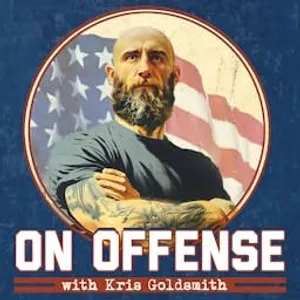
Free Daily Podcast Summary
On Offense with Kris Goldsmith: Daily Summaries Delivered
by Kris Goldsmith
On Offense with Kris Goldsmith is a podcast about fighting for democracy and organizing against fascism. Hosted by a U.S. Army combat veteran, antifascist investigator, and founder of Task Force Butler and Veterans Fighting Fascism, this show brings a strategic, hard-hitting perspective to the most urgent threats facing America today.We call it On Offense because defending democracy isn’t enough—we need to take the fight to the fascists.Each episode breaks down how everyday Americans can push back against authoritarianism—drawing on lessons from the battlefield, the streets, and the halls of power. No fluff. No navel-gazing. Just real talk from people who’ve been in the fight and aren’t backing down.Learn more and take action at weareonoffense.com
Latest Episodes
The most recent episodes — sign up to get AI-powered summaries of each one.
- Jul 29, 20261h 3m
Where Are the Veterans? Ken Harbaugh on What Comes After Election Day
For years, people have asked me the same question: Where are the veterans? In this episode, Ken Harbaugh and I answer. Ken is a former Navy pilot, veteran advocate, filmmaker, and president of VALOR Media Network. We discuss the experiences that transformed his understanding of service—from his daughter’s medical crisis and his work building veteran-led organizations to his reporting from Ukraine and firsthand exposure to the future of drone warfare. We also announce the Veterans Day Democracy March. On Wednesday, November 11, veterans and allies from across the country will gather in Washington, D.C., for a peaceful, lawful national action in support of constitutional government, lawful election results, and the rule of law. Why are we organizing now for an event after Election Day? Because the work of democracy does not end when the polls close. We expect Trump and his allies to challenge election results that threaten their hold on power, and preparation cannot begin after the crisis has already started. The march is organized around three points of unity: The voters decide. The results stand. No president is above the Constitution. America must keep faith with those who serve. The Veterans Day Democracy March is being organized through the Unite for Veterans Coalition. Veterans Fighting Fascism, VALOR Media Network, and other coalition partners are mobilizing veterans, creators, advocates, artists, and allies from across the country. Ken and I also discuss what real patriotism demands, why the oath does not expire when the uniform comes off, and what veterans owe the country when its democratic institutions are under attack. I also explain why On Offense will be taking a break for at least the month of August while I focus on writing my book. The podcast may be taking a pause. The work is not. LEARN MORE AND GET INVOLVED Join and support the Veterans Day Democracy March: VeteransFightingFascism.org Follow Ken on The Ken Harbaugh Show: TheKenHarbaughShow.Substack.com Preorder War Is a Racket, featuring a new introduction by Kristofer Goldsmith: Penguin Random House Subscribe to On Offense: OnOffense.Substack.com
- Jul 15, 20261h 7m
How to Find Political Courage in an Age of Cowardice | Reed Galen
Lindsey Graham’s death has me thinking about the choices that define a political legacy. As someone who spent years lobbying Congress on behalf of veterans, I saw firsthand the difference between politicians who were willing to listen—and those who simply weren’t. Graham built a career championing American military intervention while resisting reforms that would better protect the men and women sent to fight those wars. His life raises a question that extends far beyond one senator: What does political courage actually look like? My guest this week, Reed Galen, took a very different path. A longtime Republican strategist who worked for George W. Bush, John McCain, and other Republican leaders, Reed eventually concluded that remaining inside the party meant compromising principles he wasn’t willing to abandon. Today, through Civic Forum, he is trying to build a different kind of civic movement—one grounded in honest conversation, local engagement, and the belief that democracy requires more than simply reacting to authoritarianism. We discuss whether America’s institutions can still be reformed, why political parties struggle to speak honestly about economic power, what meaningful civic organizing looks like, and why ordinary people should start locally if they want to make a real difference. Follow Reed’s work on Substack and learn more about Civic Forum. I also wrote the introduction to a new edition of Major General Smedley Butler’s War Is a Racket, which will be published by Steerforth Press this September. Preorder the book here. On Offense with Kris Goldsmith is a podcast about fighting for democracy and organizing against fascism—because being on defense is not enough.
- Jul 1, 202657 min
What If We’ve Been Wrong About Young White Men? | Colin Davis
For years, we've been told that young white men are drifting to the political right. But what if we're asking the wrong questions? When I met fitness coach and content creator Colin Davis, I was reminded of my best friend who died at 18. It made me wonder: if he'd lived, who would he have become? Would he have followed the same path I did—or would he have been swept into the culture and politics that have transformed so many communities across America? Colin represents something too many people misunderstand. He works in a space—fitness and gym culture—that has become increasingly associated with the political right, yet he's building a different vision of masculinity rooted in community, personal responsibility, and democratic participation. In this episode, we discuss: How gym culture became intertwined with right-wing politics Why young men are searching for belonging The role of healthcare, economics, and social isolation What progressives often misunderstand about young white men Why local organizing matters more than most people realize How strength and empathy can exist together This isn't a conversation about young men. It's a conversation with one. Follow Colin Davis: Instagram: https://www.instagram.com/colin_coaches/ TikTok: https://www.tiktok.com/@colin_coaches If you enjoyed this episode, please subscribe, leave a rating and review, and share it with someone who would appreciate the conversation.
- Jun 17, 20261h 15m
Why American Resistance Keeps Failing | Tad Stoermer
Americans are angry. Millions of people recognize the danger posed by authoritarianism. So why does opposition so often feel fragmented, exhausted, and ineffective? My guest this week is historian, Army veteran, and returning On Offense guest Tad Stoermer, author of A Resistance History of the United States. In his new book, Tad argues that Americans have been taught a version of history that encourages us to trust institutions, celebrate founders, and wait for change rather than understanding how ordinary people have actually resisted abuses of power throughout American history. We discuss: Why so many Americans feel exhausted after a decade of political crisis The difference between protest and resistance What today’s opposition can learn from the Underground Railroad and the abolitionist movement Why Tad believes “pacifiers” hold democratic movements back What we’ve misunderstood about George Washington, the American founding, and the mythology surrounding both Why resistance movements need a vision for the future, not just a reaction to the present How ordinary people can identify their role in a broader movement for democratic change This is not a conversation about nostalgia. It’s a conversation about power, organizing, and what it takes to build something capable of confronting authoritarianism. As always, I end by asking the same question: What can you do to go on offense? Tad’s answer may challenge everything you’ve been told about how change happens in America. Follow Tad Stoermer:Tad Stoermer on Substack Buy the book:A Resistance History of the United States by Tad Stoermer
- Jun 3, 20261h 10m
How QAnon Took Over MAGA | Denver Riggleman
What happened to QAnon? Most Americans stopped talking about it after January 6. The headlines faded. The QAnon Shaman disappeared from the news. The movement seemed to dissolve. But according to former Congressman and January 6 investigator Denver Riggleman, QAnon never really went away. In this episode of On Offense, Kris Goldsmith sits down with Riggleman to discuss how QAnon evolved from an internet conspiracy theory into a broader political identity, why conspiracy culture remains deeply embedded in American politics, and what the January 6 investigation revealed about the networks and personalities behind the movement. Drawing on his book The Breach, Riggleman explains how conspiracy movements adapt, fragment, and survive—and why understanding those movements is essential for anyone concerned about the future of American democracy. Topics include: QAnon and its lasting influence on American politics The role of Mike Flynn and other influential figures The January 6 attack and its aftermath Radicalization, conspiracy culture, and political identity How extremist movements evolve over time What Americans still misunderstand about January 6 If you enjoyed this episode, subscribe to On Offense on your favorite podcast app and visit OnOffense.Substack.com for additional reporting, analysis, and interviews.
- May 27, 20261h 13m
How To Be a Dissident in Trump’s America | Gal Beckerman
Gal Beckerman, staff writer at The Atlantic and author of How to Be a Dissident, joins Kris Goldsmith to discuss conformity, authoritarianism, propaganda, and the pressures that cause ordinary people to stay silent while democratic institutions erode around them. But more importantly, they discuss what makes dissidents different — and the values, behaviors, and habits that shape people willing to resist normalization during moments of democratic decline. Drawing from dissident movements across history — and from the lived reality of Trump’s second administration — Beckerman argues that resistance begins long before politics. It begins with the refusal to normalize cruelty, corruption, fear, and obedience. Together, Kris and Gal discuss: why authoritarianism depends on adaptation and exhaustion; how propaganda reshapes identity and social behavior; the psychological pressure to conform; why some people comply while others “sit apart”; the role of community and “neighborism” in resisting authoritarian politics; why “hopeful pessimism” may be necessary for democratic survival; and what integrity looks like in moments of democratic decline. This is a conversation about how human beings behave when institutions fail — and how we choose who we become in the process. Buy How to Be a Dissident by Gal Beckerman:https://www.penguinrandomhouse.com/books/816867/how-to-be-a-dissident-by-gal-beckerman/ Subscribe to On Offense on Substack:https://onoffense.substack.com/ Subscribe to VALOR Media Network:https://www.youtube.com/@VALORMediaNetwork
- May 13, 20261h 24m
Why Fascism Keeps Coming Back in America | Omer Aziz
Omer Aziz, author of Shadows of the Republic: The Rebirth of Fascism in America and How to Defeat It for Good, joins Kris Goldsmith to discuss why fascism in America cannot be understood purely as an electoral or political phenomenon. Drawing from history, media culture, masculinity, religion, and modern online radicalization, Aziz explains how fascist movements use spectacle, identity, belonging, and entertainment to recruit followers — and why democratic movements consistently underestimate those forces. Kris and Omer discuss the rise of right-wing influencer culture, the collapse of civic institutions and “third spaces,” the radicalization of young men, why Trump may ultimately be remembered as a symptom rather than the endpoint of a broader movement, and why defeating Trump electorally will not be enough to defeat the conditions that produced him. They also examine: the relationship between fascism and spectacle Joe Rogan and the entertainment ecosystem surrounding MAGA why fascism appeals to some marginalized groups propaganda and media normalization anti-fascism as community and purpose the dangers of complacency after electoral victories how democratic movements can begin rebuilding civic culture from the ground up Omer Aziz is a writer, lawyer, and former foreign policy advisor. He is the author of Shadows of the Republic and Brown Boy, and his work has appeared in The Atlantic, Harper’s, The New York Times, and the Boston Globe. Subscribe to On Offense with Kris Goldsmith on Substack: https://onoffense.substack.com/
- May 6, 202658 min
How to Save Our Democracy | Tim Heaphy, Jan 6 and Charlottesville Investigator
Former January 6 investigative counsel Tim Heaphy joins Kris Goldsmith for a difficult conversation about whether American democracy still works — and whether it can survive what’s happening now. Heaphy, a former U.S. Attorney and author of Harbingers and the forthcoming We Are the Answer: How to Save Our Democracy, helped lead major investigations into both the Charlottesville Unite the Right rally and the January 6 insurrection. But this interview isn’t about revisiting history. It’s about the present moment. Kris and Tim discuss the Trump administration’s indictments of former FBI Director James Comey and the Southern Poverty Law Center, the weaponization of the justice system, political violence, disinformation, institutional collapse, accountability, and whether Americans should still have faith in the systems meant to protect democracy. Throughout the conversation, Kris challenges Heaphy’s core belief that institutions can still function if enough people stay engaged. Can democracy be repaired? Or are we already past that point? Links: Buy We Are the Answer: How to Save Our Democracy by Tim Heaphy Subscribe to On Offense on Substack Support Task Force Butler Institute Support Veterans Fighting Fascism
About On Offense with Kris Goldsmith
On Offense with Kris Goldsmith is a podcast about fighting for democracy and organizing against fascism. Hosted by a U.S. Army combat veteran, antifascist investigator, and founder of Task Force Butler and Veterans Fighting Fascism, this show brings a strategic, hard-hitting perspective to the most urgent threats facing America today.We call it On Offense because defending democracy isn’t enough—we need to take the fight to the fascists.Each episode breaks down how everyday Americans can push back against authoritarianism—drawing on lessons from the battlefield, the streets, and the halls of power. No fluff. No navel-gazing. Just real talk from people who’ve been in the fight and aren’t backing down.Learn more and take action at weareonoffense.com
Customized Recaps
AI-powered recaps with compact key takeaways, quotes, and insights.
Straight to Your Inbox
Get key takeaways from On Offense with Kris Goldsmith in a 5-minute read.
Save Hours Every Week
Stay current on your favorite podcasts without falling behind.
Frequently Asked Questions
What is Podzilla's On Offense with Kris Goldsmith daily summary?
It's a free AI-powered email that summarizes new episodes of On Offense with Kris Goldsmith as soon as they're published. You get the key takeaways, notable quotes, and links & mentions — all in a quick read.
How does the On Offense with Kris Goldsmith podcast summary work?
When a new episode drops, our AI transcribes and analyzes it, then generates a personalized summary tailored to your interests and profession. It's delivered to your inbox every morning.
Is this an official On Offense with Kris Goldsmith product?
No. Podzilla is an independent service that summarizes publicly available podcast content. We're not affiliated with or endorsed by Kris Goldsmith.
Can I get summaries of other podcasts too?
Absolutely! The free plan covers up to 3 podcasts. Upgrade to Pro for 15, or Premium for 50. Browse our full catalog at /podcasts.
How often does On Offense with Kris Goldsmith release new episodes?
On Offense with Kris Goldsmith publishes weekly. Our AI generates a summary within hours of each new episode.
What topics does On Offense with Kris Goldsmith cover?
On Offense with Kris Goldsmith covers topics including News, History. Our AI identifies the specific themes in each episode and highlights what matters most to you.
Start getting On Offense with Kris Goldsmith summaries tomorrow morning.
Free forever for up to 3 podcasts. No credit card required.
Free forever for up to 3 podcasts. No credit card required.