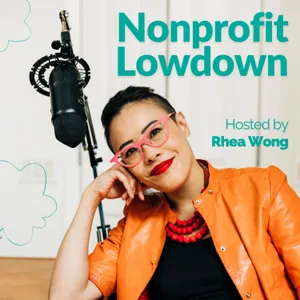
Free Daily Podcast Summary
Nonprofit Lowdown: Daily Summaries Delivered
by Rhea Wong
This is Nonprofit Lowdown where I review and recommend the best ideas, resources, tools, tricks and tips to run your nonprofit like a pro!
Latest Episodes
The most recent episodes — sign up to get AI-powered summaries of each one.
- Today20 min
#406 - Who Told You It Was Supposed To Be Easy?
Most nonprofit leaders think the problem is the workload. I had a week that told me otherwise, and it took a coaching call to see it.I was venting about year eight feeling harder than year three when my coach said, "You're upset because life does not fit your model of reality." Somewhere around year two I quietly built a model where by now I'd be sipping mai tais while the business ran itself. Nobody promised me that. I wrote it myself, filed it where I couldn't see it, and have been paying rent on it ever since. The work was a Tuesday. The belief that I shouldn't have to do it was the surcharge, and the surcharge cost more than the work.So this episode is about the models running in the background of your job. The work is good, so the money should follow. I've been here six years, the board should get it by now. I shouldn't have to sell. If I explain the need clearly enough, people will give. We did everything right, so the numbers should be up. Not one of those was ever agreed to by a donor, a board, or the universe. You wrote them, usually at a moment when you needed something to hold onto.I also name the part nobody says out loud, which is that burnout is usually loneliness, not workload. You're the only one who sees the funders, the board, the staff, and the program at the same time, and that's a lonely seat.Then I get concrete, because I don't want you closing this feeling philosophical with nothing changed. Once you stop arguing with the obstacle about whether it should be there, you can read it. The donor who gave big and drifted is a missing stewardship stage. The board that won't fundraise was never given a menu. The ask that came back at half is a ballpark question you skipped nine months upstream. The revenue you can't predict is a pipeline you never built. Every wall is a syllabus item, and that's the difference between eight years of experience and one year repeated eight times.Plus the one practice I want you to run this week. The next time you catch yourself thinking this shouldn't be this hard, finish the sentence out loud: Compared to what? Name the version you're measuring against. It usually sounds ridiculous once it's out of your mouth, and that's the whole trick.Important Links:My Big Ask Gifts ProgramMy Book, Get That Money Honey My Newsletter
- 1 weeks ago33 min
#405 - Yes! Your Nonprofit Is Allowed To Do This
Most nonprofit leaders think their biggest problem is raising money. Ny Whitaker says the real problem is influence, and money follows influence.Ny is the founder and chief strategist of Project NYNE, a former White House senior advisor and NYU professor of leadership who has spent 30 years building relationships with elected officials and teaching nonprofits to do the same.We cover why you build the relationship before the budget cut, not after. Ny walks through what a productive meeting with an elected actually looks like: lead with a problem in the district, name the three things your organization does that nobody else does, attach a dollar figure, and ask for the legislative director or budget director instead of the constituent services person who can't move money.She also clears up the thing that keeps a lot of organizations frozen. Your 501(c)(3) can do advocacy. What it cannot do is partisan political activity. That confusion is costing the sector power it already has.I pushed her on ROI too, because I was an ED with city council discretionary funding and the paperwork-to-dollars ratio felt brutal. Her answer is about what that money unlocks: matching funds, other agencies, introductions your elected can make, and being first in the queue the next time a pot of money opens.Plus the version of all this that fits a one-person shop. One thing a week. And the story of the organization that lost $100,000 in a city budget cut on a Thursday and had it restored by Monday.Important Links:Connect with NyProject NYNEMy Big Ask Gifts ProgramMy Book, Get That Money Honey My Newsletter Join the Free Webinar
- 2 weeks ago41 min
#404 - The DAF Money You're Probably Missing
Donor-advised funds are everywhere. But for a lot of nonprofit fundraisers, they’re still a little mysterious.So I invited Liza Carballeira onto the podcast to break them down. She brings a pretty unique perspective. Liza spent more than 10 years as a frontline fundraiser, then seven years working on the other side with a major DAF institution, advising philanthropists and helping distribute charitable funds. Now, she’s the founder of Epic Philanthropy, where she helps nonprofits understand and activate this increasingly important giving vehicle.In this episode, we get into what a donor-advised fund actually is, where the money comes from, and why nonprofits need to stop thinking about DAFs like traditional foundations. We talk about everything from stock and appreciated assets to the surprising fact that even things like harvested corn can make their way into a DAF.But the really juicy stuff is what happens on the nonprofit side.How do you figure out who is giving through a DAF when the gift comes through an institution? How do you properly credit and steward those donors? And how do you find the clues hiding in your CRM? Liza shares practical ways to identify potential DAF donors and explains why truly anonymous DAF grants are much rarer than many fundraisers think.We also get into some DAF mistakes that could seriously come back to bite you: sending a tax receipt for a DAF gift, accidentally miscrediting the donor, using DAF funds to cover the tangible benefits of an event, and even trying to use a DAF to fulfill an enforceable pledge. There are some surprisingly strict rules here, and you’ll want your fundraising and admin teams to know them, And then Liza gives us her SPARK framework for DAF fundraising: show your legal information, pull DAF donors from your file, add a DAF page, reset your timing to the off-season, and keep talking about it. Simple steps that can help make DAF giving easier for donors and easier for your organization to receive.We also have a spirited conversation about DAF Day, donor fatigue, and why you probably don’t need to add another fundraising holiday to your already overflowing calendar, especially if you’re a small nonprofit without extra bandwidth.If you’ve ever wondered whether DAFs are something your nonprofit should actually be paying attention to, this conversation is for you.Important Links:Connect with LizaEmail Liza: liza@epicphilanthropy.comEpic PhilanthropyLiza’s DAF ProgramUse code RHEA for 10% off!My Big Ask Gifts ProgramMy Book, Get That Money HoneyMy Newsletter
- 3 weeks ago22 min
#403 - DAF Donor Targeting Playbook
Your year-end plan is actively insulting a segment of your donor file. It's September and that plan is nearly locked, so let's fix it before it goes out.When I was a baby ED, we'd get a $7,500 check from Schwab Charitable in December and I'd code it to Schwab. Not to Susan, who actually made the gift. In my file, Susan looked like she'd bought a gala ticket. She was a major donor and I never once treated her like one, because I didn't know what a DAF was and neither did the person doing my data entry. You probably have Susans right now, sitting in your database dressed up as corporations.Here's what most fundraisers miss: a DAF donor already took her tax deduction the day the money went into the fund. February and December are the same day to her. So every countdown clock and midnight-tonight email you send that segment is factually wrong, and she knows it. It makes you look like an amateur.In this episode I give you the CRM screen to run this week, the four behavioral signals that flag someone holding a DAF who's never given you one, and why I'd rather run this play in January. Everyone decided December was the Super Bowl. January is the empty field. Keep your annual fund calendar exactly as it is, your major gift calendar is a different animal.Important Links:My Big Ask Gifts ProgramMy Book, Get That Money HoneyMy NewsletterJoin the Free Webinar
- 4 weeks ago33 min
Your board isn't lazy. They're uninstructed.
I had a board member, let's call her Lena, who told me she'd rather stick hot needles in her eye than ask her friends for money. So I asked if we could count on her for the $35,000 check instead. She said yes, done, no problem. Then she spent the next several years opening her home and hosting people for us.Lena wasn't refusing to fundraise. She had no idea what fundraising was.In 20 years I have never met a board that refuses to fundraise. I've met a lot of boards nobody bothered to instruct. And in most board members' heads, fundraising has exactly one definition: standing in front of your college roommate with your hand out. So when you say "we need the board more engaged in fundraising," what lands in their body is "we need you to go be humiliating at a cocktail party." No wonder you get crickets.Underneath that there are two fears nobody says out loud. One is social capital, they don't want to be embarrassed by how you treat their friends. You're asking to borrow their reputation and you haven't told them what you're going to do with it. The other is reciprocity, if I ask Bob, Bob asks me. And the third thing we never talk about: even rich people have money baggage. Money is not neutral territory for anybody.So I show them the machine. Six stages of EFOS, and the board leads engagement, helps with prequalification, participates in qualification, cultivation and stewardship. Staff owns the proposal, and not because it's the scary part. It's the technical part. You physically cannot strong-arm someone inside a system where they're invited to opt out at six separate doors.Then the part nobody believes the first time they hear it: there is no ask. No pounding heart, no number said out loud into silence. We dissolved that moment nine months upstream in qualification. My client Amy ran this exact play last month, donor ballpark was $75,000, they came back with $120,000 unrestricted. Nobody asked anybody for anything.I'm also giving you the board action menu, why the menu itself is the training, the Jeffersonian dinner that changes the host more than the guests, why you recruit in twos and threes, and the one word I want deleted from your vocabulary entirely.Your board is not the obstacle to your major gifts system. They're the first stage of it.What You'll Learn:The three things actually going on when your board "won't fundraise"The two fears your board members will never say out loudWhere the board belongs in each of the six EFOS stagesWhy there is no ask, and how it disappears in qualificationThe board action menu that teaches without a single trainingHow to set a give/get as a floor, not a ceilingWhat to do about the board member who does too much of the wrong thingImportant Links:My Big Ask Gifts ProgramMy Book, Get That Money HoneyMy Newsletter
- Aug 17, 202622 min
#401 - Why AI Cannot Replace Fundraising Strategy
Why AI Cannot Replace Fundraising StrategyI use Claude every day, he's literally my side piece. And I'm telling you to stop buying AI tools.Here's what I'm seeing across nonprofit shops right now: everyone's buying wealth screening software, AI donor tools, personalization platforms. They think the tool will fix it. It won't. AI amplifies what you already have. If your strategy is broken, AI just accelerates the crash.The real problem isn't AI. It's that most nonprofits don't have a strategy. They don't have criteria for what qualifies a major donor. They don't have a framework for moving donors through a process. So they purchase expensive tools and create content slop, technically personalized, completely forgettable.Here's the Ferrari metaphor: You need three things to actually get somewhere. One, the car (your AI tools). Two, to know how to drive (a clear strategy like EFOS). Three, to know where you're going (the skills to execute). Most nonprofits have one. Maybe two. Then they crash and blame the car.In this episode, I'm breaking down the five components of real qualification, timing, capacity, reason, engagement, permission and why wealth screening covers maybe one of them. Then I'm showing you what changes when you nail down EFOS first, then layer AI on top: suddenly AI becomes a qualification accelerator instead of just a donor organizer.What You'll Learn:Why wealth screening is not qualification (and what actually is)The five components of real donor qualificationHow AI synthesizes your data when you have a clear strategyThe Ferrari framework: why most nonprofits crashHow to stop chasing donors and start attracting themWhy your donor communication tools are creating slop (and how to fix it)Important Links:My Big Ask Gifts ProgramMy Book, Get That Money HoneyMy NewsletterJoin the Free Webinar
- Aug 10, 202630 min
#400 - 8 Years, 400 Episodes, and the One Thing I Got Wrong About Marketing
When I started this podcast in 2018, I had no strategy. No content calendar. Just a cheap microphone and a genuine desire to connect with busy nonprofit friends who never had time to grab coffee. I didn't think I was doing marketing. I thought I was just... connecting.Turns out, that's exactly what I was doing.But here's what I resisted for years: I didn't want to believe that visibility mattered. I wanted good work to be enough. I wanted to believe that if I just got excellent results for my clients, recognition would come. That the work would speak for itself.I was wrong. Dead wrong.And I'm not the only one. Most of you are probably under-marketing too. You're doing brilliant work. You're getting real impact. And nobody knows about it. Because you're operating on the same belief I was: that excellence gets recognized on its own.It doesn't.Here's the truth I learned in eight years: the best program nobody knows about loses every single time to the mediocre program with a megaphone. I wish that wasn't true. But it is. The math backs it up: 60% of your success comes from exposure. Who knows about you? That's the game.And the game changed. Your donors aren't coming to you anymore. They're researching you. They're Googling, YouTubing, scrolling LinkedIn. They want to self-qualify before they ever call. Which means your content is now your cultivation. Your visibility is your survival.In this episode, I walk through what I learned about visibility that actually works in 2026. Why relationships are necessary but not sufficient (you need a system, not just a lunch). Why the Bob story, the $50K gift I almost fumbled, taught me that you can't leave money on the table by hoping. Why personalization at scale isn't optional anymore. Why authenticity beats polish. And why, if you've ever said "we're the best kept secret," you need to pick up the megaphone.I also talk about the trends I'm watching: trust-based philanthropy. DAFs as the default, not the exception. A wealth transfer that's unprecedented. And a talent crisis that's bleeding your organization dry every time a fundraiser walks out the door.But the real lesson? Start before you're ready. Show up on one platform this week as a human being. Hit record and ship it before it's perfect. Done is better than perfect.Because consistency compounds. And visibility isn't vanity. It's survival.Important Links:My Big Ask Gifts Program: https://go.rheawong.com/big-ask-gifts-programMy Book, Get That Money Honey: https://go.rheawong.com/get-that-money-honeyMy Newsletter: https://www.rheawong.com/
- Aug 3, 202628 min
Stop Chasing Newly Liquid Founders
Here's what nobody tells you: when a founder gets $47M in liquidity, they don't call you. They call their advisor. And by the time you find out they exist, the giving decision's already locked in with someone else.Most nonprofits are still running the old playbook. Cold outreach to newly wealthy people (who get 100 asks a day). Hoping they land on your website. Betting on a gala where you can somehow figure out if they have capacity. It doesn't work. And the reason is simple: you're chasing donors when you should be positioning yourself with their advisors.Here's the blind spot nobody talks about: the window to be top-of-mind after a liquidity event is 6 to 12 months. After that, it closes. The advisory team, wealth advisors, tax attorneys, family office managers, they're the ones steering the giving strategy. Not the donor. The donor's overwhelmed. The advisor's asking, "Where should you give?" And if your nonprofit isn't the one they think of, you're invisible.I walk through four systematic levers for accessing this wealth before anyone else does. The Advisor Play (one board connection can generate $250K–$300K annually in referred gifts). The DealBook Scan (fifteen minutes every Monday on Crunchbase finds you one warm outreach opportunity per week). The Candid Play (your profile needs to be the obvious choice when newly liquid people search). And Founder Networks (if you have founder board members, you have direct access to people already thinking about impact).These aren't lottery tickets. They're repeatable revenue streams. The math: one systematic scan nets you roughly six to twelve donors per year at $25K–$100K each. One strong advisor relationship can generate $125K–$500K over five years.The best time to position your nonprofit for newly liquid wealth was three years ago. The second-best time is Monday morning.Important Links:My Big Ask Gifts Program: https://go.rheawong.com/big-ask-gifts-programMy Book, Get That Money Honey: https://go.rheawong.com/get-that-money-honeyMy Newsletter: https://www.rheawong.com/Join the Free Webinar: The Lapsed Donor Email That 10x'd a Gift
About Nonprofit Lowdown
This is Nonprofit Lowdown where I review and recommend the best ideas, resources, tools, tricks and tips to run your nonprofit like a pro!
Customized Recaps
AI-powered recaps with compact key takeaways, quotes, and insights.
Straight to Your Inbox
Get key takeaways from Nonprofit Lowdown in a 5-minute read.
Save Hours Every Week
Stay current on your favorite podcasts without falling behind.
Frequently Asked Questions
What is Podzilla's Nonprofit Lowdown daily summary?
It's a free AI-powered email that summarizes new episodes of Nonprofit Lowdown as soon as they're published. You get the key takeaways, notable quotes, and links & mentions — all in a quick read.
How does the Nonprofit Lowdown podcast summary work?
When a new episode drops, our AI transcribes and analyzes it, then generates a personalized summary tailored to your interests and profession. It's delivered to your inbox every morning.
Is this an official Nonprofit Lowdown product?
No. Podzilla is an independent service that summarizes publicly available podcast content. We're not affiliated with or endorsed by Rhea Wong.
Can I get summaries of other podcasts too?
Absolutely! The free plan covers up to 3 podcasts. Upgrade to Pro for 15, or Premium for 50. Browse our full catalog at /podcasts.
How often does Nonprofit Lowdown release new episodes?
Nonprofit Lowdown publishes weekly. Our AI generates a summary within hours of each new episode.
What topics does Nonprofit Lowdown cover?
Nonprofit Lowdown covers topics including Business, Non-Profit. Our AI identifies the specific themes in each episode and highlights what matters most to you.
Start getting Nonprofit Lowdown summaries tomorrow morning.
Free forever for up to 3 podcasts. No credit card required.
Free forever for up to 3 podcasts. No credit card required.