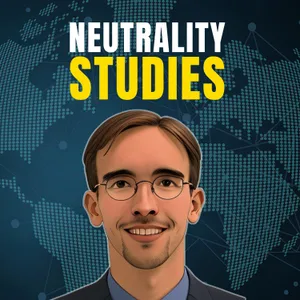
Free Daily Podcast Summary
Neutrality Studies: Daily Summaries Delivered
by Pascal
A channel dedicated to neutrality in international relations and analysis of world affairs.
Latest Episodes
The most recent episodes — sign up to get AI-powered summaries of each one.
- Yesterday53 min
US-Saudi Alliance Is SCREWED. Yemen Destroys US Middle-East Strategy | Laith Marouf
And suddenly, the underdog flips the table: Yemen is destroying US Middle-East Strategy and there is nothing the US can do about it.Laith Marouf, a Canadian-Syrian journalist based in Lebanon, discusses Yemen’s advancing front lines, Saudi Arabia’s strategy, Ansar Allah’s goals, Oman’s mediating role, US involvement, Saudi internal pressures, the wider regional war, nuclear risks, and Egypt’s decision to remain outside the conflict.Links:https://freepalestine....Neutrality Studies substack: https://pascallottaz.s...Merch: https://neutralitystud...Donation: https://neutralitystud...Timestamps:00:00:00 Yemen’s Front Lines Are Moving00:02:57 The Trigger Behind the New Offensive00:06:11 Saudi Strategy and Yemen’s History00:09:03 Territory, Population and Ansar Allah00:12:08 The Strategy Around Ma’rib and Aden00:15:20 Aden’s Geostrategic Importance00:21:20 Oman’s Role in Yemen00:26:53 US Support for Saudi Arabia00:30:17 Saudi Arabia’s Internal Crisis00:38:42 Regional War and Nuclear Risks00:47:30 Egypt’s Position and the Regional Shif
- Yesterday51 min
NATO is Working on a New Finnish-Russian War | Sakari Linden
Neocons never give up. As project Ukraine is faltering, the forces of war are working on the next battlefield with Finland in their cross-hairs. Sakari Linden, a board member of Finland’s Freedom Alliance Party and its foreign policy board, discusses Finland’s abandonment of neutrality, NATO membership, growing military tensions, economic consequences, media pressure, and the prospects for an independent and neutral Finnish foreign policy.Links:https://vapaudenliitto.fihttps://x.com/Vapauden... / vapaudenliitto Neutrality Studies substack: https://pascallottaz.s...Merch: https://neutralitystud...Donation: https://neutralitystud...Timestamps:00:00:00 Finland’s NATO path and security risks00:02:35 Freedom Alliance and Finnish neutrality00:05:25 Finland’s postwar neutrality success00:08:55 The Western pivot and media influence00:14:45 NATO accession and great-power politics00:18:45 Finland as a potential frontline state00:23:44 Russia hysteria and shifting public opinion00:30:39 Sanctions, welfare, and economic decline00:36:28 Party backlash and the new political divide00:42:04 Stubb, peace diplomacy, and Russia’s defeat00:48:24 The future of Finland’s neutralist movement
- 5 days ago59 min
REVEALED: The Sick TRICK to Make You Support Evil | Jay Shapiro
If you kill someone, they call you a murderer. If you kill a few people, they call you a mass-murderer. If you kill millions, they call you a great statesman. But how are we constantly tricked into supporting mass-murder AND applaud the sick monsters that lead us to do it? Well, turns out, there are some tricks.Jay Shapiro, filmmaker, writer, and host of The Dilemma Podcast, discusses his book Insufficient Rewards and its critique of consequentialist morality. The conversation explores cognitive dissonance, moral integrity, political systems, propaganda, objective reality, justice, peace, and how people rationalize participation in violence and injustice.Links:What Jay Thinks: https://whatjaythinks.comInsufficient Rewards: https://www.simonandschuster.net/book...Neutrality Studies substack: https://pascallottaz.substack.comMerch: https://neutralitystudies.com/shopDonation: https://neutralitystudies.com/donateTimestamps:00:00:00 Introducing Jay Shapiro and the book00:01:02 Why Jay wrote Insufficient Rewards00:04:32 History, morality, and consequentialism00:08:06 The flexibility of consequentialist thinking00:09:15 The actor’s moral dilemma00:12:06 Moral integrity and unjust systems00:16:30 Ukraine, sanctions, and moral certainty00:18:12 Cognitive dissonance and insufficient rewards00:27:07 Moral integrity, self-deception, and complicity00:32:11 First-order and second-order desires00:43:06 Objective reality and moral truth00:49:09 Justice, peace, and international violence00:57:34 Where to find Jay’s work
- 5 days ago47 min
BRICS Moves to 'Competitive Coexistence', Leaves West Behind | Prof. Anuradha Chenoy
Professor Anuradha Chenoy joins Pascal Lottaz to examine BRICS, the Shanghai Cooperation Organisation, and their evolving role in a multipolar world. They discuss India’s relations with Russia, diplomatic engagement between rivals, and the legacy of Bandung and nonalignment. Chenoy explains proposals for national currency trade, alternative payment systems, and financial reform. The conversation explores sanctions, strategic autonomy, and the differences between military alliances and cooperative forums, asking how diverse countries can pursue competitive coexistence while maintaining engagement with the West.Anuradha's Links:Articles at Scroll: https://scroll.in/author/27251India’s Foreign Policy and the Luxury of Strategic Autonomy: https://www.epw.in/journal/strategic-...The BRICS Plan for a New Financial Architecture (article record): https://pure.jgu.edu.in/id/eprint/8836/Transnational Institute profile: https://www.tni.org/en/profile/anurad...Neutrality Studies Links:Neutrality Studies Substack: https://pascallottaz.substack.comSupport Neutrality Studies: https://neutralitystudies.com/donateNeutrality Studies shop: https://neutralitystudies.com/shopTime Stamps00:00 BRICS and the SCO in a changing world06:52 India, Russia and Western pressure10:13 The BRICS declaration and diplomacy17:00 Bandung and the legacy of nonalignment23:25 Sanctions, tariffs and financial reform25:27 National currencies and alternative payments28:40 Coexistence beyond military alliances40:29 Iran, sanctions and international law
- 6 days ago58 min
Israel’s Hidden Victory: The ‘Defeat’ Of The West Is a Myth | Yakov Rabkin
Yakov Rabkin discusses Artyom Kirpichenok’s reported detention in Israel, stressing the scarcity of confirmed information. He examines unequal legal protections, Western support for Israel, and the relationship between Zionism, colonialism, and Christian Zionism. Rabkin challenges claims of inevitable Western decline, arguing that regional fragmentation may serve strategic objectives. The conversation also explores Israeli education, surveillance exports, restrictions on dissent, and the limits of electoral change, before considering public pressure, diplomatic assistance, and Jewish opposition to Zionism through his published books.Yakov's Links:Yakov Rabkin’s website: https://yakovrabkin.ca/Yakov Rabkin’s Substack: https://yakovrabkin.substack.com/Zionism Decoded in 101 Quotes: https://www.ipgbook.com/zionism-decod...Israel in Palestine: Jewish Rejection of Zionism: https://israelpalestinebook.com/Neutrality Studies Links:Neutrality Studies Substack: https://pascallottaz.substack.comSupport Neutrality Studies: https://neutralitystudies.com/donateNeutrality Studies shop: https://neutralitystudies.com/shopTime Stamps00:00 Artyom Kirpichenok’s detention05:29 Security courts and unequal justice17:06 Western support and double standards28:30 Colonial pride and the “new Hebrew”35:44 Britain and Christian Zionism39:42 Israel’s hidden victory and Western decline46:56 Security laws and shrinking civil liberties53:36 Helping Kirpichenok and finding Rabkin’s work
- 1 weeks ago59 min
The Lies of 9/11 & The War on Terror EXPOSED | Prof. Irfan Ahmad
25 years after the 9/11 incident in the USA, many are beginning to catch up with what those events really kicked off: The global war on the non-West and the multipolar world. Watch professor Irfan Ahmad in this talk deconstruct the narrative the transatlantic club has built to justify a quarter of a century of violence against the Global South.Professor Irfan Ahmad, Professor of Anthropology-Sociology at Ibn Haldun University, discusses his book Terrorism in Question: Decolonizing Anthropology and the Study of Islam. The conversation examines the neocolonial construction of terrorism, Islamophobia, enemy-making, the Global War on Terror, epistemic whitewashing, and the need to understand political violence through a more humane and decolonized anthropology.Links:Irfan Ahmad: https://fs.ihu.edu.tr/cv/academicians...Terrorism in Question: https://www.berghahnbooks.com/title/A...Neutrality Studies substack: https://pascallottaz.substack.comMerch: https://neutralitystudies.com/shopDonation: https://neutralitystudies.com/donateTimestamps:00:00:00 Terrorism in Question00:03:07 Decolonizing the terrorism question00:06:40 Securitization and the enemy00:08:25 From communism to Islamic terrorism00:15:27 Good Muslims, bad Muslims00:21:17 Manichaean thinking and Islamophobia00:27:38 The Global War on Terror00:31:28 Epistemic whitewashing00:40:55 Terrorism as ideology and theology00:49:59 War, neoliberalism and academia00:51:35 The anti-conclusion and rehumanizing terrorism00:57:04 Final thoughts and book recommendation
- 1 weeks ago56 min
AfD & Germany's Collapse: Brain Drain and Business Escapes Are Real | Dr. Stephan Ebner
The AfD just won local elections in Germany. Why? Well, not only Ukraine is currently going under, Germany is following, with its economy and social structure in deep dive. This is what explains the rise of the AfD—something the Pro-War Parties in the German establishment try to deny so hard, they rather tarnish AfD voters as "racists" rather than looking into their actual grievances.Dr. Stefan Ebner, an international lawyer working across the US, Germany, and Taiwan, discusses the AfD’s rise in Saxony, Germany’s political and economic decline, immigration, war with Russia, the EU, energy policy, the judiciary, and why professionals and businesses are leaving Germany.The law office of Dr. Stephan Ebner: https://lanaapma.ch/unser-team/Our Links:Neutrality Studies substack: https://pascallottaz.substack.comMerch: https://neutralitystudies.com/shopDonation: https://neutralitystudies.com/donateTimestamps:00:00:00 AfD victory and Germany’s decline00:08:43 AfD as opposition to the political class00:10:33 Verfassungsschutz and German democracy00:12:07 Election outlook and direct democracy00:18:05 Nazi comparisons, war and Ukraine00:23:03 Leaving Germany and brain drain00:27:13 The EU, Brexit and sovereignty00:36:20 War anxiety, arms exports and the SPD00:41:09 Energy policy and Germany’s economic future00:45:32 Immigration, Iran and Israel00:50:14 Rule of law and Germany’s future
- 1 weeks ago58 min
Europe’s Winter of Starvation, Ukraine Collapse Underway | Stas Krapivnik
Stanislav Krapivnik discusses Europe’s food and energy pressures, arguing that fertilizer costs, drought and disrupted Ukrainian exports could deepen hardship. He and Pascal Lottaz examine Germany’s AfD, divisions within European opposition parties, and the limits of renewed diplomacy with Moscow. Turning to Ukraine, Krapivnik assesses manpower shortages, Russian advances, seasonal fog and the changing role of drones. He argues that new defensive technologies may restore battlefield mobility, while Pascal questions whether local breakthroughs could develop into a broader military collapse.Stas’s YouTube: / @mrslavikman Stas’s Substack: https://zmeigarinich.substack.comNeutrality Studies Substack: https://pascallottaz.substack.comDonation: https://neutralitystudies.com/donateMerch: https://neutralitystudies.com/shop00:00 Introduction00:52 Europe’s food and fertilizer pressures06:35 Strikes on Ukraine’s ports and railways12:20 Germany’s AfD and Russia relations18:24 Energy policy and its trade-offs22:48 Diplomacy and Moscow’s ceasefire stance29:54 Weather, manpower and Russia’s next advance35:39 Tanks, drones and battlefield mobility
Get Neutrality Studies summaries in your inbox
Free AI-powered daily recaps. Key takeaways, quotes, and mentions — in a 5-minute read.
Get Free Summaries →Free forever for up to 3 podcasts. No credit card required.
You Might Also Like
Listeners also like.
NatSec Matters
Former national security officials interview top leaders on critical security challenges and U.S. policy responses.
School of War
Discussions with military leaders, policymakers, and historians on the strategy, history, and consequences of war.
Global Security Briefing
Experts analyze global security challenges and international defense policies, with a focus on the UK, Indo-Pacific, and Gulf regions.

The Real Story
Experts and decision makers analyze and debate major news stories.

One Decision
Former intelligence leaders and journalists examine high-stakes decisions that shaped global events.

The Truth of the Matter
Breaks down complex global policy issues through informed, balanced discussions without spin or sensationalism.
The Just Security Podcast
Expert analysis of national security, foreign policy, and rights from practitioners, academics, and affected individuals.

The John Batchelor Show
A daily deep dive into global news, politics, history, and science with analysis from New York and international reporting locations.

The Team House
Deep-dive conversations on national security with special operations veterans, intelligence professionals, and frontline reporters.

Call Me Back - with Dan Senor
Discusses challenges and dilemmas facing Israelis and Jews worldwide.
Sources & Methods
A weekly deep dive into national security news with NPR correspondents and interviews with military, intelligence, and diplomatic leaders.

In the Room with Peter Bergen
Peter Bergen examines global news stories through interviews with experts and firsthand reporting on national security, technology, and conflict.
Customized Recaps
AI-powered recaps with compact key takeaways, quotes, and insights.
Straight to Your Inbox
Get key takeaways from Neutrality Studies in a 5-minute read.
Save Hours Every Week
Stay current on your favorite podcasts without falling behind.
Frequently Asked Questions
What is Podzilla's Neutrality Studies daily summary?
It's a free AI-powered email that summarizes new episodes of Neutrality Studies as soon as they're published. You get the key takeaways, notable quotes, and links & mentions — all in a quick read.
How does the Neutrality Studies podcast summary work?
When a new episode drops, our AI transcribes and analyzes it, then generates a personalized summary tailored to your interests and profession. It's delivered to your inbox every morning.
Is this an official Neutrality Studies product?
No. Podzilla is an independent service that summarizes publicly available podcast content. We're not affiliated with or endorsed by Pascal.
Can I get summaries of other podcasts too?
Absolutely! The free plan covers up to 3 podcasts. Upgrade to Pro for 15, or Premium for 50. Browse our full catalog at /podcasts.
How often does Neutrality Studies release new episodes?
Neutrality Studies publishes daily. Our AI generates a summary within hours of each new episode.
What topics does Neutrality Studies cover?
Neutrality Studies covers topics including News, Politics. Our AI identifies the specific themes in each episode and highlights what matters most to you.
Start getting Neutrality Studies summaries tomorrow morning.
Free forever for up to 3 podcasts. No credit card required.
Free forever for up to 3 podcasts. No credit card required.