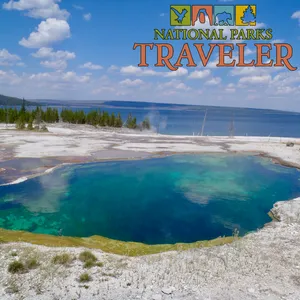
Free Daily Podcast Summary
National Parks Traveler Podcast: Daily Summaries Delivered
by Kurt Repanshek
National Parks Traveler is the world's top-rated, editorially independent, nonprofit media organization dedicated to covering national parks and protected areas on a daily basis. Traveler offers readers and listeners a unique multimedia blend of news, feature content, debate, and discussion all tied to national parks and protected areas.
Latest Episodes
The most recent episodes — sign up to get AI-powered summaries of each one.
- Jun 28, 202647 min
National Parks Traveler Podcast | See You In the Parks!
For 21 years, the National Parks Traveler has taken you around the National Park System and kept you informed on how the National Park Service and Congress have managed your national parks. We've gone underground to describe for you the wonders of Wind Cave, Jewel Cave and Mammoth Cave, hiked into cypress domes at Everglades National Park to marvel at the park's flora and fauna, and bucked the rapids of the Colorado and Green Rivers through Canyonlands National Park and Dinosaur National Monument. We've also followed the political and governmental contortions that have impacted the parks, along with the hurricanes, wildfires, floods, and climate change. In short, the Traveler has worked to be your window into all things national parks, serving both as your daily parks newspaper and feature-length magazine. This is our last episode. To look back at 21 years of Traveler, Kurt Repanshek invited Associate Editor Rita Beamish and Contributing Editor Kim O'Connell to join him for a conversation.
- Jun 21, 202648 min
National Parks Traveler Podcast | Wilderness Lost
Across the United States, from Alaska to Puerto Rico, there are about 112 million acres of officially designated wilderness. That amounts to about 5 percent of the country's land mass. It might appear to be even smaller when you consider that more than half of those 112 million acres protected as wilderness are in Alaska. To say that wilderness is at risk from the human imprint isn't hyperbole. While there are millions of acres of proposed, recommended, and potential wilderness across the country, Congress acts extremely slowly on these matters. Indeed, it was back in 1989 when America's Red Rock Wilderness Act was first proposed in Congress to protect 8 million acres in Utah as official wilderness. The clock continues to tick on that proposal. Without official designation as wilderness, lands can be impacted by motorized and mechanized activities, from logging and mining and energy development to off-road-vehicle recreation. But the threats to both unofficial and official wilderness might be growing, as the Trump administration has called for a review of wilderness management on lands managed by the Bureau of Land Management, the U.S. Fish and Wildlife Service, and even the National Park Service. To explore what's at stake with wilderness in America under these proposals, we have Kevin Proescholdt, the conservation director for Wilderness Watch, a nonprofit advocacy organization, and Bob Krumenaker, chairman of Keep Big Bend Wild, a nonprofit advocating for official wilderness designation in Big Bend National Park and a long-time National Park Service manager joining us today. Public comment on the Interior secretary's directives is being taken through mid-August. Here are links to the public comment pages: BLM https://www.regulations.gov/document/BLM-2026-0034-0001 https://www.regulations.gov/docket/BLM-2026-0068 https://www.regulations.gov/docket/BLM-2026-0069 https://www.regulations.gov/docket/BLM-2026-0067 NPS regulations.gov - NPS 2026-0101 regulations.gov - NPS 2026-0100 FWS Wilderness Administration and Resource Stewardship; Managing Climbing Activities in Wilderness https://www.regulations.gov/document/FWS-HQ-NWRS-2026-1618-0001
- Jun 14, 202647 min
National Parks Traveler Podcast | Don't Erase History So Fast
It was a little more than a year ago when Interior Secretary Doug Burgum asked the public to help him identify interpretive materials in the National Park System that disparaged Americans past or living or which contained content that detracts from viewpoints of scenic grandeur. Well, it appears that the public didn't share his concerns. Recent Freedom of Information Act requests have turned up nearly 36,000 comments in response to Secretary Burgum's mission "to restore Federal sites dedicated to history, including parks and museums, to solemn and uplifting public monuments that remind Americans of our extraordinary heritage, consistent progress toward becoming a more perfect Union, and unmatched record of advancing liberty, prosperity, and human flourishing." The folks at the Center for Western Priorities recently filtered through the nearly 36,000 comments that were received by Interior, and found that just 47 – that's right, only 47 comments – called for a sign to be removed or supported Burgum's request to tidy up history. Our guests today are Kate Groetzinger and Lilly Bock-Brownstein from the Center for Western Priorities, and they'll explain how they filtered those comments and what they found.
- May 31, 202648 min
National Parks Traveler Podcast | ESA's Future
Since this past December here at the Traveler we've been bringing you a series of stories on the Endangered Species Act and the threatened and endangered species it's intended to keep from going extinct. For me, it's been an eye-opening series because of what our editors and writers have learned about threatened and endangered species — from birds to trees and even to grasses — and the work being done to help them recover. It's certainly not an easy task, and one that often takes decades before you can see progress. In today's podcast, I sit down again with Jake Li, the vice president for conservation policy at Defenders of Wildlife, to get his take on efforts in Congress to rewrite the Endangered Species Act in ways that might not be so beneficial for threatened and endangered species. I think you'll find it to be a very insightful conversation. We recorded this conversation in mid-May, right before Endangered Species Day.
- May 24, 202648 min
National Parks Traveler Podcast | Rethinking Public Lands Stewardship
Public lands stewardship has most definitely changed under the second presidential administration of Donald Trump. Land-management agencies such as the National Park Service, U.S. Forest Service, and Bureau of Land Management have lost thousands of employees, and Interior Secretary Doug Burgum is on a mission to turn the country's public lands into a cash cow of sorts. As the political tenure in Washington D.C., swings wildly back and forth like a massive pendulum when it comes to our public lands, there is an effort under way to provide a roadmap for public lands stewardship in the United States that stretches far into the future. Ground Shift is a new nonprofit organization working to, as they put it, "develop creative, durable, and transformative ideas to shape the next century of public land and water stewardship in the United States." To better understand this organization and its goals, our guests today are Lynn Scarlett, who was a deputy Interior secretary during the administration of President George Bush, and Tracy Stone-Manning, who directed the Bureau of Land Management under President Joe Biden.
- May 17, 202658 min
National Parks Traveler Podcast | Cook Inlet's Beluga Whales
A fast-track proposal to develop a gold mine near Alaska's Cook Inlet and Lake Clark National Park and Preserve is alarming scientists, environmental groups and local communities because of the devastating effects it is expected to have on the region's critically endangered beluga whales. Cook Inlet is home to a small and genetically distinct population of beluga whales that has struggled for decades from habitat loss, industrial activity, pollution, and underwater noise. Supporters of the mining project say it will bring jobs, economic growth and profit to Native Alaskans. This week Traveler's Lynn Riddick talks with Cooper Freeman, Alaska Director of the Center for Biological Diversity. His organization along with many others argue that the gold to be extracted isn't worth the cost of threatening a species already vulnerable to extinction and forever desecrating a magnificent landscape.
- May 10, 202645 min
National Parks Traveler Podcast | Southern Campaign of the American Revolution
America's 250th birthday is coming up this summer, festivities will be held all over the country, and history buffs will be delving into the various nooks and crannies of the National Park System to see where they can visit sites of Revolutionary War battles. Don't overlook South Carolina and its three park sites that preserve Revolutionary War battlefields – Kings Mountain National Military Park, Cowpens National Battlefield, and Ninety-Six National Historic Site. The state of South Carolina takes so much pride in these three sites that some of its license plates proclaim that the Revolutionary War was won in South Carolina. But was it? Today we're going to pose that question to James Taub, the associate curator at the Museum of the American Revolution in Philadelphia.
- May 3, 202656 min
National Parks Traveler Podcast | Print Ain't Dead
We're living in somewhat tumultuous times in the print media industry. Well-familiar titles are either disappearing, shrinking drastically, or shifting over to the internet. On top of that, the advent of Artificial Intelligence has some readers wondering how much human effort and talent went into the piece they're reading. Today we're going to be talking about a throw-back, a publication that has come and gone a bit over the past six decades, but which has a hallowed space among publications for its long-form journalism that dives into mountain culture, environmental issues, and outdoor adventure. The Mountain Gazette has published such literary notaries as Hunter S. Thomas, Ed Abbey, John Fayhee, Sadie Stine, Royal Robbins and so many others. And it's back. Our guest is Mike Rogge, the owner and publisher of Mountain Gazette. He'll help us stroll down memory lane a bit and look at the current state of outdoor journalism.
Get National Parks Traveler Podcast summaries in your inbox
Free AI-powered daily recaps. Key takeaways, quotes, and mentions — in a 5-minute read.
Get Free Summaries →Free forever for up to 3 podcasts. No credit card required.
You Might Also Like
Listeners also like.
National Park After Dark
Two friends examine dark stories from U.S. National Parks to foster connection with public lands through narrative.

Nature Podcast
Covers breakthrough research from Nature journal across all scientific fields, with insights from scientists and science journalists.

MeatEater Conservation
A podcast about outdoor news and conservation issues, featuring interviews with experts and hunters.
Not Lost
A journalist and a friend travel to cities across North America, sharing meals with locals to explore cultures and personal identity.

Park Predators
A true crime podcast investigating murders, disappearances, and other crimes in national parks and forests around the world.
National Park Service Oral History
Firsthand stories from current and former National Park Service employees about life and work in America's national parks.

The American Birding Podcast
Discusses birds, birding, conservation, and birding-related travel with experts and enthusiasts across North America and beyond.
Outside/In
Explores connections between people and the natural world through stories on science, policy, and culture.

Surveyor Says! The NSPS Podcast
Conversations with leaders in the surveying profession discussing trends, innovations, and issues shaping the field.

Terrestrials
A nature podcast exploring surprising animal and plant behaviors through immersive storytelling and original songs.

The Planet Earth Podcast
Behind-the-scenes stories and personal reflections from the creators and narrator of the Planet Earth documentary series.
Out Of Office: A Travel Podcast
Two travelers explore diverse global adventures and offer practical tips for getting off the beaten path.
About National Parks Traveler Podcast
National Parks Traveler is the world's top-rated, editorially independent, nonprofit media organization dedicated to covering national parks and protected areas on a daily basis. Traveler offers readers and listeners a unique multimedia blend of news, feature content, debate, and discussion all tied to national parks and protected areas.
Customized Recaps
AI-powered recaps with compact key takeaways, quotes, and insights.
Straight to Your Inbox
Get key takeaways from National Parks Traveler Podcast in a 5-minute read.
Save Hours Every Week
Stay current on your favorite podcasts without falling behind.
Frequently Asked Questions
What is Podzilla's National Parks Traveler Podcast daily summary?
It's a free AI-powered email that summarizes new episodes of National Parks Traveler Podcast as soon as they're published. You get the key takeaways, notable quotes, and links & mentions — all in a quick read.
How does the National Parks Traveler Podcast podcast summary work?
When a new episode drops, our AI transcribes and analyzes it, then generates a personalized summary tailored to your interests and profession. It's delivered to your inbox every morning.
Is this an official National Parks Traveler Podcast product?
No. Podzilla is an independent service that summarizes publicly available podcast content. We're not affiliated with or endorsed by Kurt Repanshek.
Can I get summaries of other podcasts too?
Absolutely! The free plan covers up to 3 podcasts. Upgrade to Pro for 15, or Premium for 50. Browse our full catalog at /podcasts.
How often does National Parks Traveler Podcast release new episodes?
National Parks Traveler Podcast publishes weekly. Our AI generates a summary within hours of each new episode.
What topics does National Parks Traveler Podcast cover?
National Parks Traveler Podcast covers topics including Science, Nature, Culture, Society & Culture, Travel, Places & Travel. Our AI identifies the specific themes in each episode and highlights what matters most to you.
Start getting National Parks Traveler Podcast summaries tomorrow morning.
Free forever for up to 3 podcasts. No credit card required.
Free forever for up to 3 podcasts. No credit card required.