Free Daily Podcast Summary
by Caitanya Chandra Dasa
Deep insights and explanations on the Srimad Bhagavatam, Bhagavad-Gita, Vedanta-sutra, Upanisads, and other books that are part of the Vedas. www.ccdas.net
The most recent episodes — sign up to get AI-powered summaries of each one.
Subscribe to receive new articles by e-mail. It’s free, but if you like, you can pledge a donation:Join the Telegram group if you would like to join the live lessons. This course is maintained with your donations. Click here to donate. 💬 Text of the lesson Recovering the Vedas: Bhadraśravā worships Hayaśīrṣa in Bhadrāśva-varṣaBhadrāśva-varṣa is the tract of land east of Ilāvṛta-varṣa, ruled by Bhadraśravā, the son of Yamarāja. The Lord is present there in His form of Hayaśīrṣa (or Hayagrīva), the director of all religious principles and protector of the Vedas. At the end of each day of Brahmā, the Vedas are stolen by ignorance personified, who hides them in the lower planetary systems. Normally, the Lord, who is present as Matsya, acting as the maintainer of all living beings, fights with the demon and saves the Vedas, transmitting them again to Brahmā at the beginning of his next day. At the end of the previous day, however, the Lord appeared as Hayagrīva (the horse-headed incarnation) to fight with the demon and save the Vedas. This appears to be connected with the universal destruction at the end of the first half of the life of Brahma, which is a special event, different from the end of the other days of Brahmā. How is it that the Vedas can be stolen by a demon? In his purport, Prabhupāda connects it with the Vedas being forgotten and then transmitted again at the beginning of the next cycle of creation:“Although Vedic knowledge is imperishable, within this material world it is sometimes manifest and sometimes not. When the people of this material world become too absorbed in ignorance, the Vedic knowledge disappears. Lord Hayagrīva or Lord Matsya, however, always protects the Vedic knowledge, and in due course of time it is again distributed through the medium of Lord Brahmā. Brahmā is the trustworthy representative of the Supreme Lord. Therefore when he again asked for the treasure of Vedic knowledge, the Lord fulfilled his desire.”A demon doesn’t necessarily have to assume a form with two hands and legs to cause harm. Just as Tṛṇāvarta had the form of a whirlwind, Tamasā (the demon of ignorance personified) made everyone forget the knowledge of the Vedas. This same Lord Hayagrīva, who preserved the Vedas during the whole period of the night of Brahmā, is present in His deity form in Bhadrāśva-varṣa, where He is worshiped by His devotees, who offer him respectful obeisances and offer Him prayers in devotional trance. “The ruler Bhadraśravā and his intimate associates utter the following prayer: We offer our respectful obeisances unto the Supreme Personality of Godhead, the reservoir of all religious principles, who cleanses the heart of the conditioned soul in this material world. Again and again we offer our respectful obeisances unto Him.Alas! How wonderful it is that the foolish materialist does not heed the great danger of impending death! He knows that death will surely come, yet he is nevertheless callous and neglectful. If his father dies, he wants to enjoy his father’s property, and if his son dies, he wants to enjoy his son’s possessions as well. In either case, he heedlessly tries to enjoy material happiness with the acquired money.O unborn one, learned Vedic scholars who are advanced in spiritual knowledge certainly know that this material world is perishable, as do other logicians and philosophers. In trance they realize the factual position of this world, and they preach the truth as well. Yet even they are sometimes bewildered by Your illusory energy. This is Your own wonderful pastime. Therefore, I can understand that Your illusory energy is very wonderful, and I offer my respectful obeisances unto You.O Lord, although You are completely detached from the creation, maintenance and annihilation of this material world and are not directly affected by these activities, they are all attributed to You. We do not wonder at this, for Your inconceivable energies perfectly qualify You to be the cause of all causes. You are the active principle in everything, although You are separate from everything. Thus we can realize that everything is happening because of Your inconceivable energy.At the end of the millennium, ignorance personified assumed the form of a demon, stole all the Vedas and took them down to the planet of Rasātala. The Supreme Lord, however, in His form of Hayagrīva retrieved the Vedas and returned them to Lord Brahmā when he begged for them. I offer my respectful obeisances unto the Supreme Lord, whose determination never fails.” (SB 5.18.2-6)In his purport to text two, Prabhupāda reinfo
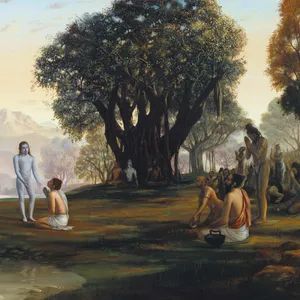
One of the eight sets of mountains surrounding Mount Sumeru, in Ilāvṛta-varṣa, is Kailāsa, located to the south. This is the abode of Lord Śiva. This abode is described in the Fourth Canto, chapter six (in the episode when the demigods go there to apologize to Lord Śiva after having offended him at the sacrifice organized by Daksa), as a paradisiac place, with pristine nature and all natural opulences. In the middle of it, there is a very auspicious place, where Lord Śiva sits under a great banyan tree, which is 100 yojanas high, with its branches spreading over 75 yojanas around. In other words, this tree alone is larger than Great Britain. Despite such a great natural opulence, Lord Śiva is not interested in material enjoyment. He spends his time absorbed in meditation and in philosophical talks with associates such as Kuvera and the four Kumāras. Despite this, his wife, Pārvatī, is very eager to serve him, accompanied by her billions of servants. This abode of Lord Śiva is off-limits for the inhabitants of the other eight varṣas. If any human man inadvertently tries to enter this sacred abode, he is immediately transformed into a woman, as described in the first chapter of the Ninth Canto, in the saga of King Sudyumna. Get full access to Mysteries of the Vedas (Caitanya Chandra Dasa) at www.ccdas.net/subscribe
The lifestyle and opulence of the inhabitants of Jambūdvīpa “On the side of Supārśva Mountain stands a big tree called Mahākadamba, which is very celebrated. From the hollows of this tree flow five rivers of honey, each about five vyāmas wide. This flowing honey falls incessantly from the top of Supārśva Mountain and flows all around Ilāvṛta-varṣa, beginning from the western side. Thus the whole land is saturated with the pleasing fragrance. The air carrying the scent from the mouths of those who drink that honey perfumes the land for a hundred yojanas around.” (SB 5.16.22-23)To the west, a complex of five rivers of celestial honey flows from the great kadamba tree situated on top of Supārśva Mountain. These five rivers flow around the whole Ilāvṛta-varṣa. The special characteristic of this honey is a very pleasing fragrance that perfumes not only the environment, but also the bodies of the inhabitants of these places. Instead of depending on artificial perfumes and cosmetics, they maintain their beauty in attractiveness by simply consuming the products of their celestial abode. “Similarly, on Kumuda Mountain there is a great banyan tree, which is called Śatavalśa because it has a hundred main branches. From those branches come many roots, from which many rivers are flowing. These rivers flow down from the top of the mountain to the northern side of Ilāvṛta-varṣa for the benefit of those who live there. Because of these flowing rivers, all the people have ample supplies of milk, yogurt, honey, clarified butter [ghee], molasses, food grains, clothes, bedding, sitting places and ornaments. All the objects they desire are sufficiently supplied for their prosperity, and therefore they are very happy.” (SB 5.16.24)The great banyan tree on top of Kumuda Mountain is the source of many rivers, which are described as “kāma-dughāḥ” (fulfilling all desires). The verse lists a long list of desirable items (milk, yogurt, honey, ghee, molasses, grains, clothing, bedding, seats, ornaments, etc.) that are directly connected with these rivers. This appears to indicate that these rivers are the direct source of all these objects, which are supplied for the happiness and prosperity of the inhabitants of Ilāvṛta-varṣa. In other words, these rivers are like kalpa-vṛkṣa trees that supply everything desirable. In this way, no one there has to work to obtain all the necessities of life… Get full access to Mysteries of the Vedas (Caitanya Chandra Dasa) at www.ccdas.net/subscribe
👆 I’m testing a new feature: an audio version of the article you can listen to. This is not an AI voice; it’s me reading the article and sometimes adding something. If you find it useful and would like to see it in other articles, leave a comment sharing your experience. Thanks! 🕉You can receive new articles directly in your inbox. Subscription is free; donations are welcome.Burnout is a problem that affects many devotees. It can lead to many negative symptoms, like irritation and impatience, headaches and other physical discomfort, depression, low self-esteem, and a feeling of impotence against what appear to be mounting and insurmountable difficulties. This physical and mental exhaustion leads to mechanical hearing and chanting, which can undermine the very foundation of our spiritual practice. It doesn’t really count when the body is there, but the mind is somewhere else.Once the foundation is impacted, other symptoms can appear, such as irritation, harsh speech, fault-finding, cynicism, and so on. Eventually, all of this combined can lead a devotee to conclude that he or she simply can’t continue, and that’s where many end up leaving the association of devotees or even spiritual practice altogether. It’s not difficult to understand why: in this case, instead of bringing bliss, spiritual practice registers in the mind as a painful experience, and even if one is very determined in the beginning, time makes the mind reject it. Once one stops, it is difficult to go back. Interestingly enough, devotees are, in general, more susceptible to burnout than regular people because we frequently have to combine our regular material obligations with work and family with our spiritual practice and service. It is easy to tell others that we need to be attentive while hearing and chanting, that we should be present, and so on. We all understand that. The question is that all of this demands energy, and it may be difficult to muster it after a journey of 16 hours of work, commuting, family problems, and other forms of pressure. Often, the pressure for being present, which is generally good advice, just adds to the problem. Ironically, the more a devotee is serious and determined to do more in spiritual life, the more he or she becomes susceptible to developing burnout. A devotee who wants to be serious in his spiritual practice frequently has to add 20 or even 30 hours of practice and service on top of responsibilities with work and family. This includes japa, listening to classes, online meetings with devotees, temple activities, book distribution, etc. For example, many devotees participate in weekend warrior programs, distributing books on weekends, often on both Saturday and Sunday. All included (commuting, organization, the distribution itself, and some meeting afterward), this may equal 16 hours of extra service per week. If one is the organizer, it can be more. Add this to 21 hours of weekly spiritual practice (japa, classes, etc.), 10 hours of temple and home programs, plus 40 hours of a regular job, 12 hours of commuting to work, 14 hours spent with family, etc. All of this under the pressure of being present and doing everything attentively. Is it even humanly possible? That’s exactly the point. Many devotees are not exactly “human” in the ordinary sense. They are in the stage of bhāva (if not beyond), impervious to the limitations of the material body and mind. One who is on such a high platform may effectively be able to maintain such a rhythm. The problem starts when it comes to regular mortals like us. In the Gītā (6.16-17), Kṛṣṇa directly alerts:“There is no possibility of one’s becoming a yogī, O Arjuna, if one eats too much or eats too little, sleeps too much or does not sleep enough. He who is regulated in his habits of eating, sleeping, recreation and work can mitigate all material pains by practicing the yoga system.”Spiritual practice is not a sprint. If we could obtain love of Godhead as we collapse after a year working 20 hours per day, this would surely be a tempting option, but unfortunately, that’s not how it works. Love of Godhead can be achieved only after a lifetime of service, performed with care and attention. The question then is how to maintain our physical and mental strength to be able to continue performing our spiritual practice with stability. How to hold enough back to be able to remain present during our hearing, chanting, and associating without being lazy. This is an art we must master to achieve success. We know philosophically that austerity is good for spiritual advancement. We hear many stories of great devotees who achieved perfection by performing great austerities, such as Dhruva Maharaja and the Six Goswamis, and thus the natural conclusion for many is that since austerity is good, the more austerity we can do, the more we will be able to advance
All the measurements in the description of Śukadeva Goswami are given in yojanas, an ancient Vedic unit of distance used in Sanskrit texts. The length of the yojana can vary according to the context, but Prabhupāda concludes that the descriptions of the Śrīmad Bhāgavatam are based on a yojana of eight miles.Jambūdvīpa is described as being circular in form (round like the leaf of a lotus flower), with a length and breadth of 100,000 yojanas (800,000 miles), as confirmed in SB 5.20.2. It’s difficult to conceive something this size, but just for comparison, the equatorial circumference of our planet is about 24,901 miles, which is about 3,113 yojanas. If we do the math, Jambūdvīpa is 2,547 times larger than the entire surface area of earth!Jambūdvīpa is divided into nine varṣas, or tracts of land, separated by gigantic mountains, whose size is almost inconceivable for us. For example, there are four great mountains surrounding Mount Sumeru (Mandara, Merumandara, Supārśva, and Kumuda), which are 10,000 yojanas, or 80,000 miles high! For comparison, Mount Everest, the highest mountain on our planet, is about 5.5 miles (0.69 yojanas) high. Again, we are speaking about a difference of orders of magnitude. Get full access to Mysteries of the Vedas (Caitanya Chandra Dasa) at www.ccdas.net/subscribe
The Vedic Cosmology of the 5th Canto The first part of the Fifth Canto describes the descendants of Mahārāja Priyavrata (who ruled during the first Manvantara), including the description of the activities of Mahārāja Āgnīdhra, the pastimes of Lord Ṛṣabhadeva, the fall of King Bharata, and so on. The second part enters into details about Vedic cosmology, including the structure of Bhū-mandala, the orbit of the sun, the heavenly and hellish planets, and so on. One could question why such a description of the universe is necessary, since the main purpose of the Śrīmad-Bhāgavatam is to discuss spiritual topics, but the truth is that this description is far more important than it may look at firstThe view we have of the universe around us is very influential in our concept of identity. If I believe the universe is an empty wasteland governed by mechanical physical laws, where things happen by chance, I will be much more inclined to believe that there is no God, life comes from matter, and life serves no purpose apart from immediate gratification. Get full access to Mysteries of the Vedas (Caitanya Chandra Dasa) at www.ccdas.net/subscribe
A serious mistake we often make when studying transcendental literature is to study it as a spectator, seeing it as something that is applicable to the personalities involved, but not to us. When we do that, we miss the whole point. Just as the Bhagavad-gītā was not just spoken to Arjuna, all the discussions in the Śrīmad Bhagavad and other books are not just for others, but especially to ourselves. When we see these passages as mere objects of intellectual study or historical narrations, we miss the purpose. Just as Rahūgaṇa, we are currently immersed in the material tree, thinking that we are men or women, that we are the maintainers of our subordinates, and so on. These instructions from Jaḍa Bharata aim to take us out of this material concept and bring us to a platform of knowledge, from which we can gradually free ourselves from material illusion, and from there attain pure devotional service to the Lord. Get full access to Mysteries of the Vedas (Caitanya Chandra Dasa) at www.ccdas.net/subscribe
Material world: The place of ephemeral and temporary happiness “Sometimes, being defeated or plundered by a superior, powerful agent, a living entity loses all his possessions. He then becomes very morose, and lamenting their loss, he sometimes becomes unconscious. Sometimes he imagines a great palatial city in which he desires to live happily with his family members and riches. He thinks himself fully satisfied if this is possible, but such so-called happiness continues only for a moment.” (SB 5.13.7)In this world, everyone looks for happiness in relationships with friends, family, and society, but this happiness is insufficient to satisfy the needs of the soul, just as a drop of water in the desert. Worse still is that this happiness is temporary, and it depends to a large extent on one’s financial means. Sometimes a person may lose everything to a powerful enemy, government officials, or other unexpected situations. Often this also causes one to lose his or her family and circle of friends. In such situations, with all plans destroyed, one often falls into depression and loses all enthusiasm. This is yet another facet of material existence. The analogy of the gandharva-pura, or the illusory castle, is also deepened by Prabhupāda in this verse: Get full access to Mysteries of the Vedas (Caitanya Chandra Dasa) at www.ccdas.net/subscribe
Deep insights and explanations on the Srimad Bhagavatam, Bhagavad-Gita, Vedanta-sutra, Upanisads, and other books that are part of the Vedas. www.ccdas.net
AI-powered recaps with compact key takeaways, quotes, and insights.
Get key takeaways from Mysteries of the Vedas in a 5-minute read.
Stay current on your favorite podcasts without falling behind.
It's a free AI-powered email that summarizes new episodes of Mysteries of the Vedas as soon as they're published. You get the key takeaways, notable quotes, and links & mentions — all in a quick read.
When a new episode drops, our AI transcribes and analyzes it, then generates a personalized summary tailored to your interests and profession. It's delivered to your inbox every morning.
No. Podzilla is an independent service that summarizes publicly available podcast content. We're not affiliated with or endorsed by Caitanya Chandra Dasa.
Absolutely! The free plan covers up to 3 podcasts. Upgrade to Pro for 15, or Premium for 50. Browse our full catalog at /podcasts.
Mysteries of the Vedas publishes weekly. Our AI generates a summary within hours of each new episode.
Mysteries of the Vedas covers topics including Religion & Spirituality, Spirituality. Our AI identifies the specific themes in each episode and highlights what matters most to you.
Free forever for up to 3 podcasts. No credit card required.