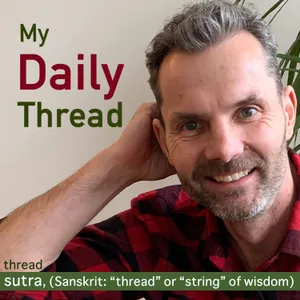
Free Daily Podcast Summary
My Daily Thread: Daily Summaries Delivered
by Jeff Lichty
Get key takeaways, quotes, and insights from My Daily Thread in a 5-minute read. Delivered straight to your inbox.
Latest Episodes
The most recent episodes — sign up to get AI-powered summaries of each one.
- Jan 23, 20265 min
294. 2:40 Śauca... Clean up your side of the street.
Śauca — Sutra 2.40 Sanskrit (Transliteration) śaucāt svāṅga-jugupsā parair asaṁsargaḥ English Translation From purity arises a natural distaste for excess attachment to one's own body and for contact with what clouds clarity. Plain-language meaning When purity develops: Obsession with the body loosens Craving, clutter, and unnecessary contact fall away You stop feeding what agitates you Key insight for listeners: Śauca isn't about being "clean" — it's about becoming less hijacked by impulses. Śauca in the Body Eat foods that leave you clear, not heavy Bathe, stretch, breathe — treat the body as a temple, not an obsession Sleep enough — fatigue pollutes awareness Soundbite: "Purity isn't about control — it's about reducing friction." Śauca in the Mind Reduce mental junk food (doom scrolling, outrage, gossip) Notice what you repeatedly feed your attention Ask: Does this bring clarity or agitation? Practice for listeners: One day. One habit. Remove one thing that muddies your mind. Śauca in Speech Speak truthfully and cleanly Less reacting, more responding Silence is often the cleanest option Śauca in Relationships Who you spend time with matters Purity doesn't mean isolation — it means discernment Choose people and environments that support steadiness Closing Reflection You don't need to add more to your life to be free. You need to remove what clouds your seeing. When purity increases: The mind lightens The heart steadies <li data-start="3152" data-end=
- Jan 20, 20265 min
293. Niyamas overview. Organizing our Inner Life.
शौचसन्तोषतपःस्वाध्यायेश्वरप्रणिधानानि नियमाः Niyamas 1:32. śauca-santoṣa-tapaḥ-svādhyāya-īśvara-praṇidhānāni niyamāḥ In the Yoga Sutras of Patanjali, the Niyamas are the inner disciplines of yoga. If the Yamas describe how we relate to the world around us, the Niyamas describe how we relate to ourselves. They are practical, grounded practices—not moral rules or spiritual ideals to perfect. They're ways of organizing our inner life so that clarity, steadiness, and freedom become possible. Patanjali offers five Niyamas. Each one is a practice of attention. Each one asks us to take responsibility—not for controlling life—but for shaping the quality of our inner experience. Today, we'll briefly name each Niyama and then explore them one by one, not as theory, but as lived practice. The Five Niyamas – Concise Setups 1. Saucha — Cleanliness Saucha is about clarity and purification—of the body, the mind, and the environment we live in. It asks a simple question: What am I allowing in? 2. Santosha — Contentment Santosha is the practice of being at peace with what is, without giving up the desire to grow. It's learning to stop arguing with reality. 3. Tapas — Disciplined Effort Tapas is the steady heat of practice—the willingness to stay with discomfort in service of growth, not punishment. It's where transformation happens. 4. Svadhyaya — Self-Study Svadhyaya is honest self-reflection. It's the courage to look inward, notice our patterns, and learn from them rather than run from them. 5. Ishvara Pranidhana — Surrender Ishvara Pranidhana is the practice of letting go—of control, of ego, of the belief that we're doing this alone. It's trusting something larger than our personal will.
- Jan 17, 20265 min
292. " Man in the Arena"- Happy New Year from Teddy and me.
Man in the Arena In this episode, Jeff reads and reflects on one of the most enduring passages on courage and participation: Theodore Roosevelt's "Theodore Roosevelt'" from his 1910 speech Citizenship in a Republic. This reflection isn't about winning, achievement, or public success. It's about something far more intimate and challenging — the willingness to step into the arena of our own lives, imperfectly and honestly, rather than standing safely on the sidelines as critics of ourselves or others. Through the lens of the Yoga Sutras, this episode explores how Roosevelt's words echo ancient yogic teachings, particularly: Abhyāsa — steady practice over time, even when we fall short Vairāgya — releasing attachment to outcomes, approval, and perfection The difference between the inner critic and the witnessing awareness cultivated through practice Jeff connects the idea of "the arena" to real life: the yoga mat, recovery, difficult relationships, moments of starting over, and the courage required simply to stay engaged when things feel uncomfortable or uncertain. Rather than offering motivation or quick fixes, this episode invites quiet reflection. It asks listeners to notice where they may be withholding effort, hiding behind judgment, or waiting until they feel ready — and to consider what it might look like to step back into participation, one small act at a time. This is an episode about effort without guarantee, action without attachment, and the kind of courage that doesn't look heroic — but changes lives.
- Dec 24, 20255 min
291. Season Finale - Transcend
A Merry Christmas and Happy New Year! As we usher out 2025, we play the yearly word game. A huge thank you to all the My Daily Thread Tribe! We an extra shout out to Peter and Laura, both who admitted that My Daily Thread was their number 1 Podcast in 2025! Now let's finish this season ... Choose the word that represents 2025, put it on paper, then send it back to the Universe with a big thank you! Choose your word for 2026, put it on paper, then send it to us in the comments. Stay safe everyone. Live. Love!! Om Peace Out! J
- Dec 24, 20255 min
290. Aparigriha ... and just letting go!
Sutra 2.39 अपारिग्रहस्थैर्ये जन्मकथन्तासम्बोधः Aparigrahasthairye janma-kathantā-sambodhah Word-by-Word Breakdown Aparigraha (अपारिग्रह) a = not / without pari = around, excessive, surrounding graha = grasping, holding, seizing → Non-possessiveness, non-grasping, freedom from hoarding Sthairye (स्थैर्ये) From sthira = steady, firm, stable In locative form: when established in steadiness → When one is firmly grounded in non-possessiveness Janma (जन्म) Birth, origin, beginning → Refers to the conditions of birth, why we are here, our karmic patterns Kathantā (कथन्ता) From katham = how, in what way -tā = abstract noun suffix → "the how-ness," the method, the why and how → The reasons, the mechanics, the story behind our birth Sambodhah (सम्बोधः) sam = complete, together bodha = awakening, understanding, knowledge → Complete awakening, deep knowledge, illumination Full Sense of the Sutra "When one is firmly established in non-possessiveness (aparigraha), there arises deep understanding of the why and how of one's birth — a clear vision of life's patterns and purpose."
- Oct 11, 202550 min
Eunice Peterson on Trauma and Gratitude - Happy Thanksgiving
Join Jeff and Eunice Peterson as they discuss Trauma, Gratitude and Yoga. Jeff and Eunice will be conducting a workshop together at Yoga Passage in Calgary, Alberta on the weekend of November the 8th.
- Aug 20, 20255 min
289. Brahmacarya – True Strength: The Right Use of Energy
We continue our exploration of the yamas in Patañjali's Yoga Sūtras with the fourth principle: brahmacarya. This yama is often misunderstood, yet it carries profound wisdom for how we direct our energy in modern life. The sūtra is Yoga Sūtra II.38: brahmacarya-pratiṣṭhāyāṃ vīrya-lābhaḥ "When one is firmly established in brahmacarya, vitality is gained." Sanskrit breakdown: brahmacarya — literally "moving in Brahman," the creative spiritual essence. Traditionally translated as celibacy, but more broadly pointing to moderation, self-mastery, and alignment with higher purpose. pratiṣṭhāyām — when firmly established, rooted. vīrya — strength, vitality, vigor, courage. lābhaḥ — attainment, gain. Not Just Celibacy In the past, brahmacarya was often reduced to celibacy. But its true meaning is much wider. It is not about denial, but about conscious choice — living in a way that honors energy rather than scattering it. It points to integrity in how we use life force, whether in sexuality, speech, thought, or action. Quite literally, brahmacarya means "to move in Brahman" — to live aligned with the deepest creative spirit energy. It's less about repression, and more about redirection. Energy Leak Awareness The sutra reminds us that vitality (vīrya) is lost when we scatter our energy through excess, distraction, or compulsion. Where does energy leak out of our lives? Overcommitment and busyness. Constant stimulation from social media, gossip, and noise. Addictive habits or compulsive desires. These patterns drain vitality, leaving us depleted. Brahmacarya calls us to become aware of where we're leaking energy and to redirect it toward what truly matters. Practical Application Relationships: approaching intimacy with respect, honesty, and presence — not compulsion or exploitation. Lifestyle: practicing moderation in food, media, consumption, and stimulation. Spiritual practice: sustaining discipline in meditation, āsana, or study without burnout, through steady rather than excessive effort. The Fruit of Practice – Vitality (Vīrya) The promise of this sūtra is vitality. Energy that was once wasted becomes available for creativity, clarity, and growth. When impulse and distraction no longer rule us, a d
- Aug 18, 20257 min
288. Asteya – The Abundance of Non-Stealing
Continuing the theme... Yoga Sūtra II.37, which speaks to the practice of asteya, or non-stealing. The sūtra reads: asteya-pratiṣṭhāyāṃ sarva-ratnopasthānam "When one is firmly established in non-stealing, all jewels present themselves." — Edwin Bryant Let's pause on this idea of pratiṣṭhām — being firmly established. When asteya becomes the foundation of how we live, "all the jewels" (sarva-ratna) naturally manifest. Things flow toward us — and isn't that what we want? Who wouldn't love a few more jewels? But here's the key: these jewels don't arrive through grasping or taking. They flow when we live with full authenticity and integrity, when we set up the energy field and vibration we want to attract into our lives. It's about becoming the kind of person who naturally earns the respect of colleagues, family, and friends. What kind of abundance do we really seek? It's not just about material abundance — bigger portfolios, a nicer car, or better stock performance. Sarva-ratna points to something richer: an abundance of love, meaningful connections, deep relationships, and vibrant health. Sometimes the question isn't whether we're stealing from others, but whether we're stealing from ourselves. Are we robbing our own health by neglecting sleep, eating poorly, or pushing too hard? Levels of pratiṣṭhām — where non-stealing plays out: Relationships: Am I demanding time or energy that isn't freely given? Am I respecting others' boundaries and autonomy? Or am I trying to take away their freedom to face their own fears and challenges in their own time? Asteya in relationships means giving people the space to grow, without stealing their process. Work: Do I acknowledge sources? Avoid taking credit that isn't mine? Show up on time? Do I overpromise, or do I consistently deliver more than I take? Social Media: Do I borrow or repost content without giving credit? To be "firmly established" in asteya means living in such a way that nothing needs to be taken, because life flows with sufficiency. At its root, pratiṣṭhāyām is grounded in the absence of fear — the fear that there isn't enough, or that we ourselves aren't enough. And maybe we can close with this simple thought: when we let go of stealing, grasping, and taking, we discover that abundance was already waiting to flow toward us.
Get My Daily Thread summaries in your inbox
Free AI-powered daily recaps. Key takeaways, quotes, and mentions — in a 5-minute read.
Get Free Summaries →Free forever for up to 3 podcasts. No credit card required.
You Might Also Like
Listeners also like.

Red Thread Podcast
Random Randy
Wisdom of the Sages
Raghunath Cappo & Kaustubha Das

Thoughtful Threads
solgoodmedia.com
Sutras & Stuff: A Philosophy Podcast
Malcolm Keating
Live Vedanta
Chinmaya Mission Niagara

Threaded Minds
Suhaib Zada
Higher Thought
Sol Good Media

Zenstr
Seth

Daily Affirmations
crebgleyg aristy

Everyday Alchemy
Terri

Inner Light
The Podcast Project

Wisdom for the Day - Standing Strong
Rick Yuhas
About My Daily Thread
threadsutra, (Sanskrit: "thread" or "string")Welcome to My Daily Thread. A little slice of wisdom from the ages. From Patanjali through the present, a little riff to make your day! That's the thread, the sutra, the wise string that binds us all together.
Customized Recaps
AI-powered recaps with compact key takeaways, quotes, and insights.
Straight to Your Inbox
Get key takeaways from My Daily Thread in a 5-minute read.
Save Hours Every Week
Stay current on your favorite podcasts without falling behind.
Frequently Asked Questions
What is Podzilla's My Daily Thread daily summary?
It's a free AI-powered email that summarizes new episodes of My Daily Thread as soon as they're published. You get the key takeaways, notable quotes, and links & mentions — all in a quick read.
How does the My Daily Thread podcast summary work?
When a new episode drops, our AI transcribes and analyzes it, then generates a personalized summary tailored to your interests and profession. It's delivered to your inbox every morning.
Is this an official My Daily Thread product?
No. Podzilla is an independent service that summarizes publicly available podcast content. We're not affiliated with or endorsed by Jeff Lichty.
Can I get summaries of other podcasts too?
Absolutely! The free plan covers up to 3 podcasts. Upgrade to Pro for 15, or Premium for 50. Browse our full catalog at /podcasts.
How often does My Daily Thread release new episodes?
My Daily Thread publishes every few days. Our AI generates a summary within hours of each new episode.
What topics does My Daily Thread cover?
My Daily Thread covers topics including Education, Religion & Spirituality, Spirituality, Self-Improvement. Our AI identifies the specific themes in each episode and highlights what matters most to you.
Start getting My Daily Thread summaries tomorrow morning.
Free forever for up to 3 podcasts. No credit card required.
Free forever for up to 3 podcasts. No credit card required.