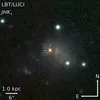
The Antimatter Explosion: Unraveling Supernova 2024afyu
Episode OverviewIn this episode, we explore the extraordinary discovery of SN 2024afyu, a nearby supernova located at redshift (z = 0.0085) (approx. 37.7 Mpc). Featuring an unusually slow 85-day rise to peak brightness and a peak magnitude of (M_r = -18.9 mag), this supernova challenges standard core-collapse models. We discuss how its massive synthesized Nickel and Sulfur components make SN 2024afyu one of the strongest candidates ever observed for a Pair-Instability Supernova (PISN)—a catastrophic thermonuclear explosion triggered by electron–positron pair creation in massive stellar cores.Key Topics CoveredA Slow Cosmic Burn: Why SN 2024afyu's broad light curve and 85-day rise time set it apart from typical Type II and Type IIb supernovae.Chemical Anomalies: The early emergence of forbidden calcium ([Ca II]) lines without typical oxygen emission, alongside unique optical and near-infrared sulfur emission features ([S I], [S II], and [S III]).Evaluating the Explosion Engine: How the heavy yields of intermediate-mass elements rule out standard core-collapse mechanisms, magnetar spin-down, and black hole fallback accretion.Comparing with Theoretical PISN Models: How spectral and photometric observations compare against low-redshift pair-instability models.The Host Galaxy: Insights into 2MFGC 13744, a star-forming dwarf galaxy providing the low-metallicity environment expected for massive PISN progenitors.### Article Reference Title: SN 2024afyu interpreted as a Pair Instability Supernova (arXiv preprint: SN 2024afyu: A Candidate Pair-Instability Supernova with Peculiar Evolution) Authors: P. J. Pessi, S. Barmentloo, Ł. Wyrzykowski, S. Schulze, J. Sollerman, A. Gangopadhyay, P. J. Mikołajczyk, S. Rose, K. Kotysz, C. Fremling, et al. Identifier / Publication: arXiv:2609.07931v1 / Astronomy & Astrophysics manuscript no. 24afyu---Acknowledements: Podcast prepared with Google/Gemini Notebook. Illustration credits: Pessi et al. (LBT)
Podzilla Summary coming soon
Sign up to get notified when the full AI-powered summary is ready.
Free forever for up to 3 podcasts. No credit card required.
Listen to This Episode
More from Multi-messenger astrophysics
Chasing Kilonovae: How LIGO-India Multiplies Multimessenger Discoveries

NMMA + Astro-COLIBRI: Unmasking Star Explosions in Real Time

Structuring the Transient Universe: Astro-COLIBRI’s New AI Pipeline
Peering Through the Ice: The Milky Way’s High-Energy Neutrino Signal
Get summaries like this every morning.
Free AI-powered recaps of Multi-messenger astrophysics and your other favorite podcasts, delivered to your inbox.
Free forever for up to 3 podcasts. No credit card required.