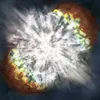
SN 2024jlc: Bridging the Gap Between Supernova Classes
In this episode, we dive into the fascinating discovery of SN 2024jlc, one of the closest and least luminous super-luminous supernovae (SLSNe) ever found. We explore how this extraordinary event is challenging our understanding of stellar explosions by serving as a "bridge" between classic stripped-envelope supernovae (SE-SNe) and their super-luminous cousins. We unpack the massive multi-wavelength campaign used to study it—spanning from ultraviolet and optical light to X-rays and even high-energy gamma-rays. Key Topics Covered:Defying Classification: Why SN 2024jlc's exceptionally low peak luminosity and rare helium signatures make it a unique SLSN-Ib, defying standard stellar explosion models.The Powering Engine Debate: What is driving this massive explosion? We discuss the two leading theories: the radioactive decay and interaction with a circumstellar medium (CSM) versus the spin-down of a rapidly rotating young magnetar. Whispers of Gamma-Rays: We look at the intriguing, tentative hint of a gamma-ray signal picked up by the Fermi-LAT space telescope, and what it might mean for the hidden central engine powering the supernova.The Future of Supernova Hunting: How upcoming surveys like the Vera C. Rubin Observatory's LSST will help uncover more of these "missing link" transitional objects in the cosmos. Article Reference Discussed in this Episode:Simongini, A., et al. (2026). Bridging the gap between SLSNe and SE-SNe: Multi-wavelength analysis of the SLSN-Ib SN 2024jlc. Astronomy & Astrophysics.Acknowledements: Podcast prepared with Google/NotebookLM. Illustration credits: NASA
Podzilla Summary coming soon
Sign up to get notified when the full AI-powered summary is ready.
Free forever for up to 3 podcasts. No credit card required.
Listen to This Episode
More from Multi-messenger astrophysics
The Schmidt Observatory System unlocking the Transient Universe
GUANO, NITRATES, and GLIMPSE: The Pipelines Powering Multi-Messenger Astronomy

The Dynamic Radio Sky: Unveiling Transients with the SKAO
X-Raying the Earth: Neutrino Tomography at the South Pole
Get summaries like this every morning.
Free AI-powered recaps of Multi-messenger astrophysics and your other favorite podcasts, delivered to your inbox.
Free forever for up to 3 podcasts. No credit card required.