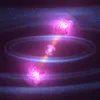
Chasing the Flash: Hunting Neutron Star Mergers with CTAO
In this episode, we dive into the thrilling world of multi-messenger astronomy! Ever since the historic detection of GW170817, scientists have known that binary neutron star (BNS) mergers can produce both gravitational waves and explosive short gamma-ray bursts (sGRBs). But how can we best catch the highest-energy light from these elusive cosmic collisions? We explore a recent study by the Cherenkov Telescope Array Observatory (CTAO) Consortium that simulates the upcoming O5 observing run to figure out the absolute best strategies for detecting these VHE (very-high-energy) gamma-ray signals. Key Topics Discussed: The Power of CTAO: An introduction to the Cherenkov Telescope Array Observatory, the next-generation ground-based gamma-ray observatory that boasts an unprecedented sensitivity to short-timescale phenomena, up to 10,000 times better than current satellite instruments for specific energies.The Race Against Time: Why speed is everything. We discuss how the probability of detecting a gamma-ray counterpart plummets if observations don't begin within the first 1 to 4 hours after the gravitational wave onset.Angles Matter: Why a GRB's "viewing angle" is the single most important factor for detectability. We explain the difference between observing a jet "on-axis" versus "off-axis" and why even a rough angle estimate from gravitational wave alerts could revolutionize follow-up campaigns.The Winning Strategy: How do you search a massive, poorly localized region of the sky? We unpack why researchers found that short, 5-minute fixed observation windows combined with Real-Time Analysis (RTA) offer the perfect balance to maximize the chances of a successful detection.The Odds of Success: A look at the study's conclusion that an optimized follow-up strategy could allow CTAO to detect VHE gamma-ray emission from roughly 5% of gravitational wave-associated short GRBs.Featured Reference: Abe, S., et al. (CTAO Consortium). "Chasing Gamma-Ray Signals from Binary Neutron Star Coalescences with the Cherenkov Telescope Array: Prospects and Observing Strategies." Draft version April 13, 2026.Acknowledements: Podcast prepared with Google/NotebookLM. Illustration credits: NASA's Goddard Space Flight Center/CI Lab
Podzilla Summary coming soon
Sign up to get notified when the full AI-powered summary is ready.
Free forever for up to 3 podcasts. No credit card required.
Listen to This Episode
More from Multi-messenger astrophysics
FRB 20191221A or "the telescope that hallucinated in the rain"
Record-Breaker: Catching Gamma Rays from the Distant Quasar OP 313
Ripples in Spacetime: Unpacking the GWTC-5.0 Catalog
SN 2017egm : Fermi-LAT's Breakthrough Gamma-Ray Detection
Get summaries like this every morning.
Free AI-powered recaps of Multi-messenger astrophysics and your other favorite podcasts, delivered to your inbox.
Free forever for up to 3 podcasts. No credit card required.