Free Daily Podcast Summary
More Health, Less Healthcare: Daily Summaries Delivered
by Peter Boland PhD
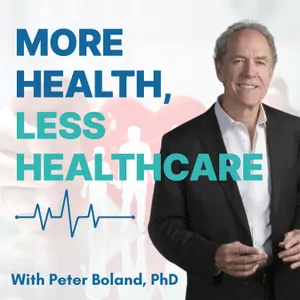
Are you ready to rethink what health really means—and what it takes for us to achieve it? Welcome to the “More Health. Less Healthcare” Podcast, your front-row seat to a revolution in American healthcare, inspired by the game-changing book by Peter Boland. Healthcare doesn’t have to be defined by endless bills, mounting debt, and a system that prioritizes profits over people. What if there’s a better way that means more health for everyone, fewer unnecessary costs, and a renewed sense of fairness in how care is delivered? The “More Health. Less Healthcare” podcast takes you inside the heart of a growing movement: one that values equity, transparency, collaboration, and, above all, real outcomes for real people. Hosted by thought leaders committed to making a difference, each episode starts with a bold question: Are we ready to do the right thing, for the right reasons, at the right price? Drawing from over 100 real-life case examples and interviews, this podcast isn’t just another critique of what’s broken. It’s your practical playbook for solutions that work—proof of concept that eradicating health disparities and cutting out waste can lead to healthier communities, a stronger economy, and a more ethical society. Learn how the hidden cost of inequity in American healthcare is draining hundreds of billions of dollars from our economy every year, and how millions of Americans endure the crushing burden of medical debt. Discover why up to a third of all healthcare spending in the U.S.—a staggering $1.4 trillion each year—has no benefit for patients and only adds to the harm. The “More Health. Less Healthcare” podcast uncovers these hard truths and turns them into a call for accountability and courage. We face a crucial choice: keep overspending on sickness care or rebalance our priorities to invest in real health creation. COVID-19 revealed the glaring gaps in our system and the disproportionate impact on minority communities, bringing discrimination and broken incentives to the forefront. The podcast tackles these issues head-on, with stories and strategies from those leading the way on public health, end-to-end care coordination, and the rebuilding of trust in our healthcare institutions. Why do traditional healthcare financing models fail us? How can we redirect wasted resources to programs that create health? What can individuals, practitioners, and policymakers do right now to drive systemic change, eliminate unnecessary care, and refocus on community-based solutions? Each episode is a masterclass in what it means to be accountable for the health of our communities. We draw on the wisdom of healthcare’s past, rooted in Hippocrates’ timeless principle—first do no harm, then try to prevent it—and update it for the 21st century. Our guests bring you groundbreaking ideas and proven methods to advance equity, commit to health creation, and embrace transparency and fairness as the guiding values of a new era. Don’t miss the conversations that matter from how to slash 26-46% of healthcare waste, to making public health programs robust statewide and nationwide, to amplifying voices that have turned health equity from an ideal into a reality. Whether you’re a patient, a clinician, a policymaker, or someone who simply cares about the future of health in America, “More Health. Less Healthcare” is your go-to resource for hope, honest dialogue, and practical steps toward a fairer, healthier tomorrow. Subscribe now and join the national conversation about how we value health, the urgent reforms we need, and how—with the right leadership and commitment—we can all experience more health and less healthcare.
Latest Episodes
The most recent episodes — sign up to get AI-powered summaries of each one.
- 2 weeks ago11 min
High costs don't equal high quality.
Welcome back to "More Health, Less Healthcare." In today's episode—part three of our 10-part series with host Peter Boland—we're challenging the pervasive narrative that the U.S. has the best healthcare system in the world. While American medical advancements are undeniably impressive, we're diving into the deep systemic issues that contradict this claim. We'll explore how our healthcare truly stacks up against other wealthy nations and scrutinize the hidden financial incentives shaping industry behavior. By the end, you'll get an honest, direct look at why our exorbitant spending doesn't translate to better health outcomes, and what it takes to actually align the system with patient well-being.In the episode, we will discuss 5 key takeaways on dismantling the healthcare status quo (and how to demand real accountability):High costs don't equal high quality: The U.S. spends vastly more than peer nations, yet yields surprisingly poor health outcomes.Beware the status quo narrative: Misleading claims of having "the best care" are often used to protect a system that prioritizes profit over community health.Incentives reveal the truth: Organizational behavior is driven by financial gains, which frequently sideline actual community health needs.True accountability means structural change: It's not enough to talk about care; we must overhaul incentive structures to directly reward improved patient health.Real stewardship requires a seat at the table: True health equity is achieved when community-represented boards are empowered to make impactful decisions.The U.S. spends more than any other wealthy nation, but health is about outcomes, not just expenditures. We have to challenge the misleading narratives protecting the status quo, restructure financial incentives, and empower community boards so the system actually works for patients, not just profits.Listen to the full episode for more!
- 3 weeks ago9 min
Finding the Money for Local Health: Eliminating Waste and Investing in Communities
Welcome back to "More Health, Less Healthcare.", In today's episode, we're diving into the crucial questions of funding local health initiatives and understanding what it truly means for healthcare to be "local." Building on our previous look at hospitals transforming their neighborhoods, we'll explore how institutions like University Hospitals in Cleveland have uncovered the money for upstream investments— by eliminating waste within existing systems. We'll also shine a spotlight on real communities, from Dubuque to Pittsburgh to Rosen Hotels in Florida, where local investment in primary care and prevention is generating striking health and economic benefits. But we'll also examine the limits of employer-driven models and the challenge of achieving true health equity for everyone. By the end, you'll see why the future of health is local—and why accountability structures must match the real needs of communities. In the episode we will discuss 6 lessons on making health local (and how numbers prove it):1. Cutting waste funds real change: University Hospitals saw costs drop by 9 percent 2. Results come in year 1, not someday: Lower spending starts immediately 3. Accountability must be local to matter: It's not enough for care to be "nearby" 4. Less hospital use is real money: Pittsburgh and Rosen saved hundreds of millions 5. Investing savings loops value into the community: Rosen’s $13 million yielded $90 million in returns 6. Employer models are powerful but incomplete: Without them, many are left behind Health is fundamentally local, and the dollars to drive change are already in the system. We just need to redirect the waste, build local accountability, and reinvest the savings so entire communities, not just the employed fortunate, actually benefit.Listen to the full episode for more!
- Aug 19, 202616 min
Why Healthcare Is Local: Transforming Communities by Treating Neighborhoods as the Patient
Welcome back to More Health Less Healthcare. Today we're launching a new series that explores a powerful idea: All healthcare is local. Over the next 2 episodes, we'll shift the conversation from what's broken in our healthcare system to the innovative work happening in communities across the country—where health systems, plans, and local organizations are investing in people and places, not just managing sickness.This isn't about policy lectures or partisan debates. It's a deep dive into real-world examples of communities reimagining health, proving that where you live has a bigger impact on your well-being than your genetics. We'll look at hospitals treating entire neighborhoods as their patients, dive into the economics of health, examine international comparisons, and discuss solutions—like affordable housing and food programs—that are delivering measurable results.Today, we start with “The Geography of Life and Death”—why your zip code can predict your health outcomes, and how bold institutions are stepping up to treat not just illness, but the underlying conditions that create it. Join us as we uncover what's possible when healthcare dollars and decision-making power stay local, transforming communities—and lives—from the ground up.80% of your health comes from where you live, eat, and work, not the care you receive Too often, we focus on hospitals and prescriptions. The reality, as I shared on the podcast, is that only 20% of health outcomes are driven by medical care. The rest is determined by zip code, by food, by housing, and by whether you have a job that pays the bills.Real healthcare transformation starts local, not in policy statements but in neighborhood investments and shared accountability. We already have proof points from hospitals treating the neighborhood as the patient. Our job is to back what works, fund it at scale, and never forget that zip codes can matter more than any test result. Listen to the full episode for more!
- Aug 12, 202618 min
Community-Driven Metrics and the Future of Healthcare Accountability
In our latest episode, Peter Boland wraps up our "What If They Got the Incentives Right?" podcast series with a powerful discussion on the role of measurement, transparency, and true accountability in transforming healthcare.Measuring What Matters: Peter Boland challenges the status quo, noting that while healthcare generates massive amounts of data, much of it measures the wrong things—often failing to produce real change for patients and communities.Spotlight: Meritus Health: Meritus Health in Annapolis stands out by publishing a public dashboard of health equity and disparity metrics, inviting scrutiny and real community engagement.Zero Defects as Equity: University Hospitals in Cleveland implemented a ‘zero defects’ policy, reducing costs and improving outcomes on a remarkable scale. Savings from eliminating low-value care were redirected into community health investments, proving it's a governance decision—not just a financial one.Prevention as Fiduciary Duty: SCAN Health Plan in California treats prevention not just as a values issue, but as a fiduciary responsibility. Their results—better ratings, healthier members—underscore that prevention pays back when measured on a long enough horizon.Key TakeawaysAccountability at the Member Level: Aggregated data hides the truth. True impact means asking if interventions improved the lives of individual membersThree Principles for Change:Align incentives with health and pay for outcomes, not activity.Treat social determinants—housing, food, neighborhoods—as core infrastructure.Put communities in the driver’s seat; let them define priorities and metricsChange Happens Locally: The most transformative work doesn't come from Washington, but from neighborhoods where collaboration drives real results
- Aug 5, 202622 min
Redefining Community Health: Lessons in Listening, Trust, and Accountability
In the latest episode of More Health, Less Healthcare, Peter Boland takes us on a journey through innovative models for community health investments that genuinely listen and respond to community needs—not just on paper, but in practice. Here’s what you need to know from this insightful installment:Peter Boland underscores the pitfalls of top-down solutions (“paternalistic and ineffective”) and explains why real change starts with asking communities what they need, not telling them what to accept. Programs must pivot based on this feedback, which, as Peter Boland notes is surprisingly rare in healthcare.Presbyterian Health (Albuquerque, NM): Grounded in four core beliefs—shared value of health, cross-sector collaboration, strong systems integration, and equity as a non-negotiable requirement. Their commitment to equitable, community-driven design sets a new industry standard.Bon Secours (West Baltimore): CEO George Club insists community members, not executives, set the agenda. Their “four ways of being”—asset-based, relational, collaborative, and dutiful—position the community as the true expert.Blue Cross Blue Shield North Carolina: Tackling social determinants of health at scale with multi-sector partnerships, and investing in training diverse rural providers.Hawaii Community Foundation: Pioneering “trust-based philanthropy” focused on unrestricted, responsive grants. Their process empowers grantees to use funds for what works locally—not just what fits a funder’s theory.University Hospitals Kansas City: Their cultural health navigator role merges interpretation, community outreach, and intelligence-gathering, bringing patient voices directly to hospital leadership.Vanderbilt Medical Center: By screening for health literacy, they discovered a fifth of patients didn’t fully understand medical instructions—a finding with major implications for patient outcomes.NYC WIC Program: First-person data collection revealed bureaucratic friction preventing eligible mothers from accessing benefits, prompting policy and process changes.Across every example, Peter Boland observes that lasting impact comes from a relentless commitment to listening, adapting, and partnering with communities as the authority on health needs—not imposing solutions from above.
- Jul 29, 202615 min
How Employers Can Use Their Buying Power to Change Healthcare for Good
In our latest episode, Peter Boland explores a transformative question: What if employers used their full leverage to reshape employee healthcare — and invested the savings back into their communities?Most U.S. employers have enormous purchasing power and a unique relationship with their workforce, yet often act as passive consumers of traditional insurance products. Peter Boland argues that this status quo is not inevitable — and shares examples of what’s possible when employers become proactive health investors instead.Peter Boland breaks down the Health Rosetta model, built around eight core components:Transparent networks with known prices and outcomesIndividualized health stewardshipAdvanced primary care with aligned incentivesActive, independent plan managementTransparency in pharmacy benefitsRigorous oversight of major and outlier casesHigh-performance plan designTransparent, aligned relationships with benefits advisorsIn short: Remove conflicts of interest, align incentives, and focus on actual outcomes.With proven models and compelling results, Peter Boland challenges employers to stop being passive purchasers. The tools and blueprints are already here; what’s needed is a proactive choice at the board level to invest wisely—and reinvest dividends back into the community.
- Jul 22, 202611 min
Housing as Healthcare: When Communities Decide Where Investments Go
Peter Boland dives deep into the transformative power of community-driven housing investments and how shifting incentives—and power—can radically improve health equity.Featured DiscussionsHealthy Homes Des Moines Tackling childhood asthma and allergies at the source, this program goes directly into homes, identifies environmental triggers, and provides meaningful repairs and supplies. The lesson? Fix the environment, not just the patient.The SPARC Initiative in Oakland Through collective action from over 500 local stakeholders, SPARC is moving affordable housing and anti-displacement efforts forward by putting decisions in the hands of residents. Real systemic change: the City of Oakland now rewards developers who partner with the community.Bon Secours' Audacious Shift in Baltimore In one of the boldest moves yet, Bon Secours sold its century-old hospital and reinvested funds to build stable housing, educational spaces, and job opportunities. Their philosophy: work for the community, not just with it.Key TakeawaysCommunity is the True Unit of Intervention. Programs deliver better results when residents decide what's needed and where investment goes.Structural Change Beats Status Quo. Changing local government and health system policies shifts real power to those most affected.Tangible Returns. Investments in stable housing yield social returns that rival, if not outperform, traditional financial instruments—and improve health in the process.Empowering communities isn’t just a theory—it’s happening now, and it’s changing lives. Be sure to catch Peter Boland's insightful analysis and real-world examples by listening to the full podcast.
- Jul 15, 202612 min
Treating Neighborhoods as Patients: Hospital-Led Housing Initiatives
Welcome back to More Health, Less Healthcare with Peter Boland. In this, we dive into why housing is far more than just a place to live—it's a clinical intervention that can shape the health of entire communities.Key TakeawaysTreating Neighborhoods as the Patient: Peter Boland explores how Nationwide Children’s Hospital in Columbus redefined its mission, tackling intergenerational poverty by viewing the community itself as the patient. Investing in housing revitalization led to a 20.8% drop in ER visits and a 12.7% reduction in hospital admissions in targeted neighborhoods.Institutional Investment Over Charity: Both Nationwide Children’s and Boston Medical Center demonstrate the power of allocating real capital—not just charitable donations—toward social infrastructure. Boston Medical Center devoted its entire $6.6 million Determination of Need fund to housing initiatives, securing long-term stability for patients with chronic health issues.Integration as Prevention: Blue Cross Blue Shield of Minnesota’s Center of Prevention illustrates how scaling institutional efforts—integrating affordable housing, food access, and tobacco cessation—can transform both health outcomes and communities.Why It MattersShort-term thinking doesn’t move the needle on health equity or chronic disease. As Peter Boland puts it, “Institutions need to change, not people.” Long-term, strategic investments in housing create real and measurable health improvements.
About More Health, Less Healthcare
Are you ready to rethink what health really means—and what it takes for us to achieve it? Welcome to the “More Health. Less Healthcare” Podcast, your front-row seat to a revolution in American healthcare, inspired by the game-changing book by Peter Boland. Healthcare doesn’t have to be defined by endless bills, mounting debt, and a system that prioritizes profits over people. What if there’s a better way that means more health for everyone, fewer unnecessary costs, and a renewed sense of fairness in how care is delivered? The “More Health. Less Healthcare” podcast takes you inside the heart of a growing movement: one that values equity, transparency, collaboration, and, above all, real outcomes for real people. Hosted by thought leaders committed to making a difference, each episode starts with a bold question: Are we ready to do the right thing, for the right reasons, at the right price? Drawing from over 100 real-life case examples and interviews, this podcast isn’t just another critique of what’s broken. It’s your practical playbook for solutions that work—proof of concept that eradicating health disparities and cutting out waste can lead to healthier communities, a stronger economy, and a more ethical society. Learn how the hidden cost of inequity in American healthcare is draining hundreds of billions of dollars from our economy every year, and how millions of Americans endure the crushing burden of medical debt. Discover why up to a third of all healthcare spending in the U.S.—a staggering $1.4 trillion each year—has no benefit for patients and only adds to the harm. The “More Health. Less Healthcare” podcast uncovers these hard truths and turns them into a call for accountability and courage. We face a crucial choice: keep overspending on sickness care or rebalance our priorities to invest in real health creation. COVID-19 revealed the glaring gaps in our system and the disproportionate impact on minority communities, bringing discrimination and broken incentives to the forefront. The podcast tackles these issues head-on, with stories and strategies from those leading the way on public health, end-to-end care coordination, and the rebuilding of trust in our healthcare institutions. Why do traditional healthcare financing models fail us? How can we redirect wasted resources to programs that create health? What can individuals, practitioners, and policymakers do right now to drive systemic change, eliminate unnecessary care, and refocus on community-based solutions? Each episode is a masterclass in what it means to be accountable for the health of our communities. We draw on the wisdom of healthcare’s past, rooted in Hippocrates’ timeless principle—first do no harm, then try to prevent it—and update it for the 21st century. Our guests bring you groundbreaking ideas and proven methods to advance equity, commit to health creation, and embrace transparency and fairness as the guiding values of a new era. Don’t miss the conversations that matter from how to slash 26-46% of healthcare waste, to making public health programs robust statewide and nationwide, to amplifying voices that have turned health equity from an ideal into a reality. Whether you’re a patient, a clinician, a policymaker, or someone who simply cares about the future of health in America, “More Health. Less Healthcare” is your go-to resource for hope, honest dialogue, and practical steps toward a fairer, healthier tomorrow. Subscribe now and join the national conversation about how we value health, the urgent reforms we need, and how—with the right leadership and commitment—we can all experience more health and less healthcare.
Customized Recaps
AI-powered recaps with compact key takeaways, quotes, and insights.
Straight to Your Inbox
Get key takeaways from More Health, Less Healthcare in a 5-minute read.
Save Hours Every Week
Stay current on your favorite podcasts without falling behind.
Frequently Asked Questions
What is Podzilla's More Health, Less Healthcare daily summary?
It's a free AI-powered email that summarizes new episodes of More Health, Less Healthcare as soon as they're published. You get the key takeaways, notable quotes, and links & mentions — all in a quick read.
How does the More Health, Less Healthcare podcast summary work?
When a new episode drops, our AI transcribes and analyzes it, then generates a personalized summary tailored to your interests and profession. It's delivered to your inbox every morning.
Is this an official More Health, Less Healthcare product?
No. Podzilla is an independent service that summarizes publicly available podcast content. We're not affiliated with or endorsed by Peter Boland PhD.
Can I get summaries of other podcasts too?
Absolutely! The free plan covers up to 3 podcasts. Upgrade to Pro for 15, or Premium for 50. Browse our full catalog at /podcasts.
How often does More Health, Less Healthcare release new episodes?
More Health, Less Healthcare publishes weekly. Our AI generates a summary within hours of each new episode.
What topics does More Health, Less Healthcare cover?
More Health, Less Healthcare covers topics including Medicine, Fitness, Health & Fitness. Our AI identifies the specific themes in each episode and highlights what matters most to you.
Start getting More Health, Less Healthcare summaries tomorrow morning.
Free forever for up to 3 podcasts. No credit card required.
Free forever for up to 3 podcasts. No credit card required.