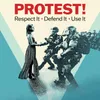
Protest works, but it needs your help now more than ever, veteran activists say
"We are experiencing what some people call sort of a shutdown of the public square in the United States and around the world," says veteran environmental activist André Carothers. Along with the former executive director of Greenpeace US, Annie Leonard, the two have co-authored a new book about the history of protest, why it works, and why it's under attack. Protest: Respect It. Defend It. Use It. was written to "remind readers about the role protests played in gaining a lot of the progress that we take for granted today," Leonard says. Earth Day 1970 famously saw around 10% of the U.S. population actively participating in one of the largest demonstrations in the nation's history. This led to a number of landmark environmental laws that are arguably taken for granted today. Protest highlights how movements begin, and ultimately shape public discourse leading to these significant victories. The authors also highlight how some in society often lionize protest movements of the past, while condemning ones of the present, forgetting that at their inception, protests and the movements they represent are often unpopular. Leonard and Carothers point to Dr. Martin Luther King Jr., whose approval rating never went above 50% in all his years as a civil rights leader. His disapproval rating stood at 75% the year he was assassinated. "There's something about the gymnastics of history that allows us to honor these people well after they're dead, but not when it's happening right in front of them," Carothers says. You can find a copy of Protest: Respect It. Defend It. Use It. at theprotestbook.com. Please take a minute to let us know what you think of our podcast here. Mike DiGirolamo is the host & producer for the Mongabay Newscast based in Sydney. Find him on LinkedIn and Bluesky. Image Caption: Photographer Jonathan Bachman was a finalist for the Pulitzer Prize for capturing a photograph of Ieshia Evans being arrested in Baton Rouge, Louisiana. It was Ieshia Evans first protest, and Bachman's first time covering one. The photo was included in The New York Times' "The Year in Pictures 2016," among other honors. jonathan bachman / reuters. Shepard Fairey—a prolific artist and activist who often addresses social and political issues in his work—was invited by the authors of 'Protest' to interpret Bachman's photograph for the book. Image credit to Shepard Fairey. Image Courtesy of Patagonia Books. —- Timecodes (00:00) The attack on protesters (10:32) Combatting vilification of protesters (16:27) Amplifying messaging through art (21:05) Why non-violence works (32:04) A red line has been crossed (36:56) How students are stopping a pipeline (39:46) Earth Day 1970 (42:48) Protest is not enough
Podzilla Summary coming soon
Sign up to get notified when the full AI-powered summary is ready.
Free forever for up to 3 podcasts. No credit card required.
Listen to This Episode
More from Mongabay Newscast

The world must address pandemic threats urgently, says former CDC officer

A new Netflix documentary captures rare mountain gorilla behavior

Centering an Indigenous approach to forestry through reciprocity, not extraction

Across oceans, seabird flyways gain recognition — and a chance at protection
Get summaries like this every morning.
Free AI-powered recaps of Mongabay Newscast and your other favorite podcasts, delivered to your inbox.
Free forever for up to 3 podcasts. No credit card required.