Free Daily Podcast Summary
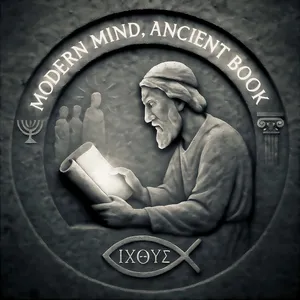
Modern Mind, Ancient Book: Daily Summaries Delivered
by Roger Ferguson, Host and Biblical Scholar
Modern Mind, Ancient Book explores the Bible through its ancient Jewish context, helping modern believers rediscover the faith Jesus lived and taught — The Way. Modern Mind, Ancient Book is a Bible teaching ministry dedicated to restoring historical depth, theological clarity, and spiritual formation to the Christian faith. We study Scripture as Jesus and the early believers understood it — rooted in the Torah, the Prophets, the Writings, and fulfilled in Rabbi Jesus. 📖 What you’ll find here: • Verse-by-verse Bible teaching • Jewish historical context • The life and teachings of Jesus • Early church history • Faithful, thoughtful Christian discipleship This podcast is for seekers, believers, and teachers who want more than surface-level faith.
Latest Episodes
The most recent episodes — sign up to get AI-powered summaries of each one.
- 2 days ago9 min
The Fast Is Not the Point: Yom Kippur and Jesus — with an Original Song
The fast is not the point by itself. What does Scripture actually ask on Yom Kippur, and how did Jewish tradition give that humbling a communal form? Roger Ferguson opens Leviticus 16 and Leviticus 23:26–32, follows Isaiah 58 and Mishnah Yoma into truth and responsible repair, and then lets Hebrews 9–10 make its own priestly argument toward Jesus the Messiah. Along the way, he distinguishes Torah from later practice, protects health and wise boundaries, and offers a simple way to enter the Day of Atonement as a learner.Then stay for The Jesus We Want Them to Know, an original country-gospel duet from Modern Mind, Ancient Book. Its visual story moves from creation through covenant, Torah and the Prophets, the cross, Jesus walking from the grave, and a family praying together before bedtime. It invites families to open the Book, meet Rabbi Jesus inside Israel's story, practice forgiveness, and walk the Way together.Yom Kippur 5787 begins Sunday, September 20 at sundown and ends Monday, September 21 at nightfall under the commonly used Diaspora calendar.Chapters:00:00 The Fast Is Not the Point05:53 The Jesus We Want Them to Know — Original SongOur people celebrate this way. Come join us to remember and receive mercy.Continue exploring the Bible's ancient holidays with Modern Mind, Ancient Book. Join our email newsletter for thoughtful Bible teachings and practical holiday resources when there is something worth sharing: https://modernmindancientbook.org/newsletter/?utm_source=podcast&utm_medium=audio&utm_campaign=newsletter_always_on&utm_content=T2-BHF-YKP-2026-ANTHOLOGY-01#YomKippur #DayOfAtonement #BiblicalHolidays
- 2 days ago1h 5m
Before the Sun: Spirit, Speech, and Light | Genesis 1:1–5
What do the first five verses of Genesis say about God's Spirit, speech and light? Roger Ferguson and Yu Song begin reading the Torah together, comparing Jewish and Christian interpretations and following the language of creation into John 1.In Parashat, Yu joins Roger as a fellow learner, with room for questions and disagreement.Roger's connections involving early creator belief, Egypt, Moses and Jethro are interpretive opinions—not settled historical conclusions or views Yu must share. We present different readings so you can examine the sources and decide. Modern Mind, Ancient Book is for Jesus.SOURCE NOTESGenesis 1:1–5: https://www.sefaria.org/Genesis.1.1-5?lang=biAlso discussed: Isaiah 11:1–2; John 1:1–5; 2 Corinthians 4:6.Genesis Rabbah 2:4 connects the Spirit with the messianic king, without identifying him as Jesus:https://www.sefaria.org/Bereshit_Rabbah.2.4?lang=biCompiled around the fifth century AD; this alone does not prove what Jesus or Paul knew:https://www.mohrsiebeck.com/en/book/genesis-rabbah-in-text-and-context-9783161547034/The proposed Ubaid creator-belief sequence is Roger's hypothesis, not established by this archaeological overview:https://www.metmuseum.org/essays/the-ubaid-period-5500-4000-b-cThe bull comparison concerns Apis, associated with Ptah at Memphis; Ptah's usual image is mummiform. A link to the golden calf remains an interpretation:https://www.metmuseum.org/art/collection/search/570663https://www.metmuseum.org/art/collection/search/570745Theophilus argued for creation from nothing in the second century AD (To Autolycus II.4, II.10), distinct from what Hebrew grammar alone establishes:https://www.newadvent.org/fathers/02042.htmSonoluminescence illustrates wonder, not a proven Genesis mechanism. Laboratory ultrasound is not ordinary speech; salt water is one medium and temperatures depend on conditions:https://suslick.scs.illinois.edu/documents/marinechem.1992.pdfhttps://suslick.scs.illinois.edu/documents/nature.030205.pdfContinue exploring Scripture with thoughtful teachings and resources in our email newsletter:https://modernmindancientbook.org/newsletter/?utm_source=podcast&utm_medium=audio&utm_campaign=newsletter_always_on&utm_content=parashat-e02-genesis-1-1-5Find the Way—Meet Rabbi Jesus.Walk the Way — Modern Mind, Ancient Book.#Genesis #TorahStudy #BibleStudy
- 3 days ago38 min
Babylon, Exile, Persia, and Return
What happens to faith when Jerusalem falls, the temple burns, and God's peoplemust build their lives under another empire's sky?This episode follows Judah from Babylon's rise and Jerusalem's captures in 597and 586 BC through exile, Persia's conquest of Babylon, return, templerebuilding, and the later work of Ezra and Nehemiah. Biblical history appearsbeside the Babylonian Chronicle, Jehoiachin's ration records, Babylonian civicand religious culture, and the Cyrus Cylinder—with each source identified byits own genre and limits.Jeremiah teaches displaced families to build, plant, pray, seek the city's good,and hope patiently. Ezekiel sees the LORD's glory in Babylon and promises a newheart and the Spirit. Daniel models faithful presence without surrender toidolatry. Ezra records a real return where joy and grief sound together. Haggaiand Zechariah reveal why temple and wall could not complete every promise.The historical return was real, but the prophetic hope was larger: forgivensin, transformed hearts, God's indwelling Spirit, the humble King, and peace tothe nations. Matthew, Mark, and Luke carry that exile-and-return hope to RabbiJesus and the new covenant in His blood.## Scripture in this episode2 Kings 24:10–16; 2 Kings 25:8–12; Psalm 137:1–4; Jeremiah 29:4–7,10–14; Jeremiah 31:31–34; Ezekiel 11:16–20; Ezekiel 36:24–28;Ezra 1:1–5; Ezra 3:10–13; Haggai 2:3–9; Zechariah 9:9–10;Isaiah 40:1–5; Matthew 1:17; Mark 1:1–3; Luke 4:18–21; Luke 22:20.Scripture quotations are from the Berean Standard Bible, third printing.## Historical world explored- Babylon's rise, Jerusalem's fall, deportation, and continued Judean life- Jeremiah, Lamentations, Ezekiel, Daniel, Isaiah, and exilic Psalms- The Babylonian Chronicle and Jehoiachin ration tablets- Cyrus, Persian restoration policy, and the Cyrus Cylinder's proper limits- Ezra, Nehemiah, Esther, Haggai, Zechariah, and Malachi in the Persian world- The difference between return to the land and completed restoration- The road from exile-shaped hope to Rabbi JesusGenerated historical scenes in the video and artwork will be visibly disclosedas artistic reconstructions. They illustrate the teaching and are not presentedas photographs of particular people, events, or artifacts.Public references include the[British Museum Cyrus Cylinder record](https://www.britishmuseum.org/collection/object/W_1880-0617-1941),the [Metropolitan Museum of Art's Cyrus Cylinder overview](https://www.metmuseum.org/exhibitions/listings/2013/cyrus-cylinder),the [Met's discussion of Cyrus and the Judean diaspora](https://www.metmuseum.org/de/perspectives/cyrus-and-the-judean-diaspora),and the [ABC 5 Jerusalem Chronicle dossier](https://www.livius.org/sources/content/mesopotamian-chronicles-content/abc-5-jerusalem-chronicle/).Find the Way—Meet Rabbi Jesus.Walk the Way — Modern Mind, Ancient Book.
- 5 days ago19 min
Leviticus Explained: Holiness, Sacrifice, and Life with God
Leviticus begins where Exodus leaves Israel: the tabernacle stands, the Creator's glory fills it, and a redeemed people must learn how to approach the holy God who now dwells among them. Roger Ferguson surveys the book's offerings, priesthood, atonement, appointed times, neighbor-love, justice, and whole-life holiness.This restored teaching preserves Roger's original human voice at a natural 1.20x pace, with improved audio, complete captions, and new Leviticus-specific illustrations. Three narrow legacy errors were removed without replacement narration. Leviticus 1–7 presents five major offering forms—burnt, grain, peace, sin, and guilt—and the grain offering is bloodless. Leviticus 23 names Sabbath, Passover and Unleavened Bread, Firstfruits, Weeks, Trumpets, the Day of Atonement, and Booths; it does not list Tisha B'Av, Hanukkah, or Purim.Primary new on-screen Scripture witness: Berean Standard Bible, third printing. Roger's legacy audible reading is preserved and captioned as spoken. The episode artwork is illustrative and is not presented as an archaeological reconstruction.Scripture path: Exodus 40:34–38; Leviticus 1–7; Leviticus 11:44–45; Leviticus 16; Leviticus 19; Leviticus 23; Leviticus 25–26; Matthew 22:34–40; Mark 12:28–34.Original first-party teaching: https://www.youtube.com/watch?v=Zc9y1SFUqesNext in the book-by-book journey: Survey of Numbers (planned).Find the Way—Meet Rabbi Jesus.Walk the Way — Modern Mind, Ancient Book.
- 1 weeks ago1h 11m
A Time for Everything—But Not Control | Ecclesiastes 3–5
How do we live faithfully when we cannot control the season, guarantee theoutcome, stop injustice, secure another person's loyalty, or make wealthsatisfy the soul?Ecclesiastes chapters three through five begin with the famous poem about atime for every purpose under heaven. The Teacher then follows that poem intoGod's enduring work, human limitation, corrupt judgment, oppression,friendship, worship, vows, wealth, sleeplessness, and the gift of enjoying ourlot and labor.This study explains why the time poem describes the range of human life ratherthan commanding every action; what the difficult Hebrew word olam contributesto Ecclesiastes chapter three, verse eleven; why two are better than one; howto approach God truthfully; and why possession is not the same as theGod-given capacity to enjoy. The canonical landing follows these themes towardJesus, fulfilled time, divine judgment, compassion for the oppressed, andresurrection hope.The governing truth is simple: we can act faithfully within time withoutpretending we own time.Scripture• Ecclesiastes 3:1–5:20• Mark 1:15• Matthew 5:33–37; 6:19–21• Luke 12:13–21• Acts 17:30–31• Romans 12:15• Galatians 6:2Scripture quotations use the Berean Standard Bible, third printing.Chapters• 00:00 — Modern Mind, Ancient Book opening• 00:22 — A time for everything—but not control• 13:18 — Eternity in our hearts and limited sight• 23:34 — Injustice, oppression, and tears• 30:41 — Rivalry, isolation, and companionship• 37:33 — Let your words be few• 44:35 — What money cannot give• 52:07 — Receiving enjoyment from God• 55:20 — Jesus, fulfilled time, and resurrection hope• 64:00 — Living faithfully without owning time• 70:33 — Next study and final invitation• 71:20 — Modern Mind, Ancient Book endingSources for further study• Ludwig Koehler, Walter Baumgartner, Johann Jakob Stamm, and M. E. J. Richardson, The Hebrew and Aramaic Lexicon of the Old Testament, electronic edition (Brill, 1994–2000), entry עוֹלָם, including Ecclesiastes 3:11.• Duane A. Garrett, Proverbs, Ecclesiastes, Song of Songs, New American Commentary 14 (Broadman & Holman, 1993), comments on Ecclesiastes 3:1–5:20.• Graham S. Ogden and Lynell Zogbo, A Handbook on Ecclesiastes, UBS Handbook Series (United Bible Societies, 1998), comments on Ecclesiastes 3:1–5:20, especially the time poem, the thematic question, and Ecclesiastes 3:11.These sources support specific lexical, literary, historical, and theologicalobservations. Their inclusion does not mean Modern Mind, Ancient Book adoptsevery conclusion they contain.Continue the study at https://modernmindancientbook.org/Find the Way—Meet Rabbi Jesus.Walk the Way — Modern Mind, Ancient Book.
- 1 weeks ago43 min
Two Kingdoms in the Shadow of Empires
What does a nation do when the map is shrinking, tribute is rising, and theempire at the border says resistance is useless?This episode follows Israel and Judah from the division after Solomon throughthe fall of Samaria and Sennacherib's campaign in Judah. Kings, prophets,Assyrian inscriptions, tribute monuments, siege rhetoric, loyalty oaths, andthe books written within this collective historical world appear on onetimeline.Assyria tells us how empire wanted to be seen. Scripture tells us what theseevents mean. Amos exposes prosperity without justice. Hosea names the covenantwound no empire can heal. Isaiah shows that the rod is not the hand. Hezekiahspreads the threatening letter before the living God. And the prophetic hopeleads to Rabbi Jesus: Israel's faithful Son, Bethlehem's shepherd, Galilee'slight, and the righteous King.Scripture in this episode1 Kings 12:25–33; 2 Kings 14:23–27; Amos 3:1–2; Amos 5:21–24;Hosea 5:13; Hosea 6:4–6; Hosea 11:1–11; 2 Kings 15:29–30;2 Kings 16:7–9; 2 Kings 17:5–18; 2 Kings 18:13; 2 Kings 19:14–19,32–36; Isaiah 9:1–7; Isaiah 10:5–21; Isaiah 11:1–5; Micah 5:2–5;Proverbs 25:1; Matthew 2:5–6, 15; Matthew 4:12–17; Matthew 9:13.Scripture quotations are from the Berean Standard Bible, third printing.Historical world explored• The divided kingdoms of Israel and Judah• Ahab and the 853 BC campaign at Qarqar• The Black Obelisk and Jehu's 841 BC tribute• Jeroboam II, Amos, Hosea, and northern prosperity• Tiglath-pileser III, deportation, and the fall of Samaria• Sennacherib, Lachish, Hezekiah, and Jerusalem in 701 BC• Neo-Assyrian royal inscriptions, prophetic reports, and loyalty oaths• Kings, Chronicles, Jonah, Amos, Hosea, Isaiah, Micah, Proverbs, Nahum, Zephaniah, and early Jeremiah within their collective historical settingGenerated historical scenes in the video and artwork are visibly disclosed asartistic reconstructions. They illustrate the teaching and are not presentedas photographs of particular people, events, or artifacts.Public historical references include theBritish Museum Black Obelisk record: https://www.britishmuseum.org/collection/object/W_1848-1104-1,ORACC's Black Obelisk study: https://oracc.museum.upenn.edu/nimrud/livesofobjects/blackobelisk/index.html,ORACC's overview of Israel as the House of Omri: https://build-oracc.museum.upenn.edu/saao/aebp/essentials/countries/israel/,and the RINAP corpus of Neo-Assyrian royal inscriptions: https://build.oracc.org/rinap/rinap1/corpus/.Find the Way—Meet Rabbi Jesus.Walk the Way — Modern Mind, Ancient Book.
- 1 weeks ago18 min
Exodus Explained: Redemption, Covenant, and the Presence of God
Exodus is the story of the Creator acting in history: He hears an oppressed people, remembers His covenant with Abraham, judges Egypt's false order, redeems Israel through Passover and the sea, and forms them at Sinai as a covenant people among whom He chooses to dwell. Roger Ferguson surveys the book from Moses' birth through the tabernacle, tracing redemption, covenant, vocation, holiness, and the divine name.This restored teaching preserves Roger's original human voice and conservative early-Exodus framework. It also removes a small set of objective legacy errors without replacement narration. The restoration does not claim that Exodus names Hatshepsut or Amenhotep II, does not say Moses worshiped Egyptian gods or ceased to be Hebrew, does not present YHWH as a new deity, and does not define the divine name through quantum physics or string theory. The Abrahamic and Mosaic covenants remain connected in the Creator's purpose without being collapsed into one undifferentiated covenant.Roger's audible reading of Exodus 6:6–7 uses legacy NASB-family wording. New on-screen Scripture cards use the Berean Standard Bible, third printing, and the translation boundary is disclosed rather than silently rewriting Roger's human performance.Scripture path: Genesis 15:13–16; Exodus 1–3; Exodus 6:2–8; Exodus 12–15; Exodus 19–25; Exodus 29; Exodus 40; Acts 7:20–29; 1 Kings 6:1; Judges 11:26.Original first-party teaching: https://www.youtube.com/watch?v=JBbyu2KHvTUFind the Way—Meet Rabbi Jesus.Walk the Way — Modern Mind, Ancient Book.
- 2 weeks ago38 min
What Do We Gain From All Our Work? | Ecclesiastes 1–2
Send us Fan MailWhat happens when wisdom, pleasure, success, possessions, and hard work arereal gifts—but still cannot make us permanent?In Ecclesiastes chapters one and two, the Teacher conducts a royal experiment.He tests knowledge, laughter, wine, houses, vineyards, gardens, wealth,reputation, achievement, and legacy. The experiment succeeds at acquisitionand fails at lasting gain. Then the book makes a surprising turn: food, drink,work, wisdom, knowledge, and joy may be received from the hand of God.This opening study explains the Hebrew images behind Qoheleth, hevel, andyitron; the meaning of “under the sun”; the limits of wisdom and inheritance;and the responsible canonical connection between Ecclesiastes' death boundary,Jesus' resurrection, and labor “in the Lord.”Scripture- Ecclesiastes 1:1–2:26- Genesis 2:15; 3:17–19- 1 Corinthians 15:20–28, 50–58Scripture quotations use the Berean Standard Bible, third printing.Chapters- 00:00 — Modern Mind, Ancient Book opening- 00:22 — What do we gain from all our work?- 03:15 — The Teacher, Solomon, and the book- 08:30 — Generations, cycles, and life under the sun- 12:25 — Wisdom reveals what is crooked- 16:11 — The royal experiment — Ecclesiastes 2:1–11- 21:26 — Wisdom is light, but it is not resurrection- 24:41 — Work, inheritance, grief, and sleeplessness- 28:21 — Receiving enjoyment from the hand of God- 32:17 — Jesus, resurrection, and labor in the Lord- 37:08 — Next study and the final invitation- 38:00 — Modern Mind, Ancient Book endingSources for further study- Ludwig Koehler, Walter Baumgartner, Johann Jakob Stamm, and M. E. J. Richardson, The Hebrew and Aramaic Lexicon of the Old Testament, electronic edition (Brill, 1994–2000), entry I הֶבֶל.- Duane A. Garrett, Proverbs, Ecclesiastes, Song of Songs, New American Commentary 14 (Broadman & Holman, 1993), comments on Ecclesiastes 1:1–2:26.- Graham S. Ogden and Lynell Zogbo, A Handbook on Ecclesiastes, UBS Handbook Series (United Bible Societies, 1998), introduction and comments on Ecclesiastes 1:1–3; 2:1; 2:24–25.- Barry G. Webb, Five Festal Garments (InterVarsity Press, 2000), chapter 4.- Mishnah Yadayim 3:5: https://www.sefaria.org/Mishnah_Yadayim.3.5?lang=en and Babylonian Talmud, Shabbat 30b: https://www.sefaria.org/Shabbat.30b?lang=en preserve identifiable later Jewish reception discussions of Ecclesiastes.These sources support specific lexical, literary, historical, and canonicalobservations. Their inclusion does not mean Modern Mind, Ancient Book adoptsevery conclusion they contain.Continue the study at https://modernmindancientbook.org/Find the Way—Meet Rabbi Jesus.Walk the Way — Modern Mind, Ancient Book.Buzzsprout tagsEcclesiastes Bible study, Ecclesiastes 1, Ecclesiastes 2, meaning of hevel, life under the sun, wisdom literature, work and purpose, biblical view of success, Solomon Ecclesiastes, royal experiment, Jesus and resurrection, Modern Mind Ancient Book
Get Modern Mind, Ancient Book summaries in your inbox
Free AI-powered daily recaps. Key takeaways, quotes, and mentions — in a 5-minute read.
Get Free Summaries →Free forever for up to 3 podcasts. No credit card required.
You Might Also Like
Listeners also like.

Scripture Central
Provides research, videos, and digital resources to strengthen faith in Jesus Christ through the Book of Mormon and Restoration scripture.
The Ten Minute Bible Hour Podcast
A daily walkthrough of Bible books, covering one passage at a time in short, sequential episodes.
Unshaken Saints
A religion scholar explores scripture, doctrine, and faith crises to help strengthen belief amid cultural and spiritual change.
The Scriptures Are Real
Examines the Book of Mormon and LDS scriptures through historical, archaeological, and personal perspectives to deepen understanding and spiritual connection.

Kids Bible Stories
Bible stories for kids brought to life with sound, voice, and storytelling to connect faith with everyday life.
Renewing Your Mind
Daily Bible teaching from a Reformed Christian perspective, focusing on theology and applying Scripture to life.
Exploring My Strange Bible
Tim Mackie explores the Bible through a theological lens in this podcast.
BibleProject
Explores the Bible and theological concepts through detailed discussions that complement animated video content.

The Remnant Radio's Podcast
Explores Christian theology, church history, and spiritual gifts through respectful dialogue with believers across denominations.
Knowing Faith
Explores the Christian faith through Scripture, examining belief, practice, and biblical foundations in an accessible way.

Ask NT Wright Anything
A weekly podcast exploring theology and biblical questions through discussions with NT Wright, hosted by Mike Bird.
Bible Mysteries
Explores hidden meanings in the Bible to reveal insights about the modern world.
About Modern Mind, Ancient Book
Modern Mind, Ancient Book explores the Bible through its ancient Jewish context, helping modern believers rediscover the faith Jesus lived and taught — The Way. Modern Mind, Ancient Book is a Bible teaching ministry dedicated to restoring historical depth, theological clarity, and spiritual formation to the Christian faith. We study Scripture as Jesus and the early believers understood it — rooted in the Torah, the Prophets, the Writings, and fulfilled in Rabbi Jesus. 📖 What you’ll find here: • Verse-by-verse Bible teaching • Jewish historical context • The life and teachings of Jesus • Early church history • Faithful, thoughtful Christian discipleship This podcast is for seekers, believers, and teachers who want more than surface-level faith.
Customized Recaps
AI-powered recaps with compact key takeaways, quotes, and insights.
Straight to Your Inbox
Get key takeaways from Modern Mind, Ancient Book in a 5-minute read.
Save Hours Every Week
Stay current on your favorite podcasts without falling behind.
Frequently Asked Questions
What is Podzilla's Modern Mind, Ancient Book daily summary?
It's a free AI-powered email that summarizes new episodes of Modern Mind, Ancient Book as soon as they're published. You get the key takeaways, notable quotes, and links & mentions — all in a quick read.
How does the Modern Mind, Ancient Book podcast summary work?
When a new episode drops, our AI transcribes and analyzes it, then generates a personalized summary tailored to your interests and profession. It's delivered to your inbox every morning.
Is this an official Modern Mind, Ancient Book product?
No. Podzilla is an independent service that summarizes publicly available podcast content. We're not affiliated with or endorsed by Roger Ferguson, Host and Biblical Scholar.
Can I get summaries of other podcasts too?
Absolutely! The free plan covers up to 3 podcasts. Upgrade to Pro for 15, or Premium for 50. Browse our full catalog at /podcasts.
How often does Modern Mind, Ancient Book release new episodes?
Modern Mind, Ancient Book publishes weekly. Our AI generates a summary within hours of each new episode.
What topics does Modern Mind, Ancient Book cover?
Modern Mind, Ancient Book covers topics including Education, Religion & Spirituality, Spirituality, Christianity, Kids & Family. Our AI identifies the specific themes in each episode and highlights what matters most to you.
Start getting Modern Mind, Ancient Book summaries tomorrow morning.
Free forever for up to 3 podcasts. No credit card required.
Free forever for up to 3 podcasts. No credit card required.