Free Daily Podcast Summary
Misquoting Jesus with Bart Ehrman: Daily Summaries Delivered
by Bart Ehrman
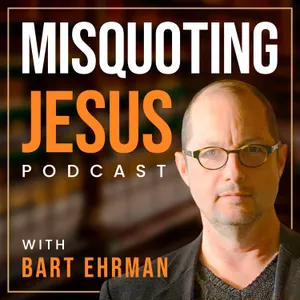
"Misquoting Jesus" uncovers the many fascinating, little known facts about the New Testament, the historical Jesus, and the rise of Christianity. The show features Dr. Bart Ehrman and host, Megan Lewis.
Latest Episodes
The most recent episodes — sign up to get AI-powered summaries of each one.
- 2 days ago46 min
Was 70 the year that changed everything?
In the summer of 70 CE, Roman legions broke into Jerusalem and burned the temple. The sacrifices that had organized Jewish worship for centuries stopped, and never started again. Everyone in the early Jesus movement lived through it or grew up in its shadow, and every Gospel in the New Testament was almost certainly written afterward. Bart joins host Megan Lewis to look at what the temple's fall did to a movement that was still a small Jewish sect: how the Gospel writers wrote about a world that no longer existed, why Judaism and Christianity both reorganized around texts once the sacrifices ended, and what it means that Christianity's founding documents were all written on the far side of a catastrophe.
- 1 weeks ago41 min
Did the Winners Write the Bible?
As early christians wrestled with their beliefs and theologies surrounding Jesus, they both produced new texts and gospels, and edited existing ones to better fit with specific theological views. What were some of these early heretical beliefs? How did the Church Fathers fight against them? And can we see traces of that battle in the manuscripts of the New Testament? Today on Misquoting Jesus, we're talking about how the New Testament was shaped by theological fights between early Christian groups.
- 2 weeks ago46 min
Did Jesus Believe in Ghosts?
The Bible's world is crowded and unsystematic: ghosts, familiar spirits, demons that cause illness, and the dead who can be summoned. And at times, this world breaks through in ways modern readers don't always appreciate. When the disciples see Jesus walking on the water, their first thought is that he's a ghost. After the resurrection, Jesus has to reassure them he isn't one. King Saul has a medium call the prophet Samuel up from the dead, and it works. So what happened to all those ghosts? Bart joins host Megan Lewis to explore the haunted world the Bible was written in, and how later Christians tidied it into a neater system of angels and demons, heaven and hell. Along the way: why demons were blamed for illness, why Jesus was accused of sorcery, and why believing in angels but not ghosts turns out to be a choice Christians made, not one the Bible made for them.
- 3 weeks ago43 min
Where Did Original Sin Come From?
Most Christians grow up believing that everyone is born a sinner, that when Adam and Eve ate the fruit, humanity inherited a broken nature and a guilt we can't escape. It's one of the most influential ideas in Western Christianity. But it isn't in Genesis, Jesus never taught it, and it didn't take its familiar form until four centuries after him. Bart joins host Megan Lewis to trace where original sin actually came from: what the Garden of Eden story says and doesn't say, what Paul meant when he wrote that sin came into the world through one man, and how Augustine turned that line into a doctrine about every human being from the moment of conception. Along the way, why Eastern Orthodox Christians never fully accepted it, and what changes when you realize this belief has a history.
- Oct 6, 202656 min
How Apologists Use (and Misuse) Manuscripts
Do manuscripts prove the Bible never changed? Some Christian apologists have argued that the Great Isaiah scroll (1QIsaa) is proof of an unchanging Bible, that it's "Word for Word" identical to the later Masoretic Text. Some have argued that P52 – a small fragment of John's gospel – shows that eyewitnesses quickly wrote down gospels. In a debate with Bart a decade back, Daniel Wallace even referenced a first century Gospel of Mark, that turned out to be a stolen manuscript that was eventually dated much later. For some modern Christians and apologists, manuscripts are "proof" of something... that the Bible is unchanging or perhaps inerrant. But can that claim hold up? In this episode, Bart unpacks what manuscripts do and don't prove, and the challenges they raise for people who want to argue for an unchanging Bible.
- Sep 29, 202641 min
Was Daniel Jesus' Favorite Book?
The Book of Daniel is set in the sixth century BCE, during the Babylonian exile. It describes visions of empires rising and falling — and for a long stretch, the sequence tracks real history with remarkable precision. Kingdom after kingdom, exactly as it happened. Then, at a certain point, it stops being right. That break is one of the most important pieces of evidence. Bart joins host Megan Lewis to explain what Daniel gets right, where it goes wrong, and why the exact point of failure tells us when the book was really written. And Bart will talk about how this book and its ideas may have shaped Jesus' thinking.
- Sep 22, 202644 min
Is The King James Bible the Worst Study Bible Ever?
The King James Bible is arguably the most influential book in the English language, and Bart thinks it's a literary masterpiece. He also thinks it's one of the worst Bibles you can study from. In this episode of Misquoting Jesus, Bart and host Megan Lewis trace where the KJV came from, starting with William Tyndale, whose translation it largely reuses and who was burned at the stake for making it. They look at why its unicorns and cockatrices trip up modern readers, and why the words you think you understand, like "conversation," "strange," and "admiration," are more misleading than the ones you don't. They cover the theological choices its translators made, the late Greek manuscripts behind its New Testament, and a 1631 printing that told readers "thou shalt commit adultery." Bart also shares which modern translations he recommends instead. In the listener Q&A: where the doctrine of original sin came from, whether early Christians evangelized door to door, and what Jesus meant about eunuchs in Matthew 19:12.
- Sep 15, 202637 min
Fixing Gospel Contradictions: 2nd Century to Now
Around 170 CE, a Syrian Christian named Tatian noticed what a lot of readers have noticed since: the four Gospels don't always agree. So he fixed it. Tatian wove all four into a single, seamless account of Jesus' life. And for roughly two hundred years, in the Syriac-speaking churches of the East, that harmony was the Gospel. Then the church came for it. Bishops collected copies and destroyed them. Tatian was condemned as a heretic. Today not a single copy survives in its original language — we know the text only through a commentary, some translations, and a sixth-century Latin Bible that still carries its shape. Bart unpacks what Tatian actually did to the Gospels, why the church found it so threatening, and what it means that an entire branch of Christianity once read a Bible we can no longer read.
Get Misquoting Jesus with Bart Ehrman summaries in your inbox
Free AI-powered daily recaps. Key takeaways, quotes, and mentions — in a 5-minute read.
Get Free Summaries →Free forever for up to 3 podcasts. No credit card required.
You Might Also Like
Listeners also like.

Data Over Dogma
A Bible scholar and an atheist podcaster examine the Bible’s content, misconceptions, and historical impact.

The Life of Jesus
A dramatized audio series retelling the life of Jesus Christ through scripture and performances by a cast of actors.

Ask NT Wright Anything
A weekly podcast where listeners submit questions on theology and scripture for scholar NT Wright to answer, hosted by Mike Bird.

The Eric Metaxas Show
Metaxas Media
Standard of Truth
Explores Latter-Day Saint history to deepen understanding and strengthen faith, hosted by a BYU professor of Church History and Doctrine.

I Don't Have Enough FAITH to Be an ATHEIST
Examines ideas and challenges atheism from a Christian perspective.

Biblical Time Machine
Two hosts explore the historical context of biblical people, places, and events from the Old and New Testaments.

Kids Bible Stories
Bible stories for children brought to life with sound and playful voices to help them connect faith to daily life.

The Russell Moore Show
Russell Moore discusses books, culture, and ethical issues from a Christian perspective.
Ten Minute Bible Talks Devotional Bible Study
A daily devotional exploring one Bible passage with practical insights for everyday life.

I Don't Have Enough FAITH to Be an ATHEIST
Examines ideas and Christianity in relation to truth.

BibleThinker
Teaches biblical theology, apologetics, and verse-by-verse Bible studies to help listeners think biblically and defend the Christian faith.
About Misquoting Jesus with Bart Ehrman
"Misquoting Jesus" uncovers the many fascinating, little known facts about the New Testament, the historical Jesus, and the rise of Christianity. The show features Dr. Bart Ehrman and host, Megan Lewis.
Customized Recaps
AI-powered recaps with compact key takeaways, quotes, and insights.
Straight to Your Inbox
Get key takeaways from Misquoting Jesus with Bart Ehrman in a 5-minute read.
Save Hours Every Week
Stay current on your favorite podcasts without falling behind.
Frequently Asked Questions
What is Podzilla's Misquoting Jesus with Bart Ehrman daily summary?
It's a free AI-powered email that summarizes new episodes of Misquoting Jesus with Bart Ehrman as soon as they're published. You get the key takeaways, notable quotes, and links & mentions — all in a quick read.
How does the Misquoting Jesus with Bart Ehrman podcast summary work?
When a new episode drops, our AI transcribes and analyzes it, then generates a personalized summary tailored to your interests and profession. It's delivered to your inbox every morning.
Is this an official Misquoting Jesus with Bart Ehrman product?
No. Podzilla is an independent service that summarizes publicly available podcast content. We're not affiliated with or endorsed by Bart Ehrman.
Can I get summaries of other podcasts too?
Absolutely! The free plan covers up to 3 podcasts, any in the catalog. Basic raises that to 15, Pro to 40 and Max to 100. Browse our full catalog at /podcasts.
How often does Misquoting Jesus with Bart Ehrman release new episodes?
Misquoting Jesus with Bart Ehrman publishes weekly. Our AI generates a summary within hours of each new episode.
What topics does Misquoting Jesus with Bart Ehrman cover?
Misquoting Jesus with Bart Ehrman covers topics including History, Religion & Spirituality, Spirituality, Christianity. Our AI identifies the specific themes in each episode and highlights what matters most to you.
Start getting Misquoting Jesus with Bart Ehrman summaries tomorrow morning.
Free forever for up to 3 podcasts. No credit card required.
Free forever for up to 3 podcasts. No credit card required.