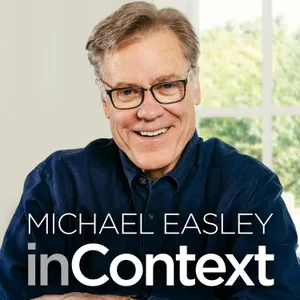
Free Daily Podcast Summary
Michael Easley inContext: Daily Summaries Delivered
by Michael Easley
Michael Easley inContext is designed to help you form a Biblical worldview through sound Biblical exposition and real-life insights.
Latest Episodes
The most recent episodes — sign up to get AI-powered summaries of each one.
- Today51 min
Abortion, Forgiveness, and Finding Healing in Christ With Victoria Robinson
Abortion can leave deep wounds long after the decision itself. Shame, grief, and the fear of judgment can keep people from seeking the healing and forgiveness found in Jesus Christ. On this episode of Michael Easley inContext, Michael sits down with Victoria Robinson, author, speaker, and founder of Reassemble Life, to discuss her personal experience with abortion and the ministry God built from her journey toward healing. Victoria shares how she spent ten years believing God could never forgive her before attending a Scripture-based abortion recovery retreat. That experience changed her life and led to more than three decades of helping women and men find freedom from abortion-related shame and grief. Michael and Victoria discuss the importance of biblical truth, the often-overlooked pain men experience after abortion, and the church's responsibility to respond with compassion rather than condemnation. Victoria also explains how recovery retreats help participants move from defining themselves by their past to embracing their identity in Christ. In this episode: -Victoria's personal story of abortion and recovery -The relationship between shame, secrecy, and spiritual healing -God's forgiveness and the promise of Romans 8:1 -Why men also need abortion recovery support -How Scripture-based retreats help people find freedom -The church's role in supporting post-abortive women and men -Finding compassionate, confidential support after abortion Chapters 00:00 — The importance of compassion and Victoria's story 02:31 — God's mercy and the loss of a child 03:40 — Victoria's journey into single motherhood 06:36 — The circumstances surrounding her abortion 09:02 — The emotional aftermath and years of shame 11:23 — Finding a path toward recovery 13:30 — The lasting effects of abortion 15:48 — Reassemble Life and the recovery retreat model 17:19 — Finding a new identity in Christ 18:00 — How Scripture brings healing 21:02 — Reaching men who carry abortion-related grief 23:12 — The need for men's abortion recovery retreats 27:44 — Creating a safe place for healing 29:39 — How the church can offer compassion 32:21 — The ongoing need for abortion recovery support 34:10 — God's forgiveness and the power of redemption 36:09 — A ministry born from personal healing 40:30 — Breaking free from secrecy and self-condemnation 44:11 — Understanding the pain men experience 46:28 — Finding help and recovery resources 47:48 — The healing power of community 49:39 — No condemnation for those in Christ 50:30 — Final encouragement and closing thoughts Links Mentioned: They Lied To Us by Victoria Robinson They Lied To Us Too by Victoria Robinson Reassemble Life website Watch the highlights and full version of this interview on our Youtube channel. For more inContext interviews, click here.
- 1 weeks ago40 min
How Should Christians Engage in Politics? With Jeff Samelson
How should Christians engage in politics without allowing political convictions to divide families, friendships, and the church? Michael Easley sits down with Jeff Samelson, author of Walk This Way, to discuss how believers can approach politics through the lens of their Christian faith. Rather than fitting Christianity into our political positions, Jeff challenges Christians to let their identity in Christ shape how they vote, engage, and respond to disagreement. They discuss political polarization, Christian nationalism, voting with integrity, Paul's Roman citizenship, and the church's responsibility to help believers think biblically about political issues. Jeff also shares his practical SEE IT / CULMET model for responding thoughtfully to difficult issues. Ultimately, Christians can hold firm convictions, love their neighbors, and engage the political world without losing sight of what matters most: our identity in Christ and confidence in God's sovereignty. In This Episode: - How Christian identity should shape political engagement - Navigating political division and broken relationships - Why Christians should resist political binaries - Christian nationalism and national identity - Paul's example of using Roman citizenship - The church's role in addressing political issues - Voting with biblical conviction and integrity - Humility, listening, and loving our neighbors - Trusting God's sovereignty amid political uncertainty Chapters: 00:00 – Introducing Jeff Samelson and Walk This Way 02:28 – Putting Politics in the Context of Christian Faith 03:35 – Understanding Political Division 05:00 – Christian Identity and Loving Our Neighbors 06:30 – Why We Need Humility in Political Conversations 08:25 – Moving Beyond Political Binaries 10:15 – Voting with Integrity 11:40 – Understanding Christian Nationalism 13:45 – Personal Identity Versus National Identity 15:00 – Paul's Roman Citizenship and Christian Engagement 17:40 – Should Churches Address Political Issues? 20:00 – Evaluating Candidates and Moral Convictions 23:40 – Political Compromise and the Pro-Life Question 25:40 – Restoring Civility in Political Conversations 27:55 – God's Sovereignty and an Eternal Perspective 30:00 – Human Nature and Political Leadership 31:40 – Humility and the Temptation of Power 34:15 – The SEE IT / CULMET Model 36:10 – Center, Assess, Learn, Measure, Implement, Trust 38:25 – Loving Others Through Political Disagreement Links Mentioned: Walk This Way by Jeff Samelson Jeff’s Website Watch the highlights and full version of this interview on our Youtube channel. For more inContext interviews, click here.
- 2 weeks ago45 min
Can We Trust The Bible? With Todd Hampson
Can we trust the Bible? From fulfilled prophecy and archaeological discoveries to ancient manuscripts and historical records, there are compelling reasons to take Scripture seriously. In this episode of Michael Easley inContext, Michael sits down with Todd Hampson, author of The Apologetics Guide to Trusting the Bible, to explore six lines of evidence supporting the reliability of God's Word. Todd explains why apologetics should be about more than winning arguments. The goal is to remove barriers to belief, strengthen Christians' confidence in Scripture, and help others consider the claims of Jesus. Together, they discuss fulfilled prophecy, the Dead Sea Scrolls, archaeological discoveries, the historical evidence for Jesus, and the Bible's remarkable unity across authors, centuries, and cultures. Whether you're a believer seeking to strengthen your faith or someone honestly examining Christianity's claims, this conversation offers an accessible introduction to the evidence for trusting the Bible. In this episode: - Why biblical apologetics should serve evangelism - Six lines of evidence for the Bible's reliability - Fulfilled prophecy and the predictions concerning Jesus - Daniel's prophecies and successive world empires - The Dead Sea Scrolls and the preservation of Scripture - Archaeological discoveries involving David, the Hittites, Jericho, and other biblical figures and places - Internal and external evidence for the Bible - How ancient manuscripts support confidence in the biblical text - What it means for Scripture to be God-breathed - Why Christians should prioritize God's Word over sensational extra-biblical texts Chapters - 00:00 — Apologetics, faith, and removing barriers to belief - 00:33 — Todd Hampson's journey into prophecy and ministry - 04:45 — What is biblical apologetics, and why does it matter? - 06:45 — Using evidence to strengthen faith and reach skeptics - 08:55 — Creation, intelligent design, and the evidence for God - 10:38 — Fulfilled prophecy as evidence for Scripture - 12:38 — The statistical significance of Jesus' fulfilled prophecies - 14:24 — Daniel's prophecies and the succession of empires - 16:52 — The Dead Sea Scrolls and the preservation of Scripture - 19:40 — Israel's dispersions and regathering in biblical prophecy - 25:50 — Archaeology and the historical reliability of the Bible - 29:47 — Biblical discoveries involving Hezekiah, Jericho, and David - 35:41 — Internal and external evidence for the Bible - 37:39 — How ancient manuscripts support biblical reliability - 41:46 — Inspiration, inerrancy, and the authority of Scripture - 43:07 — Extra-biblical texts and the sufficiency of God's Word - 44:00 — Using apologetics as a tool for evangelism Links Mentioned: Todd’s books The Apologetics Guide to Trusting The Bible by Todd Hampson Watch the highlights and full version of this interview on our Youtube channel. For more inContext interviews, click here.
- 3 weeks ago1h 0m
Can Pastors Use AI to Prepare Sermons? With Dr. Charles Boyd
Can pastors use artificial intelligence for sermon preparation without sacrificing biblical integrity, theological depth, or originality? Michael Easley welcomes Dr. Charlie Boyd for a practical conversation about using AI as a research assistant for biblical preaching. They explore the risks of outsourcing sermon preparation, the value of establishing theological boundaries, and ways AI can help pastors research Scripture more efficiently. Charlie shares his sermon preparation framework, including four essential conversations: listening to the text, listening to listeners, listening to the Spirit, and listening to Christ. He also explains how a preparation grid can help pastors develop a clear central idea, anticipate objections, incorporate application throughout a message, and evaluate their sermons. The conversation goes beyond technology to address the purpose of preaching itself. Faithful preaching is not simply about communicating information or giving people rules to follow. It connects Scripture to the redemptive work of Christ and points believers toward the Spirit-enabled transformation that comes from abiding in Him. IN THIS EPISODE -Using AI as a research assistant rather than a sermon writer -Protecting biblical integrity and theological convictions -Building a sermon preparation and evaluation grid -Developing a clear, text-driven big idea -Anticipating listener questions and resistance -Connecting biblical exposition to Christ’s redemptive work -Moving beyond external rules toward inward transformation -Practicing Scripture meditation and prayer for spiritual growth CHAPTERS 00:00 — Can Pastors Use AI for Sermon Preparation? 03:26 — The Cautions and Dangers of AI in Preaching 05:06 — Is AI Research Cheating? 07:31 — Saving Research Time to Study Scripture More Deeply 10:17 — Listening to the Text and Developing the Big Idea 14:38 — Building a Sermon Preparation Grid 17:34 — Setting Theological Boundaries for AI 20:07 — Training AI to Understand Your Preaching Approach 22:35 — Integrity, Originality, and Giving Attribution 26:18 — Using AI to Discover Biblical Connections 29:16 — How to Set Up AI for Sermon Research 32:33 — Listening to Your Congregation and Anticipating Questions 38:42 — The Gospel Pivot and Grace-Based Application 43:19 — Refining Your AI-Assisted Preparation Process 46:40 — Abiding in Christ Rather Than Just Following Rules 48:56 — Scripture, Prayer, and Transformation from the Inside Out 53:40 — Praying Scripture and Renewing Your Mind 55:45 — Growth, Discipleship, and Becoming More Like Jesus 57:09 — Using AI to Make More Time for Meditation Links Mentioned: Dr. Boyd’s AI PDF 1 Dr. Boyd’s AI PDF 2 Dr. Boyd’s AI PDF 3 Scripture on AI by John Dyer Watch the highlights and full version of this interview on our Youtube channel. For more inContext interviews, click here.
- 4 weeks ago36 min
Why Asking Better Questions Changes Everything With Dr. J.R. Briggs
What if one of the most important skills for following Jesus is something we rarely study: asking good questions? Michael Easley sits down with J.R. Briggs, author of The Art of Asking Better Questions, to explore how our questions shape our relationships, spiritual maturity, and conversations with others. J.R. explains why thoughtful questions are an expression of hospitality, how “shift responses” can turn conversations back toward ourselves, and why curiosity, wisdom, humility, and courage are essential for asking better questions. The conversation also moves into a deeper question: What do we ask God when life hurts? J.R. shares a framework for moving from “Why did this happen?” toward asking what God may be forming in us through difficulty. Most importantly, Michael and J.R. examine the questions of Jesus. Jesus asked more than 300 questions, often using questions to invite people into deeper reflection rather than simply giving them answers. If you want to become a better listener, deepen your relationships, grow in spiritual maturity, or learn to engage people with greater curiosity and humility, this conversation will give you practical ways to start. CHAPTERS 00:00 — Why We Should Study Jesus’ Questions 01:44 — Meet J.R. Briggs 03:56 — Living With Your Arrows Pointing Out 05:18 — Stop Asking Lazy Questions 06:48 — Shift Responses vs. Support Responses 08:46 — The Quality of Your Questions 09:59 — Asking Better Questions at Church 13:52 — Questions as Hospitality 15:04 — “Tell Me Your Story” 16:08 — The Connection Between Questions and Listening 17:16 — How Questions Engage the Brain 19:16 — The Questions God Asks 21:43 — Asking Better Questions in Pain 22:51 — From “Why?” to “What Is God Forming?” 25:44 — Does Spiritual Maturity Come With Age? 27:03 — What Do You Need to Unlearn? 30:21 — Wisdom Revealed Through Questions 31:20 — Studying the Questions of Jesus 34:01 — Questions That Keep Working After the Conversation 34:41 — The Art of Asking Better Questions KEY TOPICS • Asking better questions • Jesus’ questions • Listening well • Curiosity, wisdom, humility, and courage • Questions and spiritual maturity • Faith in seasons of suffering • Discipleship and community • Hospitality through conversation • Learning, unlearning, and relearning • Loving others by keeping our “arrows pointing out” Links Mentioned: The Art of Asking Better Questions by Dr. J.R. Briggs Dr. Briggs’ website Watch the highlights and full version of this interview on our Youtube channel. For more inContext interviews, click here.
- Oct 13, 202635 min
The Biblical Reason You Need Sleep With Brett McCracken
What does sleep have to do with trusting God? Michael Easley sits down with Brett McCracken, author of The Wisdom of Sleep, to explore why God designed us to sleep, what rest reveals about our dependence on Him, and how our technology-driven culture has changed the way we work and rest. Sleep reminds us that we are creatures, not the Creator. We cannot always be working, producing, watching, or striving. At some point, we have to stop—and trust that God continues to provide while we rest. Brett and Michael discuss the biblical wisdom of Psalm 127, the connection between sleep and Sabbath, the impact of phones and screens on rest, the dangers of blurred work-life boundaries, and why receiving sleep can point us toward the gospel of grace. In a culture marked by anxiety and exhaustion, learning to rest may become a powerful way to live differently. Key Topics Covered: - Why God designed us to sleep - Sleep as a reminder of our limitations - Psalm 127 and anxious toil - Rest and trusting God's provision - Technology and disrupted sleep - Work, productivity, and boundaries - Sleep, Sabbath, and God's abundance - Sleep as a picture of grace - Becoming a countercultural witness through rest Chapters: 00:00 — Welcome & The Wisdom of Sleep 02:23 — Why Talk About Sleep? 04:13 — Why Did God Design Us to Sleep? 06:35 — Sleep as a Reminder That We Are Creatures 08:34 — Is Sleep a Spiritual Discipline? 10:18 — Psalm 127 and Trusting God's Provision 11:21 — Why We Resist Rest 13:02 — How Sleep Affects Our Relationships 16:22 — Technology, Work, and Modern Rest 17:19 — How Screens Disrupt Sleep 20:07 — When Work Follows You Home 21:21 — Sleep as the “Chief Nourisher” 23:46 — Sleep, Resurrection, and the Gospel 24:43 — The Grace We Receive in Sleep 27:11 — Learning to Live Within God's Limits 30:04 — Sleep, Sabbath, and God's Abundance 32:21 — Becoming a Rested, Countercultural Witness 34:45 — Closing Thoughts Links Mentioned: Brett’s Website The Wisdom of Sleep by Brett McCracken
- Oct 6, 202648 min
How to Finish Strong in Every Season of Life With Ed Hatch
What happens when the role that once defined you suddenly changes? Michael Easley sits down with Ed Hatch, author of The Caleb Challenge, to discuss 9/11, military service, retirement, suffering, leadership, legacy, and what it means to finish strong. Ed's experience in the military—including being at the Pentagon on September 11, 2001—forced him to reconsider what mattered most. That experience eventually shaped his understanding of transition and his work helping others navigate major changes in life. Drawing from the life of Caleb, Ed describes transition as a process of release, refine, and re-enter. The wilderness wasn't wasted time. It was preparation. Michael and Ed also discuss why retirement should not mean retiring from God's purposes, how suffering shapes us, and why our legacy should focus on equipping others to continue the mission. Key Topics -The impact of 9/11 -Military service and transition -Retirement and purpose -Caleb's example of perseverance -Release, refine, and re-enter -Suffering and spiritual growth -Leadership and legacy -Finishing strong -Living for the line rather than the dot Chapters 00:00 – Introduction and the 9/11 connection 02:35 – Ed's experience at the Pentagon on 9/11 06:19 – How 9/11 recalibrated what mattered 08:59 – Why Ed wrote The Caleb Challenge 12:43 – Change versus transition 13:45 – Caleb and finding God's purpose 16:08 – Release, refine, and re-enter 18:03 – Purpose beyond retirement 23:09 – Why transitions are difficult 23:59 – Suffering and spiritual transformation 29:58 – Navigating transition with biblical principles 32:55 – Love, live, lead, and leave a legacy 37:45 – Leading worthy and finishing strong 42:16 – Retirement isn't simply another job transfer 45:18 – The wilderness wasn't wasted time 49:08 – Living for the line, not the dot 50:42 – Final thoughts on The Caleb Challenge Links Mentioned: The Caleb Challenge by Ed Hatch Watch the highlights and full version of this interview on our Youtube channel. For more inContext interviews, click here.
- Sep 29, 202638 min
The Best Possible Life With Jim Murphy
What if the life you’re working so hard to build isn’t actually the life you want? Jim Murphy, author of The Best Possible Life, joins Michael Easley for a wide-ranging conversation about achievement, suffering, joy, purpose, unconditional love, and what it means to live fully. Jim draws from his experience as a professional baseball player, coach, and mentor to high-performing athletes and leaders. He explains why achievement can become a substitute for identity, why we cannot always trust our feelings, and why suffering and difficulty can play an important role in developing wisdom, courage, and strength. Michael and Jim also discuss parenting, retirement, the pressure to perform, being present, gratitude, and the challenge of mastering the ego. Chapters 00:00 — Why difficulty is necessary for growth 00:37 — Jim Murphy’s story and the road to The Best Possible Life 01:24 — From professional baseball to a crisis of identity 02:54 — The three worlds model 05:32 — Achievement, identity, and the need for love 07:17 — Why success can leave us empty 09:47 — Purpose, sacrificial love, and joy 11:18 — Happiness vs. joy 13:37 — Trusting God when we are uncertain 14:49 — What unconditional love really means 16:33 — Why you can’t always follow your heart 18:03 — Feelings versus truth 19:01 — Parenting, grit, and doing hard things 21:19 — When achievement doesn’t bring happiness 22:28 — The role of suffering in growth 24:12 — The hidden struggles of high achievers 26:16 — Growth through suffering 26:41 — Four daily goals 29:02 — Learning to live in the present 30:10 — Letting go of achievement 32:07 — What people really want 34:54 — Mastering the ego 36:23 — Learning through pain and experience Key topics covered • Achievement and identity • The pursuit of success • Unconditional love • Happiness vs. joy • Sacrificial love • Suffering and spiritual growth • Parenting and grit • Purpose and retirement • Presence and gratitude • High performance • Mastering the ego • Love, wisdom, and courage Links Mentioned: Inner Excellence website The Best Possible Life by Jim Murphy The Inner Excellence 90 Day Challenge Watch the highlights and full version of this interview on our Youtube channel. For more inContext interviews, click here.
Get Michael Easley inContext summaries in your inbox
Free AI-powered daily recaps. Key takeaways, quotes, and mentions — in a 5-minute read.
Get Free Summaries →Free forever for up to 3 podcasts. No credit card required.
You Might Also Like
Listeners also like.

The Esau McCaulley Podcast
A theologian and guests explore the spiritual and cultural themes in movies, music, news, and politics with insight and humor.

The Christian Outlook | Full Interviews
Salem Podcast Network

BibleThinker
Teaches biblical theology, apologetics, and verse-by-verse Bible studies to help listeners think biblically and defend the Christian faith.

Breakpoint
Daily analysis of culture, politics, and media from a Christian worldview perspective.

Culture & Christianity: The Allen Jackson Podcast
Explores contemporary cultural issues through a Christian worldview, offering biblical insights for everyday life.

The Russell Moore Show
Russell Moore discusses books, culture, and ethical issues from a Christian perspective.

Ask NT Wright Anything
A weekly podcast where listeners submit questions on theology and scripture for scholar NT Wright to answer, hosted by Mike Bird.
The BEMA Podcast
Examines the Bible through historical context to challenge and reshape common interpretations.
Ed Newton Daily Devotional Podcast
A daily devotional exploring one Bible verse and applying it to life’s challenges, doubts, and God’s purpose for the day.

Complexified
Explores how religion and politics intersect with everyday life to uncover hidden histories and envision paths for social change.

Elevation with Steven Furtick
Sermons and teachings from Pastor Steven Furtick and Elevation Church.

The Eric Metaxas Show
Metaxas Media
About Michael Easley inContext
Michael Easley inContext is designed to help you form a Biblical worldview through sound Biblical exposition and real-life insights.
Customized Recaps
AI-powered recaps with compact key takeaways, quotes, and insights.
Straight to Your Inbox
Get key takeaways from Michael Easley inContext in a 5-minute read.
Save Hours Every Week
Stay current on your favorite podcasts without falling behind.
Frequently Asked Questions
What is Podzilla's Michael Easley inContext daily summary?
It's a free AI-powered email that summarizes new episodes of Michael Easley inContext as soon as they're published. You get the key takeaways, notable quotes, and links & mentions — all in a quick read.
How does the Michael Easley inContext podcast summary work?
When a new episode drops, our AI transcribes and analyzes it, then generates a personalized summary tailored to your interests and profession. It's delivered to your inbox every morning.
Is this an official Michael Easley inContext product?
No. Podzilla is an independent service that summarizes publicly available podcast content. We're not affiliated with or endorsed by Michael Easley.
Can I get summaries of other podcasts too?
Absolutely! The free plan covers up to 3 podcasts, any in the catalog. Basic raises that to 15, Pro to 40 and Max to 100. Browse our full catalog at /podcasts.
What topics does Michael Easley inContext cover?
Michael Easley inContext covers topics including Religion & Spirituality, Spirituality, Christianity. Our AI identifies the specific themes in each episode and highlights what matters most to you.
Start getting Michael Easley inContext summaries tomorrow morning.
Free forever for up to 3 podcasts. No credit card required.
Free forever for up to 3 podcasts. No credit card required.