Free Daily Podcast Summary
Message from the Minbar: Daily Summaries Delivered
by Hanbali Disciples
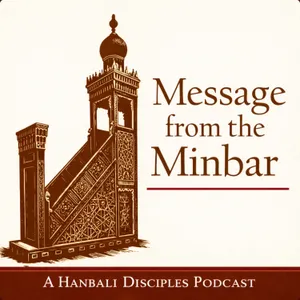
Message from the Minbar presents Friday sermons and post-sermon reflections rooted in the Hanbali tradition of Islamic scholarship. Each episode offers guidance drawn from the Qur’an, the Sunnah, and the teachings of the classical scholars, addressing the spiritual and moral challenges of everyday life. These messages are delivered from the mosque pulpit and offered as reminders for strengthening faith, refining character, and cultivating presence of heart in worship.
Latest Episodes
The most recent episodes — sign up to get AI-powered summaries of each one.
- 3 weeks ago16 min
Knowing Allah
In the second sermon of Unsteady: Strengthening the Foundations of Life with Allah, we turn to another essential foundation: knowing Allah. We explore what Allah has revealed about Himself, His knowledge of all things, His power and authority, His promises and warnings, and His mercy. The more we come to know Allah, the more we understand why we should trust Him, turn to Him in our struggles, and seek His pleasure in everything we do.But knowing Allah is more than learning about His Names and Attributes. This sermon explores how that knowledge becomes firmly established in our hearts through certainty and action, leading us toward watchful awareness (murāqabah). We learn how remembering Allah can shape our thoughts, correct our intentions, and guide our choices before we act. Through practice, this awareness becomes part of who we are, helping us live according to what we know about Him.Preserve the Tradition. Become a Patron.https://www.hanbalidisciples.com/patrons
- Oct 2, 202622 min
Where Steadiness Begins
In the opening sermon of Unsteady: Strengthening the Foundations of Life with Allah, we begin with a simple question: what keeps our life with Allah steady when our feelings, circumstances, and motivation begin to change? The Qurʾān calls us to steadfastness, but steadfastness does not appear on its own. It has to be built upon foundations strong enough to hold us in place when life becomes difficult.This sermon explores the first of those foundations: spiritual striving (mujāhadah). We look at how striving trains the self, exposes what still needs to be corrected, and leads us into honest self-examination (muḥāsabah). From there, the path turns toward watchful awareness of Allah (murāqabah), learning to live with the knowledge that He sees us, knows us, and is present to every part of our journey. This is where steadiness begins.Preserve the Tradition. Become a Patron.https://www.hanbalidisciples.com/patrons
- Oct 2, 202623 min
Those Under Our Roof
The eighth sermon in the series Estranged: Joining Creation as God’s Servant.Having returned to the ordinary appetites of life, we now return to the place where spiritual formation is tested most intimately: the home. What happens when Allah has taught us to need less, endure more, worship more seriously, or detach from things that once occupied us, but the people under our roof have not been brought to the same place? In this sermon, we consider the danger of making our families carry the weight of our spiritual development, and the responsibility to remove ourselves from the center without abandoning the trusts Allah has placed in our hands. Through the encounter between Salmān and Abū al-Dardāʾ, we see that devotion to Allah cannot consume the rights Allah Himself has given to others.The sermon then turns the gaze inward. When a spouse or child disappoints us, their conduct may sometimes expose something we have learned not to see in ourselves. Yet self-examination does not make us sovereign over another person’s heart. We are responsible for how we lead, teach, correct, provide, and cultivate, but guidance belongs to Allah. Our task is to form a household directed toward Him while preparing those within it to live responsibly in the world. The clearest sign that the path has truly brought us home is that those under our roof are the first to taste the fruits of what Allah has cultivated within us.Produced by Hanbali Disciples.Preserve the Tradition. Become a Patron.https://www.hanbalidisciples.com/patrons
- Sep 25, 202624 min
Back at the Table
The seventh sermon in the series Estranged: Joining Creation as God's Servant.Having learned that what reaches us through another person’s hand does not begin there, we now turn to one of the most ordinary forms of provision we receive: food. A meal may appear simple, but the table quickly reveals what appetite has learned to expect from us. Do we have to reach first, secure what we prefer, or allow our own satisfaction to set the pace for everyone around us? What seems too small to matter may expose whether the self has truly learned that it is no longer the center of the room.In this sermon, we explore how appetite can narrow our attention until the people beside us begin to disappear, how even refusing hospitality can become another way of centering ourselves, and why our conduct should change according to who shares the table with us—with the wealthy, dignity; with the poor, preference; and with our brothers, ease. We then turn inward to a subtler form of appetite: the way anticipated pleasures can occupy us before they ever arrive, pulling us away from what Allah has placed before us now. The path is neither to chase what has not been given nor to reject what has. It is to receive what Allah provides, enjoy it with gratitude, and remain at the table fully present with those beside us while the heart remains directed toward His greatness.Produced by Hanbali Disciples.Preserve the Tradition. Become a Patron.https://www.hanbalidisciples.com/patrons
- Sep 12, 202625 min
Through the Hand of Another
The sixth sermon in the series Estranged: Joining Creation as God's Servant.Having learned to recognize our own faqr, we now face the question that naturally follows: when our need becomes practical and something we require appears to rest in another person’s hands, toward whom does our poverty actually turn?In this sermon, we explore the adab of asking and receiving from creation without mistaking creation for the Source. Need has a measure. We can become too quick to place ordinary burdens upon others, just as we can become so protective of our independence that we refuse to ask even when help is appropriate. The goal is neither habitual dependence nor radical self-sufficiency, but a truthful relationship with need in which we remain capable of asking, receiving, and depending upon one another without allowing the heart to lose its direction toward Allah.The sermon then turns to the image of the treasurer. Another person may genuinely possess what we need, but what rests in the hand does not make the hand its ultimate owner. The Prophet Muḥammad ﷺ expressed this order with remarkable clarity: “I am only a distributor, and Allah is the One who gives.” Even as Allah caused immeasurable mercy and guidance to flow through His Messenger ﷺ, the Prophet never confused the means with the Source. In the same way, we learn to thank those through whose hands Allah provides without becoming servile before them, and without becoming so spiritually detached that we fail to acknowledge the human kindness Allah chose to use.Finally, we consider what happens when the hand remains closed. A refusal can expose where our hope had quietly settled, especially when disappointment turns into resentment toward someone who was never the owner of what we sought. Allah reminds us that whatever mercy He opens, none can withhold, and whatever He withholds, none can release after Him. The closed hand therefore does not mean the treasury is empty. Whether provision reaches us through one hand or another, the heart no longer has to decide beforehand which hand Allah must use.The sermon concludes at the door of al-Muʿṭī, the Giver. We can need one another without making one another lords, receive without becoming owned by the gift, and give without imagining that what passes through our hands began with us. We thought we were waiting at someone else’s door, but every door was His, every treasury was His, and every hand belonged to one of His servants.Produced by Hanbali Disciples.Preserve the Tradition. Become a Patron.https://www.hanbalidisciples.com/patrons
- Sep 5, 202622 min
Protecting Poverty
The fifth sermon in the series Estranged: Joining Creation as God's Servant.Having learned to recognize the dignity of another person’s need, we now turn the mirror toward ourselves. What happens when we spend so much of our lives learning how not to need that dependence itself begins to feel like a problem we have solved?In this sermon, we explore the meaning of faqr: not material deprivation, but the servant’s unchanging dependence upon Allah. Wealth, stability, competence, planning, and provision do not necessarily threaten that poverty. The danger begins when what fills the hand persuades the heart that it has become sufficient. As comfort increases, pleasures become expectations, expectations become necessities, and we may gradually construct lives in which need rarely has enough time to remind us what we are.The test becomes sharper when obedience threatens something we have come to believe we cannot live without. We may begin searching for religious permission only after the desire has already decided what must be preserved. What began as provision becomes reassurance, and the self quietly returns to the center, asking religion to protect it from having to surrender.The sermon concludes with the reminder that ultimately strips every illusion of sufficiency away: death. The salary ends, the position passes, the house remains, the plans stop, and even the body is left behind. Everything upon the earth will perish, while Allah remains, al-Ghanī, the One free of all need. And before Him, we stand exactly as we always were: poor.Produced by Hanbali Disciples.Preserve the Tradition. Become a Patron.https://www.hanbalidisciples.com/patrons
- Aug 28, 202620 min
The Honor of Need
The fourth sermon in the series Estranged: Joining Creation as God's Servant.Having learned not to let wealth enlarge another person in our sight, we now face the opposite test: what happens when another person’s need tempts us to make them small? We may believe deeply in charity while still arranging our lives so that poverty remains at a distance, allowing us to give without ever truly knowing the people who need us.In this sermon, we explore the hidden cost of asking, the dignity that can be lost when need must be repeatedly explained, and the responsibility to notice before another person is forced to disclose what they would rather carry quietly. We consider how generosity itself can become another form of injury when accompanied by irritation, judgment, reminders, or the expectation that hardship should quickly disappear once we have helped.The sermon then turns the encounter inward. The person who is poor of hand may be rich of heart, while the person whose hand is full may remain deeply poor within. Allah makes some of us a trial for others: one of us may be tested through having to ask, while another is tested through what happens in the heart when someone asks.The poor person may therefore be holding a mirror before us. If need does not strip a person of dignity, why do we keep our distance from those whose need reminds us of our own?Produced by Hanbali Disciples.Preserve the Tradition. Become a Patron.https://www.hanbalidisciples.com/patrons
- Aug 27, 202620 min
In the Presence of Wealth
The third sermon in the series Estranged: Joining Creation as God's Servant.Having learned how to return among those who do not share the same spiritual formation, we now turn toward another reality we inevitably encounter in the world: wealth, and those who possess it. The spiritually formed servant does not return to a world emptied of material abundance, status, influence, or access. He returns to a world still shaped by possession, where some have little and others have much. How do we remain in the presence of wealth without allowing it to distort our sight, bend our course, or alter the way we stand before those who possess it?In this sermon, we explore how wealth can begin to resemble independence, how the apparent weight of possession can transfer to the person holding it, and how the heart can slowly enter another person's orbit before anything has ever been asked or promised. Drawing upon the imagery of gravity, orbit, light, and borrowed radiance, we consider how the glitter of worldly life can captivate the eye, enlarge the wealthy in our estimation, and quietly diminish us before them. The servant learns to resist this pull through dignity, cutting off covetousness, severing hope from what is in the hands of creation, and refusing to give another servant a dwelling place within the heart.But freedom from wealth carries its own danger. The one who is no longer impressed by possession may begin to become impressed with his own detachment from it. Spiritual poverty can harden into distance, disdain, and superiority if the wealthy are no longer seen in their proper proportion. The sermon therefore turns inward, showing that the wealthy and the spiritually poor each carry their own discipline: one must loosen the hand through generosity, while the other must empty the heart of false dependence.Ultimately, the question is not whether we will live with need, but where that need will finally come to rest. The servant remains faqīr, and Allah alone is al-Ghanī. When the heart remembers where its poverty belongs, wealth may remain in the world without determining our course.Produced by Hanbali Disciples.Preserve the Tradition. Become a Patron.https://www.hanbalidisciples.com/patrons
Get Message from the Minbar summaries in your inbox
Free AI-powered daily recaps. Key takeaways, quotes, and mentions — in a 5-minute read.
Get Free Summaries →Free forever for up to 3 podcasts. No credit card required.
You Might Also Like
Listeners also like.

Quran For Busy People: Weekly insights into the simple beauty and spiritual depth of Islam – from the inside-out
Weekly insights into Islamic spirituality and teachings, featuring discussions and expert interviews on faith and personal growth.
Ahmad Taleb Hameed
Muslim Central

Sheikh Ali Jaber | القارئ علي جابر
علي جابر - Ali Jaber

On the Other Hand: Ten Minutes of Torah
ReformJudaism.org

Khalid Yasin
Muslim Central
Stories of the Prophets
General Iq

The Hereafter
Anwar al-Awlaki

Tehilim by Meaningful Minute
Meaningful Minute

Abiding Together
A podcast for women seeking to grow in their faith and live out their purpose in Christ.

BYU Speeches
BYU Speeches

Once Upon A Crescent: Muslim Kids Podcast
Islamic bedtime stories for children that teach moral lessons through gentle, engaging tales.
Ahmed Deedat
Lectures and debates by Islamic scholar Ahmed Deedat on faith, religion, and interfaith dialogue.
About Message from the Minbar
Message from the Minbar presents Friday sermons and post-sermon reflections rooted in the Hanbali tradition of Islamic scholarship. Each episode offers guidance drawn from the Qur’an, the Sunnah, and the teachings of the classical scholars, addressing the spiritual and moral challenges of everyday life. These messages are delivered from the mosque pulpit and offered as reminders for strengthening faith, refining character, and cultivating presence of heart in worship.
Customized Recaps
AI-powered recaps with compact key takeaways, quotes, and insights.
Straight to Your Inbox
Get key takeaways from Message from the Minbar in a 5-minute read.
Save Hours Every Week
Stay current on your favorite podcasts without falling behind.
Frequently Asked Questions
What is Podzilla's Message from the Minbar daily summary?
It's a free AI-powered email that summarizes new episodes of Message from the Minbar as soon as they're published. You get the key takeaways, notable quotes, and links & mentions — all in a quick read.
How does the Message from the Minbar podcast summary work?
When a new episode drops, our AI transcribes and analyzes it, then generates a personalized summary tailored to your interests and profession. It's delivered to your inbox every morning.
Is this an official Message from the Minbar product?
No. Podzilla is an independent service that summarizes publicly available podcast content. We're not affiliated with or endorsed by Hanbali Disciples.
Can I get summaries of other podcasts too?
Absolutely! The free plan covers up to 3 podcasts, any in the catalog. Basic raises that to 15, Pro to 40 and Max to 100. Browse our full catalog at /podcasts.
How often does Message from the Minbar release new episodes?
Message from the Minbar publishes weekly. Our AI generates a summary within hours of each new episode.
What topics does Message from the Minbar cover?
Message from the Minbar covers topics including Religion & Spirituality, Spirituality, Islam. Our AI identifies the specific themes in each episode and highlights what matters most to you.
Start getting Message from the Minbar summaries tomorrow morning.
Free forever for up to 3 podcasts. No credit card required.
Free forever for up to 3 podcasts. No credit card required.