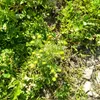
The spiritual life of home and place shifts with the seasons for me. As my Thank-You gift to all of you who have come alongside me for the past two years of Flash💥Devos, I offer my article about the world I encounter on my lawnmower, an unlikely but perfect place to connect with creation. May the ways you tend to the world bring you surprise and insight, too. Around the Yard in 100 Daysby Marianne Abel-LipschutzSpring mowing in Iowa releases the sweet pineapple aroma of chamomile. I discovered this stubborn, single stem plant in our driveway gravel, creeping improbably across compacted zones like it owns this place. Driving from one side of the lawn to mow beyond a building, I trim it so often that it barely tops my toes. Also known as Common Mayweed, this herb defies annual baths of RoundUp, subzero winters, snow plows, and herbicide spills. Green sprouts proliferate even after the grader blade shaves the gravel so flat it pools water like beach sand. Mayweed is a persistent gift that teaches me how to thrive in unlikely places.Chamomile varieties have been cultivated since the Neolithic. Commercial producers harvest a blue oil and components of the flowers and leaves for pharmaceuticals, cosmetics, and teas. One source claims that people around the world drink more than a million cups of chamomile tea daily. The tiny plant yields bioactive phytochemicals that treat ailments from hay fever and hemorrhoids to insomnia and muscle spasms. Native to northeastern Asia and northwestern US, sources say chamomile was likely brought eastward across America with the Lewis and Clark expedition as they returned to St. Louis in 1806. Rich folklore and traditional healing treatments document its spread westward from Asia.On our farm, mayweed is a wild companion, my souvenir of our history here. We bought this property from the Federal Land Bank in September 1987 and did not meet the former owners until later. Foreclosed in 1983 during the agricultural crisis, this dairy and general farm had been operated by generations of one family for almost one hundred years. Neighbors declined to buy the land, a common protest strategy, leaving the acreage to the care of renters. The property’s ragged edges showed how quickly vegetation reclaims the spaces people leave behind.We moved here in late November after most plants and shrubs had withered. I would have liked to walk around the yard with the former owners to learn what grew where. Even if we had met then, they probably would have directed my attention away from the weeds. We had never lived west of the Mississippi or on a farm, and though many common plants and trees were familiar in this northern climate zone, many were new to us. We’d come from West Virginia where eroded, hillside soils formed from decayed woodlands over rock and clay. Iowa offered a new nature with lush prairie sods and soils created by glacial drift layered over ancient marine sedimentation.Our first year here presented a calendar of outdoor surprises. Perennial onions, hyacinths, and tulips appeared after the snow melted. Rhubarb emerged like an organism coming out of hibernation. Asparagus fingers poked through like Rip Van Winkle calling out to meet the newcomers. Rangy willows waved their yellow catkins at us when we looked out the kitchen window. A solitary cherry tree by the road, exposed to harsh northwest winds for countless winters, finally exhaled some blooms after much effort. Peony fists shook in the wind along the west ditch. I would have enjoyed a crowd of white or lavender lilacs, even a few hollyhocks. It’s just as well that this place had few frills. Roses and fussy ornamentals would have perished from my neglect.I feel at home with seemingly insignificant plants like chamomile that blend in as part of the scheme of things. Pineapple Weed is another popular name for this miniature cousin of the daffodil. It sprouts above the grit with a lime-green stalk topped by a yellow, cone-shaped, button flower stuffed with potential. Thousands of its seeds weigh a fraction of an ounce, an abacus of years counting forward into the future. We notice mayweed in northeast Iowa at the beginning of June when that unmistakable sweetness rises again.The area where mayweed grows best now was the site of the property’s original house. This small, clapboard structure had been used as a garage and metal-working shop after the family moved into the big house across the driveway, built in 1924. By the time we bought the place, the shop was a multi-generational mix of wasp nests, spiders, parts, nails, oil slicks, and metal paraphernalia that outbuildings accumulate as if by magnetism. We salvaged odd tools and dimensional lumber, and bulldozed the rest to expand the driveway for maneuvering large equipment.The demolition exposed that patch of ground to daylight and rain, activating a botanical l
Podzilla Summary coming soon
Sign up to get notified when the full AI-powered summary is ready.
Free forever for up to 3 podcasts. No credit card required.
Listen to This Episode



Get summaries like this every morning.
Free AI-powered recaps of Marianne's FLASH💥DEVOS Podcast and your other favorite podcasts, delivered to your inbox.
Free forever for up to 3 podcasts. No credit card required.