Free Daily Podcast Summary
Mahabharat by Kumar Varun: Daily Summaries Delivered
by Kumar Varun
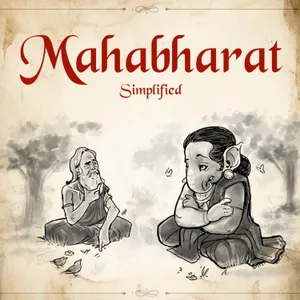
This series is a simplified retelling of the epic Indian scripture, “Mahabharata”. It is important to note that this version does not encompass the full depth, complexity, and nuances of the original text, which spans multiple volumes and contains numerous intricate storylines. The purpose of this simplified retelling is to make it easy for interested viewers to grasp the fundamental narrative and lessons that are inherent to this ancient tale. While sincere efforts have been made to remain faithful to the essence of the original epic, certain details, subplots, and cultural reference
Latest Episodes
The most recent episodes — sign up to get AI-powered summaries of each one.
- Sep 29, 20257 min
Ep.106: The Final Ascent
Narrated by Kumar VarunThe final episode of our Mahabharata series. Yudhishthira renounces the world and walks north with his brothers and Draupadi. One by one, they fall. A dog follows. What happens next is the most moving and profound chapter of the Mahabharata : a tale of loyalty, illusion, and ultimate truth.Sources, Bibliography and Suggested further readings:The Mahabharata – translated by C. RajagopalachariThe Mahabharata of Vyasa – Kisari Mohan Ganguli (public domain)
- Sep 16, 20256 min
Ep. 105: The Death of Krishna
Narrated by Kumar VarunAfter 36 years of peace, Dwaraka descends into chaos. A drunken brawl among the Yadavas fulfills a deadly curse. Krishna watches as his clan destroys itself. Balarama retreats into the ocean. And on a quiet forest floor, a hunter’s arrow ends the mortal life of Vasudeva.Sources, Bibliography and Suggested further readings:Mahabharata – Mausala Parva (Book 16), especially the C. Rajagopalachari abridged version (Bharatiya Vidya Bhavan, 1951)Mahabharata – Critical Edition, Bhandarkar Oriental Research Institute (Pune)K.M. Ganguli translation of the Mahabharata (1883–1896), public domainBhagavata Purana – Skanda 11, Chapters 30–31 (describes the destruction of the Yadavas and Krishna’s departure)Bibek Debroy, The Mahabharata (Penguin India, 2010–2014), Volume 10 (for critical edition-based English translation)P. Lal, The Mahabharata of Vyasa (Writers Workshop, Kolkata) – poetic retelling for reference tone
- Sep 16, 20255 min
Ep. 104: Dhritarashtra, Gandhari, Kunti – The End of a Generation
Narrated by Kumar VarunKunti, Gandhari, and Dhritarashtra walk away from the palace, from power, from family , and into the forest. This is the story of their final journey, their last goodbye, and how they embraced the fire that ended it all.Sources, Bibliography and Suggested further readings:Vyasa Mahabharata (Ashramavasika Parva)C. Rajagopalachari’s MahabharataCritical Edition by Bhandarkar Oriental Research Institute (BORI), with focus on the Ashramavasika ParvaTranslations and commentaries from P. Lal, K. M. Ganguli, and the Gita Press editions
- Sep 2, 20255 min
Ep. 103: When Dhritarashtra Walked Away
Narrated by Kumar Varun Dhritarashtra stayed in the palace for fifteen years after the war. He was treated with dignity, but grief doesn’t listen to comfort. One day, the blind king said he was ready to leave, ready to walk into the forest and never return. What followed was a heartbreaking moment of truth between father and son, power and guilt, grief and grace.This episode of the series follows the emotional farewell of Dhritarashtra and Gandhari, and Yudhishthira’s reckoning with the weight of war, power, and pain.Sources, Bibliography and Suggested further readings:Vyasa’s Mahabharata, Ashramavasika Parva (Book 15) Primary Sanskrit source of the episode, describing Dhritarashtra’s withdrawal to the forest.K.M. Ganguli’s English Translation (1883–1896) – The Mahabharata of Krishna-Dwaipayana Vyasa.: The most widely used public domain English rendering of the full text.C. Rajagopalachari, Mahabharata, Bharatiya Vidya Bhavan (1951).: A respected narrative retelling used in schools and general readership, which preserves the spirit of the original with simplicity.P. Lal, The Mahabharata of Vyasa: Condensed from Sanskrit, Writers Workshop, Kolkata (2005 reprint): Poetic and interpretive retelling offering key emotional beats in concise form.Bibek Debroy, The Mahabharata (10-volume translation), Penguin Books India (2010–2014).: Modern scholarly English translation based directly on the Critical Edition from the Bhandarkar Oriental Research Institute (BORI).Bhandarkar Oriental Research Institute (BORI), Critical Edition of the Mahabharata- The most rigorous Sanskrit edition, prepared over 50 years of textual collation across regional manuscripts.
- Aug 26, 20254 min
Ep. 102: After the War: The Quiet Rule of Yudhishthira
Narrated by Kumar VarunAfter winning the war, Yudhishthira becomes king, but there's no joy in his victory. In this episode, we explore how the Pandavas treated Dhritarashtra and Gandhari with deep respect, how Bhima struggled with forgiveness, and how Yudhishthira ruled not like a conqueror, but like a man carrying the burden of loss. A quiet, emotional chapter of what it truly means to lead with dharma.Sources, Bibliography and Suggested further readings:1. The Mahabharata by C. Rajagopalachari 2. Critical Edition of the Mahabharata (Bhandarkar Oriental Research Institute) 3. The Mahabharata of Vyasa (translated by Kisari Mohan Ganguli) 4. The Essence of the Mahabharata by P. Lal (Writers Workshop, Kolkata)
- Aug 19, 20256 min
Ep 101: A Pound of Flour vs. a King’s Horse Sacrifice
Narrated by Kumar VarunAt Yudhishthira’s grand Ashwamedha Yajna, a strange weasel appears , half of it pure gold. What it says shocks everyone. It tells the story of a starving family’s tiny gift... that outweighed the king’s entire sacrifice.Sources, Bibliography and Suggested further reading:C. Rajagopalachari, Mahabharata Bharatiya Vidya Bhavan, 1951.Kisari Mohan Ganguli (translator), The Mahabharata of Krishna-Dwaipayana Vyasa Published 1883–1896. Public domain translation.Critical Edition of the Mahabharata produced by the Bhandarkar Oriental Research Institute (BORI), Pune.
- Aug 12, 20256 min
Ep. 100 : Krishna’s Friend, Krishna’s Test
Narrated by Kumar VarunKrishna meets an old brahmana friend after the war. What follows is a test of wisdom, ego, and humility — and a divine gift tragically rejected.Sources, Bibliography and Suggested further readings:1. C. Rajagopalachari’s Mahabharata (Bharatiya Vidya Bhavan)2. Kisari Mohan Ganguli Translation of Mahabharata3. Critical Edition References: Bhandarkar Oriental Research Institute
- Aug 5, 20258 min
Ep.99: The Day Fire Fled: Samvarta vs Brihaspati
Narrated by Kumar VarunWhat happens when the guru of the gods becomes jealous of his own brother?This is the story of Brihaspati, Samvarta, a golden yajna, and the day fire itself got scared.Sources, Bibliography and Suggested further readings:C. Rajagopalachari, Mahabharata, Bharatiya Vidya Bhavan, Mumbai, 1970.The Mahabharata of Krishna-Dwaipayana Vyasa, translated by Kisari Mohan Ganguli, Book 12 (Shanti Parva)Gita Press, Mahabharata (Hindi-Sanskrit), Volume 4: Shanti Parva,
About Mahabharat by Kumar Varun
This series is a simplified retelling of the epic Indian scripture, “Mahabharata”. It is important to note that this version does not encompass the full depth, complexity, and nuances of the original text, which spans multiple volumes and contains numerous intricate storylines. The purpose of this simplified retelling is to make it easy for interested viewers to grasp the fundamental narrative and lessons that are inherent to this ancient tale. While sincere efforts have been made to remain faithful to the essence of the original epic, certain details, subplots, and cultural reference
Customized Recaps
AI-powered recaps with compact key takeaways, quotes, and insights.
Straight to Your Inbox
Get key takeaways from Mahabharat by Kumar Varun in a 5-minute read.
Save Hours Every Week
Stay current on your favorite podcasts without falling behind.
Frequently Asked Questions
What is Podzilla's Mahabharat by Kumar Varun daily summary?
It's a free AI-powered email that summarizes new episodes of Mahabharat by Kumar Varun as soon as they're published. You get the key takeaways, notable quotes, and links & mentions — all in a quick read.
How does the Mahabharat by Kumar Varun podcast summary work?
When a new episode drops, our AI transcribes and analyzes it, then generates a personalized summary tailored to your interests and profession. It's delivered to your inbox every morning.
Is this an official Mahabharat by Kumar Varun product?
No. Podzilla is an independent service that summarizes publicly available podcast content. We're not affiliated with or endorsed by Kumar Varun.
Can I get summaries of other podcasts too?
Absolutely! The free plan covers up to 3 podcasts. Upgrade to Pro for 15, or Premium for 50. Browse our full catalog at /podcasts.
How often does Mahabharat by Kumar Varun release new episodes?
Mahabharat by Kumar Varun publishes weekly. Our AI generates a summary within hours of each new episode.
What topics does Mahabharat by Kumar Varun cover?
Mahabharat by Kumar Varun covers topics including Religion & Spirituality, Spirituality, Hinduism. Our AI identifies the specific themes in each episode and highlights what matters most to you.
Start getting Mahabharat by Kumar Varun summaries tomorrow morning.
Free forever for up to 3 podcasts. No credit card required.
Free forever for up to 3 podcasts. No credit card required.