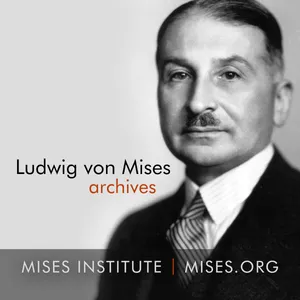
Free Daily Podcast Summary
Ludwig von Mises Archives: Daily Summaries Delivered
by Ludwig von Mises
Get key takeaways, quotes, and insights from Ludwig von Mises Archives in a 5-minute read. Delivered straight to your inbox.
Latest Episodes
The most recent episodes — sign up to get AI-powered summaries of each one.
- Mar 5, 2020
The Political Consequences of the Welfare State
Ludwig von Mises speaks about the political consequences of the welfare state. He begins by recounting the origin and semantics of the term welfare state. He then concentrates on how the interests of individual members of a legislature is not the welfare of the nation, but the welfare of its constituents. Mises believes the system of interventionist government leads to inflation. Delivered at the meeting of the Mont Pèlerin Society in Princeton, New Jersey, on September 9, 1958.
- Mar 2, 2020
Language and the Inflation Debates
Ludwig von Mises discusses inflation, labor unions, and issues of the adoption of improper terminology and widespread public misinformation. Delivered at the ninth meeting of the Mont Pèlerin Society; Princeton, New Jersey; September 11, 1958. A transcript of this lecture is available here: Mises.org/wire/mises-adopt-keynesian-terminology-legitimize-it
- Jan 24, 1972
Why Socialism Always Fails
Ron Paul alludes to this speech in his book End the Fed (pp. 51-52): Mises, at the time, was elderly but sharp. His subject was socialism, and his lecture explained why socialism always fails due to the absence of a free market pricing structure for capital goods... The lecture was held in a modest-sized classroom, but the place was overflowing. Popularizing Austrian economics at the time was in its very early stages, but it was obvious even then that there was a starvation for truth in economics. Presented at the University of Houston in 1972.
- Mar 26, 1971
Question and Answer Session
Two important questions to be answered: (1) What is inflation? What causes it? What are the effects? Inflation is an increase in the quantity of money available caused by an increased in the production of gold and silver, or an over-issuance of paper money. Prices rise. Purchasing power falls. (2) Why should somebody hoard money? Cash-holding plays an important part in building capital. Every unit of capital is in some way dedicated to production. Owning cash is either a sound or an unsound investment, but it is always an investment. The two processes - increased cash holding and increased capital accumulation - take place side by side.Recorded March 26,1971. Special thanks to Bettina Bien Greaves for making this important recording available. [1:08:43]
- Jun 23, 1970
Monetary Problems
The monetary problem – the market problem – is the medium of exchange. The illusion is that one would be better off if only one had more money. Everybody should have more money. Therefore, make more money. This creates the system of inflation. This increase in the quantity of money brings about higher prices. Individuals are left with no real possibilities of acting.So, in truth, the medium of exchange (money) must, first of all, be restricted in quantity. Why gold? Gold is scarce. Its quantity cannot be easily increased by governments.Two models for society exist. One model is the absolute rule of one. All must obey. The totalitarian system produces order which is slavery.Another model is individuals acting by their own ideas. The market system produces exchanges and social cooperation through everybody voluntarily making choices.Recorded June 23,1970. Special thanks to Bettina Bien Greaves for making this important recording available. [1:00:53]
- May 2, 1970
Socialism versus Free Market Exchange
Human beings are collaborators with each other. Socialism is one kind of cooperation of people. One thing determines the socialist organization. It is the lack of freedom and the complete obedience to a Fuehrer (leader). Not surprisingly, everyone considers themselves to be part of the ruling group, forcing others to submit.But, the system of exchange of products and services has been helped by the technical creation of a medium of exchange. We now have a system of civilization that works better than any other– a free market capitalist system.Recorded at the University of Washington; May 2, 1970. [1:14:44]
- Feb 21, 1970
The Free Market Society
Division of labor and an exchange economy are the basis of society. Various commodities competed for being money, but gold prevailed as the medium of exchange, without any interference by governmental authorities. We should have again a gold standard all over the world.When government increases the money supply it does not matter what the government does with the money. The increase alone dilutes the purchasing power of each unit of money, making everyone but first receivers worse off. Governments are in the position of destroying the monetary system. The quantity of money must be restricted.Recorded February 21,1970. Special thanks to Bettina Bien Greaves for making this important recording available. [1:03:15]
- Nov 8, 1969
A Seminar on Money
From a practical point of view, the supply of money is very different from the supply of any other good. An increase in other goods, like shoes or meat, is a welcome event, but an increase in the supply of money dilutes the purchasing power of each money unit.The world laughs at the idea of gold as money, yet the only reason that paper money is favored by governments is that the government wants to spend more without openly taxing the people, so they run the printing press. Inflation is a vicious stealth tax. Such inflation happened in 1781 during the continental revolution. Inflation of money supplies has happened during all ages, even before printing. Coins were debased, adding lesser metals to those of higher value. Money must be something that cannot be increased by government.Recorded November 8,1969. Special thanks to Bettina Bien Greaves for making this important recording available. Note that this recording ends abruptly. [41:33]
Get Ludwig von Mises Archives summaries in your inbox
Free AI-powered daily recaps. Key takeaways, quotes, and mentions — in a 5-minute read.
Get Free Summaries →Free forever for up to 3 podcasts. No credit card required.
You Might Also Like
Listeners also like.
The Life, Times, and Work of Ludwig von Mises

Mises Audio Books Podcast
Mises.org

Mises Audio Books Podcast Reverse Order
Mises.org

Mises U 2019
Mises Institute
Mises Institute
Audio Mises Wire
Mises Institute
Ludwig von Mises Institut Deutschland
Ludwig von Mises Institut Deutschland

Mises University 2017
Mises Institute
Ludwig von Mises – Der kompromisslose Liberale
Thorsten Polleit, Christian Leuenberg

Mises Ljud
mises.se: österrikisk ekonomi, frihet, historia,

Mises U 2021
Mises Institute

The Theory of Money and Credit
Ludwig von Mises
About Ludwig von Mises Archives
Only a few recordings survive of the great economist, and only those after his immigration to the United States.
Customized Recaps
AI-powered recaps with compact key takeaways, quotes, and insights.
Straight to Your Inbox
Get key takeaways from Ludwig von Mises Archives in a 5-minute read.
Save Hours Every Week
Stay current on your favorite podcasts without falling behind.
Frequently Asked Questions
What is Podzilla's Ludwig von Mises Archives daily summary?
It's a free AI-powered email that summarizes new episodes of Ludwig von Mises Archives as soon as they're published. You get the key takeaways, notable quotes, and links & mentions — all in a quick read.
How does the Ludwig von Mises Archives podcast summary work?
When a new episode drops, our AI transcribes and analyzes it, then generates a personalized summary tailored to your interests and profession. It's delivered to your inbox every morning.
Is this an official Ludwig von Mises Archives product?
No. Podzilla is an independent service that summarizes publicly available podcast content. We're not affiliated with or endorsed by Ludwig von Mises.
Can I get summaries of other podcasts too?
Absolutely! The free plan covers up to 3 podcasts. Upgrade to Pro for 15, or Premium for 50. Browse our full catalog at /podcasts.
How often does Ludwig von Mises Archives release new episodes?
Ludwig von Mises Archives publishes occasional. Our AI generates a summary within hours of each new episode.
What topics does Ludwig von Mises Archives cover?
Our AI identifies the specific themes in each episode and highlights what matters most to you.
Start getting Ludwig von Mises Archives summaries tomorrow morning.
Free forever for up to 3 podcasts. No credit card required.
Free forever for up to 3 podcasts. No credit card required.