Free Daily Podcast Summary
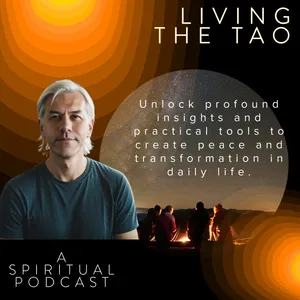
Living the Tao-A Spiritual Podcast: Daily Summaries Delivered
by Mikel Steenrod
Find calm, clarity, and spiritual wisdom with Living the Tao. Taoist Master Mikel Steenrod shares ancient teachings made practical for modern life. Each episode explores mindfulness, meditation, philosophy, and personal growth—helping you reduce stress and live with balance.🎧 New full episodes release the first Friday each month, with biweekly Living the Tao Shorts for quick inspiration.🌐 Learn more about Taoist practice and teachings: https://www.the-taoism-for-modern-world.com📖 Explore dozens of articles and Qi Gong videos: https://www.watermountainvirtual.com
Latest Episodes
The most recent episodes — sign up to get AI-powered summaries of each one.
- Today17 min
Shorts | What are You Without the Voice in Your Head?
What are you without the voice talking inside your head? In this episode of Living the Tao Shorts (2-30), Taoist Master Mikel Steenrod and Morgan explore one of the most basic—and surprisingly difficult—questions we can ask: What is the self? Is the self the internal narrator commenting on your life? Your memories? Your experiences? And if that familiar voice falls silent, have you actually lost anything at all? From there, the conversation moves into mortality, Daoist immortality, and the human desire for permanence. Why do we assume that something must last forever in order to have value? Why would creatures who have never experienced permanence make permanence the measure of importance? Along the way, there are ancient immortals, geological spans of time, and even the realization that after a few hundred years of serious spiritual cultivation, immortals apparently spend quite a bit of time going to parties. But beneath the humor is a distinctly Daoist question: perhaps the truth of who you are is not an idea called the “self,” but the experience of actually living. And perhaps the long spiritual journey ends somewhere unexpected—with becoming what you already are. 🌐 Explore more Taoist teachings: https://www.the-taoism-for-modern-world.com 🎧 Listen to more Living the Tao Shorts & full episodes: https://podcast.the-taoism-for-modern-world.com -From Beginner to Expert, examine our collection of free videos and articles on qi gong: https://www.watermountainvirtual.com/qi-gong-collection/ Premium Episodes, Full Catalog (4x the content), AMA, and episode commentary: https://living-the-tao.supercast.com
- Today0 min
Trailer | The Fractured Self
What if the reason you cannot make yourself do something is not a lack of discipline—but a divided self? In this trailer for Living the Tao Episode 1-198, The Fractured Self, Taoist Master Mikel Steenrod explores the gap between what we say we want and what deeper parts of us may actually be doing. The episode begins with three simple possibilities: unwilling, unable, or uneducated. From there, it moves into a deeper Taoist problem—how the socially conditioned self becomes fragmented, how that fragmentation interferes with choice and capability, and why spiritual development requires more than outward compliance. The goal is not simply greater control. It is greater internal coherence. Listen to the full episode on Supercast. Premium Episodes, Full Catalog (4x the content), AMA and episode commentary: https://living-the-tao.supercast.com
- 1 weeks ago0 min
Trailer | Watching, Blessing, Living
What if the future is already visible in the present? In this trailer for Living the Tao Episode 1-197, Master Mikel Steenrod introduces one of the simplest—and most demanding—skills in Taoist training: observation. He explains why his teacher could often predict what was about to happen simply by watching carefully, how judgment interferes with perception, and why learning to see what is actually there can become a form of Taoist practice. The episode then moves into advanced Qigong training and the practice of blessing, where thousands of repetitions can expose an uncomfortable question: is what you believe about yourself actually true? Watching, Blessing, Living explores observation, wu-wei, symbolic truth, qi, and the difference between reality and the stories we tell ourselves. This full episode is available to Living the Tao subscribers on Supercast. Premium Episodes, Full Catalog (4x the content), and episode commentary: https://living-the-tao.supercast.com
- 2 weeks ago13 min
Shorts | Karma: No Consequence, No Power
What if karma isn’t a cosmic system of reward and punishment? In this Living the Tao Short (2-30), Taoist Master Mikel Steenrod and Morgan unpack the idea of the karmic nursery—a condition in which actions may have social consequences without accumulating the kind of karmic weight that produces lasting power. That protection comes with a tradeoff: no consequence also means no power. Steenrod explains why karma, in this framework, is not the universe handing out justice. Instead, karmic accumulation depends on consistency. A person may act positively, negatively, or neutrally—but without consistency, little accumulates. Leave the nursery, and actions begin to add up. They can build power, diminish it, move you toward what you seek, or move you away. The conversation also explores why someone might choose to return to the nursery, why doing so can mean living a “much smaller life,” and why the karmic nursery is not simply a product of the social mind. A short discussion about consequence, responsibility, ling, and what it means for your actions to truly matter. hat if the future already exists—and your choices still matter? In this Living the Tao Short, Taoist Master Mikel Steenrod and Morgan explore the Taoist concept of nonlinear time: a model in which past, present, and future are not simply points moving along a single line. The conversation moves from memory and our ordinary experience of time into much stranger territory. If every moment remains part of existence, does that mean everything is predetermined? Steenrod argues that it does not. Change, in the Taoist model he describes, does not necessarily depend upon linear time. Along the way, they examine why our sense of the past may be tied to fading memory, why every action may remain part of existence, why Taoism resists placing the individual at the center of creation, and why nonlinear time was traditionally a subject reserved for more advanced practice. The future has already happened. And somehow, you may still be writing it. Prefer the video format? That's here: https://youtu.be/gI1MFRJGASs 🌐 Explore more Taoist teachings: https://www.the-taoism-for-modern-world.com 🎧 Listen to more Living the Tao Shorts & full episodes: https://podcast.the-taoism-for-modern-world.com -From Beginner to Expert, examine our collection of free videos and articles on qi gong: https://www.watermountainvirtual.com/qi-gong-collection/ Premium Episodes, Full Catalog (4x the content), AMA, and episode commentary: https://living-the-tao.supercast.com
- 2 weeks ago30 min
The 4 Spheres, Camelot and an Old Shirt
Can Qi stop a bullet? That question opens a much larger discussion about the Four Spheres and a common human mistake: trying to solve a problem with the wrong kind of tool. In this episode (1-196), Taoist Master Mikel Steenrod explores why physical force, social influence, intelligence, Qi practice, and other approaches each belong to different kinds of problems. The issue is not simply whether one sphere is “stronger” than another, but whether the method being used actually fits the situation. Along the way, Steenrod and Morgan look at Taoist martial skill, surgeons and swordsmen, negotiation, asymmetric warfare, intelligence networks, revolution, and why force often becomes most useful only after better options have already disappeared. And then there is Camelot: Arthur, the Round Table, Merlin, the dream of the perfect kingdom—and Steenrod's observation that he owns shirts that have apparently lasted longer. A practical discussion about timing, strategy, Qi, and why lasting change usually begins before the crisis does. Prefer to watch rather than listen? https://youtu.be/-6_6SYmIn8Q 🎧 Listen to more Living the Tao Shorts & full episodes: https://podcast.the-taoism-for-modern-world.com The supercast version of this episode has extensive commentary: https://living-the-tao.supercast.com Intro music: “Finding Movement” by Kevin MacLeod — licensed under a Creative Commons Attribution 4.0 International License. Source: incompetech.com
- 3 weeks ago0 min
Trailer | AMA- What Makes Something Real?
What happens when your questions become part of the show? The Living the Tao AMA gives Supercast subscribers a place to ask about Taoist practice, the I Ching, spiritual development, unusual experiences, and the questions that do not always fit neatly into a regular episode. In the August AMA, Taoist Master Michael Steenrod takes up questions about changing interpretations of the I Ching, choosing among too many possible paths, becoming the complete human, and how we decide whether something is real. Some questions get a brief answer. Others open a much larger door—and can become the basis for future episodes. This AMA episode is available exclusively to Living the Tao subscribers on Supercast. Bring your questions. Premium Episodes, Full Catalog (4x the content), and episode commentary: https://living-the-tao.supercast.com
- 4 weeks ago16 min
Shorts | The Future Has Already Happened
What if the future already exists—and your choices still matter? In this Living the Tao Short, Taoist Master Mikel Steenrod and Morgan explore the Taoist concept of nonlinear time: a model in which past, present, and future are not simply points moving along a single line. The conversation moves from memory and our ordinary experience of time into much stranger territory. If every moment remains part of existence, does that mean everything is predetermined? Steenrod argues that it does not. Change, in the Taoist model he describes, does not necessarily depend upon linear time. Along the way, they examine why our sense of the past may be tied to fading memory, why every action may remain part of existence, why Taoism resists placing the individual at the center of creation, and why nonlinear time was traditionally a subject reserved for more advanced practice. The future has already happened. And somehow, you may still be writing it. Prefer the video format? That's here: https://youtu.be/4KQ6FH6UNZc 🌐 Explore more Taoist teachings: https://www.the-taoism-for-modern-world.com 🎧 Listen to more Living the Tao Shorts & full episodes: https://podcast.the-taoism-for-modern-world.com -From Beginner to Expert, examine our collection of free videos and articles on qi gong: https://www.watermountainvirtual.com/qi-gong-collection/ Premium Episodes, Full Catalog (4x the content), and episode commentary: https://living-the-tao.supercast.com
- Aug 22, 20260 min
Trailer | Method of Happy Living
What if happiness is not found in pushing life to its limits? In Living the Tao, Episode 1-194 — The Method of Happy Living, Taoist Master Mikel Steenrod introduces the ancient idea that a good life is built through balance, adaptability, and the preservation of your ability to act upon the future. Drawing from the Yellow Emperor’s Inner Classic and the Taoist Art of Living, the episode explores why health, relationships, resources, and moderation are not merely practical concerns—they form the foundation from which deeper spiritual development becomes possible. Life will have extremes. The question is whether you can return from them. “Extremes are a nice place to visit, but you don’t want to live there.” Full episode with commentary is now avaialble on supercast. Subscribe now at https://living-the-tao.supercast.com
About Living the Tao-A Spiritual Podcast
Find calm, clarity, and spiritual wisdom with Living the Tao. Taoist Master Mikel Steenrod shares ancient teachings made practical for modern life. Each episode explores mindfulness, meditation, philosophy, and personal growth—helping you reduce stress and live with balance.🎧 New full episodes release the first Friday each month, with biweekly Living the Tao Shorts for quick inspiration.🌐 Learn more about Taoist practice and teachings: https://www.the-taoism-for-modern-world.com📖 Explore dozens of articles and Qi Gong videos: https://www.watermountainvirtual.com
Customized Recaps
AI-powered recaps with compact key takeaways, quotes, and insights.
Straight to Your Inbox
Get key takeaways from Living the Tao-A Spiritual Podcast in a 5-minute read.
Save Hours Every Week
Stay current on your favorite podcasts without falling behind.
Frequently Asked Questions
What is Podzilla's Living the Tao-A Spiritual Podcast daily summary?
It's a free AI-powered email that summarizes new episodes of Living the Tao-A Spiritual Podcast as soon as they're published. You get the key takeaways, notable quotes, and links & mentions — all in a quick read.
How does the Living the Tao-A Spiritual Podcast podcast summary work?
When a new episode drops, our AI transcribes and analyzes it, then generates a personalized summary tailored to your interests and profession. It's delivered to your inbox every morning.
Is this an official Living the Tao-A Spiritual Podcast product?
No. Podzilla is an independent service that summarizes publicly available podcast content. We're not affiliated with or endorsed by Mikel Steenrod.
Can I get summaries of other podcasts too?
Absolutely! The free plan covers up to 3 podcasts. Upgrade to Pro for 15, or Premium for 50. Browse our full catalog at /podcasts.
How often does Living the Tao-A Spiritual Podcast release new episodes?
Living the Tao-A Spiritual Podcast publishes 2x weekly. Our AI generates a summary within hours of each new episode.
What topics does Living the Tao-A Spiritual Podcast cover?
Living the Tao-A Spiritual Podcast covers topics including Religion & Spirituality, Spirituality. Our AI identifies the specific themes in each episode and highlights what matters most to you.
Start getting Living the Tao-A Spiritual Podcast summaries tomorrow morning.
Free forever for up to 3 podcasts. No credit card required.
Free forever for up to 3 podcasts. No credit card required.