Free Daily Podcast Summary
Light Hearted: Daily Summaries Delivered
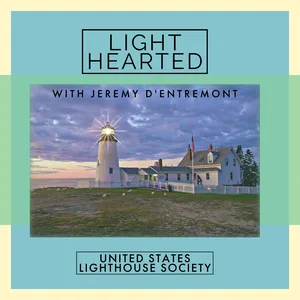
by Jeremy D'Entremont, U.S. Lighthouse Society
The official podcast of the U.S. Lighthouse Society
Latest Episodes
The most recent episodes — sign up to get AI-powered summaries of each one.
- 2 days ago1h 8m
Light Hearted Live audio edition: Author & historian Eric Jay Dolin
This is the audio from the Light Hearted Live episode of September 9. The guest is the acclaimed maritime historian and author Eric Jay Dolin. Eric grew up near the beaches of New York and Connecticut, and from an early age he was fascinated by the ocean. He earned a masters degree in environmental management from Yale, then a Ph.D. in environmental policy and planning from MIT. Eric has written 17 books and many articles on American history. His books include Leviathan: The History of Whaling in America; Fur, Fortune, and Empire: The Epic History of the Fur Trade in America; Black Flags, Blue Waters: The Epic History of America’s Most Notorious Pirates; and A Furious Sky The Five-Hundred-Year History of America’s Hurricanes. His books have won many awards. Eric’s book Brilliant Beacons: A History of the American Lighthouse is discussed in this interview. Sea History Magazine called it “A must-read for anyone interested in lighthouses or America’s maritime history…This history of American lighthouses is both engaging and enjoyable.”
- 1 weeks ago34 min
Light Hearted ep 352: Ed Metcalf’s memories of Boston Harbor and its lighthouses in the 1950s and ‘60s
Ed Metcalf is from Winthrop, Massachusetts, on the north side of Boston Harbor. He served as a police officer in Winthrop, and he then worked for the Division of Fisheries and Wildlife. He became the game warden on Nantucket, Massachusetts, in 1974, and he still lives there today. Born in 1933, his memories reach back to the late 1930s. Some of his visits to the harbor islands were guided by the popular historian and author Edward Rowe Snow. He also frequented lighthouses in the harbor in the 1950s and ’60s, including Deer Island Light and Graves Light. He often brought newspapers, fish, and other things to the keepers. Deer Island, which is attached to Winthrop, was also home to a prison for many years. Ed also remembers visits to the range lights at Spectacle Island in the inner harbor before they were demolished in the 1950s. 
- 2 weeks ago28 min
Light Hearted Lite #42 – Jem Finer: London’s Trinity Buoy Wharf Lighthouse and “Longplayer”
This is an edited version of an interview with Jem Finer that was first heard in June 2020. In an area of London known as the Docklands is a part of the waterfront known as the Trinity Buoy Wharf. On the wharf is London’s only lighthouse. The lighthouse at the Trinity Buoy Wharf was never used for navigation. Completed in 1866, it was used by Trinity House for the training of prospective lighthouse keepers. The scientist Michael Faraday also carried out experiments there. Musician and composer Jem Finer has repurposed the lighthouse in a unique way. His ambient sound piece called Longplayer started playing in the lighthouse at the stroke of midnight just as the year 2000 began. It’s been playing ever since, and the intention is that it won’t repeat until midnight on December 31, 2999. Longplayer is composed for singing bowls, a type of ancient bell. Click here to listen to Longplayer
- 3 weeks ago50 min
Light Hearted 351 – Midge Eliassen and the Lighthouses of Lake Sunapee, New Hampshire
Lake Sunapee covers more than 4,000 acres in west-central New Hampshire, adjacent to Mount Sunapee State Park. The lake contains 11 islands and three lighthouses, which were built in the late 1800s during the steamboat era on the lake. A number of large resort hotels and private estates lined the lake’s shores in that era. Today, the three lighthouses are maintained by the Lake Sunapee Protective Association, or LSPA. The organization, founded in 1898, is dedicated to preserving and enhancing the environmental integrity of the Lake Sunapee Region. Our guest, Midge Eliassen, is a past president of the LSPA. She’s been a photojournalist and she continues to capture the beauty of Lake Sunapee and its wildlife in her photography. Her extensive water sampling on the lake has been praised by Dartmouth College and others, and the LSPA awards a fellowship for lake research in Midge’s name. Midge was the recipient of the 2018 John F. Morten Award for Exemplary Lake Stewardship.
- Aug 23, 202638 min
Light Hearted Live #10 (audio edition) – Pharologist Anastasia Makarova
This episode features edited audio from our “Light Hearted Live” episode of August 19. Our guest, Anastasia Makarova, is from Russia and now lives in Slovenia. She is a lighthouse tour guide, club founder, writer, lecturer, and magazine editor – among other things! She’s also a singer, songwriter, and guitarist who has recorded four albums. One of Anastasia’s current projects is the development of an online museum devoted to Augustin Fresnel and his lenses that were used in lighthouses all over the world. You can see the entire live stream video from August 19 on our YouTube channel. Hug a Lighthouse!
- Aug 16, 202632 min
Light Hearted Lite #41 – Kirby Eldridge, keeper at Boon Island, Maine
This is an edited version of an interview that was first heard in May 2021. The guest is Kirby Eldridge, a former Coast Guard lighthouse keeper. Kirby was one of the two last keepers of Boon Island Light Station, which is about seven miles off the coast of southern Maine. Kirby and the other keeper at the time, Leo Berry, had to evacuate Boon Island during the devastating Blizzard of 1978, and the light was automated soon after that. In this interview, Kirby recalls his harrowing rescue during the blizzard, as well as memories of everyday life at one of America’s most desolate light stations.
- Aug 9, 202625 min
Light Hearted ep 350: Boston Light special
Boston Light Station in Boston Harbor, Massachusetts, holds an honored place among America’s lighthouses. It was established in 1716 as the first light station on the continent. It’s also one of a small number of lighthouses to achieve designation as a National Historic Landmark. This past week, it was announced that the light station will be available to a suitable new steward under the guidelines of the National Historic Lighthouse Preservation Act. Photo by Jeremy D’Entremont “Light Hearted” host Jeremy D’Entremont at Boston Light circa 1990 This episode contains sound clips from the following: a 1939 newsreel; a 1988 interview with the son of Maurice Babcock; a 1980s clip of Keeper Ralph Norwood; a 1991 clip of Josephine Norwood, wife of Keeper Norwood; a 1989 clip of Coast Guard keeper Dennis Dever; a 1989 clip of Senator Edward M. Kennedy announcing legislation concerning Boston Light; and three clips of Sally Snowman, the last (2003-2023) keeper of the station.
- Aug 2, 202654 min
Light Hearted Live! #8 – Author Jazmina Barrera (audio edition)
Jazmina Barrera, a native of Mexico City, is an award-winning author. Her book On Lighthouses is equal parts personal memoir, literary history, and observations on lighthouses. The book was published in Spanish in 2017 and translated into English in 2020. “Barrera’s obsession is contagious. Her graceful sentences ensnare tidbits of history and tantalizing glimpses of her own life, accompanied by delicate sketches of lighthouses she’s visited, making this book a refuge from everyday life, a place of enchantment and safety.” —Shelf Awareness. This is the audio from the live stream of July 29, 2026. You can see the video on YouTube.
About Light Hearted
The official podcast of the U.S. Lighthouse Society
Customized Recaps
AI-powered recaps with compact key takeaways, quotes, and insights.
Straight to Your Inbox
Get key takeaways from Light Hearted in a 5-minute read.
Save Hours Every Week
Stay current on your favorite podcasts without falling behind.
Frequently Asked Questions
What is Podzilla's Light Hearted daily summary?
It's a free AI-powered email that summarizes new episodes of Light Hearted as soon as they're published. You get the key takeaways, notable quotes, and links & mentions — all in a quick read.
How does the Light Hearted podcast summary work?
When a new episode drops, our AI transcribes and analyzes it, then generates a personalized summary tailored to your interests and profession. It's delivered to your inbox every morning.
Is this an official Light Hearted product?
No. Podzilla is an independent service that summarizes publicly available podcast content. We're not affiliated with or endorsed by Jeremy D'Entremont, U.S. Lighthouse Society.
Can I get summaries of other podcasts too?
Absolutely! The free plan covers up to 3 podcasts. Upgrade to Pro for 15, or Premium for 50. Browse our full catalog at /podcasts.
How often does Light Hearted release new episodes?
Light Hearted publishes weekly. Our AI generates a summary within hours of each new episode.
What topics does Light Hearted cover?
Light Hearted covers topics including Culture, Society & Culture, Travel, Places & Travel. Our AI identifies the specific themes in each episode and highlights what matters most to you.
Start getting Light Hearted summaries tomorrow morning.
Free forever for up to 3 podcasts. No credit card required.
Free forever for up to 3 podcasts. No credit card required.