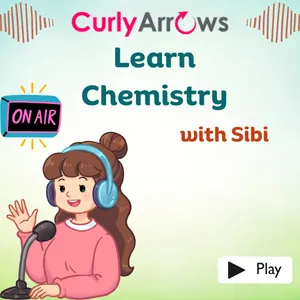
Free Daily Podcast Summary
Learning Organic Chemistry with Sibi: Daily Summaries Delivered
by CurlyArrows Chemistry Education
Learning Organic Chemistry with Sibi
Latest Episodes
The most recent episodes — sign up to get AI-powered summaries of each one.
- 1 weeks ago9 min
Resonance in Chemistry: A Complete Audio Guide
A 10-minute audio lesson with slides on resonance, from Kekulé's benzene to resonance structures, the resonance hybrid and the 145 kJ/mol resonance energy of benzene.Slides, transcript and the tutorials this episode is based onSubscribe to Introductory Organic Chemistry
- 2 weeks ago17 min
Covalent Bonds: A Complete Audio Guide
How covalent bonds form, the theories from Dalton to Pauling, and how bond order sets bond strength and length. A 17-minute audio lesson with slides.Slides, transcript and the tutorials this episode is based onSubscribe to Introductory Organic Chemistry
- Feb 18, 20264 min
Four Common Mistakes while Drawing Hydrogen Bonds
In this CurlyArrows 'Learn Chemistry with Sibi' Podcast, I covers the four common mistakes a beginner in chemistry makes while drawing a Hydrogen bond.1) Number One – Choosing the Wrong Atoms2) Number Two – Choosing the Wrong Donors and Acceptors3) Number Three - Not Maintaining the Hydrogen Bond Angle4) Number Four - Place incorrectly the DipolesReference Article This excerpt is part of the chapter Intermolecular Forces, part of the Organic Chemistry Fundamentals study program. Study Program on Organic Chemistry FundamentalsCurlyArrows has created a beginner's guide - Organic Chemistry Fundamentals covering 14 fundamental chapters required to master organic chemistry reactions. The chapters are highly structured, carefully crafted, simplified, illustrative, and descriptive.Subscribe to Introductory Organic Chemistry
- Feb 18, 20262 min
Hydrogen Bonding Explained in Two Minutes
In this 2-minute podcast on Hydrogen Bonding on CurlyArrows 'Learning Chemistry with Sibi', we will learn how this weak-but-mighty force works, and why it only happens with H attached to O, N, or F. Hydrogen bonding is why water is a liquid, and our DNA stays twisted in that perfect double helix.Reference Article This excerpt is part of the chapter Intermolecular Forces, part of the Organic Chemistry Fundamentals study program. Study Program on Organic Chemistry FundamentalsCurlyArrows has created a beginner's guide - Organic Chemistry Fundamentals covering 14 fundamental chapters required to master organic chemistry reactions. The chapters are highly structured, carefully crafted, simplified, illustrative, and descriptive.Subscribe to Introductory Organic Chemistry
- Jan 21, 20263 min
Podcast - Polar and Non-Polar Covalent Bond
In this podcast, we will look at how the distribution of two electrons between two atoms in a covalent bond gives rise to a bond type based on polarity, creating two variants: polar and nonpolar covalent bonds. These covalent bond types are essential in organic chemistry, as they are responsible for various molecular interactions, solubility, and transformations. This excerpt is part of the chapter Bonding in Atoms, part of the Organic Chemistry Fundamentals study program. Original Article Study Program on Organic Chemistry FundamentalsCurlyArrows has created a beginner's guide - Organic Chemistry Fundamentals covering 14 fundamental chapters required to master organic chemistry reactions. The chapters are highly structured, carefully crafted, simplified, illustrative, and descriptive.Subscribe to Introductory Organic Chemistry
- Dec 8, 20255 min
Podcast - Acids | Arrhenius, Bronsted-Lowry, and Lewis
In this audio, we will cover the basic vocabulary related to acids, Lewis, Bronsted-Lowry, and Arrhenius. We will also see how the strength of an acid is measured using Ka values, and try to understand what a conjugate acid-base pair is. We will also discuss polarizability and the hard-soft acid-base concept.Here is the link to the article Study Program on Organic Chemistry FundamentalsCurlyArrows has created a beginner's guide - Organic Chemistry Fundamentals covering 14 fundamental chapters required to master organic chemistry reactions. The chapters are highly structured, carefully crafted, simplified, illustrative, and descriptive.Subscribe to Introductory Organic Chemistry
- Sep 11, 20252 min
Podcast - Lone Pair: Chemistry's Quiet Influencers | CurlyArrows
The world of the atoms can seem strange and counterintuitive, governed by probability. Still, we can't help but see parallels when we try to grasp their world through the lens of our own. In the language of chemistry, lone pairs are an atom's valence shell electrons that took part in hybridization but evaded the covalent bond formation with other atoms. Lone pair is covered in detail in the chapter Fundamentals of Organic Reactions where we discuss various bond formation theories and other covalent bond properties.Subscribe to Introductory Organic ChemistryTake the Quiz!
- Aug 12, 20253 min
Podcast - sp³ Carbon Explained: The Secret Behind Diamonds & DNA! | CurlyArrows
Imagine a single atom responsible for every organic and a few inorganic elements you see on Earth! Diamonds, methane, and even the molecules in your body. That’s sp³ carbon for you!sp3 Carbon is covered in detail in the chapter Covalent Bond where we discuss various key players controlling the outcome of organic chemistry reactions.Subscribe to Introductory Organic Chemistry
Get Learning Organic Chemistry with Sibi summaries in your inbox
Free AI-powered daily recaps. Key takeaways, quotes, and mentions — in a 5-minute read.
Get Free Summaries →Free forever for up to 3 podcasts. No credit card required.
You Might Also Like
Listeners also like.
Modern Chemistry Podcast
Paul Orange Ph.D.
Stereo Chemistry
Voices and stories from the world of chemistry, reported by Chemical & Engineering News.
Bringing Chemistry to Life
Talks with leading chemists about their discoveries, careers, and the science shaping our world.
Pathways Podcast - Warwick Chemistry
Warwick Chemistry
Cannabis Cultivation and Science Podcast
Experts discuss science-based organic cannabis cultivation techniques and advancements in growing technology.

Elementary
A student-run podcast exploring a different chemical element each episode through fun facts, science games, and interviews with researchers.

Scope Conditions Podcast
A podcast showcasing cutting-edge research in comparative politics.
Periodically
A University of Oxford podcast exploring how menstruation impacts undergraduate life in chemistry, from tutorials to labs.
Teach Me Biology
A biology teacher and her student sister explore A-Level biology topics through structured, conversational lessons for revision.

Culips Everyday English Podcast
Learn everyday English through fun conversations about idioms, slang, and cultural topics with native-speaking hosts.

Smologies with Alie Ward
Kid-friendly science episodes exploring diverse fields from moon studies to toad research through playful conversations with experts.
Math & Physics Podcast
Two University of Toronto students discuss topics in math and physics.
About Learning Organic Chemistry with Sibi
Learning Organic Chemistry with Sibi
Customized Recaps
AI-powered recaps with compact key takeaways, quotes, and insights.
Straight to Your Inbox
Get key takeaways from Learning Organic Chemistry with Sibi in a 5-minute read.
Save Hours Every Week
Stay current on your favorite podcasts without falling behind.
Frequently Asked Questions
What is Podzilla's Learning Organic Chemistry with Sibi daily summary?
It's a free AI-powered email that summarizes new episodes of Learning Organic Chemistry with Sibi as soon as they're published. You get the key takeaways, notable quotes, and links & mentions — all in a quick read.
How does the Learning Organic Chemistry with Sibi podcast summary work?
When a new episode drops, our AI transcribes and analyzes it, then generates a personalized summary tailored to your interests and profession. It's delivered to your inbox every morning.
Is this an official Learning Organic Chemistry with Sibi product?
No. Podzilla is an independent service that summarizes publicly available podcast content. We're not affiliated with or endorsed by CurlyArrows Chemistry Education.
Can I get summaries of other podcasts too?
Absolutely! The free plan covers up to 3 podcasts. Upgrade to Pro for 15, or Premium for 50. Browse our full catalog at /podcasts.
How often does Learning Organic Chemistry with Sibi release new episodes?
Learning Organic Chemistry with Sibi publishes monthly. Our AI generates a summary within hours of each new episode.
What topics does Learning Organic Chemistry with Sibi cover?
Learning Organic Chemistry with Sibi covers topics including Education. Our AI identifies the specific themes in each episode and highlights what matters most to you.
Start getting Learning Organic Chemistry with Sibi summaries tomorrow morning.
Free forever for up to 3 podcasts. No credit card required.
Free forever for up to 3 podcasts. No credit card required.