Free Daily Podcast Summary
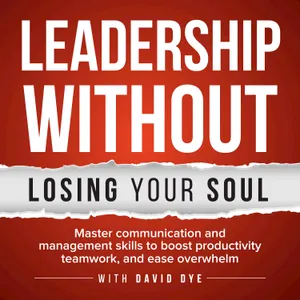
Leadership Without Losing Your Soul: Master Communication & Management Skills To Boost Productivity, Teamwork & Ease Overwhelm: Daily Summaries Delivered
by David Dye
Does your team's lack of productivity frustrate you? What if I told you it's possible to be a decent human being and STILL lead teams that achieve transformational, breakthrough results? In Leadership without Losing Your Soul, your host, best-selling author David Dye, gives you the same real-world leadership and management tools he’s shared with tens of thousands of leaders around the world to help you master communication skills, boost productivity, and ease your overwhelm. You’ll learn how to support your team, hold them accountable, and still feel like yourself at the end of the day. In every episode, you’ll gain communication skills to: → Confidently navigate tough leadership and management scenarios → Increase your team’s productivity without burning out → Reduce stress and have fun while building effective teamwork and strong relationships Ready to transform your leadership? Listen to fan-favorite episode: “12 G.O.A.T. Powerful Phrases to Instantly Boost Your Communication Skills” and get started - today!
Latest Episodes
The most recent episodes — sign up to get AI-powered summaries of each one.
- 3 days ago22 min
371 Stop Planning Icebreakers, Start Planning Outcomes: End-of-Year Meeting Design-Leadership, Communication Skills, Productivity
How can you transform your end-of-year meeting from a forgettable event into a catalyst for meaningful action?A successful gathering should do more than entertain people or fill an agenda. With intentional end of year meeting design, you can strengthen teamwork, clarify priorities, gather valuable ideas, and inspire action that continues after everyone returns to work.After listening, you’ll be equipped to:Design meaningful experiences that build connection and reinforce your organization’s purpose.Clarify the most important message and connect it to each team’s daily work.Transform employee ideas and event energy into practical, repeatable leadership habits.Play the episode to discover how leadership meeting design can move your team from temporary inspiration to meaningful action.02:35 – Plan the outcome before the agenda.Start by deciding what you want people to discuss, remember, and do differently after the event. This question helps every activity serve a clear purpose.07:54 – Give your meeting one clear priority.Identify the most important thing people need to understand, believe, or do. Then use that focus to shape presentations, conversations, recognition, and next steps.12:29 – Put your team’s collective wisdom to work.Replace broad requests for ideas with a specific question tied to a real strategic challenge. You’ll generate more useful insights and show employees where their expertise can make a difference.18:41 – Turn inspiration into a 30-day experiment.Choose one action that feels simple, measurable, and slightly uncomfortable. This approach converts event energy into a practical leadership habit you can sustain at work.Leadership Without Using Your Soul podcast offers insightful discussions on leadership and management, focusing on essential communication skills, productivity, teamwork, delegation, and feedback to help leaders navigate various leadership styles, management styles, conflict resolution, time management, and active listening while addressing challenges like overwhelm, burnout, work-life balance, and problem-solving in both online and in-person teams, all aimed at cultivating human-centered leadership qualities that promote growth and success
- 1 weeks ago15 min
370 What to Do When Employees Ignore Minor Workplace Rules - leadership, communication skills, performance management
How do you handle a team member who breaks minor workplace rules without overreacting or compromising your leadership?When employees ignore rules that seem insignificant, it can create confusion, frustration, and bigger performance issues. The key is knowing whether the rule truly matters, then using clear communication and curiosity to respond appropriately. After listening, you’ll be equipped to:Evaluate whether a workplace rule serves a meaningful purpose or needs to be changed. Clarify expectations by explaining how important requirements affect customers, coworkers, safety, quality, or team results. Address repeated issues with active listening, clear accountability, and a specific commitment for what happens next. Play the episode to strengthen your leadership skills and handle those seemingly small rule violations with greater clarity, consistency, and care. Be sure to pay attention to:02:10 – Decide whether the rule deserves to be a rule.Before addressing an employee, ask why the requirement exists and whether it still serves a meaningful purpose. This helps you distinguish an important expectation from an outdated or unnecessary rule.07:22 – Explain why the expectation matters.Skip “because that’s the policy” and connect the rule to its real impact. Show how the behavior affects customers, coworkers, safety, quality, or your team’s ability to deliver results.09:17 – Reset expectations when you’ve let things slide.If you haven’t consistently reinforced a rule, own your part and clarify what needs to happen going forward. Then check for understanding before moving into accountability.10:53 – Get curious before jumping to conclusions.Explore what’s behind repeated performance issues instead of assuming an employee simply doesn’t care. You may uncover a confusing process, competing priorities, or a need for additional training.Leadership Without Using Your Soul podcast offers insightful discussions on leadership and management, focusing on essential communication skills, productivity, teamwork, delegation, and feedback to help leaders navigate various leadership styles, management styles, conflict resolution, time management, and active listening while addressing challenges like overwhelm, burnout, work-life balance, and problem-solving in both online and in-person teams, all aimed at cultivating human-centered leadership qualities that promote growth and success
- 2 weeks ago17 min
369 The Silent Habit that Will End Your Executive Career - Leadership, Communication Skills, Conflict Resolution
https://letsgrowleaders.com/accountabilityIs avoiding difficult conversations quietly putting your executive career at risk?As a senior leader, it can be tempting to assume experienced people should already know what’s expected or that addressing performance issues can wait until you have more time. But delayed or softened feedback can lead to unclear expectations, weak accountability, unnecessary conflict, and problems that become harder to solve. This episode explores how the conversations you avoid can affect your team’s ability to execute and, over time, your effectiveness as a leader. After listening, you’ll be equipped to:Recognize how avoiding difficult feedback can create accountability gaps, lower productivity, and contribute to conflict across your team. Challenge the belief that senior leaders should already know what’s expected and see why clear feedback becomes even more important as responsibility increases. Communicate feedback sooner and more directly so issues can be addressed before they become entrenched patterns. Play the episode to uncover the silent habit that can threaten your executive career and discover why clear, timely conversations are essential to building a team that can execute.Key insights to strengthen your communication skills:03:07 – Your team is watching what you do.Discover why better training, frameworks, and performance management systems may not improve accountability if your own communication habits send a different message.05:16 – See the hidden cost of avoiding difficult feedback.Find out how carrying unresolved issues can increase frustration, self-doubt, and resentment while allowing problems to become harder to address.10:30 – Challenge the belief that “they should know.”Explore why experienced senior leaders still need clear feedback and how a lack of clarity at the executive level can affect entire teams and departments.13:00 – Make difficult feedback simpler and more direct.See how brief, specific communication delivered close to the moment can help you address issues sooner without becoming a harsher leader.Leadership Without Using Your Soul podcast offers insightful discussions on leadership and management, focusing on essential communication skills, productivity, teamwork, delegation, and feedback to help leaders navigate various leadership styles, management styles, conflict resolution, time management, and active listening while addressing challenges like overwhelm, burnout, work-life balance, and problem-solving in both online and in-person teams, all aimed at cultivating human-centered leadership qualities that promote growth and success
- 3 weeks ago19 min
368 Stop Repeating Yourself: A 3 Step Leadership Communication System to to Address Ongoing Performance Problems
What should you do when you address a performance problem, receive a promise to change, and then see the same behavior happen again?Repeated performance problems can leave you frustrated and undermine your team’s productivity. This episode gives you a practical leadership communication system for escalating accountability conversations while maintaining trust, showing genuine concern, and keeping the focus on results.After listening, you’ll be equipped to:• Address a specific action before it develops into an ongoing performance problem.• Identify repeated behavior using clear examples and secure a meaningful commitment to change.• Navigate trust conversations with directness and compassion while documenting the feedback process.Play the episode to gain the communication skills and exact language you need to stop repeating yourself and create meaningful accountability.Be sure to pay particular interest to:02:51 – Escalate accountability without damaging relationships.Use the ART method to address performance problems with increasing urgency while continuing to build trust and maintain your commitment to the employee’s success.05:42 – Make repeated behavior difficult to dismiss.Support your feedback with three recent, specific examples that clearly establish a pattern. This can help an employee recognize an issue they may have minimized or overlooked.10:32 – Shift the conversation from performance to trust.When an employee breaks a commitment, address the effect on trust instead of discussing the same behavior again. You’ll hear how to communicate concern directly while keeping the conversation compassionate and constructive.15:04 – Document conversations before you need the record.Capture what was discussed, what the employee committed to, and when the conversation occurred. A simple summary email can support your management process and help HR guide the appropriate next steps.Leadership Without Using Your Soul podcast offers insightful discussions on leadership and management, focusing on essential communication skills, productivity, teamwork, delegation, and feedback to help leaders navigate various leadership styles, management styles, conflict resolution, time management, and active listening while addressing challenges like overwhelm, burnout, work-life balance, and problem-solving in both online and in-person teams, all aimed at cultivating human-centered leadership qualities that promote growth and success.
- Aug 20, 202620 min
367 Master Accountability Conversations with 4 Critical Leadership Communication Skills that Level Up Productivity and Conflict Resolution
How can you hold someone accountable for better performance without creating defensiveness, unnecessary drama, or more conflict?When performance falls short, effective leadership starts with communication skills that create clarity, encourage ownership, and keep the conversation focused on results. In this episode, you’ll learn a practical four-part system for accountability conversations that helps you address performance issues, strengthen productivity, and support earlier conflict resolution without getting pulled into arguments or assumptions.After listening, you’ll be equipped to:• Establish clear expectations and check for understanding before turning a performance problem into an accountability issue.• Navigate difficult conversations with observable facts, active listening, curiosity, and questions that invite employees to take ownership of solutions.• Secure commitment by confirming the solution, preventing miscommunication, and scheduling a specific time to follow up on progress.Play the episode to gain practical leadership skills and specific language you can use to make your next accountability conversation clearer, more productive, and more human-centered.Be sure to pay attention to:02:02 – Check for clarity before correcting performance. Before you start an accountability conversation, find out whether the person truly understands the desired outcome, why it matters, and what success requires. You may discover that clearer expectations can prevent unnecessary performance problems.06:37 – Stick to observable facts, not assumptions. See how to address a performance or behavior issue by describing exactly what you observed instead of labeling someone’s attitude or intentions. This communication skill helps you keep the conversation grounded and reduce defensiveness.09:29 – Give people space to share their perspective. When you ask what’s going on, resist the urge to fill an uncomfortable silence. Giving someone time to think can uncover important context and help you respond to the real issue rather than your assumptions.17:49 – Stop arguing with excuses and shift to solutions. Instead of debating every reason someone gives for poor performance, ask how they can meet the expectation despite normal obstacles. You’ll keep accountability focused on problem solving, ownership, and better performance.Leadership Without Using Your Soul podcast offers insightful discussions on leadership and management, focusing on essential communication skills, productivity, teamwork, delegation, and feedback to help leaders navigate various leadership styles, management styles, conflict resolution, time management, and active listening while addressing challenges like overwhelm, burnout, work-lifebalance, and problem-solving in both online and in-person teams, all aimed at cultivating human-centered leadership qualities that promote growth and success.
- Aug 13, 202619 min
366 4 Questions Every Leader Needs to Ask Before Giving Feedback (Communication Skills That Work)
To learn more about the Let's Grow Leaders Performance Management training, click here.Are you wasting time trying to address the wrong performance problem? When someone on your team misses deadlines, makes mistakes, or stops following through, it’s easy to assume they don’t care or to jump straight into feedback, training, or closer oversight. But if you treat the wrong cause, you waste time, add to everyone’s overwhelm, and leave the real issue unresolved. In this episode, you’ll learn a practical, human-centered leadership framework for diagnosing poor performance accurately, strengthening your communication skills, and helping your team regain sustainable productivity without avoiding accountability.After listening, you’ll be equipped to:• Use four diagnostic questions centered on connection, clarity, curiosity, and commitment to uncover what is really affecting an employee’s performance.• Match your response to the actual problem, whether the person needs clearer expectations, stronger skills or confidence, better priorities and resources, a repaired process, or direct accountability.• Lead fairer, more effective performance conversations that build trust, support problem solving, and get people back on track faster.Play the episode now to learn the four-question performance loop that can save you from solving the wrong problem and help your team deliver stronger, more sustainable results.Be sure to pay attention to:03:38 – Separate what you observe from what you assume.Turn vague judgments such as “bad attitude” into specific, observable behaviors you can address fairly. You’ll make feedback clearer and open the door to a productive conversation.06:59 – Make expectations unmistakably clear.Discover why many performance problems begin with expectations that seemed obvious to you but were never clear to the employee. You’ll see how shared clarity creates a stronger foundation for accountability.09:59 – Find what is really blocking performance.Explore how capability, confidence, capacity, and workplace systems can affect follow-through. Asking the right questions helps you solve the actual problem instead of defaulting to training or closer oversight.15:42 – Know when direct accountability is necessary.Learn how to respond when someone has the clarity, skills, resources, and support to succeed but still does not follow through. You’ll hear how to establish a specific commitment and a clear follow-up plan.
- Aug 6, 202621 min
365 The 3 Communication Skills Smart Leaders Use to Eliminate 90% of their Performance Management Conversations
What if three leadership communication skills could eliminate 90% of your performance management conversations?When your team doesn’t remember a critical message, leaves a meeting with different expectations, or agrees to deadlines without discussing competing priorities, productivity suffers. In this episode, you’ll learn three practical ways to keep everyone focused, confirm that communication has actually happened, and uncover barriers that could prevent success.You’ll learn how to:Use five-by-five communication to reinforce critical messages at least five times in five different ways.Check for understanding so you know the message received is the message you intended to send.Schedule the finish by discussing feasibility, resources, and competing priorities before making a calendar commitment.For more creative ways to reinforce important messages, explore these 101 remote team communication approaches.Press play now to learn three communication skills that can help your team stay focused, work more productively, and avoid unnecessary performance management conversations.Key Moments for Stronger Leadership Communication02:50 – Make your most important messages stick.Discover why one-time communication isn’t enough when you need your team to internalize a critical message.08:35 – Stop mistaking silence for understanding.Learn how a quick check for understanding can reveal confusion and confirm that everyone knows what happens next.14:26 – Replace vague deadlines with clear commitments.Explore how scheduling the finish creates a conversation about feasibility, competing priorities, and available resources.19:09 – Eliminate performance problems before they begin.See how these three communication skills improve focus, increase efficiency, and reveal structural issues that could prevent success
- Jul 30, 202612 min
364 Why Good Crisis Leadership Can Kill Your Team's Productivity, Cause Burnout and Overwhelm (and the Communication Skills to Fix it)
Does your team only perform at its best when something goes wrong?Strong crisis leadership is valuable when a real emergency occurs, but relying on urgency to motivate your team can become a trap. When everything feels critical, people become overwhelmed, trust begins to erode, and there is little time to build the routines that support sustainable performance. In this episode, you’ll learn how to help your team succeed without depending on pressure, adrenaline, or last-minute heroics.You’ll learn how to:• Define what strong performance looks like during an ordinary workday when nothing is on fire.• Build clear systems, routines, and communication habits that keep work moving without manufactured urgency.• Recognize steady progress and quiet excellence so your team develops healthier, more sustainable ways to succeed.Play the episode to strengthen your crisis leadership skills while building a team that can deliver consistent results without burnout, unnecessary drama, or constant emergencies.Check out: 02:05 | When Crisis Leadership Becomes a TrapDiscover why some leaders and teams perform best under pressure, but struggle to maintain clarity, urgency, and follow-through when the crisis ends.05:12 | Define What Winning Looks Like Without the FireLearn how to describe strong everyday performance and build systems, routines, and communication habits that do not depend on urgency.08:49 | Celebrate the Unglamorous WinsExplore how recognizing steady progress and quiet excellence can help your team build sustainable success without relying on last-minute heroics.Leadership Without Using Your Soul podcast offers insightful discussions on leadership and management, focusing on essential communication skills, productivity, teamwork, delegation, and feedback to help leaders navigate various leadership styles, management styles, conflict resolution, time management, and active listening while addressing challenges like overwhelm, burnout, work-life balance, and problem-solving in both online and in-person teams, all aimed at cultivating human-centered leadership qualities that promote growth and success.
About Leadership Without Losing Your Soul: Master Communication & Management Skills To Boost Productivity, Teamwork & Ease Overwhelm
Does your team's lack of productivity frustrate you? What if I told you it's possible to be a decent human being and STILL lead teams that achieve transformational, breakthrough results? In Leadership without Losing Your Soul, your host, best-selling author David Dye, gives you the same real-world leadership and management tools he’s shared with tens of thousands of leaders around the world to help you master communication skills, boost productivity, and ease your overwhelm. You’ll learn how to support your team, hold them accountable, and still feel like yourself at the end of the day. In every episode, you’ll gain communication skills to: → Confidently navigate tough leadership and management scenarios → Increase your team’s productivity without burning out → Reduce stress and have fun while building effective teamwork and strong relationships Ready to transform your leadership? Listen to fan-favorite episode: “12 G.O.A.T. Powerful Phrases to Instantly Boost Your Communication Skills” and get started - today!
Customized Recaps
AI-powered recaps with compact key takeaways, quotes, and insights.
Straight to Your Inbox
Get key takeaways from Leadership Without Losing Your Soul: Master Communication & Management Skills To Boost Productivity, Teamwork & Ease Overwhelm in a 5-minute read.
Save Hours Every Week
Stay current on your favorite podcasts without falling behind.
Frequently Asked Questions
What is Podzilla's Leadership Without Losing Your Soul: Master Communication & Management Skills To Boost Productivity, Teamwork & Ease Overwhelm daily summary?
It's a free AI-powered email that summarizes new episodes of Leadership Without Losing Your Soul: Master Communication & Management Skills To Boost Productivity, Teamwork & Ease Overwhelm as soon as they're published. You get the key takeaways, notable quotes, and links & mentions — all in a quick read.
How does the Leadership Without Losing Your Soul: Master Communication & Management Skills To Boost Productivity, Teamwork & Ease Overwhelm podcast summary work?
When a new episode drops, our AI transcribes and analyzes it, then generates a personalized summary tailored to your interests and profession. It's delivered to your inbox every morning.
Is this an official Leadership Without Losing Your Soul: Master Communication & Management Skills To Boost Productivity, Teamwork & Ease Overwhelm product?
No. Podzilla is an independent service that summarizes publicly available podcast content. We're not affiliated with or endorsed by David Dye.
Can I get summaries of other podcasts too?
Absolutely! The free plan covers up to 3 podcasts. Upgrade to Pro for 15, or Premium for 50. Browse our full catalog at /podcasts.
How often does Leadership Without Losing Your Soul: Master Communication & Management Skills To Boost Productivity, Teamwork & Ease Overwhelm release new episodes?
Leadership Without Losing Your Soul: Master Communication & Management Skills To Boost Productivity, Teamwork & Ease Overwhelm publishes weekly. Our AI generates a summary within hours of each new episode.
What topics does Leadership Without Losing Your Soul: Master Communication & Management Skills To Boost Productivity, Teamwork & Ease Overwhelm cover?
Leadership Without Losing Your Soul: Master Communication & Management Skills To Boost Productivity, Teamwork & Ease Overwhelm covers topics including Business. Our AI identifies the specific themes in each episode and highlights what matters most to you.
Start getting Leadership Without Losing Your Soul: Master Communication & Management Skills To Boost Productivity, Teamwork & Ease Overwhelm summaries tomorrow morning.
Free forever for up to 3 podcasts. No credit card required.
Free forever for up to 3 podcasts. No credit card required.